Regional Dance Concert Hosted by UALR this weekend

UALR springs into Spring (today is the first full day) by hosting a major regional conference this spring expected to bring more than 400 visitors from 28 different colleges and universities from 10 different states.
ACDFA South Conference 2014

The 2014 south conference of The American College Dance Festival Association will be held March 21 through 24. Dance students and faculty from as far away as Baja, Calif., have registered to attend performances, workshops, panels, and master classes that will be taught by visiting faculty and internationally known guest artists, according to chair of the department, Dr. Jay Raphael.

The primary focus of the ACDFA is to support and promote the talent and creativity prominent at college and university dance departments across the nation. Raphael said the regional conference will also provide an opportunity for students and faculty to have their dance works adjudicated by a panel of nationally recognized dance professionals.

“The conference is a primary means for our students to gain exposure to the diversity of the national college dance world,” he said. “For our program to be only five years old at this point and to host a regional conference of this magnitude is a major accomplishment.”

UALR reinstated its dance major in 2009, and today it is the only Bachelor of Fine Arts dance performance program in the state. Hosting the ACDFA further solidifies the reputation of the dance program at UALR and helps to promote Little Rock as a beacon for performing arts professionals, according to Raphael. ACDFA has 12 regions throughout the country, which include the south conference. It also sponsors the National College Dance Festival.

Two works presented in Little Rock will be chosen for presentation at this event, which is scheduled June 5 through 7 at the Kennedy Center in Washington D.C. For tickets and more information, contact the box office at 501.569.3456.

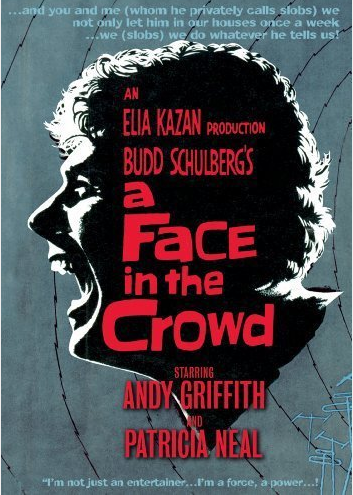
Second Friday Cinema at Old State House – A FACE IN THE CROWD

OSH FaceFor Second Friday Cinema, the Old State House Museum will screen A Face in the Crowd.

With scenes shot in Piggott and other Arkansas locations, A Face in the Crowd tells the story of an Arkansas native, Lonesome Rhodes (played by Andy Griffith in his first screen role), who becomes a media sensation. Director Elia Kazan used many Arkansans as extras in the film and praised the people of Piggott for their hospitality. The film has achieved notoriety in recent years because of its predictions about the rise of the cult of celebrity and the power of television to make and break personalities and politicians.

Joining Griffin in this film are Patricia Neal, Anthony Franciosa, Walter Matthau, Lee Remick and Kay Medford.  Also in the cast are Lois Nettleton, Charles Nelson Reilly, Diana Sands and Rip Torn. Lending an air of reality to the movie is a series of cameos by media personalities playing themselves including Bennett Cerf, Faye Emerson, Betty Furness, Burl Ives, John Cameron Swayze, Mike Wallace and Walter Winchell.

Ben Fry, General Manager of KLRE/KUAR and coordinator of the film minor at UALR, will introduce the film and lead a discussion after the screening.

The screening starts at 5:30 pm.

Arkansas College Art History Symposium is today

ualr logoFive University of Arkansas at Little Rock art students will present papers at the 24th Annual Arkansas College Art History Symposium on Friday, March 14.

Students will give 20-minute illustrated talks on an area of their research, similar to professional art historians. The symposium is being held this year at the University of Central Arkansas.

The following UALR students will present their work:

  • Ann Beck, a Master of Arts student with an emphasis in art history, will deliver a presentation called “Mirror Game.”
  • Tessa Davidson, also a student emphasizing art history in the M.A. program, will present on “Laocoön and his Secrets: Dating Attribution Concerns of the Vatican Sculpture Laocoön and his Sons.”
  • Hayley Chronister, who is pursuing a Bachelor of Arts in art with an art history emphasis, will present “Thomas Gainsborough’s Response to Nature: An Analysis of Two Shepherd Boys with Dogs Fighting.”
  • Jeannie Lee, also pursuing a B.A. in art with an art history emphasis, will do her presentation on “Of Marriage and Death: Alternative Meaning in the Myth of Persephone.”
  • Badi Galinkin is in the Bachelor of Fine Arts in studio art program with a graphic design emphasis and will present “Mrs. Musters as Hebe by Sir Joshua Reynolds.”

The symposium was established in 1991 by Dr. Floyd Martin of UALR and Dr. Gayle Seymour of UCA as a means of encouraging and recognizing student achievements in art history in the state.

The symposium, which has been hosted by UALR, UCA, and Hendrix College, has helped encourage cooperation among art history faculty throughout the state.

Each symposium includes a guest art historian, this year’s is Dr. Ann Prentice Wagner, curator of drawings at the Arkansas Arts Center.

The Play’s The Thing at UALR Shakespeare Scene Festival

bardofavonThe annual Shakespeare Scene Festival started yesterday at UALR.  It continues this morning. The Shakespeare Scene Festival is a UALR event sponsored by the Departments of English and Theatre Arts and Dance. It takes place in March in the UALR Center for the Performing Arts (University Theater). Its main purpose is to provide teachers and students a venue for the performance of Shakespeare’s plays.  One of the purposes is to demystify Shakespeare for students in school.

It was founded by Roslyn Knutson in 1998 and inspired by a workshop at the Folger Shakespeare Library.

The schedule for today includes:

9:35 – 10:00
In Fair Verona
Central High, Drama I
Instructor: Dr. Rhonda Fowler

10:05-10:20
From A Midsummer Night’s Dream
Sheridan Middle
Instructor: Amber Forbush

10:25 – 10:50
Richard III
J.A. Fair High, GT 10
Instructor: Allison McMath

10:55 – 11:20
A Midsummer Night’s Dream Act III, Scenes 1 & 2 and Act V, Scene 1
J.A. Fair High, Freshmen Troupe
Instructor: Christina Cereghini

11:25 – 11:40
The Banquet Scene from Macbeth
Mayflower High, Drama
Instructor: Di Baldwin

11:45 – 12:00
From A Midsummer Night’s Dream
Sheridan Middle
Instructor: Amanda Honea

12:05 – 12:30
From Much Ado about Nothing, The Tempest, Othello, A Midsummer Night’s Dream, Twelfth Night, and The Taming of the Shrew
Parkview Arts-Science Magnet High School
Classic Scene Study
Instructor: Fred Boosey

Among yesterday’s presenters were Central High, Mayflower High, Sheridan Middle and Warren Dupree Elementary.

UALR Theatre production SPEECH AND DEBATE continues this weekend

Speech&Debate-400wideStephen Karam’s award winning comedy Speech and Debate continues at UALR through this weekend.

It is being performed at 8pm Thur and Fri, 7pm on Saturday and 2:30pm on Sunday at the University Theatre on the UALR campus.

This production is directed by visiting professor, Robert Neblett. The play, a dark comedy with music, concerns three misfit teenagers, Howie (openly gay), Solomon (nerdy), and Diwata (frumpy and obsessed with musicals), and their attempts to expose a drama teacher who preys on teen boys. It employs humor and dance as it explores this.

Each of the scenes is a title of an event in competitive forensics.

Little Rock Look Back: HAIR comes to LR in 1972

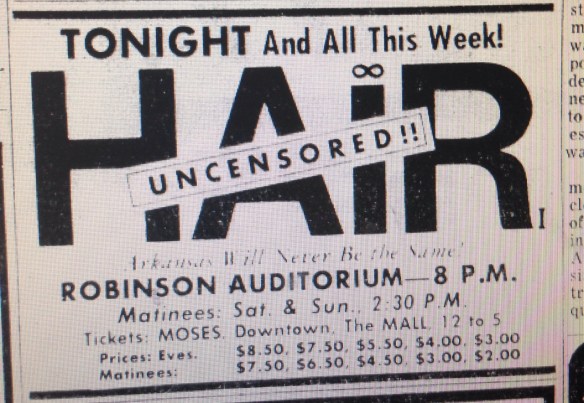
Ad for the original production of HAIR in Little Rock. Note the ticket prices. And that they could be purchased at Moses Music Shops.

Ad for the original production of HAIR in Little Rock. Note the ticket prices, and that they could be purchased at Moses Melody Shops.

It seems fitting that a touring production of Hair is the final Broadway show at Robinson Center Music Hall before it is closed for a two year renovation. The first time the show played at Robinson, it caused quite a stir. To be fair, the actual production in January 1972 did not cause a stir, it was the process leading up to it that was the source of much ado.

In February 1971, a young Little Rock attorney named Phil Kaplan petitioned the Little Rock Board of Censors to see if it would allow a production of Hair to play in the city. He was asking on behalf of a client who was interested in bringing a national tour to Arkansas’ capital city. The show, which had opened on Broadway to great acclaim in April 1968 after an Off Broadway run in 1967, was known for containing a nude scene as well for a script which was fairly liberally sprinkled with four-letter words. The Censors stated they could not offer an opinion without having seen a production.

By July 1971, Kaplan and his client (who by then had been identified as local promoter Jim Porter and his company Southwest Productions) were seeking permission for a January 1972 booking of Hair from the City’s Auditorium Commission which was charged with overseeing operations at Robinson Auditorium. At its July meeting, the Commissioners voted against allowing Hair because of its “brief nude scene” and “bawdy language.”

Kaplan decried the decision. He stated that the body couldn’t “sit in censorship of legitimate theatrical productions.” He noted courts had held that Hair could be produced and that the Auditorium Commission, as an agent for the State, “clearly can’t exercise prior censorship.” He proffered that if the production was obscene it would be a matter for law enforcement not the Auditorium Commission.

The Commission countered that they had an opinion from City Attorney Joseph Kemp stating they had the authority. One of the Commissioners, Mrs. Grady Miller (sister-in-law of the building’s namesake the late Senator Robinson who had served on the Commission since 1939), expressed her concern that allowing Hair would open the door to other productions such as Oh! Calcutta!

On July 26, 1971, Southwest Productions filed suit against the Auditorium Commission. Four days later there was a hearing before Judge G. Thomas Eisele. At that hearing, Auditorium Commission member Lee Rogers read aloud excerpts from the script he found objectionable. Under questioning from Kaplan, a recent touring production of Neil Simon’s Plaza Suite was discussed. That play has adultery as a central theme of one of its acts. Rogers admitted he found the play funny, and that since the adultery did not take place on stage, he did not object to it. Among those testifying in favor of it was Robert Reddington, who was director of performing arts at the Arkansas Arts Center.

Judge Eisele offered a ruling on August 11 which compelled the Auditorium Commission to allow Hair to be performed. Prior to the ruling, some of the Auditorium Commissioners had publicly stated that if they had to allow Hair they would close it after the first performance on the grounds of obscenity. To combat this, Judge Eisele stated that the Commission had to allow Hair to perform the entire six day engagement it sought.

Upon hearing of the Judge’s ruling, Commissioner Miller offered a succinct, two word response. “Oh, Dear!”

In the end, the production of Hair at Robinson would not be the first performance in the state.  The tour came through Fayetteville for two performances in October 1971. It played Barnhill Arena.

On January 18, 1972, Hair played the first of its 8 performances over 6 days at Robinson Auditorium.  In his review the next day, the Arkansas Gazette’s Bill Lewis noted that Hair “threw out all it had to offer” and that Little Rock had survived.

The ads promoting the production carried the tagline “Arkansas will never be the same.”  Tickets (from $2 all the way up to $8.50) could be purchased at Moses Melody Shops both downtown and in “The Mall” (meaning Park Plaza). That business is gone from downtown, but the scion of that family, Jimmy Moses, is actively involved in building downtown through countless projects. His sons are carrying on the family tradition too.

Little Rock was by no means unique in trying to stop productions of Hair.  St. Louis, Birmingham, Los Angeles, Tallahassee, Boston, Atlanta, Charlotte NC, West Palm Beach, Oklahoma City, Mobile and Chattanooga all tried unsuccessfully to stop performances in their public auditoriums.  Despite Judge Eisele’s ruling against the City of Little Rock, members of the Fort Smith City Council also tried to stop a production later in 1972 in that city. This was despite warnings from City staff that there was not legal standing.

Within a few years, the Board of Censors of the City of Little Rock would be dissolved (as similar bodies also were disappearing across the US). Likewise, the Auditorium Commission was discontinued before Hair even opened with its duties being taken over by the Advertising and Promotion Commission and the Convention & Visitors Bureau staff.  This was not connected to the Hair decision; it was, instead, related to expanding convention facilities in Robinson and the new adjacent hotel.  Regardless of the reasons for their demise, both bygone bodies were vestiges of earlier, simpler and differently focused days in Little Rock.

Over the years, Hair has returned to the Little Rock stage.  UALR has produced it at least twice.  The Weekend Theater has also mounted a production. By 2014, Hair is a period piece. For some, a wistful look at their long-gone youth while for others a romanticized time when disparate spirits could band together and change the world.

Ark Rep production of prize winning CLYBOURNE PARK focus at Clinton School today

ClybourneThe Arkansas Repertory Theatre works in partnership with the Clinton School of Public Service to participate in the UACS’s Distinguished Speaker Series, hosting educational panel discussions on various Rep productions. The latest in these takes place today, Thursday, January 23 at 12 noon at Sturgis Hall in Clinton Presidential Park.

Arkansas Repertory Theatre producing artistic director, Bob Hupp, will host a panel discussion on the upcoming production of Bruce Norris’ Clybourne Park, winner of the 2011 Pulitzer Prize and 2012 Tony Award for Best Play.

Clybourne Park is a bitingly funny and fiercely provocative new play about the volatile combination of race and real estate. In 1959, a white couple sells their home to a black family, causing uproar in their middle-class neighborhood. Fifty years later in 2009, the same house is changing hands again and neighbors wage battle over territory and legacy revealing how far our ideas about race and gentrification have evolved.

Panelists director Cliff Fannin Baker, Jess Porter and John Kirk from the UALR History Department, along with Bob Hupp, will discuss how Clybourne Park relates to issues of race, real estate, history, and legacy in our own community.

Clybourne Park opens tomorrow night (with previews last night and tonight). It runs through Sunday, February 9. Wednesday, Thursday and Sunday evening performances are at 7 p.m., Friday, Saturday evening performances are at 8 p.m. Sunday Matinees performances are at 2 p.m.

clinton-school-logo