Little Rock Look Back: Basketball Comes to Robinson Auditorium

Entrance to Robinson off Garland Street. Used to attend basketball games.

Entrance to Robinson off Garland Street. Used to attend basketball games.

While Joseph Taylor Robinson Memorial Auditorium is known today as a performance and meeting venue, in its early days it was also the home to sports. Seventy-four years ago tonight the first basketball game was played at Robinson.

One of the first regular activities which took place in the lower level exhibition hall was a series of boxing and wrestling matches.  Building on the success of this, basketball came to the convention hall in January 1940.

A series of games featuring Little Rock High School and North Little Rock High School were announced by Coach Earl Quigley to take place from January 11 through February 16, the official opening day for the facility.

At that time, neither high school had a gymnasium; therefore both schools played their basketball games on their school auditorium stages with fans seated in the audience. The convention hall offered a regulation size floor (made of pecan block parquet) with seating for over 1,300 people along the sidelines and in the balcony.  The first men’s basketball game in Robinson Auditorium took place between the Little Rock High School Tigers and the North Little Rock High School Wildcats on January 11, 1940.

The Tigers lost the game before a crowd estimated to be 1,300.  Earlier in the evening there had been an exhibition between two women’s basketball teams.  The cost for admission to the games was 35 cents for the reserved seating and 25 cents for general admission.

First 2nd Friday Art Night of 2014

2nd Friday Art NightThe first 2nd Friday Art Night of 2014 takes place tonight.  Among the participating locations are Historic Arkansas Museum, the Central Arkansas Library System and Old State House Museum.

Historic Arkansas Museum will feature live music by Phil G. and Lori Marie from 5pm to 8pm.  It will also host the opening reception for Chasing the Light: Photography by Brian Chilson, in the Second Floor Gallery through March 10.  Arkansas Times photographer Brian Chilson has had a front row seat to some of the most exciting, entertaining, eventful and sometimes poignant events in Arkansas, as well as those smaller moments of everyday life. This collection of photographs taken over the past decade, from 2003 to 2013, serves as a sort of retrospective of life in Arkansas in the arenas of fashion, sports, politics and human interest.

At the Central Arkansas Library’s Butler Center a new exhibit will open.  Unusual Portraits: New Works by Michael Warrick and David O’Brien features explorations in portraiture by two accomplished Little Rock artists. Featured musician for the evening is Das Loop, a Little Rock duo that creates instrumental compositions using live loops and “layers of poly-rhythmic bliss.” The featured artist is Jacquelyn Kaucher, a painter who works with watercolor and acrylics, and she is a long-time teacher of watercolor and experimental watercolor painting in Little Rock.

The Old State House will host Second Friday Cinema: “Broncho Billy Anderson: Arkansas’s First Movie Star” at 6:00 pm. Born Max Aronson in Little Rock, Ark., Gilbert M. Anderson was a motion picture pioneer, who appeared in the groundbreaking film The Great Train Robbery in 1903. Anderson partnered with George Spoor to form the Essanay (S and A) Studios, where he wrote, directed, and starred in hundreds of one-reel westerns and comedies, the most popular featuring a character Anderson created for himself, Broncho Billy. “Broncho Billy” Anderson became Hollywood’s first western star, and Essanay one of the most successful studios of the early motion picture era.

The screening will include three short movies featuring Gilbert M. “Broncho Billy” Anderson:   The Great Train Robbery (1903) Broncho Billy’s Fatal Joke (1914) The Son-of-a-Gun (1919).  Ben Fry, General Manager of KLRE/KUAR and coordinator of the film minor at UALR, will introduce the films and lead a discussion.

“Scandal” Inspiration Judy Smith at “Bless the Mic” Tonight

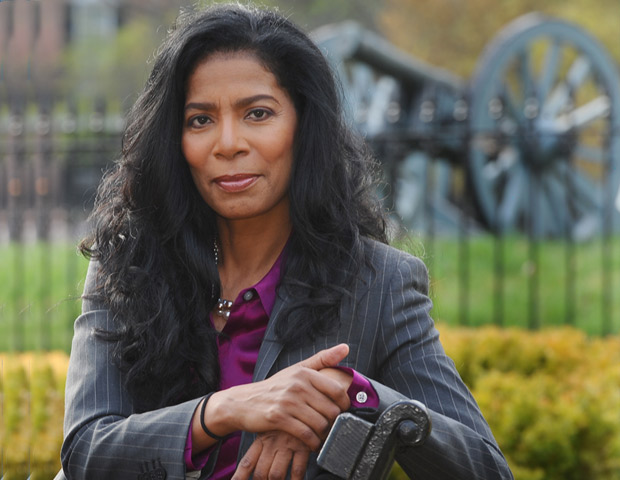
pscsmithThose needing to get their “Scandal” fix while awaiting the return of new episodes next month have the chance tonight.  Judy Smith, the Washington politico who is the real life inspiration of Olivia Pope will be featured tonight at Philander Smith College’s “Bless the Mic” series.

The founder and president of Smith & Company, a strategic and crisis communications firm with offices in Los Angeles and Washington, DC, Smith has honed her skills through experiences guiding her clients through some of the most sensational events of our time, including the Iran Contra investigation, the Los Angeles riots, President Clinton’s involvement with Monica Lewinsky and the congressional inquiry of Enron, to name a few. Celebrities she has consulted in times of crisis include actor Wesley Snipes, NFL quarterback Michael Vick, and more recently, celebrity chef Paula Deen. She has also worked with Fortune 500 companies such as BellSouth and Wal-Mart.

In 1991, Smith joined the White House with her appointment as special assistant and deputy press secretary to President George H. W. Bush. During her tenure she provided the president and his cabinet with communications advice on a wide range of foreign and domestic issues.  Smith earned her B.S. in public relations from Boston University and graduated from the American University Washington College of Law where she was the first African American woman to serve as executive editor of the Law Review. The author of Good Self, Bad Self: Transforming Your Worse Qualities into Your Biggest Assets, Smith’s writing her been featured in numerous publications and she frequently appears on major TV networks offering commentary on topical issues of the day.

Free and open to the public, all lectures are held in the M.L. Harris Auditorium. Tickets are not required; seating is first-come, first-serve. For more information, call 501-370-5354.

Legacies & Lunch Looks at Slavery in Arkansas

legaciesSlave resistance in Arkansas is the topic of Legacies & Lunch in January. Kelly Houston Jones, a Ph.D. candidate at the University of Arkansas, will present “A Rough, Saucy Set of Hands to Manage,” a discussion of her research on slavery in Arkansas.

This work was the lead essay in the Spring 2012 issue of Arkansas Historical Quarterly. Making extensive use of legal documents and carefully reading oral histories, Jones sought “to recover the slave point of view in examining explicit resistance.” She concludes that “slaves’ resistance in Arkansas seems to have had more to do with making their lives a little easier than with a continuing, self conscious effort to undermine the slave regime.”

Legacies & Lunch is free, open to the public, and supported in part by the Arkansas Humanities Council. The program is held from noon-1 p.m. on the first Wednesday of each month in the Main Library’s Darragh Center. Attendees are invited to bring a sack lunch; drinks and dessert will be provided.

The Butler Center for Arkansas Studies is a department of the Central Arkansas Library System (CALS). It was founded in 1997 to promote the study and appreciation of Arkansas history and culture. The Butler Center’s research collections, art galleries, and offices are located in the Arkansas Studies Institute building at 401 President Clinton Ave. on the campus of the CALS Main Library.

For more information, call 918-3086.

Tales from the South Tin Roof Project: Carole Katchen

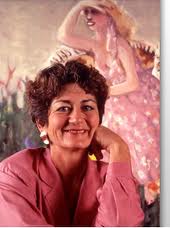
Carole KatchenThe first Tuesday of each month, Tales from the South features one person sharing their life story. They call it Tin Roof Project.  The January featuree is artist Carole Katchen.  The program will be Tuesday, January 7.

Music is by Brad Williams and blues guitarist Mark Simpson.

A native of Colorado, by the time Carole Katchen was 21, she was already an established freelance magazine writer.  The first children’s book she wrote and illustrated, I Was a Lonely Teen-Ager, was published in 1965.  It sold over 700,000 copies.  By 1969 she had decided that she wanted to become an artist.  She studied art at West Valley College in Northern California and received their Outstanding Achievement in Art Award.

As her career as an artist developed, she would often take hitchhiking trips across the continent to get inspiration for her artwork.  By the end of the 1970s, she was able to support herself full time as an artist.  In the mid 1980s, she moved to Los Angeles and started to focus more on pastel and less on oil painting.  She continued to receive national recognition and continued writing.  By the end of the 1980s, she had published six art instruction books which had been translated into several languages.

In 1995, she relocated to Hot Springs where she continued to paint, teach and encourage others.  In 2000, she began to produce bronze sculptures of the chefs and society figures from some of her most famous (and whimsical) paintings.  She has returned to television production creating the program “Symphony Sam.”  Katchen has also continued to travel extensively having spent several weeks in Asia recently teaching art and being honored for her contributions.

“Tales From the South” is a radio show created and produced by Paula Martin Morell, who is also the show’s host. The show is taped live on Tuesday. The night is a cross between a house concert and a reading/show, with incredible food and great company. Tickets must be purchased before the show, as shows are usually standing-room only.

“Tales from the South” is a showcase of writers reading their own true stories. While the show itself is unrehearsed, the literary memoirs have been worked on for weeks leading up to the readings. Stories range from funny to touching, from everyday occurrences to life-altering tragedies.

The program takes place at Starving Artist Café.  Dinner is served from 5pm to 6:30pm, the show starts at 7pm.  Admission is $7.50, not including dinner.

You MUST purchase your ticket before the show

Previous episodes of “Tales from the South” air on KUAR Public Radio on Thursdays at 7pm.

Terry Library Reopens Today; Open House set for Thursday, January 9

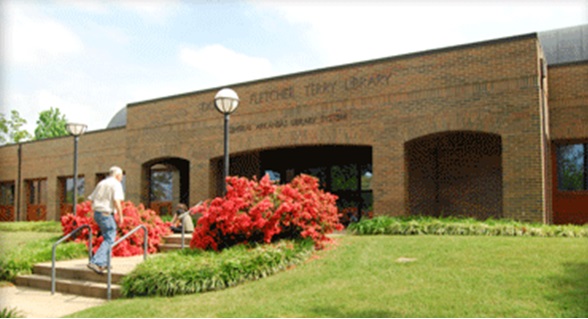
TerryLibTerry Library has a new look for 2014. The Central Arkansas Library System’s (CALS) Adolphine Fletcher Terry Library, 2015 Napa Valley, will reopen on Monday, January 6, after a makeover. New carpet and expanded lighting has been installed, the meeting room was updated, and a significant remodel created a larger audio-visual section and a new young adult area.

An Open House will be held on Thursday, January 9 from 3-6 p.m. Patrons visiting the library beginning on Monday, January 6, can register for a gift certificate to River Market Books & Gifts and a gift card to Wal-Mart, which will be given away at the Open House.

Rearrangement of existing shelves and additional furniture resulted in more comfortable reading areas and tables for working and studying, as well as a lighter and more spacious feeling to the existing building. The new children’s area features colorful new paint, carpet, and tile as well as furniture. A new Young Adult (YA) space provides for the increased number of books and DVDs geared to YA readers. An expanded audio visual area allows for more comfortable browsing of DVDs and books on CD.

Adam Clemons, Terry Library branch manager, said, “We have missed seeing our patrons, and the staff is looking forward to seeing their reactions to the wonderful new space. They loved the building as it was, but they will enjoy their library visits even more with more light and comfortable reading areas.”

In early 2013, CALS completed a satisfaction survey to determine the way library services were accessed and used by library patrons, and why non-users did not take advantage of library services. Modern libraries are community centers that provide a broad range of services beyond lending books. Input from the survey was used to design the remodel of the Terry Library. Items that are used most heavily are more prominently featured and sightlines within the main reading area have been opened up, allowing better access to the services used by patrons.

Funds from a 2012 capital improvement bond refinance were used to cover the $325,000 cost of the remodel and update.

The Terry Library was opened in 1990 to serve the west Little Rock community and was expanded to 19,030 square feet in 2001. The library was named for Adolphine Fletcher Terry, a Little Rock native, who was a library advocate and served as a trustee of the Little Rock Public Library for more than 40 years. She was a proponent of advancing Arkansas’s school system, forming the first school improvement association in the state. She was the daughter of Little Rock Mayor John Gould Fletcher, the wife of Congressman David D. Terry and also the sister of Pulitzer Prize-winning poet John Gould Fletcher.

Little Rock Look Back: John Gould Fletcher, 32nd Mayor of Little Rock

IMG_4006Future Little Rock Mayor John Gould Fletcher was born on this date in 1831. The son of Henry Lewis and Mary Lindsey Fletcher, he later served as a Captain in the Capital Guards during the Civil War. One of his fellow soldiers was Peter Hotze.

Following the war, he and Hotze began a general merchandise store in Little Rock. They were so successful that they eventually dropped the retail trade and dealt only in cotton. Peter Hotze had his office in New York while Fletcher supervised company operations in Little Rock. In 1878 Fletcher married Miss Adolphine Krause, sister-in-law of Hotze.

John Gould Fletcher was elected Mayor of Little Rock from 1875 to 1881. He was the first Mayor under Arkansas’ new constitution which returned all executive powers to the office of the Mayor (they had been split under a reconstruction constitution). Following his service as Mayor, he served one term as Pulaski County Sheriff. Mayor Fletcher also later served as president of the German National Bank in Little Rock.

Mayor and Mrs. Fletcher had five children, three of whom lived into adulthood. Their son was future Pulitzer Prize winning poet John Gould Fletcher (neither father nor son used the Sr. or Jr. designation). Their two daughters who lived to adulthood were Adolphine Fletcher Terry (whose husband David served in Congress) and Mary Fletcher Drennan.

In 1889, Mayor Fletcher purchased the Pike House in downtown Little Rock. The structure later became known as the Pike-Fletcher-Terry House. It was from this house that Adolphine Fletcher Terry organized the Women’s Emergency Committee which worked to reopen the Little Rock public schools during the 1958-1959 school year.

In the 1960s, sisters Adolphine Fletcher Terry and Mary Fletcher Drennan deeded the house to the City of Little Rock for use by the Arkansas Arts Center. For several decades it served as home to the Arts Center’s contemporary craft collection. It now is used for special events and exhibitions.

Mayor Fletcher died in 1906 and is buried in Mt. Holly Cemetery along with various members of his family. His grandson William Terry (son of Adolphine Fletcher Terry) and members of his family still reside in Little Rock.