Tiger Transfer Announced by Little Rock Zoo

Hiland TigerThe Little Rock Zoo announced today that four of its six Malayan tigers have been shipped to other zoos accredited by the Association of Zoos and Aquariums (AZA).

Three of the Zoo’s four tiger cubs born on Nov. 12, 2013 and named by the public as Liem, Olan and Eko were shipped safely to the Woodland Park Zoo in Seattle, Wash. on March 13, 2015 to be part of the zoo’s new Banyan Wilds exhibit that opened to the public May 2.

The cubs’ mother, Suhanna, was shipped today to the Bronx Zoo in New York on a breeding recommendation. She will pair with a male tiger in hopes that the two will produce off-spring.

The Little Rock Zoo will keep Asmara, the female cub born in the litter with Liem, Olan and Eko, as well as Liku, the cubs’ father. The Zoo is hopeful that Asmara will receive a breeding recommendation soon. Liku will then be transferred to another zoo so that Little Rock Zoo can acquire a mate for Asmara at the recommendation of the AZA Malayan Tiger Species Survival Plan (SSP).

The move of the tigers comes at the recommendation of the SSP that makes recommendations for the long-term survival of endangered species as well as companionship recommendations for particular animals.

About the Little Rock Zoo

The Little Rock Zoo is accredited by the Association of Zoos and Aquariums (AZA).  Look for the AZA logo whenever you visit a zoo or aquarium as your assurance that you are supporting a facility dedicated to providing excellent care for animals, a great experience for you and a better future for all living things.  With its more than 200 accredited members, AZA is a leader in global wildlife conservation and your link to helping animals in their native habitats.  For more information, visit www.aza.org.

Heritage Month – Chisum House

Chisum HouseBuilt in 1894, the Chisum House (located at 1320 Cumberland Street) is a significant example of modified Queen Anne architecture.  It is notable for its architectural oddity in relation to other buildings in Little Rock.  The Chisum House embodies many of the Victorian period characteristics of irregular shape, towers, and multiple gales and bays.  The Chisum House represents the eclectic manner of late nineteenth-century architectural style in America through its use of these characteristics.

The house was built by and has since been associated with families of long social prominence in Little Rock.  Jason Sowell, who built the house, came from a family who had already been leaders in social life in Little Rock for many years; the family had been one of Little Rock’s earliest families.  Jason Sowell’s daughter married into the Chisum family, who were also among the favored social class in Little Rock and were to remain so for many years.

Sowell’s daughter married Oscar Clifton Chisum in 1892.  Chisum was born in Austin, Arkansas, in 1860.  He was associated with a drug firm in Memphis, Tennessee, until he moved to Little Rock in 1892.  Upon moving to Little Rock he assumed the position of Arkansas-Texas representative of a Louisville, Kentucky, hardware firm.

In 1894 Jason Sowell built a house for himself, his daughter, and her husband at 1320 Cumberland Street in Little Rock.  In 1894, Cumberland Street was considered the “elite” section of town, and residence in the area symbolized social and/or financial success.

The Chisums had one son, O. C. Chisum, Jr., who was born June 13, 1899.  He attended the University of Illinois and later was employed with the Internal Revenue Service.  O. C. Chisum, Jr., was the first member of the Arkansas Industrial Board which was created in 1927 by the Arkansas General Assembly.

O. C. Chisum, Sr., lived in the Chisum House until his death in 1924; his son, O. C. Chisum, Jr., lived in the same house until his death in 1937.

The Chisum House is a significant structure in its architectural style.  It has always been one of the most unusual residences in Little Rock.  The aristocratic style of the house reflects the tastes of the man who built it and of the family it housed for many years.

It was added to the National Register of Historic Places on December 4, 1975.

Student Showcase tonight at South on Main highlighting UALR visual and performing arts students

UALR Coopt artistsStudents in the visual and performing arts at the University of Arkansas at Little Rock will present their work at South on Main from 5 to 9 p.m. tonight (May 7)

The event is free and open to the public. Seating at the bar is open, but reservations must be made for table service. Reservations can be made at 501.244.9660 or at opentable.com.

For the third consecutive semester, visual artists will display their work for the viewing public at the event known as Co-opt.

“Twenty students will have the chance to hone, and share, their craft with a public audience at an established location and promote the arts at UALR,” said Taimur Cleary, UALR Artist in Residence and instructor of the course that inspires the event.

UALR’s Department of Art and Department of Theatre Arts and Dance are teaming up with Oxford American magazine and South on Main to host the semi annual event in order to promote these emerging artists.

Cleary and his students will speak briefly at 7 p.m. during the show. Following their talk, students from the Department of Theatre Arts and Dance will share a selection of four plays all written, directed, and performed by the students.

This will be the first time performing artists from both music and theatre will be included in the show.

In addition to the live presentations, artwork will remain on display in Oxford American’s Annex Gallery from Thursday, May 7 through Saturday, May 9.

According to Cleary, the title Co-opt carries a number of meanings, namely to cause someone to become a part of your movement. It also refers to cooperative learning strategies that the class uses.

In Cleary’s class, Learning Co-Op, students representing almost every department on campus create works of art through printmaking, painting, ceramics, and sculpture.

Cleary is a painter and teaches full-time at UALR. His artistic direction is informed and fueled by evolving interests in art history, perception, meteorology, memory, abstraction, and photography.

Heritage Month – Choctaw Station

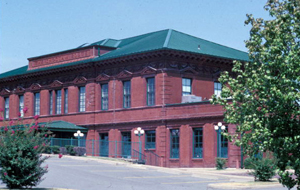
Choctaw StationForty years ago today, on May 6, 1975, Little Rock’s Choctaw Route Station was added to the National Register of Historic Places.

This turn-of-the-century railroad depot is one of the finest examples of railroad, architecture in Arkansas.  This red brick with terra cotta elements building is a two story rectangular structure with one story wings projecting from both the north and south elevations.  A long one story porch covers the passenger loading area along the entire east elevation, with a smaller porch over the entry on the west elevation.

The Choctaw Route Station was built between 1899 and 1901 (records vary) by the Choctaw, Oklahoma and Gulf Railroad.  This railroad amalgamated with many small lines in Oklahoma and extended into Arkansas in the early 1890’s.  Used as a passenger station, the Little Rock terminal building housed two waiting rooms, a baggage room, restaurant and dining room.

When the Choctaw, Oklahoma and Gulf Railroad was sold in 1902, the Choctaw Route Station became the property of the Rock Island Railroad.  Until the mid 1950’s it continued to serve as a passenger station for the Rock Island.  It later served as a warehouse, restaurant and nightclub.

Since 2004, it has been the home to the Clinton School for Public Service as well as Clinton Foundation offices.  Restoration was underwritten by the Roy and Christine Sturgis Foundation. In recognition of this, it is now known as Sturgis Hall.  Former Clinton School Dean David Pryor referred to it as “the little red school house.”

On Earth Day (April 22, 2015), it was announced that Sturgis Hall had received Gold LEED certification from the US Green Building Council.  In August 2009, the Clinton School received a stimulus grant from Governor Mike Beebe to implement sustainable and maintenance practices for reducing the environmental impact of the building. Utility bills costs have already been lowered by $38,000 annually and water usage has been significantly curtailed.

This designation made it the oldest building in Arkansas to be LEED certified and one of the oldest university buildings in the world.  The LEED certification had been a goal of Clinton School Dean Skip Rutherford and Clinton Foundation Executive Director Stephanie Streett.

Local Live Tonight at South on Main – Cindy Woolf and Mark Bilyeu

pic_cindy_woolf_(1).jpg.190x140_q60_cropTonight at 7:30 PM—Join the Oxford American magazine for this week’s Local Live concert at South on Main, starring Cindy Woolf and Mark Bilyeu! As always, Local Live is free and open to the public. To guarantee a table/seat for this popular series, call ahead at (501) 244-9660. Local Live is made possible by the generous sponsorship of Cosmic Cowboy Music.

Guitarist Mark Bilyeu and banjoist Cindy Woolf have been playing together for the better part of ten years, performing on the Americana/Folk and singer-songwriter circuit. They are a full-time duo in music and in life, having wed in 2013. Spring of 2015 finds them in the studio recording an album of traditional Ozarks’ songs, culled from the folksong collections of Max Hunter (from Springfield, Missouri, Mark’s home town) and John Quincy Wolf (from Batesville, Cindy’s home town); thus the title Wolf Hunter. This will be the first album from these two as a duo; Cindy has three CDs under her own name; Mark has one solo title plus the back catalogue from his previous work in Big Smith.

Little Rock Look Back: Rabbi Ira Sanders

SandersIraE_fOn May 6, 1894, Ira Eugene Sanders was born in Missouri.  After receiving an undergraduate degree and rabbinate degree in Cincinnati, he was ordained a rabbi in 1919.  He served congregations in Pennyslvania and New York before coming to Little Rock in September 1926.

Shortly after arriving to lead the B’nai Israel congregation, Rabbi Sanders became active in the Little Rock community.  Among his projects were the Little Rock Community Fund, Little Rock School of Social Work (which he founded), Central Council of Social Agencies, and University of Arkansas Extension Department. During the Great Depression, he helped organize the Pulaski County Public Welfare Commission.  Other areas of involvement over his career included the Arkansas Human Betterment League, Urban League of Greater Little Rock and Arkansas Lighthouse for the Blind.  On November 3, 1930, Rabbi Sanders debated Clarence Darrow about the existence of God in front of a packed house at Little Rock High School.

For his many involvements, he received an honorary Doctor of Humanities degree in 1951 from the University of Arkansas.  Three years later he received an honorary Doctor of Divinity degree from Hebrew Union College’s Jewish Institute of Religion.

A lifelong supporter of a Jewish state, he participated in nineteen bond drives for the state of Israel.  In August 1963, he retired as the leader of B’nai Israel after over 35 years. He would remain as Rabbi Emeritus until his deal in 1985.

In January 1978, Rabbi Sanders tendered his resignation from the Central Arkansas Library board of directors.  The City Board of Directors passed resolution 5873 which noted that he had served for 51 years on the Library Board. He was first appointed in 1926.  He served during 19 different Mayoral administrations from Charles Moyer’s first term through Donald Mehlburger’s.

On April 8, 1985, Rabbi Ira Eugene Sanders died of natural causes.  He is buried in the City’s Oakland Jewish Cemetery.  The Central Arkansas Library System honors his memory with an annual distinguished lecture series.

Legacies & Lunch – Chris Engholm discusses White River Memoirs today at noon

white_riverThe White River and its tributaries represent the most ecologically intact watershed in the continental United States. Over a million people inhabit it, living in 234 communities in 60 counties. For the past two years, Chris Engholm has traveled the White River in a cedar strip canoe, listening to people connected to it and collecting the artwork of 25 fine artists who maintain a special relationship with the river.

This artwork is showcased in a gallery exhibition, White River Memoirs, on view in Butler Center Galleries, 401 Pres. Clinton Ave., now through July 25, 2015. At Legacies & Lunch, Engholm will discuss his experiences and present visual documentation of his findings.

The program takes place today at noon at the Darragh Center on the Main Library campus.

Legacies and Lunch is sponsored in part by the Arkansas Humanities Council. Bring a sack lunch; drinks and dessert are provided.