Little Rock Look Back: Mayor William Ashley

W E Ashley signature

On August 6, 1823, future Little Rock Mayor William Eliot Ashley was born in Little Rock.  He would go on to become the first Little Rock Mayor to be born in Little Rock.  Ashley was the son of Mary and Chester Ashley; his father would later serve as a U. S. Senator from Arkansas.  He was the second of the couple’s seven children.

Though he was raised in Little Rock, he did receive some schooling out of state. The State History Commission has correspondence between eleven year old William, studying in New York, and his father. Part of the letter is a request for money.

On October 26, 1846, he married Frances Eliza Grafton at Christ Episcopal Church.  They were the first Little Rock residents to be married in that church.  The couple had five children, including triplets.  Only one of the children, Frances (who was one of the triplets) survived to adulthood.

Ashley was first elected Mayor of Little Rock in 1857. After completing a two year term, he was succeeded by Gordon N. Peay (another scion of a prominent Little Rock family).  In 1861, Ashley returned to the office of Mayor.  He was reelected to a third term in 1863.  In September 1863, following the defeat of Confederate troops by the Union forces at the Battle of Little Rock, the City of Little Rock ceased operations.  On September 21, 1863, Little Rock municipal government closed its doors, stopped collection of taxes and disbanded.  Thus Ashley’s third term ended.

In addition to his interest in local government, Ashley was a member of St. John’s College Board and a director of the newly-formed Little Rock Gas Company.

William Eliot Ashley died on August 16, 1868, at the age of 45.  He was buried in Mt. Holly Cemetery (which sat partially on land that had once belonged to his family). His parents, wife and children are all buried in Mt. Holly as well.

Interestingly, for someone who grew up in a prominent family, there does not appear to be a surviving likeness of Mayor Ashley – either in painting or photograph.  Several exist of his parents, but none of him.

Tonight’s Oxford American Local Live at South on Main features Katmandu

llsom katmanduTonight at 7:30pm, join the Oxford American magazine for this week’s Local Live concert at South on Main, featuring Katmandu!

As always, Local Live is free and open to the public. To guarantee a table/seat for this popular series, call ahead at (501) 244-9660. Local Live is made possible by the generous sponsorship of the Ben and Jane Hunt Meade.

Katmandu is primarily a classic rock band based out of Central Arkansas. All band members have been playing together in various bands off and on for several years including the Resistors, Idol hands, and Thumpin. Band members include Kat Hood on lead vocals and guitar, Chuck Gilbert lead guitar and vocals, Paul Edmonson on drums and vocals, Billy Hoover on keyboard and vocals, David Seago on bass guitar and Vince Castiglia III on vocals and guitar. Kat and Chuck met in 2001 and began the acoustic duo that later became the Kat Hood Trio w/ Eric Nolen. The trio were the 2002 Central Arkansas Acoustic festival and their 2004 performance still can be seen on AETN’s Front Row.

In 2009, a mutual desire to play classic rock tunes with Chuck’s former band mate, Paul Edmonson, inspired the beginnings of Katmandu. Their slogan, “Music for you that works for us” came from their vision of performing a variety of well loved, but not over played tunes by such artists as Steely Dan, Eric Clapton, Bonnie Raitt, Allman brothers, Fleetwood Mac, the Band, etc. Their repertoire also includes some interesting original band compositions that stem from the acoustic flavor that the duo started out with. Expect to hear some tight vocal harmonies backed by solid, in-the-pocket percussion, creative guitar and piano leads, and a band that truly loves each other as well as the music they obviously love to perform.

Shakespeare at the Shelter this Friday and Saturday

shakeatshelterProving that all the world really is a stage and that each of us truly has a part to play, Our House presents Shakespeare at the Shelter this weekend!

Now in its 4th year, Shakespeare at the Shelter is a summer-long community building project in which Our House clients and alumni come together with staff, volunteer scholars and theater experts to study the work of William Shakespeare, culminating in two performances of some of the Bard’s most famous scenes and monologues.

This program invites Our House clients to challenge themselves intellectually and provides opportunities to hone skills necessary in the workforce (team work and confidence chief among them). It also invites the community to challenge their assumptions about homelessness. It is Our House’s great pleasure to invite the public to the 4th annual production of Shakespeare at the Shelter, Friday August 7th and Saturday August 8th from 7:30-8:30 p.m.

The participants have been working with Ganelle Blake and Crystal Mercer.  Each person has a fascinating story.  For instance, one is a blind piano tuner.  He has learned his lines by listening to a recording made on his phone.

Tickets are $20 each and can be purchased at the Our House website.  Tickets are going fast, don’t delay!

All money raised by Shakespeare at the Shelter goes to improve the quality of life for Our House clients. Proceeds from this year’s event will go to further improve the Shelter kitchen as well as to purchase laptops for the Learning Center. With the assistance of over 50 generous volunteer groups, we provide 220 meals each day at the Shelter. Laptops for the Learning Center will support our adult education and employment services programs which provide support to over 500 shelter residents and community members each year.

When
August 7th and 8th, 2015
7:30 – 8:30 p.m.
 
Where
Our House Shelter
302 E Roosevelt
Little Rock AR 72206

Marcie Cohen Ferris will discuss THE EDIBLE SOUTH at special Legacies & Lunch at noon today

Marcie Ferris at her home in Chapel Hill, NC. Photo by Kate Medley

Marcie Ferris at her home in Chapel Hill, NC. Photo by Kate Medley

Marcie Cohen Ferris, author of The Edible South, is a professor of American studies at the University of North Carolina at Chapel Hill. Ferris’ research and teaching interests include the history of the Jewish South and the foodways and material culture of the American South. The Edible South: The Power of Food and the Making of an American Regionexamines the visceral connection between Southern food and the politics of power from the colonial period to the present.

At this special Legacies & Lunch, co-hosted by the Butler Center for Arkansas Studies and the Clinton School of Public Service, Ferris will talk about the power of food to nourish cultures as well as people’s bodies and the way it helps people understand the South – from scholars and chefs to casual consumers and hardcore foodies. Books will be available for purchase, and Ferris will sign copies after her talk.

The Butler Center’s Legacies & Lunch program is free and open to the public and supported in part by the Arkansas Humanities Council. Attendees are invited to bring a sack lunch; drinks and dessert will be provided.

The Butler Center for Arkansas Studies is a department of the Central Arkansas Library System (CALS). It was founded in 1997 to promote the study and appreciation of Arkansas history and culture. The Butler Center’s research collections, art galleries, and offices are located in the Arkansas Studies Institute building at 401 President Clinton Ave. on the campus of the CALS Main Library.

Little Rock Look Back: Louis Armstrong

SatchmoLouis Armstrong was born on August 4, 1901 in New Orleans.  As he rose to fame, he would play Little Rock numerous times in a variety of venues.

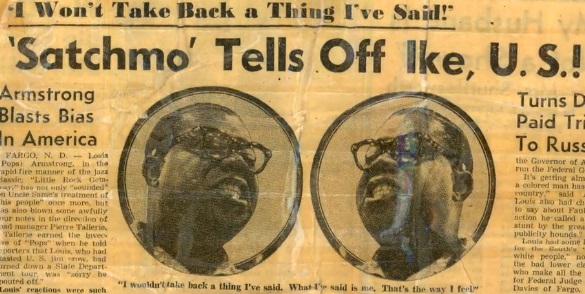
As the Civil Rights movement started taking hold in the mid-1950s, many African American entertainers were vocal in their support.  Armstrong stayed silent.  Until, that is, September 17, 1957.  That night, in Grand Forks, North Dakota, he blasted President Dwight Eisenhower for his lack of action to make Governor Orval Faubus obey the law.  This was in an interview conducted by a 21 year old University of North Dakota journalism student named Larry Lubenow.

Journalist David Margolick wrote about the incident in The New York Times in September 2007 in conjunction with the 50th anniversary of the integration of Little Rock Central High School.  He recounted how the story, written for the Grand Forks Herald, was picked up all over the country.  The entire Margolick piece can be read here.  Margolick tells that when Armstrong was given the chance to back off the comments, he asserted that he meant all of it.

On September 24, 1957, the night that the 101st Airborne was being mobilized to come into Little Rock, Armstrong sent Eisenhower a telegram again criticizing him for lack of action.  He used colorful language which sarcastically spoofed the “Uncle Tom” moniker which some of his critics had bestowed when they felt he was not doing enough for Civil Rights.  The Eisenhower Presidential Library has a copy of that telegram.  The incident between Satchmo and Ike was the basis for two different plays: Terry Teachout’s Satchmo at the Waldorf and Ishmael Reed’s The C Above C Above High C.

Armstrong would again play a part in Little Rock’s Civil Rights history.  In September 1966, he played the first major concert in Robinson Auditorium that was before a fully integrated audience.  Since the early 1960s, there had been a few sporadic concerts which had been before integrated audiences. But the policy of the Auditorium Commission remained that the building was to be segregated.  Following the approval of the 1964 Civil Rights Act, public facilities had to be integrated. Louis Armstrong played before a full house at Robinson Auditorium that night.

Little Rock Look Back: Mayor William Whipple

whippleOn August 4, 1834, future Little Rock Mayor William G. Whipple was born in Connecticut.  He attended school in Massachusetts and graduated from Wesleyan University. After studying law at Albany Law School, he moved to Milwaukee, Wisconsin.

In 1868, Whipple moved to Little Rock following the 1866 death of his first wife in Wisconsin. Long active in Republican politics, he quickly became involved in Little Rock’s political and social life.  Shortly after his arrival he was appointed United States Attorney and served three years.

In 1870, he married Mary S. Dodge, daughter of former mayor Roderick Lathrop Dodge MD.  They had one son Durand, who followed his father into the legal profession. The Whipples were active members of Trinity Episcopal Cathedral.

In 1887, Whipple was elected Mayor of Little Rock and was re-elected two years later.  Whipple’s mayoral administration introduced electric lighting to the city beginning on September 1, 1887, paved many streets with granite and macadam, created sixty miles of new brick and concrete sidewalks, and introduced a steam dummy railway.

In 1892, he ran for Governor of Arkansas as the Republican nominee but was unsuccessful.  In 1895, he sought a third term for Mayor but was defeated by James A. Woodson.

From 1897 to 1900, he served as register of the US Land Office in Arkansas.  Whipple, who had long practiced law, was appointed United States Attorney for the Eastern District of Arkansas in 1900.  He served in that capacity until 1913.

In July 1914, Mayor Whipple died.  He is buried at Oakland Cemetery in Little Rock.

Cleanup day at William E. Woodruff House announced for Saturday, Aug 8

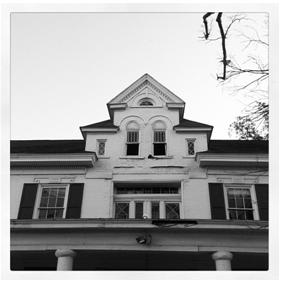
The historic Woodruff house.

The historic Woodruff house.

The QQA acquired the William E. Woodruff Housein December 2014 with the help of the City of Little Rock and the Arkansas Historic Preservation Program.   The QQA has donated interior and façade easements to protect the house in perpetuity, and we continue to work with the City and AHPP to stabilize the house and make repairs before selling it for development.

On Saturday, August 8 from 8am to 12 noon, join other volunteers at the Woodruff House (1017 East 8th Street) for a cleanup day.

The main task is basic landscape cleanup surrounding the house.  Before the house can be treated for termite damage and repaired, weeds and shrubs surrounding the foundation must be removed.  There is also trash on the property that needs to be picked up.

Volunteers must sign a waiver before working, they will be available on site.  Volunteers should wear old clothes, sturdy closed-toe shoes, and bring work gloves. If you would like to be involved but can’t join us on the 8th, you can help by donating cold drinks, snacks, or lunch to our volunteers. Contact the QQA office at qqa@quapaw.com or 501-371-0075 to make arrangements. If you have supplies you would be willing to let us borrow, drop them by QQA office, clearly labeled with your name and phone number, or just bring them with you when you volunteer.

If you’re interested in sponsoring this or future work days at the Woodruff House, please contact the QQA office at qqa@quapaw.com or 501-371-0075. 

The Quapaw Quarter Association’s mission is to promote the preservation of Little Rock’s architectural heritage through advocacy, marketing and education. Incorporated in 1968, the QQA grew out of an effort to identify and protect significant historic structures in Little Rock during the urban renewal projects of the early 1960s. Throughout its existence, the QQA has been a driving force behind historic preservation in Greater Little Rock.