

City Hall circa 1908
109 years ago today, Little Rock City Hall officially opened at the corner of Markham and Broadway.
On April 15, 1908, the Italian Renaissance Revival style building, which had been designed by local architect Charles Thompson, played host to an open house. Staff had started moving into the building in March of that year. This was, as often is the case, behind schedule. The date in the cornice toward the top of the building is 1907, but the building was not completed until 1908.
An open house took place on April 15, 1908, presided over by Acting Mayor John Herndon Hollis and his wife as well as former Mayor W. E. Lenon and his wife. (Mayor Hollis’ wife is a distant cousin of the Culture Vulture.)
In 1903, W. E. Lenon became Mayor of Little Rock. Back then, the terms were two-year terms. Before the start of his second term in 1905, he realized that the City was outgrowing City Hall, which was, at the time, on the northeast corner of Markham and Louisiana – where part of the Statehouse Convention Center sits today.
In February 1906, Mayor Lenon appointed a committee of five aldermen to over see the planning for the building of a new City Hall. In July 1906, the City Council approved plans, which called for a City Hall with an municipal auditorium wing. There was some hue and cry about the cost spending and a resulting lawsuit, so, in September 1906, those plans were scrapped and a simpler City Hall was approved for the cost of $175,000.
The last resolution in the old City Hall called for the banning of smoking in the new Council Chambers – while the Council was in session. This may well have been the first smoking ban in a public government building in the history of Arkansas.
When the building opened, the third floor was not finished out. The space was not needed. When the Museum of Natural History and Antiquities (now the Museum of Discovery) moved into City Hall in 1929, they had to finish out their space.
In 1913, the new Central Fire Station, designed in the Beaux Arts style, was constructed adjacent to City Hall. During the 1930s, as the City grew, more space was needed. A garage, designed in the “austere, utilitarian” style was built in 1936 and a City Jail Annex, built by the WPA in the modified Art Deco style was built in 1938.

By 1955, the copper-clad dome which sat on top of City Hall needed severe repairs. The wooden supports and the copper cladding were both in dire shape. Mayor Pratt Remmel set aside money for the dome to be repaired. After defeating Remmel in his bid for a third term, Mayor Woodrow Mann scrapped plans for the repair and, indeed, scrapped the dome.
Following the lead of County Judge Arch Campbell who had removed the tower at the County Courthouse, Mann proposed removal of the dome. He had an informal survey which had three options: repair the dome, replace the dome with an aluminum one, or remove it. This was open to anyone to respond – voting eligibility or Little Rock residency did not matter. By a slim margin, remove the dome won – so the dome was removed.
In 1960, as air conditioning was installed, windows were bricked in to promote energy efficiency. At the time, the feeling was that a new City Hall would be constructed in the 1970s somewhere more central to the growing city. Relocation talk persisted throughout the 1970s and early 1980s. By that time, City Hall had been modified a great deal – with no thought about historic preservation. When the Police and Fire Department had moved out into their new facilities, their old spaces had become storage.
By 1984, the decision was made to stay at Markham and Broadway. An extensive renovation and restoration effort was undertaken. In 1988, the building reopened, and the interior had been restored to its 1908 appearance.
 On April 15, 1880, former president Ulysses S. Grant spoke in Little Rock as part of his world tour. While here he made a couple of appearances and participated in a parade. It was Grant’s first visit to Arkansas either as a soldier or a politician.
 On April 13, 1743, Thomas Jefferson was born in Virginia. Along with Benjamin Franklin, he was one of the first American multi-hyphenate Renaissance men. Author, musician, inventor, diplomat, epicurean, architect, educator, and President. Certainly his writing of the Declaration of Independence was of paramount importance to the US, even if he had never served as President.
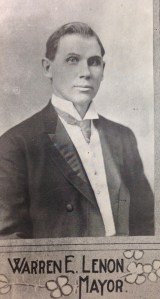 On April 12, 1904, Mayor W. E. Lenon made what was the first official proposal for a municipal auditorium in Little Rock. Little did he know at the time that it would take from April 1904 until February 1940 to make this dream a reality.
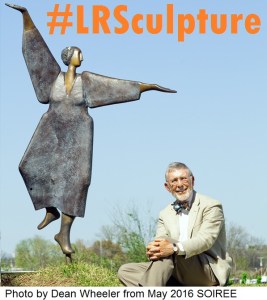 The Sculpture in the River Market Show will celebrate its 10th year in April. As part of that, they are rolling out a plan that encourages the public to explore, appreciate, and share public art offerings in Little Rock through social media.
 Photos showing misuse of the sculpture will not be considered.
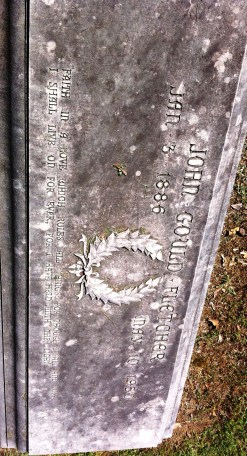 The Pulitzer Prizes are to be announced today. This year marks the 100th anniversary of the prizes, though not all of the current categories have been around since 1917.
 The other Pulitzer Prize winner buried in Mount Holly is J. N. Heiskell, the longtime editor of the Arkansas Gazette. It was Heiskell, in fact, who asked Fletcher to compose the poem about Arkansas. Heiskell served as editor of the Gazette from 1902 through 1972. He died at the age of 100 in 1972.
 On April 9, 1722, French explorer Jean-Baptiste Bénard de La Harpe rounded the bend of the Arkansas River and saw La Petite Roche and Le Rocher Français. He had entered the mouth of the Arkansas River on February 27 after traveling up the Mississippi River from New Orleans.
 Little Rock Culture Vulture