
Registration is open for Arkansas Rep fall classes

Image may contain: 6 people, people dancing, people standing, shoes and indoorRegistration is now open for fall classes with the Arkansas Repertory Theatre’s Education Department. Classes run Sept. 9-Nov. 14 for students of all ages and experience levels.

“Whether you’re new to The Rep or continuing your theatre studies, we’ve got something fun for everyone this fall,” said Anna Kimmell, Director of Education. “We create a fun, high-energy creative environment where artists of all ages can learn, discover, and grow.”

Fall classes include training in acting, musical theatre, improvisation, Shakespeare, theatre dance, tap dance and playwriting for students of all ages and abilities. Scholarships are available.

The Rep provides a professional and encouraging environment for artists of all ages and abilities. With new material every semester, classes can be taken multiple times.

Along with Kimmell, faculty members include Matt Boyce, Bridget Davis, Katherine Greer, Leann Hatley, TJ Medel, Brandon Nichols, Rebekah Scallet and Hilary Trudell.

Each year, The Rep reaches more than 7,500 Arkansas students through classes, workshops with guest artists, summer programs, community outreach, and the Student Matinee Program. More than $18,000 in scholarships were awarded in 2017-2018 to students for theatre training at The Rep.

The full class schedule (including class dates and fee costs), online registration and info on teaching artists can be found TheRep.org/Education. Available courses include:

Acting and Creative Movement (K-2nd)
In this class, young actors will use their voices, bodies, and imaginations as tools to create new characters, atmospheres, and narrative.

Acting (3rd-5th)
Dive into the foundations of acting technique and improvisation in this fun and collaborative class!

Musical Theatre (3rd-5th)
Discover the fun and fundamentals of musical theatre technique by integrating acting, singing, and simple choreography in the development of Broadway repertoire.

Theatre Dance (3rd-5th)
Learn jazz and theatre basics in this high-energy dance class focusing on Broadway-style choreography.

Theatre Dance (6th-8th)
Learn jazz and theatre basics in this high-energy dance class focusing on Broadway-style choreography.

Acting (6th-8th)
In this class, actors will explore character development skills, delve into text analysis, and learn how to create dynamic relationships on stage through ensemble building.

Musical Theatre (6th-8th)
Build on the fundamentals of musical theatre technique by integrating acting, singing, and basic choreography in the development of a musical revue.

Preach! A Comedy Collage Class (9th-12th)
As media changes, so do the voices that create it. In this youth-centered class, their voices will be tested through an array of forms in comedy that range from improv to spoken word.

Teen Ensemble (9th-12th – Audition Only)
Teen Ensemble is The Rep’s audition-only performance class featuring the top high school-aged singers, dancers, and actors in the area.  Auditions will be held by appointment only on Monday, August 12 from 5-8 p.m. Email akimmell@therep.org for an audition slot.

Theatre Dance (8th – Adult)
Get moving in this fun, high-energy dance class focusing on Broadway-style choreography.

Beginning Tap Dance (8th – Adult)
Make some noise in this introductory course laying the foundation of tap dance technique. (Tap shoes required.)

Intermediate Tap (8th – Adult)
Make some noise in this course that builds upon the foundation of tap dance technique.  This class is not for beginners. Students must have a basic tap dance vocabulary including shuffles, flaps, riffles, paradiddles, drawbacks, etc. (Tap shoes required.)

Shakespeare Scene Study (Adult)
Take a deep dive into Shakespeare text work through this intensive scene study class.  We will cover two plays in the class — As You Like It and Richard III — to give the opportunity to work on both comic and dramatic text.  *Familiarity with using scansion and rhetorical techniques in Shakespeare is required. If no previous experience, please also enroll in the Shakespeare 101 workshop.

Intro to Playwriting (Adult)
Have you ever wanted to write a play but didn’t know where to start? Here’s your chance! Creator of the ACANSA/Rep Ten-Minute Play Showcase, Hilary Trudell, will teach participants the basics of ten-minute playwriting. All completed ten-minute plays will receive an automatic submission into the 2020 Ten-Minute Play Showcase for an opportunity to be produced on a Rep stage! No experience necessary.

Improvisation (Adult)
In this class, students will learn fundamental improvisational skills and how to apply them to their daily lives. Under the philosophy of “Yes! And…,” actors will heighten their ability to listen to understand, build relationships through an “attitude of gratitude,” and enhance their cognitive skills by building a community of support.

BingoFlix at the CALS Ron Robinson Theater tonight

Plan 9 Alternative poster.jpgJoin the CALS Ron Robinson Theatre for the very first BingoFlix!

Play bingo to some of the most hilarious movie cliches during an exclusive screening of Plan 9 From Outer Space. Win prizes including free movie and event tickets (including a pair to the upcoming Trae Crowder show)!

This Edward D. Wood, Jr. classic starring Bela Lugosi and Maila Nurmi as Vampira is considered by some to be the epitome of “so-bad-it’s-good” cinema.

Aliens from another world attack Earth and set their terrible “Plan 9” in action. As they resurrect the dead to destroy the living, human lives are in danger!

Cost is $5.  The fun starts at 7pm.

Birth of Little Rock’s 22nd and 24th mayor – William Eliot Ashley

On August 6, 1823, future Little Rock Mayor William Eliot Ashley was born in Little Rock.  He would go on to become the first Little Rock Mayor to be born in Little Rock.  Ashley was the son of Mary and Chester Ashley; his father would later serve as a U. S. Senator from Arkansas.  He was the second of the couple’s seven children.
Though he was raised in Little Rock, he did receive some schooling out of state. The State History Commission has correspondence between eleven year old William, studying in New York, and his father. Part of the letter is a request for money.

On October 26, 1846, he married Frances Eliza Grafton at Christ Episcopal Church.  They were the first Little Rock residents to be married in that church.  The couple had five children, including triplets.  Only one of the children, Frances (who was one of the triplets) survived to adulthood.

Ashley was first elected Mayor of Little Rock in 1857. After completing a two year term, he was succeeded by Gordon N. Peay (another scion of a prominent Little Rock family).  In 1861, Ashley returned to the office of Mayor.  He was reelected to a third term in 1863.  In September 1863, following the defeat of Confederate troops by the Union forces at the Battle of Little Rock, the City of Little Rock ceased operations.  On September 21, 1863, Little Rock municipal government closed its doors, stopped collection of taxes and disbanded.  Thus Ashley’s third term ended.

In addition to his interest in local government, Ashley was a member of St. John’s College Board and a director of the newly-formed Little Rock Gas Company.

William Eliot Ashley died on August 16, 1868, at the age of 45.  He was buried in Mt. Holly Cemetery (which sat partially on land that had once belonged to his family). His parents, wife and children are all buried in Mt. Holly as well.

Interestingly, for someone who grew up in a prominent family, there does not appear to be a surviving likeness of Mayor Ashley – either in painting or photograph.  Several exist of his parents, but none of him.

LR Movies Monday: THE STORY OF DR. WASSELL and MACARTHUR

With the Arkansas Cinema Society’s FILMLAND 2019 later this month (August 21 to 25), Mondays in August will feature movies with Little Rock connections.  Today’s films are both about World War II military heroes and both had their world premieres in Little Rock.

One was released during World War II and starred Gary Cooper as Dr. Corydon Wassell. The other was released in the 1970s and starred Gregory Peck as General Douglas MacArthur.

Dr. WassellBorn in Little Rock on July 4, 1884, Corydon McAlmont Wassell (called “Cory”) was born to Albert and Leona Wassell. A grandson of Little Rock Mayor John Wassell, he graduated from what is now UAMS in 1909. In 1911, he married Mary Irene Yarnell, with whom he would have four children.  In 1914, the couple volunteered to be Episcopal missionaries in China.  He served there until 1927. Following Mary’s death and his remarriage, he and new wife Madeline Edith Day Wassell returned to Arkansas in 1927.

Dr. Wassell resumed his medical practice. Given his experience with malaria in China, he proved to be an asset fighting malaria among Civilian Conservation Corps members in Arkansas. He was subsequently called to active duty in the Navy in 1936 and stationed in Key West.

After the outbreak of World War II, he was stationed in Indonesia. In early 1942, he refused to abandon his patients after the Japanese started invading Indonesia. Instead, he was able to evacuate a dozen severely wounded men over 150 miles to get to a ship. It took ten days for the ship to get to Australia, during which time it was attacked numerous times.  His official Navy Cross citation notes that he disregarded personal safety while caring for others.

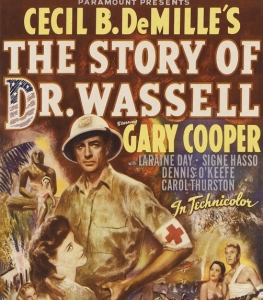
He became an instant international hero. During the early days of the war, his heroism was one of the few bright spots.  President Roosevelt praised him in a fireside chat. James Hilton wrote of Dr. Wassell in a book which was then adapted by Cecil B. DeMille into the 1944 movie starring Cooper.  Originally Arkansan Alan Ladd was wanted to play Cooper’s sidekick, but Ladd was pressed into military service and unavailable.

From April 24 to 26, 1944, Cecil B. DeMille was in Little Rock for the world premiere screening of The Story of Dr. Wassell. Little Rock rolled out the red carpet (literally and figuratively) for DeMille and a contingency from Hollywood.  Dr. and Mrs. Wassell also returned to Little Rock for the festivities.  Unfortunately, Gary Cooper (who played Wassell in the film) was unable to attend due to illness.  His costar, Laraine Day, was making another film and could not attend either.    Those in attendance with DeMille (and Mrs. DeMille) included actresses Signe Hasso and Carol Thurston, and actor Melvin Francis.  The latter played himself; he had actually been one of the sailors saved by Dr. Wassell.

Sold-out screenings of the movie took place at the Capitol and Arkansas Theatres. On April 27, 1944, a regular run of the movie started at the Capitol Theatre.  It would be released nationally on July 4, 1944, which also happened to be Dr. Wassell’s birthday.

Thirty-three years after The Story of Dr. Wassell was released, MacArthur was brought to the screen by Universal Pictures.  It was their attempt to capitalize on the success of the movie Patton, including sharing some of the same members of the production team.

macarthur-gregory-peck-1977-everettTold entirely in flashback, it stars Gregory Peck as the fabled World War II general who was born in Little Rock. It focuses primarily on events in 1942 during the war, his dismissal by Truman in 1952, and his famous address to West Point in 1962.

Peck initially did not care for the subject or the script, but eventually stated that he grew to admire the challenges MacArthur faced.  Peck later called it one of his favorites roles, if not one of his favorite movies.

Producer Frank McCarthy, who worked on both Patton and MacArthur once said of Patton and MacArthur: “Both were complex men but General MacArthur was complex on a much broader scale. Patton had no ambition except to be a soldier and to command a field army. He was strictly command.”

Most of the film was shot on the backlot at the movie studio, which impacted the quality of the film.  The production budget simply would not allow for overseas location filming.

The film was released in July 1977.  One of the premieres was held in Little Rock. Peck attended a reception in the Arsenal Building where MacArthur was born. Now the home to the MacArthur Museum of Arkansas Military History, in 1977 the building still housed the Museum of Science and Natural History (now the Museum of Discovery).  Since MacArthur only spent a few hours in Little Rock as an adult, it is possible that Peck spent more time in the building than the General did.

The evening of August 5, 1977, started with an exclusive reception for 100 people with Gregory and Veronique Peck.  The movie itself was shown at the Cinema 150, where its general run would start on Saturday, August 6.  Following the film, a reception and silent auction brought people back to the museum.  Tickets ran $250 a person for all events, $100 a person for the film and post-show reception, and $25 for the movie.  It sold out.

Governor and Mrs. David Pryor escorted the Pecks into the theatre.  Former Governor (and World War II hero) Sid McMath introduced Mr. Peck to the crowd.  He extolled the virtues of Peck and MacArthur.  (It is interesting that he should admire MacArthur so much, since the General and President Truman had a well-publicized tiff, and McMath and Truman had enjoyed a warm relationship.)  Little Rock City Director Jim Dailey presented Peck with a Key to the City.

Organist Rees Taylor Roberts in “Farewell” Concert tonight

Music director, organist & choirmaster Rees Roberts of St. Luke’s Episcopal Church will play a farewell concert at the church, 4106 JFK Boulevard, at 5:30 p.m. on Sunday, August 4.

The performance will be followed by a festive reception in the parish hall to wish him well as he leaves Arkansas to complete his university studies at Arizona State University in Tempe under the tutelage of eminent scholar-performer Dr. Kimberly Marshall. The concert is free and open to the public.

A native of Arkansas, Rees Roberts embarked on his keyboard career at age 12 studying piano with Craig Chotard of St. Mark’s Episcopal Church in Little Rock, but soon became enthralled by the organ. After graduating from Little Rock Central High School, he continued his musical education at the Oberlin Conservatory of Music in Ohio, studying organ with Jonathan Moyer and harpsichord with Webb Wiggins. He also sang in Oberlin’s premier early music choir, Collegium Musicum, under director Steven Plank.

He has played in master classes with Wilma Jensen in Memphis, Marie-Louise Langlais in Paris, France, and Kimberly Marshall in Little Rock. During his two and a half years at St. Luke’s, he led an adult choir and oversaw a bell choir as well as an ambitious program of Sunday morning services, evensongs, hymn sings, recitals, and special programs and events.

The program for the concert will include the following works:

  • Fête, Opus 51 – Jean Langlais (1907−1991)
  • Chaconne in E Minor – Dieterich Buxtehude (1637–1707)
  • Ballo del Granduca – Jan Pieterszoon Sweelinck (1562–1621)
  • Chaconne in B Flat Major – Johann Bernhard Bach  (1676–1749)
  • Toccata Septima – Georg Muffat (1653–1704)
  • Variations on “Ora Labora” – Gerre Edward Hancock  (1934–2012) 
  • Prelude & Fugue in B Minor, BWV 544 – Johann Sebastian Bach (1685  1750)
  • Sicilienne, from Pelleas et Melisande – Gabriel Fauré (1845 –1924)
  • Symphonie No. 3, Opus 28, IV. Adagio – Louis Vierne (1870-1937)
  • Fugue in E Flat Major, “St. Anne,” BWV 552 – Johann Sebastian Bach

1906 verdict halts plans for new LR City Hall, Jail and Auditorium

The 1906 plans for City Hall with the Municipal Auditorium on the left portion.

Little Rock Mayor Warren E. Lenon had been advocating for a new City Hall a municipal auditorium since shortly after taking office in April 1903. After plans were approved in July 1906, a group of citizens, led by Arkansas Gazette publisher J. N. Heiskell, filed suit to stop the City.

The closing arguments in the trial against plans for a new City Hall and auditorium complex had been heard on Monday, July 30.  The case was heard by Chancery Judge J. C. Hart.  Serving as an advisor to Chancellor Hart throughout the trial (though with no official legal standing) was Pulaski County Circuit Court Judge Robert J. Lea.  To accommodate the expected large attendance, the trial had been moved into his courtroom which was larger than Chancellor Hart’s.

On Friday, August 3, Pulaski County Chancery Judge J. C. Hart issued an injunction to keep the City from signing a contract for the construction of a city hall, jail and auditorium.  Chancellor Hart concurred with the plaintiffs that Arkansas’ constitution and laws dictated all taxation must be for public purposes.  He found there was nothing in Arkansas case law which defined an auditorium to be used for conventions as a public purpose.

As had been the case throughout the trial, the tone of the coverage of the decision differed greatly in the city’s two daily papers.  The subheading in the Democrat noted that the plaintiffs would be liable for any losses to the municipal government’s coffers due to a delay in commencing the construction if Little Rock eventually prevailed.  That fact is not mentioned by the Gazette.  Both papers did make note that Judge Lea agreed with the Chancellor’s decision.

For now, it looked as if the City of Little Rock would be stuck in the 1867 City Hall on Markham between Main and Louisiana.  Mr. Heiskell and his compatriots waited to see if the City would appeal the decision.

While August would be a quiet month publicly, work would go on behind the scenes.  More on that, in the future.