
Little Rock Look Back: LR Voters approve additional funds for Robinson Center in 1940

Though Joseph Taylor Robinson Memorial Auditorium opened in February 1940, there was still money that needed to be raised to finish the construction and the building’s furnishing.  Ten days after the auditorium opening, the City Council approved an ordinance to call a special election on April 2, 1940, for the purposes of approving bonds for three separate projects.  One of these was for $30,000 for the completion of the auditorium; the bonds would not require any additional tax levy.

At the same meeting, a letter was read from the Young Men’s Business Association expressing support for the auditorium in the election, which was to be held in conjunction with the annual municipal general election. The Auditorium Commission had previously asked the City Council to consider issuing the bonds to pay for additional equipment for the building.  In their request to the aldermen, the members stressed that due to the current bond structure, these new bonds would not necessitate any tax increase.

The campaign for the new bonds used a similar structure and message as the 1937 election to build the auditorium.  There were newspaper ads by the steering committee (this time simply called the Citizen’s Committee and led by Omar Throgmorton) and support from civic organizations.  One thing very different from the 1937 campaign was the presence of an actual building.  On Sunday, March 31, just two days before the election, there was an open house for the public to explore the edifice.  From 1:00 p.m. to 9:00 p.m., members of various Little Rock Boy Scout troops led 4,000 visitors on tours of the auditorium.  Visitors were shown all over the building; one scout calculated that the walking tour equated to two miles.  Though most people were from Little Rock, the guest registry indicated visitors from California and Pennsylvania.

On April 2, 1940, Little Rock voters approved the new bonds 1,413 to 423.  Every precinct in every ward of the city voted in favor of the new bonds.  Shortly after the election, the bonds were issued.  The auditorium construction which had first been broached in 1904 was now completed in 1940.

Little Rock Look Back: Final City Council meeting in 1868 City Hall

On March 30, 1908, the Little Rock City Hall held its final meeting in the 1868 City Hall.  The new city hall, located at Markham and Broadway streets, was nearing completion.  The meeting was presided over by Mayor W. E. Lenon.

The aldermen present were: John A. Adams, John Brod, A. B. Hightower, W. H. Jarrett, Christopher Ledwidge, Louie Miller, Jonathan S. Odom, R. C. Powers, A. L. Smith, George Stratman, Jonathan H. Tuohey, Louis Volmer, and L. N. Whitcomb.  Three aldermen missed the meeting: John Herndon Hollis, A. B. Poe and Benjamin S. Thalheimer.

The meeting was filled with typical requests for zoning and street improvements.  There was actually nothing out of the ordinary about the meeting.  If there was mention that it would be the final meeting, it did not make it into the minutes.

There was a request by the Arkansas Association of Pharmacists to have a meeting at the new building on May 12, 13 and 14.  It was referred to the City Hall Committee.  At prior meetings, there had also been requests by other groups to hold conferences at the new edifice.

At the conclusion of the meeting, it was noted that former City Clerk Clay Jones had died. A resolution memorializing him was proposed to be presented and adopted at the next meeting.

And with that, the meeting ended.  Forty years of City Council meetings at 120 to 122 West Markham came to a close.

LR Women Making History – June Freeman

June Biber Freeman, born and reared in New Jersey, came to Pine Bluff from the University of Chicago, where she had met and married her husband, Edmond Freeman, a Pine Bluff native.

Long interested in the arts, she was instrumental in establishing the Little Firehouse Community Arts Center. Serving as its unpaid director until, with her continued vision and help, it morphed into the Arts and Science Center for Southeast Arkansas (ASC).  In 1973, she conceived and organized the  Women and the Arts: A Conference on Creativity,  the first of its kind in the region. Governor Dale Bumpers appointed her to the Governor’s Commission on the Status of Women.  In 1975,  Freeman was  hired by  Townsend Wolfe as the Arkansas Arts Center’s Director of State Services, a job  she held for the next five years.

In 1982, she was instrumental in establishing Pine Bluff Sister Cities.   She has served on the Little Rock Arts+Culture Commission as well as the boards of the Arkansas Arts Center, the Mid-American Arts Alliance and the Arkansas Arts Council. (In view of her background in psychology, she has served as a longstanding member of the UAMS Advisory Board of the Psychiatric Research Institute.)

Freeman is the founding director of the non-profit Architecture and Design Network (ADN) which got underway in 2003. Securing the support of the Arkansas Arts Center, the UA Fay Jones School of Architecture and Design (FJSAD) and the central section of the Arkansas chapter of the American Institute of Architects (AIA), Freeman launched a series of free public lectures by distinguished architects.  Retiring as director at the end of 2016, she continues to serve as a board member. She was named an honorary member of the FJSAD Dean’s Circle and, in 2013, was given an Award of Merit by the state Chapter of the AIA at its annual meeting. In 2016 the ADN board named the lecture series for her.

In 2017, she was inducted into the Arkansas Women’s Hall of Fame.  In 1995, she received the Governor’s Arts Award for Outstanding Patron.  In 2018, she became a rare two-time award recipient of a Governor’s Arts Award as she received the Lifetime Achievement Award.

Freeman and her husband, who retired as publisher of the Pine Bluff Commercial, moved to Little Rock in 1995. The couple has four children and six grandchildren.

Little Rock Look Back: Farewell to the Hotel Marion and the Grady Manning Hotel

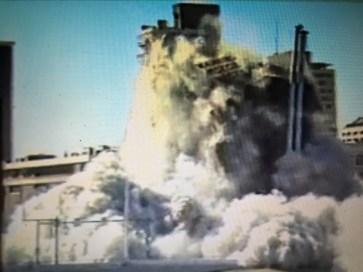
Manning Implosion.JPGOn February 17, 1980, a cold and clear Sunday morning, over seven decades of Arkansas history came tumbling down as the Hotel Marion and Grady Manning Hotel were imploded.  Thousands of people watched from places in downtown Little Rock and along the Arkansas River.  Many more were able to watch from live coverage carried on KATV, KARK and KTHV.  Those that missed it were able to see the replays multiple times on the news.

It was the first large-scale implosion in Little Rock’s history.  (It was likely the first implosion, but there could have been a small one that is not known.)  The two hotels were torn down to make way for the construction of the Excelsior Hotel and the Statehouse Convention Center.

The Hotel Marion, named after the builder Herman Kahn for his wife, opened in 1907. For four years it was Arkansas’ tallest structure.  It was the largest and grandest hotel in the City. For decades it would be the host to many dignitaries, conventions, and gala celebrations.

The Grady Manning Hotel was originally known as the Hotel Ben McGhee when it opened in 1930.   Manning was the head of the company which owned both the Marion and Ben McGhee properties.  Upon his untimely death by drowning in September 1939, the property was subsequently renamed in his memory.

The Manning Hotel, though taller, was never as grand a hotel as the Marion.  It was more of a mid-range property in pricing.

By the 1970s, both hotels were suffering from neglect and disinterest.  Changes in the lodging industry combined with a decline in downtown Little Rock had left both facilities with little business.

When Little Rock civic and government leaders decided to construct a larger convention center downtown with an adjacent hotel, it was decided that neither of these facilities could be properly renovated to be part of the project.  Instead, the land on which they stood (and the space in between) would be prime for the new hotel and center.

So, on the cold Sunday morning, the explosives were detonated, and the buildings came down.   Sunday morning was chosen because it would have the least impact on traffic flows since it would cause numerous streets to be closed for safety reasons.  The blast was delayed due to a rumor that someone might be in one of the buildings.  After checking both sites and finding them empty, the charges were set off.

And the Marion and Grady Manning became as much a memory as the long gone people who had once populated them.

The University of Arkansas’ Pryor Center for Oral and Visual History has a video of the implosion.

CALS Branch Up for Best Public Library

Hillary Clinton Children’ s Library and Learning Center (photo courtesy of Polk Stanley Wilcox)

And then there were 32!

The Central Arkansas Library System’s Hillary Clinton Children’s Library and Learning Center is advancing in a national competition for the Best Public Library.  The search is sponsored by Engaging Local Government Leaders (ELGL).

The competition started with 116 libraries spread throughout all 50 states.  CALS was the only library system with three nominees. They were the Main Branch, the Roosevelt Thompson Branch, and the Hillary Clinton Children’s Library and Learning Center.  After over 11,000 votes were cast, the top 32 were announced on Saturday.

The next round features 32 libraries from 25 states.  You can vote for Little Rock, here!  Voting runs through February 2!  You can only vote once, so encourage others to do so, too!

The award is named for fictional city government employee extraordinaire Leslie Knope.

Little Rock Look Back: LR Votes FOR a Municipal Auditorium

On January 26, 1937, Little Rock voters went to the polls to vote on three different municipal bond issues.  One of them was the construction of a municipal auditorium.

The bonds for the auditorium would be $468,000 in general obligation bonds which would be paid off between 1940 and 1971. This was toward a total cost of $760,000 for the entire project.

The official campaign for the auditorium was sponsored by the Little Rock Forward Committee which was led by W. H. Williams. In campaign advertisements it showed the value of conventions in New York City which was estimated at $100 per convention attendee. Little Rock organizers were estimating a $10 a day expenditure by visitors, which the committee stressed was very conservative. The campaign committee emphasized the importance of acting at that time due to the federal government money involved.

Various committees and organizations endorsed the auditorium project including the Little Rock Chamber of Commerce, Little Rock Federation of Women’s Clubs, and the Young Business Men’s Association.

The thrust of the campaign focused on the economic benefit to Little Rock as well as the fact that the auditorium would be for all citizens. This message was picked up in editorials by both the Democrat and Gazette. In editorials on January 23 and 25, the Democratopined that the benefits of the auditorium would be distributed among all classes of the citizenry. The next day, both papers ran editorials which touted the economic boon an auditorium would bring through conventions and meetings.

The Democrat’s approach broke down the current value of conventions to Little Rock with, what it termed, the city’s “existing inadequate” facilities. The paper emphasized a conservative estimate of what the added value to Little Rock’s economy would be with the new auditorium.

In expressing support for the auditorium the Gazette stressed the values for local, statewide and national groups. “An auditorium would provide a more convenient and better adapted community center for all kinds of local gathering,” and continued that it would make Little Rock “the logical meeting place for state conventions of every sort.” In discussing the value of state, regional and national meetings the paper stressed that the outside money spent by convention attendees has an impact beyond stores, hotels and restaurants.

Both papers also echoed the importance of the federal government financing to make this possible. The Democrat noted that the Public Works Administration grant and federal low cost loan made this an ideal time.

On January 26, 1937, Little Rock voters approved the auditorium bond by a vote of 1,518 to 519. It passed in each of the city’s 23 precincts. Little Rock Mayor R. E. Overman expressed his pleasure at the outcome of the vote and extended his thanks to the voters.

After the election, a Gazette editorial commented on the low turnout for the special election by commenting that the weather had been nice and there were no other barriers to voting. The editorial writer opined that those not voting in the election must not have been opposed to the endeavor.

Little Rock Look Back: LR FINALLY takes possession of Robinson Auditorium

Robinson Auditorium

On January 25, 1940, the City of Little Rock officially took complete possession of the Joseph Taylor Robinson Memorial Auditorium. By assuming custody of the structure from the contractor and the PWA, the City accepted responsibility for any of the remaining work to be completed.  This event happened one day shy of the third anniversary of the election which approved plans to issue bonds for an auditorium.  The act took place only about five months behind schedule.

E. E. Beaumont, the Auditorium Commission chairman, stated that an opening date could not be set until more work was completed. A major unfinished task was the laying of the front sidewalk which had been delayed due to cold weather.

The night before Little Rock took possession, Robinson Auditorium had been a topic of discussion at the Little Rock Chamber of Commerce annual meeting. The new Chamber president Reeves E. Ritchie (who as an Arkansas Power & Light executive had been engaged in the lengthy discussions about the installation of the steam line and transformers of the building) pledged that the Chamber would work to bring more and larger conventions to Little Rock at the Joseph Taylor Robinson Memorial Auditorium.