
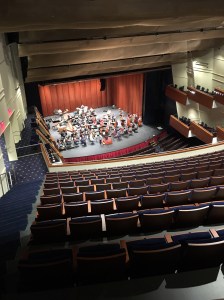
Help the ASO with an acoustic test at Robinson Center

The ASO in rehearsal at Robinson Center

School’s back.

It is test time!

Tonight you can take a test that has no wrong answer. It requires no studying.

ASO is conducting an amplified acoustic test and tuning of the Robinson Center on Tuesday, August 27, with a goal of optimizing the concert and listening experience for our Pops Live! series and other concerts with amplified instruments or voice.

The orchestra will be on stage and the ASO needs you to be in the house to get a realistic sonic environment, and to provide feedback on your listening experience. You will have a rare chance to peek behind the curtain at a working rehearsal, where you will hear ASO work on selections chosen to test the venue for an optimized orchestra experience, including two vocalists, a sneak peek at an upcoming Pops Live! Concert, and maybe even a Holiday selection!

This free, general admission event is limited to ASO season ticket holders, Concert Members, SHARP members, donors, members of the ASO’s youth and education programs, and their invited guests. If you have friends you would like to introduce to the orchestra, please invite them! We will ask all attendees to complete a very short survey about your listening experience. We want people to spread throughout the hall so we have listeners in every section, so we can best serve our entire audience. Please RSVP for you and your guests at ArkansasSymphony.org/acoustic-test

The orchestra will work in an empty hall from 7 p.m., the audience will be allowed in to take their seats at 7:45 p.m., and the open rehearsal/test will begin at 8 p.m. and will last about an hour.

August 26, 1935 – plans approved which would lead to creation of Robinson Auditorium

An August 25, 1935, rendering in the ARKANSAS GAZETTE of the proposed Little Rock auditorium at Capitol and Scott Streets.

On August 26, 1935, the City of Little Rock took its first significant step in a decade for the creation of a City auditorium.

Under the leadership of Mayor R. E. Overman, the City Council approved authorization for the City to apply for $1,000,000 from the Federal Emergency Administration of Public Works (PWA) for the construction of an auditorium.  The PWA had issued a September 16, 1935, deadline for applications to be received as it sought to spend $4.8 billion in construction projects.

The auditorium plan was announced on Saturday, August 24, 1935.  Much preparation had already been undertaken before the project was publicly unveiled.  Private presentations hhad taken place, a team of architects had been chosen (Eugene Stern and the firm of Wittenberg & Delony), and a location had been selected.

The auditorium complex was slated for a block bounded by Capitol, Scott, Fourth and Cumberland Streets.  The Women’s City Club building on that block would remain with the new structure being built to wrap around two sides of the existing structure. The site was chosen because it was one block east of the Main Street business corridor and near existing meeting locations such as the Boys Club, Albert Pike Hotel, Albert Pike Masonic Lodge and several churches.

As planned by the architects, this structure’s front façade would have run the length of the Capitol Avenue side of the block.  The building was proposed to be constructed of concrete, stone and steel.  It would have a large hall with a proscenium stage and seating capacity of 4,000 with overflow of an additional 500.  The adjoining exhibition hall could seat 3,500 people.  The plan called for 150 cars to be parked in the building, and an additional 100 cars to be parked on a surface lot on the site.

Following an August 26 closed door meeting to discuss the project from which members of the public and press were excluded, in open session the City Council voted to pursue the funding for the million dollar auditorium.  If approved by the PWA, the funds would be provided in grants and loans, to be paid by over a 35 year period.

The auditorium proposal was filed with the PWA in Washington in September 1935.  Throughout the next several months, Mayor Overman and the city were engaged in a series of conversations and negotiations with the PWA for the expansion of both the water system and the sewer system. This diverted attention from pursuing the auditorium immediately.  This specific auditorium project stalled.  But because the plan had been filed by the September 16 deadline, it allowed the City to make use of PWA funds a few years later which would lead to the construction of Robinson Auditorium.

Farewell Party at the Arkansas Arts Center today

No photo description available.

The Arkansas Arts Center is celebrating the end of an era!

After 56 years, it is time to say goodbye to the current MacArthur Park space with a party that takes over the whole building.

They have filled the galleries with a carnival of activities – karaoke, giant yard games, a beach party, photo booth, and inflatable fun zone. Don’t miss music, dancing, food, drinks and much more!

Join the AAC for family-focused fun and activities for all ages from 2–5 p.m. Starting at 5 p.m., the Farewell Festival will be 21+.

The Farewell Festival is free for Arkansas Arts Center members, with special perks available for members of ’22&You.

Membership Card Required for Entry

PS – Stay tuned for announcements of upcoming events! Just because the facility in MacArthur Park will be closed for reconstruction does not mean the AAC is ceasing having events.

August 20, 1961 – Groundbreaking for Arkansas Arts Center

On a warm Sunday afternoon, ten golden shovels turned dirt to mark the start of construction for the new Arkansas Arts Center.  The activity followed a series of speeches that day, August 20, 1961.

The speakers and dignitaries sat on the front portico of the original Museum of Fine Arts in MacArthur Park. That building would be incorporated into the new structure.

Among those who took part in the speeches and groundbreaking were Winthrop Rockefeller, Jeannette Edris Rockefeller, Gov. Orval Faubus, Congressman Dale Alford, and Little Rock Mayor Werner Knoop.

The efforts to create the Arkansas Arts Center started in the mid-1950s when the Junior League of Little Rock started an effort to establish a new art museum.  Next, the business community founded a Committee for a Center of Art and Science to accept funds donated.

When a suitable location within Little Rock could not be found, the decision was made to join with the Fine Arts Club and the Museum of Fine Arts.  Under the leadership of the Rockefellers, the drive to form the Arkansas Arts Center was launched. In September 1960, the City of Little Rock formally established the Arkansas Arts Center.

1906 verdict halts plans for new LR City Hall, Jail and Auditorium

The 1906 plans for City Hall with the Municipal Auditorium on the left portion.

Little Rock Mayor Warren E. Lenon had been advocating for a new City Hall a municipal auditorium since shortly after taking office in April 1903. After plans were approved in July 1906, a group of citizens, led by Arkansas Gazette publisher J. N. Heiskell, filed suit to stop the City.

The closing arguments in the trial against plans for a new City Hall and auditorium complex had been heard on Monday, July 30.  The case was heard by Chancery Judge J. C. Hart.  Serving as an advisor to Chancellor Hart throughout the trial (though with no official legal standing) was Pulaski County Circuit Court Judge Robert J. Lea.  To accommodate the expected large attendance, the trial had been moved into his courtroom which was larger than Chancellor Hart’s.

On Friday, August 3, Pulaski County Chancery Judge J. C. Hart issued an injunction to keep the City from signing a contract for the construction of a city hall, jail and auditorium.  Chancellor Hart concurred with the plaintiffs that Arkansas’ constitution and laws dictated all taxation must be for public purposes.  He found there was nothing in Arkansas case law which defined an auditorium to be used for conventions as a public purpose.

As had been the case throughout the trial, the tone of the coverage of the decision differed greatly in the city’s two daily papers.  The subheading in the Democrat noted that the plaintiffs would be liable for any losses to the municipal government’s coffers due to a delay in commencing the construction if Little Rock eventually prevailed.  That fact is not mentioned by the Gazette.  Both papers did make note that Judge Lea agreed with the Chancellor’s decision.

For now, it looked as if the City of Little Rock would be stuck in the 1867 City Hall on Markham between Main and Louisiana.  Mr. Heiskell and his compatriots waited to see if the City would appeal the decision.

While August would be a quiet month publicly, work would go on behind the scenes.  More on that, in the future.

Sandwich in History at the Stebbins-Roberts Building today

Image may contain: plant, sky and outdoor

You are invited to join the Arkansas Historic Preservation Program’s next “Sandwiching in History” tour, which will visit the Stebbins-Roberts Building at 1300 East Sixth Street in Little Rock beginning at noon on Friday, August 2, 2019.

The 1947 Stebbins-Roberts Building was designed by noted Arkansas architect H. Ray Burks for the Stebbins & Roberts Paint Company, the former sole provider of Benjamin Moore paint products in Arkansas. The building is a late example of Art Deco and Art Moderne architecture by Burks, who was known for his work in the style.

Sandwiching in History tours are worth one hour of AIA continuing education credit. If you would like to receive email notifications of upcoming tours instead of postcards or need additional information, please contact Callie Williams, Education and Outreach Coordinator for AHPP, at 501-324-9880 or Callie.Williams@arkansas.gov.