Bladesmith Jerry Fisk to be named Honorary Arkansas Living Treasure by Arkansas Arts Council

Image may contain: 1 person, sittingThe Arkansas Arts Council will recognize Jerry Fisk, a well-known bladesmith, with an Honorary Arkansas Living Treasure award during a reception 5:30 p.m. to 7:30 p.m. Thursday, May 23, at the Historic Arkansas Museum.

The honorary award is a first for the Arts Council. Ricardo Vilar, a fellow bladesmith from Nashville, will speak during the reception. Arkansas Arts Council Director Patrick Ralston will present the award.

Fisk, of Nashville, was named National Living Treasure in 1999. He then helped start the Arkansas Living Treasure program in 2002 by working with the Department of Arkansas Heritage and the Arkansas Arts Council.

Outside of his public service, Fisk is a nationally and internationally recognized bladesmith. He creates various styles of knives, including the Bowie Knife – a fighting knife first made in Arkansas.

Fisk’s knives are in permanent museum collections, including the New York State Museum and the Historic Arkansas Museum, where Fisk is an advisor. He also holds workshops on traditional knife-making techniques at various locations.

Little Rock Look Back: Plans for Arkansas Arts Center unveiled on May 22, 1961

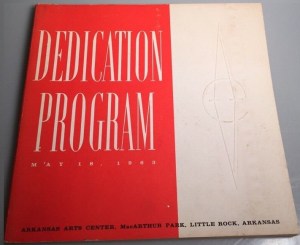
In a dinner at the Hotel Sam Peck, plans for the new Arkansas Arts Center were unveiled on Monday, May 22, 1961.

It was estimated the project would cost $600,000. A total of $646,000 (the equivalent of $5.5 million in 2019) had been raised by the Junior League of Little Rock, Fine Arts Club, and the Board of the Museum of Fine Arts.

At the time the project was getting underway, it was one of the first types of multidisciplinary arts facilities in the United States.

Ground was broken in August 1961 and the building would open officially in May 1963 (though parts of it were already in use by December 1962).

The firm of Ginocchio, Cromwell, Carter & Neyland did the architectural design.  Pickens-Bond Construction Company was the general contractor.

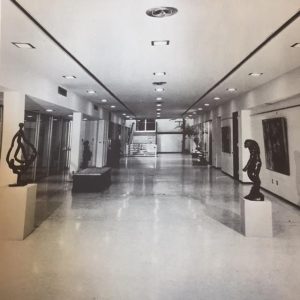
The May 1961 plans featured a slight expansion of existing gallery space (which was the 1937 Museum of Fine Arts building). It included the addition of a theatre, classrooms, administrative offices, a library, and more gallery space.  While the original entrance would be kept, the main focus of the building would be shifted from 9th Street into MacArthur Park with a new south entrance.

Over the years, the building underwent several additions.  These were tacked on to the existing edifice without truly linking it into one building.  On July 1, 2019, the facility will be closed to begin the work on the re-imaging and renovation. That process will unite the existing and new spaces into one seamless structure.

Curbside Couture tonight at the Clinton Center

Image result for curbside couture

The eighth annual Curbside Couture, Arkansas’s largest “green” fashion show, will feature recycled and up cycled designs.  Doors open at the Clinton Center tonight (April 28) at 5:30pm, the show begins at 7pm.

Third through Twelfth grade students are invited to apply their creativity and technical skills to create wearable designs made of recycled material.

Students will have the opportunity to attend a mentoring session with acclaimed fashion designers, including Korto Momolu, who was first runner-up in Project Runway’s fifth season, and the Clinton Center’s own Connie Fails.

A reception with complimentary cheese and crackers and a cash bar will follow the fashion show. Clinton Center members at the Friend Level and above receive complimentary beverages.

Tickets can be purchased here.

“Weathering It Together” Designing for the Anthropocene” is topic of Architecture and Design Network lecture

Image may contain: sky, ocean, cloud, house, outdoor, water and natureTonight (April 23), the Architecture and Design Network (ADN) continues its 2018/2019 June Freeman lecture series by welcoming Dr. Victoria Herrmann, President and Managing Director of the Arctic Institute for a lecture entitled, “Weathering It Together: Designing for the Anthropocene.”

This lecture is in partnership and provided by the Fay Jones School of Architecture and Design lecture series.  It starts at 6pm at the Arkansas Arts Center; a 5:30pm reception precedes it.

The Fourth National Climate Assessment, released in late 2018, warned that the quality of life for residents across the southeast will be compromised as the built environment becomes ever-more vulnerable to increasing temperatures and flooding brought about by a changing climate, particularly as infrastructure ages and populations shift to urban areas. Professionals in design, architecture, and historic preservation can be the game-changers needed to support the continued vibrancy and viability of resilient communities amidst rapid environmental change.

This interactive lecture will help the audience better understand the climate change impacts already underway in the southeast and, through examples from across America, the role the architecture and design community has in building a community-driven vision for a resilient future.

This lecture will analyze the gaps in climate change adaptation for the built environment, and the opportunities to co-create buildings that produce adaptation and mitigation benefits, while focusing to help understand the concept of loss and damage in climate change, and examine the role architecture and design can play in loss and damage work.

Dr. Victoria Herrmann is the President and Managing Director of the Arctic Institute, a nonprofit organization dedicated to Arctic security research. She is one of 16 women leaders in the top 100 U.S. think tanks, and the youngest of all 100. As a National Geographic Explorer, Dr. Herrmann traveled across the country in 2016 and 2017 interviewing 350 local leaders to identify what’s needed most to safeguard coastal communities against unavoidable climate change impacts.

Her current JMK Innovation Prize project, Rise Up to Rising Tides, is creating a matchmaking program to connect skills-based volunteers with climate-affected communities for climate adaptation, historic preservation, and cultural heritage documentation projects. Dr. Herrmann teaches sustainability at American University and science communication at the University Centre of the Westfjords, Iceland. She was previously a Junior Fellow at the Carnegie Endowment, a Fulbright Canada Awardee, a Mirzayan Science and Technology Policy Fellow at the National Academies of Sciences, and a Gates Scholar at the Cambridge University.

Little Rock City Hall turns 111 today

City Hall circa 1908

111 years ago today, Little Rock City Hall officially opened at the corner of Markham and Broadway.

On April 15, 1908, the Italian Renaissance Revival style building, which had been designed by local architect Charles Thompson, played host to an open house. Staff had started moving into the building in March of that year.   This was, as often is the case, behind schedule.  The date in the cornice toward the top of the building is 1907, but the building was not completed until 1908.

An open house took place on April 15, 1908, presided over by Mayor John Herndon Hollis and his wife as well as former Mayor W. E. Lenon and his wife.  (Mayor Hollis’ wife is a distant cousin of the Culture Vulture.)

In 1903, W. E. Lenon became Mayor of Little Rock. Back then, the terms were two-year terms.  Before the start of his second term in 1905, he realized that the City was outgrowing City Hall, which was, at the time, on the northeast corner of Markham and Louisiana – where part of the Statehouse Convention Center sits today.

In February 1906, Mayor Lenon appointed a committee of five aldermen to over see the planning for the building of a new City Hall. In July 1906, the City Council approved plans, which called for a City Hall with an municipal auditorium wing. There was some hue and cry about the cost spending and a resulting lawsuit, so, in September 1906, those plans were scrapped and a simpler City Hall was approved for the cost of $175,000.

The last resolution in the old City Hall called for the banning of smoking in the new Council Chambers – while the Council was in session. This may well have been the first smoking ban in a public government building in the history of Arkansas.

When the building opened, the third floor was not finished out. The space was not needed. When the Museum of Natural History and Antiquities (now the Museum of Discovery) moved into City Hall in 1929, they had to finish out their space.

In 1913, the new Central Fire Station, designed in the Beaux Arts style, was constructed adjacent to City Hall. During the 1930s, as the City grew, more space was needed. A garage, designed in the “austere, utilitarian” style was built in 1936 and a City Jail Annex, built by the WPA in the modified Art Deco style was built in 1938.

By 1984, the decision was made to stay at Markham and Broadway. An extensive renovation and restoration effort was undertaken. In 1988, the building reopened, and the interior had been restored to its 1908 appearance.

“Project Row Houses at 25” is focus of Architecture and Design Network June Freeman Lecture tonight

Image may contain: sky, tree, outdoor and nature

Architecture and Design Network (ADN) continues its 2018/2019 June Freeman lecture series by welcoming Eureka Gilkey, Project Row Houses’ Executive Director. Project Row Houses is a nonprofit organization in Houston, Texas that is dedicated to empowering people and enriching the Third Ward community through engagement, art and direct action. PRH was founded 25 years ago with a mission to be the catalyst for the transformation of community through the celebration of art and African American history and culture.

PRH’s work with the Third Ward community began in 1993 when seven visionary African-American artists recognized real potential in a block and a half of derelict shotgun houses at the corner of Holman and Live Oak. Where others saw poverty, these artists saw a future site for positive, creative, and transformative experiences in the Third Ward. So, together they began to explore how they could be a resource to the community and how art might be an engine for social transformation. This is how the PRH story began.

With the founders engaged with a community of creative thinkers and the neighbors around them, Project Row Houses quickly began to shift the understanding of art from traditional studio practice to a more conceptual base of transforming the social environment. While they were artists, they were also advocates.
Over the next 25 years the organization brought together groups and pooled resources to materialize sustainable opportunities for artists, young mothers, small businesses, and Third Ward Residents helping to cultivate independent change agents by supporting people and their ideas so that they have tools and capacity to do the same for others.

PRH is, and has always been a unique experiment in activating the intersections between art, enrichment, and preservation. The lecture will cover PRH’s rich 25 year history and how the nonprofit became an international model for artists and communities to address their needs for historic preservation and community enrichment.

Architecture and Design Network lectures are free and open to the public. No reservations are required. Supporters of ADN include the Fay Jones School of Architecture and Design, the Central Section of the Arkansas Chapter of the American Institute of Architects and friends in the community.