Brown Bag lecture at Old State House today focuses on Robinson Center construction

robinson-auditorium-by-scott-carterToday (Thursday, October 6) at noon at the Old State House, the Brown Bag lecture focuses on the construction of the Joseph Taylor Robinson Memorial Auditorium.

After three decades of failed attempts to build a municipal auditorium in Little Rock, the New Deal finally offered the opportunity to build a structure for performances and conventions. But there were still many roadblocks on the way to the opening of the Joseph Taylor Robinson Memorial Auditorium.

For this Brown Bag Lunch Lecture, Scott Whiteley Carter will examine the changes and chances from October 1935 to April 1940 leading up to the opening of Robinson Auditorium. The period featured a reluctant but triumphant mayor, a crusading newspaper editor, political intrigue, financial chaos, and a plethora of frustration — all ultimately leading to a monument to civic pride.

A native of Little Rock, Carter is Special Projects Administrator at the City of Little Rock. Among his duties in this capacity are research and functioning as the city’s historian.

LR Look Back: JFK in LR (and Greers Ferry)

JFK LROn October 3, 1963, President John F. Kennedy delivered remarks at the Arkansas State Fairgrounds.  Only a few weeks later, he would be felled by an assassins bullet in Texas.

In the speech, the President praised Arkansas’ congressional delegation including Senators John McClellan and J. William Fulbright and Congressmen Took Gathings, Bill Trimble, Wilbur Mills and Oren Harris.  Each of these men held senior leadership positions in key committees.  The main focus of the speech was to discuss President Kennedy’s vision for a new economy in the South.

The President was actually in the state to speak at the dedication of the Greers Ferry Dam. He agreed to make that appearance as a part of a negotiation with Congressman Mills as they were deadlocked over changes to the tax code.  He had previously visited Little Rock in 1957 when he came to the state to address the Arkansas Bar Association meeting in Hot Springs.

President Kennedy continued the string of 20th Century Presidents to visit Little Rock.  Presidents Theodore Roosevelt, William Howard Taft, Franklin Roosevelt and Harry Truman had all visited while in office.  Woodrow Wilson, Herbert Hoover and Dwight Eisenhower all visited prior to attaining the presidency.

Little Rock Look Back: Razorback Football Launches War Memorial Stadium

wms1948-first-gameIn honor of the Arkansas Razorbacks taking on Alcorn State today in Little Rock, a look back at the first football game (or event of any kind) at War Memorial Stadium.

On September 18, 1948, the Hogs took on Abilene Christian and won the game by a score of 40 to 6.  It was the first game of the season, and the Razorbacks went into the game ranked #13. They maintained that ranking for four weeks before falling out of national standings.  The team ended up with a season record of five wins and five losses. Playing four of their games at War Memorial that season, they were two and two in Little Rock. They were one and two in Fayetteville and amassed a 2-1 record on the road.

Dedication ceremony in 1948. Photo courtesy of the War Memorial Stadium Commission.

Dedication ceremony in 1948. Photo courtesy of the War Memorial Stadium Commission.

Prior to the game, the stadium was dedicated to the veterans of World War I and World War II in a ceremony led by former Razorback standout and Medal of Honor recipient Maurice “Footsie” Britt.  Though he would later be known for entering politics and becoming Arkansas’ first Republican Lieutenant Governor, in his college days he was known statewide as an outstanding Razorback football and baseball athlete.  During World War II, his bravery and courage allowed him to become first person in American history to earn all the army’s top awards, including the Medal of Honor, while fighting in a single war.

Also participating in the opening ceremony were a mass of high school marching bands from across the state. Reports indicate up to forty bands were on the field to play the National Anthem as part of the event.

The construction of the stadium had been a dream of Governor Ben T. Laney. He had encouraged the Arkansas General Assembly to create the stadium during the 1947 session.  In August of 1947, Little Rock was chosen as the location over Hot Springs and North Little Rock. West Memphis had abandoned its bid when it was unable to secure the necessary financial pledges.  Construction started in 1947 and continued up until opening day.  On the day of the game, newspaper photos showed heavy equipment grading the parking lot prior to paving.  Though it had been Laney’s dream, with the passing of the guard, a newspaper photo on the day after the dedication focused on the incoming governor, Sid McMath.  Because Arkansas was such a Democratic heavy state, the paper referred to him as Governor-designate even though it was six weeks prior to the 1948 General Election when he would face off against C. R. Black.  McMath won the race with 89.4% of the vote.

Happy Father’s Day with Rabbit Reach

Cherry - Rabbit ReachToday is Father’s Day.  In honor of that, today’s Sculpture Vulture revisits Tim Cherry’s Rabbit Reach.  The sculpture was given in memory of two fathers.

The sculpture is a gift from Whitlow Wyatt and the Carey Cox Wyatt Charitable Foundation. It was given in memory of George Wyatt and Frank Kumpuris.  Those two gentlemen were the fathers of Whitlow Wyatt and Dean & Drew Kumpuris.

The sculpture is located at the corner of Sherman Street and President Clinton Avenue across from the Museum of Discovery.

Cherry’s sculpture was selected for this spot because of its proximity to children at the Museum and in the River Market district.  The design and size of the sculpture encourages children to climb on it and to play around the rabbit.

While some public art is situated so it cannot be touched, this one is situated to be touched as part of the appreciation experience.

Rabbit Reach received national publicity in 2015 when Melissa Joan Hart featured it on her social media while she was in Little Rock filming a movie.

Little Rock Look Back: Former LR Mayor Sprick takes on Muhammad Ali and Loses

Ali SprickDan T. Sprick was a Little Rock Mayor for two years in the 1940s after having previously served on the City Council.  From 1961 until 1970, he served as a State Senator from Little Rock and was a reliable ally for Governor Orval Faubus. Once Faubus left office and was replaced by Governor Winthrop Rockefeller, Sprick continued to wave the banner of segregation and agitation.  One of his new focuses was boxer Muhammad Ali.

In 1969, the University of Arkansas announced that Ali would be one of the speakers for its public appearance series.  After refusing to be drafted and go to Vietnam, Ali was barred from earning a living as a professional boxer and so was making a living giving lectures.  His refusal to submit to the draft was based on his religious beliefs as a recent convert to the Nation of Islam.

Opposition to Ali’s appearance rose almost immediately, and from Little Rock not Fayetteville. The Pulaski Businessman’s Association sent a letter to UA president David Mullins asking him to bar Ali from speaking. President Mullins insisted that he had the right to speak on campus. When that didn’t work, Senator Sprick and his cohorts in the state’s upper chamber went to work. A resolution calling for Ali to be barred from speaking failed on a voice vote after much debate.

While there were certainly some racial overtones to Sprick’s opposition, he and others seemed to be more concerned over the former Cassius Clay’s conversion to Islam plus his ensuing refusal to be drafted.  Senator Sprick declared that if President Nixon would draft him now he would go to serve in Vietnam.  (Sprick was in his late 60s at the time.)

Ali’s speech on the campus actually caused some controversy on its own.  One of the things he advocated for segregation. He praised Alabama Governor George Wallace.  The Arkansas Gazette which had been following the saga in both news stories and editorials, noted that remarks like that should have endeared Ali to Dan Sprick and others.

Ali, of course, resumed his boxing career and defined that sport in the 1970s with his talent in the ring and his showmanship.

Based on an editorial, Sprick sued the Gazette for libel. The paper settled with him out of court because his health was poor. Sprick died in 1972.

Little Rock Look Back: Cornice placed on Robinson Auditorium

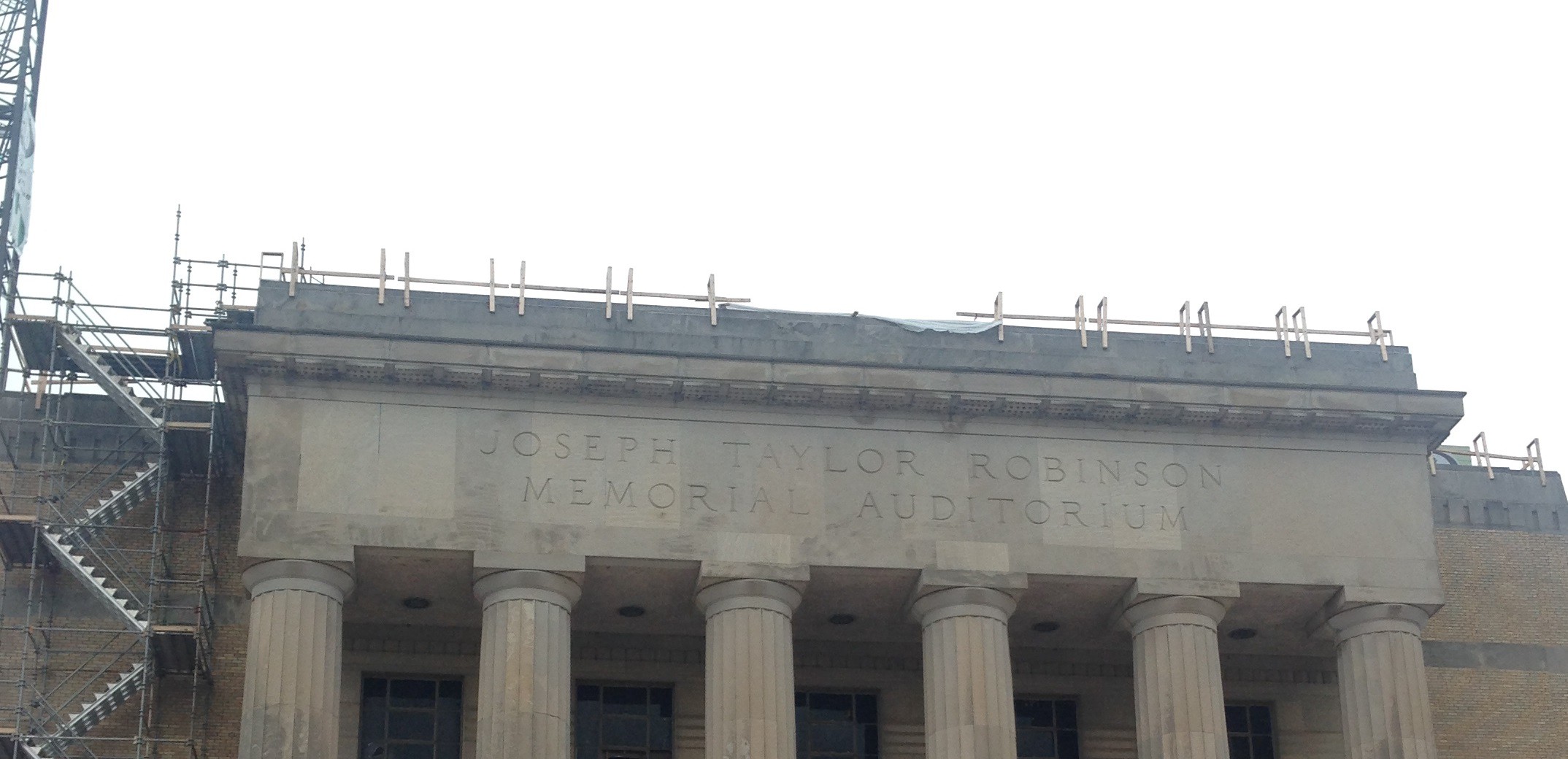
JTR CorniceOn June 1, 1939, the cornice was installed on Robinson Auditorium.  This granite slab noted the name of the building as the Joseph Taylor Robinson Memorial Auditorium.  (It is interesting to note that it used the more modern “u” instead of the classical “v” which was often used in buildings during prior decades – as evidenced by the Pvlaski Covnty Covrt Hovse across the street.)

This was a milestone marking the completion of the front facade of the structure.  Much work would continue on the interior of the structure.  This step in the construction was considered major enough that the Arkansas Gazette mentioned it in a news article.

Today the cornice is again surrounded by construction materials and braces. The front lobby, the cornice and columns are pretty much the only parts of the building not currently under construction as Robinson Center is readied for its second act.  It is scheduled to open in November 2016.

War Hero Cinema: Gary Cooper and Gregory Peck as LR natives

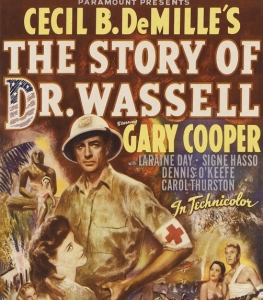
Dr. WassellThe exploits of two Little Rock natives during World War II have both been turned into Hollywood movies.  One was released during World War II and starred Gary Cooper as Dr. Corydon Wassell. The other was released in the 1970s and starred Gregory Peck as General Douglas MacArthur.

Born in Little Rock on July 4, 1884, Corydon McAlmont Wassell (called “Cory”) was born to Albert and Leona Wassell. A grandson of Little Rock Mayor John Wassell, he graduated from what is now UAMS in 1909. In 1911, he married Mary Irene Yarnell, with whom he would have four children.  In 1914, the couple volunteered to be Episcopal missionaries in China.  He served there until 1927. Following Mary’s death and his remarriage, he and new wife Madeline Edith Day Wassell returned to Arkansas in 1927.

Dr. Wassell resumed his medical practice. Given his experience with malaria in China, he proved to be an asset fighting malaria among Civilian Conservation Corps members in Arkansas. He was subsequently called to active duty in the Navy in 1936 and stationed in Key West.

After the outbreak of World War II, he was stationed in Indonesia. In early 1942, he refused to abandon his patients after the Japanese started invading Indonesia. Instead, he was able to evacuate a dozen severely wounded men over 150 miles to get to a ship. It took ten days for the ship to get to Australia, during which time it was attacked numerous times.  His official Navy Cross citation notes that he disregarded personal safety while caring for others.

He became an instant international hero. During the early days of the war, his heroism was one of the few bright spots. James Hilton wrote a biography of him; President Roosevelt praised him in a fireside chat. James Hilton wrote of Dr. Wassell in a book which was then adapted by Cecil B. DeMille into the 1944 movie starring Cooper.  Originally Arkansan Alan Ladd was wanted to play Cooper’s sidekick, but Ladd was pressed into military service and unavailable.

Thirty-three years after The Story of Dr. Wassell was released, MacArthur was brought to the screen by Universal Pictures.  It was their attempt to capitalize on the success of the movie Patton, including sharing some of the same members of the production team.

macarthur-gregory-peck-1977-everettTold entirely in flashback, it stars Gregory Peck as the fabled World War II general who was born in Little Rock. It focuses primarily on events in 1942 during the war, his dismissal by Truman in 1952, and his famous address to West Point in 1962.

Peck initially did not care for the subject or the script, but eventually stated that he grew to admire the challenges MacArthur faced.  Peck later called it one of his favorites roles, if not one of his favorite movies.

Producer Frank McCarthy, who worked on both Patton and MacArthur once said of Patton and MacArthur: “Both were complex men but General MacArthur was complex on a much broader scale. Patton had no ambition except to be a soldier and to command a field army. He was strictly command.”

Most of the film was shot on the backlot at the movie studio, which impacted the quality of the film.  The production budget simply would not allow for overseas location filming.

The film was released in July 1977.  One of the premieres was held in Little Rock. Peck attended a reception in the Arsenal Building where MacArthur was born. Now the home to the MacArthur Museum of Arkansas Military History, in 1977 the building still housed the Museum of Science and Natural History (now the Museum of Discovery).  Since MacArthur only spent a few hours in Little Rock as an adult, it is possible that Peck spent more time in the building than the General did.