Little Rock Look Back: Boxing Day look at Robinson Auditorium boxing

Boxer Al Globe lays in the ring after being knocked down by Bob Sikes in this GAZETTE staff photo

Boxer Al Globe lays in the ring after being knocked down by Bob Sikes in this GAZETTE staff photo

Though the origins of the name Boxing Day have nothing to do with pugilism, today’s entry looks at early boxing matches at Robinson Auditorium.

Though the building did not open until February 1940, there were a few preview events in the lower level exhibition hall beginning in October 1939.  (The construction upstairs would not be completed until January 1940.)

Wrestling was a more common sport on the lower level. But from time to time there was boxing.  It appears that the first boxing matches took place on November 9, 1939.

Pine Bluff’s heavyweight Bob Sikes was the star attraction on the main card as he faced off against Chicago’s Al Globe.  The two were fairly evenly matched through the first three rounds. In the fourth round, Globe sent Sikes to the mat, before the latter arose on the seventh count. (He was a bit groggy and could not name the city in which he was boxing.)  Ninety seconds into the fifth round, however, Sikes delivered a knockout punch to Globe.

The warm-up bout featured Carolinian Maxie Doyle against Jimmy Merritt of Oklahoma. After the ref called the match on a TKO in favor of Doyle, the two continued to fight in the ring. It took their seconds to leave the corner and help the ref break it up.  The boxers were threatened with suspension if they continued it any further.

Prior to the Doyle-Merritt bout, Bauxite’s Woody Bell edged out Young Leonard in six rounds. Charley Regan and Bobbie Lee came to a draw after their six.  The first match of the evening featured two African American boxers: Little Rock’s Bill Walker, who earned a decision over North Little Rock’s Herbert Taylor.

Since the heating system was not yet operational at Robinson Auditorium, promoters for the early wrestling and boxing matches touted the fact that a temporary heating system was in place as temperatures started to drop.

Sikes was back at Robinson in another marquee match on February 9, 1940, one week before the official opening of the upstairs Music Hall.  By this time permanent heating and lighting had been connected.

Boxer Bob Sikes, GAZETTE staffer Lou MacDuff and boxer Joe Regan in a GAZETTE staff photo

Boxer Bob Sikes, GAZETTE staffer Lou MacDuff and boxer Joe Regan in a GAZETTE staff photo

The headline bout was Sikes against Joe Regan of Ames, Iowa.  They were scheduled for ten rounds.

Earlier fights on the card were the six-round middleweight match of Gould Nix of Willow meeting Buck Buchanan of Rogers; welterweight Doyle Venable of Dierks vs. Little Rock’s Freddie Richardson; Johnny Allen of Saint Louis meeting Woody Bell of Bauxite; and, in the first match, Kid Tobey of Hot Springs vs. Bill Walker of Little Rock. The latter was a four round bout featuring two African American boxers.

The marquee fight did not go anywhere near as long as ten rounds.  Fifty-four seconds into the second round, Sikes pummeled Regan with a right to the chin, a right to the cheek and a left hook to the head. After that Regan was down for the count. Though at the eight count he did manage to turn over from his back to his stomach and remained in that position until being helped to his corner following the bell.

Earlier in the evening, Nix, Venable, and Bell all won their bouts by decisions of the judges. Walker won the curtain raiser by a knock out in the second round.

It was a capacity crowd for the boxing event at Robinson Auditorium.  Tickets, which were available for purchase at Rube & Scott, Inc. men’s clothing store, ranged from 55 cents for general admission, to $1.10 for reserved seating and ringside seats of $1.65 or @2.20.

15 Highlights of 2015 – Chelsea Clinton was 1,000th Clinton School Speaker

chelsea

Eleven years to the day of the first Clinton School Speaker Series public program, that initiative celebrated its 1,000th speaker on September 18, 2015.

In “It’s Your World: Get Informed, Get Inspired & Get Going!,” Chelsea Clinton tackles the biggest challenges facing us today. She combines facts, charts, photographs and stories to give readers a deep understanding of the world around them and how anyone can make a difference. With stories about children and teens who have made real changes big and small, this book inspires readers of all ages to do their part to make our world a better place.

One of Clinton’s favorite childhood books was “50 Simple Things Kids Can Do to Save the Earth.” As an elementary school student in Little Rock, she helped start a paper-recycling program at her school; as a teenager in Washington, D.C., she led her school’s service club; and as a student at Stanford University, she volunteered as a reading and writing tutor and at the Children’s Hospital.

Today, she is Vice Chair of the Bill, Hillary and Chelsea Clinton Foundation where she helps lead the work of the Foundation across its various initiatives, with a particular focus on work related to health, girls and women, creating service opportunities, and empowering the next generation of leaders. Chelsea holds a BA from Stanford University, an MPH from Columbia University, and an MPhil and doctorate degree in international relations from Oxford University.

The lecture featuring Chelsea Clinton was the 1,000th public program for the Clinton School of Public Service. On September 18, 2004, the Clinton School welcomed their first public program speaker, Senator Bob Dole.

This event will be at the Wally Allen Ballroom at the Statehouse Convention Center at 6pm.

15 Highlights of 2015 – Robinson Center Renovation Tops Out

LRCV 1The Little Rock Convention & Visitors Bureau (LRCVB), members of the Little Rock Advertising and Promotion Commission (LRA&P), local officials, and members of the design and construction teams hosted a topping out ceremony July 1, 2015 at 10:00 AM for the Robinson Center’s new conference facility, signifying a one–‐year milestone in the 28–‐month, $70 million renovation and expansion project.

Following a press conference and ceremonial beam signing held on the western side of the Robinson Center, local media and special guests were given tours of the magnificent ballroom platform and conference center located on Robinson’s north side. This new addition not only provides some of the most dramatic enhancements of the project, but will also provide groups with spectacular views of the Arkansas River and the city’s illuminated bridges.

Along with additional meeting and pre–‐function space situated above its ballroom, the new conference center will also provide a new connection to the DoubleTree Hotel, with an adjoining lobby and additional pre–‐function space.

Robinson Center will reopen in November 2016.  The Arkansas Symphony Orchestra will return its Masterworks and Pops series to Robinson. Ballet Arkansas will perform The Nutcracker there in December 2016.  Celebrity Attractions will bring Broadway back to Robinson (on Broadway, no less) next season as well.  They have already announced The Phantom of the Opera for March 2017.

LRCV 5For more information on the Robinson Center Second Act renovation and expansion project, visit http://www.RobinsonCenterSecondAct.com.

Robinson Construction Facts to Date:

  • Nearly 10,000 tons of material have been recycled, representing 91% of the waste material diverted 1,216 tons of steel has been erected
  • 2,300 cubic yards of concrete has been placed
  • 470 individuals have gone through CDI/Hunt Safety Orientation
  • 73% of the project subcontractors are local

Little Rock Look Back: Groundbreaking for Robinson Auditorium

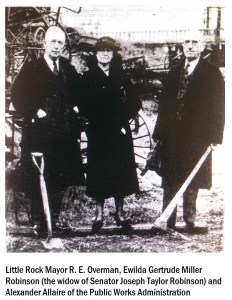
122437 GroundbreakOn December 24, 1937, at 11:30 a.m., Little Rock Mayor R. E. Overman, Ewilda Gertrude Miller Robinson (the widow of Senator Joseph Taylor Robinson) and  Alexander Allaire of the PWA turned dirt to participate in the brief groundbreaking ceremony for Little Rock’s municipal auditorium.  That morning, the Arkansas Gazette ran a brief story on the upcoming groundbreaking.  The story mentioned that the building would be named in memory of the late beloved Arkansas politician.  This appears to be the first public pronouncement of the Robinson name for this civic structure.

Among others in attendance at the groundbreaking were Mrs. Charles Miller (sister-in-law of Mrs. Robinson), Mr. and Mrs. Grady Miller (brother and sister-in-law of Mrs. Robinson), the mayor’s wife, the three architects (George Wittenberg, Lawson Delony and Eugene John Stern), and D. H. Daugherty and Will Terry of the City’s Board of Public Affairs.

Construction had to start by January 1, 1938, in order to receive PWA funds.  By breaking ground on December 24, there was over a week to spare.  The site had been selected in late October 1937, and the purchase had not been finalized.  But the PWA did give permission for the City to let a contract for excavation, demolition and filling on the site.

The groundbreaking took place at the corner of Garland and Spring Streets which was on the northeast corner of the block set aside for the auditorium.  Today, Spring Street does not extend north of Markham; the street was closed to make way for the parking structure and what is now the Doubletree Hotel.  Garland Street is basically an alley that runs parallel to Markham north of City Hall, Robinson Auditorium and the Doubletree Hotel.

Little Rock Look Back: LR Mayor Roswell Beebe

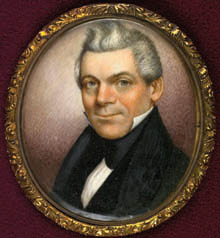
Mayor BeebeOn December 22, 1795, future Little Rock Mayor Roswell Beebe was born in Hinsdale, New York.  His family were wealthy English immigrants.  At seventeen, Beebe went to New Orleans and fought with Andrew Jackson in the 1815 Battle of New Orleans.  He stayed in the Crescent City for the next two decades building successful lumber and brick businesses.

Due to health concerns, he moved north to a drier climate in 1834.  After first stopping in Fulton, Arkansas, he settled in Little Rock in 1835 at the age of forty.  He stayed at the home of Chester Ashley and married Ashley’s sister-in-law, Clarissa Elliott.  He and Clarissa had two children, Roswell and Cora.

For nearly 30 years, Little Rock had a complicated history of deeds, titles and land ownership.  In 1839, Beebe went to Washington DC and received the original patent from President Martin Van Buren.  He then set about clearing up the land and title issues, as well as drawing up a plan for the city and laying off blocks and streets.  Beebe deeded the streets and alleys to the City for a dollar.  He also donated the land on Markham Street for a new State Capitol building (now home of the Old State House Museum).  Along with his brother-in-law Chester Ashley, he donated the land for the establishment of Mount Holly Cemetery.

In 1848, Beebe was elected to the Little Rock City Council.  The following year, he was elected Mayor.  He served as Mayor of Little Rock from April 1849 to February 1850.

While his primary business focus in the 1840s had been real estate, in the 1850s he focused on railroads.  Beebe was named president of the Cairo and Fulton Railroad Company in 1853.

While on a visit to New York, Beebe died on September 27, 1856.  His body was returned to Little Rock, and Roswell Beebe was buried at Mount Holly Cemetery.  The town of Beebe, Arkansas, is named in his honor.

15 Highlights of 2015 – 86% of voters approve new CALS projects

Cals ELection

For the final fifteen days of 2015, a look back at some of the cultural highlights of 2015.

Up next –

In July 86.10% of those voting approved the Central Arkansas Library System bond refinancing.

The refinancing will allow CALS to:

  • Expand the Thompson, Fletcher, and Dee Brown libraries and reconfigure their children’s areas
  • Limited remodel in the Main Library and refurbish the Williams Library
  • Expand and upgrade the digital/Internet network
  • Purchase thousands of books, eBooks, DVDs, & CDs

Because of the restructuring of the debt, it will actually lower taxes by about $2 per year on a $100,000 home and extend the bond payments by approximately five years.

The final numbers were 3,834 FOR, 619 AGAINST.  Two ballots were cast which were overvotes (voters filled in both bubbles) and five ballots were cast which were undervotes (they were blank). 4400 votes in a special election in July is a fairly decent turnout. It was 3.51% turnout.  When one considers how anemic voter turnout is for presidential elections, this should be viewed as fairly strong.

Looking at the precinct reports, it shows a deep level of support from all areas of the city.  It passed overwhelmingly in every precinct.  The most votes garnered against it in a precinct were 291 at one of the two Pulaski Heights Presbyterian precincts in Hillcrest.  But as that precinct had over 3,000 voters, it was still only 9% of the voters at that ballot box.

The Central Arkansas Library System is in the process of hiring a replacement for retiring director Dr. Bobby Robert

6th Annual “Holiday Music at the Arsenal” today at the MacArthur Museum of Arkansas Military History

macmusThis afternoon from 2pm to 4pm, visitors to the MacArthur Museum of Arkansas Military History can enjoy a seasonal concert given by pupils of the Margaret Wyatt Vocal and Piano Studios.

Wyatt enjoyed a career in both opera and musical theater, working throughout the United States and locally with the Arkansas Repertory Theater and Arkansas Symphony Orchestra.  She has taught piano and voice in Little Rock for over 25 years.  Included in the concert will be holiday favorites from around the world.  The concert is free and open to the public.

Located in the historic Arsenal Tower in MacArthur Park, the MacArthur Museum of Arkansas Military History honors the Arkansans who have served in the armed forces.  Exhibits feature artifacts, photographs, weapons, documents, uniforms and other military items that vividly portray Arkansas’s military history at home and abroad.

Other exhibits include:

  • Undaunted Courage, Proven Loyalty: Japanese American Soldiers in World War II
  • From Turbulence to Tranquility: The Little Rock Arsenal
  • Capital In Crisis and Celebration: Little Rock and the Civil War
  • Alger Cadet Gun
  • Camden Expedition
  • David Owen Dodd
  • Through the Camera’s Eye: The Allison Collection of World War II Photographs
  • By the President in the Name of Congress: Arkansas’ Medal of Honor Recipients
  • Conflict and Crisis: The MacArthur- Truman Controversy
  • Duty, Honor and Country: General Douglas MacArthur
  • The Sun Never Sets on the Mighty Jeep: The Jeep During World War II
  • War and Remembrance: The 1911 United Confederate Veterans Reunion
  • First Call – American Posters of World War I