Little Rock Look Back: Charles Taylor, LR’s 42nd Mayor

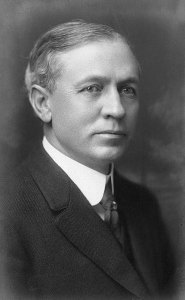
Mayor TaylorOn September 15, 1868, future Little Rock Mayor Charles E. Taylor was born in Austin, Mississippi.  After locating to eastern Arkansas, his family moved to Little Rock around 1880.

Taylor graduated from Scott Street High School in Little Rock and proceeded to work for various hardware stores and other businesses.  In 1895 he married Belle Blackwood, with whom he would have four children.

In 1910, Taylor announced his intention to run for Mayor of Little Rock.  Though he had never held elective office, he had been involved in several civic organizations.  Taylor was the main challenger to Alderman John Tuohey.  Seen as a reformer, Taylor initially lost to Tuohey.  But after an investigation of voter fraud and a subsequent runoff, Taylor was elected Mayor.

Upon taking office in August 1911, Mayor Taylor focused on improving health conditions in the city, upgrading the fire department and enhancing the overall moral tone of the city.

As a progressive of the era, he fought against gambling, drinking and prostitution.  He created a Health Department and enhanced the City Hospital.  His efforts led to a decrease in the death rate in Little Rock.  As Mayor, Taylor introduced motorized vehicles to the Fire Department.  He also led the City Council to establish building and electrical codes.  Mayor Taylor also oversaw the construction of the 1913 Beaux Arts Central Fire Stations (which today serves as the City Hall West Wing).

Under his leadership, the City of Little Rock annexed Pulaski Heights. One of the selling points to Pulaski Heights residents was Mayor Taylor’s ability to provide modern services such as paved streets, water mains, fire hydrants and street lights.

Though neither his 1911 Parks Master Plan nor his dreams for a civic auditorium came to fruition, they paved the way for future successes in both of those areas.

Funding for projects continued to be a problem throughout Mayor Taylor’s four terms in office.  He believed that one obstacle to city funding was the prohibition by the state constitution against cities issuing bonds.  Though that ban has since been lifted, Taylor tried three times unsuccessfully to get it changed while he was Mayor.

In April 1919, Taylor left office after having served eight years.  He was the longest serving Mayor of Little Rock until Jim Dailey served in the 1990s and 2000s.  Following several business ventures, Taylor moved to Pine Bluff and led their chamber of commerce from 1923 through 1930.

Mayor Charles E. Taylor died in Pine Bluff in 1932. He was buried at Oakland Cemetery in Little Rock.

During his time in office, Mayor Taylor was presented with an unofficial flag of Little Rock by a group of citizens.  During Mayor Dailey’s tenure, that flag was restored by some private citizens and presented to the City.  It is framed on the 2nd Floor of Little Rock City Hall.

Today is last day to purchase tickets for First Ladies event at Old State House

Help save the dresses by participating in the Luncheon on Tuesday, October 6!

The First Ladies’ Gowns exhibit at the Old State House Museum is the largest exhibit of its kind outside the Smithsonian and by far the most popular at the museum. The exhibit features gowns worn by the first ladies alongside items of everyday life in Arkansas from the 1840s to the present.

While the gowns have always been preserved according to the highest professional standards, some deterioration with age is inevitable. The current version of the First Ladies’ Gowns exhibit is housed on the second floor of the museum, in the west wing, in cases specially designed to minimize the deterioration caused by light, dust and humidity.

During a routine survey of artifacts in 2014, the museum’s curator noticed signs of stress on certain gowns. Upon closer inspection it was decided that a textile conservator should evaluate the collection. The museum staff worked closely with conservator Harold Mailand to create a prioritized list of conservation needs for gowns in the exhibit.

“One challenge is to secure funding both to conserve the gowns and to update the exhibit area so that a substantial part of the collection can be kept on view while preserving the gowns for generations of future Arkansans,” said Bill Gatewood, director of the Old State House Museum, a museum of the Department of Arkansas Heritage.

First lady Susan Hutchinson, along with the Old State House Museum Associates board of directors, a nonprofit group established to support the Museum, will host a lunch on the grounds of the Governor’s Mansion on Tuesday, October 6, to raise funds to preserve the gowns.

A seated lunch on the lawn will be followed by a special presentation in the Great Hall. Five of Arkansas’s former first ladies (Ginger Beebe, Janet Huckabee, Betty Tucker, Gay White and Barbara Pryor) have committed to be present for the event and will attend a special reception for table sponsors before the luncheon.


Creative Corridor Celebrated This Afternoon

A grand opening to highlight the new features and completed sections of the Creative Corridor’s Low Impact Development (LID) streetscape will be held 3 p.m. Monday, Sept. 14, as the revitalization of Little Rock’s Main Street continues to take shape, block by block.
Little Rock Mayor Mark Stodola will join Ron Curry, Region 6 administrator for the U.S. Environmental Protection Agency, and Randy Young, executive director of the Arkansas Natural Resources Commission, for the kickoff event, which will begin with a project update at the Arkansas Repertory Theatre (601 Main Street). Professor Stephen Luoni of the University of Arkansas School of Architecture and director of the UA Community Design Center will give an informative presentation on the theories of Low Impact Development and creative place-making that underpin the project.

The most recently completed improvements in the 500 block of Main Street will be open to the public for strolling along the tree-lined boardwalk on the west side.  All of the pedestrian and environmentally friendly streetscapes in the 100, 200, 300 and 500 blocks of Main Street contain LID features such as bioswales, porous pavers, rain gardens, and other biodiverse vegetation.

The grand opening will also celebrate the elements of creative place-making that have occurred. Recent public art installations and the clustering of artistic and creative organizations on Main Street are transforming the Creative Corridor into a downtown hub that supports a great level of pedestrian activity, sociability, recreation and aesthetics.

An arts open house and reception will follow the tour, with the Arkansas Repertory Theatre, Arkansas Symphony Orchestra, Ballet Arkansas, Matt McLeod Fine Art, and Cranford Co. opening the doors to their new, connected spaces.

“The progress on Main Street is a harbinger of the exciting development yet to come for this area,” says Stodola. “The Creative Corridor, once just a vision, has become a vibrant reality that has earned national accolades, brought together many of our City’s cultural institutions, and created these beautiful spaces that will continue to grow.”

The Creative Corridor is a mixed-use development project aimed at restoring the vitality of Main Street by creating an arts district and retrofitting a four-block segment of the street between President Clinton Avenue and 7th streets. The City of Little Rock estimates that more than $100 million in private and public investment has occurred to date to help make this vision a reality.


Little Rock Look Back: Mayor Sharon Priest

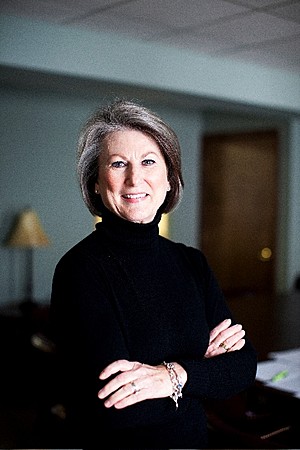
13632023960On September 12, 1947, future Little Rock Mayor Sharon Priest was born in Montreal, Canada. After marrying Bill Priest, she came to Little Rock. She began her public service at the grassroots level when she led the effort to bring flood relief to Southwest Little Rock and Pulaski County following the devastating flood of 1978 that killed 13 people in central Arkansas.

She was appointed to the Little Rock City Beautiful Commission.  Following that, she challenged an incumbent City Director and won her first elective office in 1986. In January 1989, she was named Vice Mayor of Little Rock by her colleagues on the City Board.  Two years later, she was selected Mayor becoming only the second female to serve as Mayor of Little Rock.  During her service to the City of Little Rock, she spearheaded the effort to create a Little Rock flag.  At the conclusion of her second four year term on the City Board, she decided to run for Secretary of State.

In November 1994, she elected Secretary of State, becoming the first woman to be elected to that position in Arkansas.  She was reelected in 1998.   In the summer of 2000, she became President of the National Association of Secretaries of State. After the 2000 presidential election, she was thrust into the forefront of the movement toward election reform. Ms. Priest testified before U.S. House and Senate Committees on election reform. As Secretary of State, restoring the Governor’s Reception Room and the Old Supreme Court Chamber of the State Capitol to their original splendor and restoring the rotunda marble are a few of her proudest achievements.

In January 2003, Priest was selected to serve as Executive Director of the Downtown Little Rock Partnership. She served in that capacity until early 2015.  She has also been a leading champion for the redevelopment of MacArthur Park, the City’s oldest park.

Prior to her work as an elected official, she worked as Director of Membership for Little Rock Chamber of Commerce and was founder and owner of the Delvin Company, a property management firm.

She was a Toll Fellow in 1995, and has won numerous distinctions including the Excellence in Leadership Fellowship, Women Executives in State Government, 1997 and TIME/NASBE Award for Outstanding Leadership in Voter Education, 1996.  In 2013, she was the featured honoree at the Big Brothers/Big Sisters Roast and Toast, becoming the first (and to date only) female to be so honored.


Little Rock Look Back: Alderman Angelo Marre

angelomarre

On September 11, 1842, future Little Rock Alderman Angelo Marre was born in Borzonaca, Italy.  He immigrated to Tennessee with his parents in 1854.

During the Civil War, he served in the Confederate Army. From 1865 to 1868, Angelo Marre worked for the Memphis Police Department but was forced to resign after he was accused of killing a man during an argument.  After his acquittal, he returned to the saloon business.  In 1872 Marre was convicted of stealing money and sentenced to three years in prison.

Tennessee Governor John Brown granted Marre a full pardon two years into his sentence, and he regained his citizenship in 1879.

After getting out of prison, he claimed an inheritance and joined his brothers in Little Rock.  He worked as a bartender at the Metropolitan Hotel.  He later opened a saloon and billiard parlor.

By the mid-1880s, Marre owned two saloons, a liquor import business, an office building in downtown LR, 3,000 sharesof stock in mining companies operating in Garland and Montgomery counties, and he was the first president of Edison Electric Company of LR.

In 1883, he was elected as an alderman on the Little Rock City Council.  He lost is bid for reelection in 1885. In 1888, he was an unsuccessful candidate for Pulaski County Sheriff.

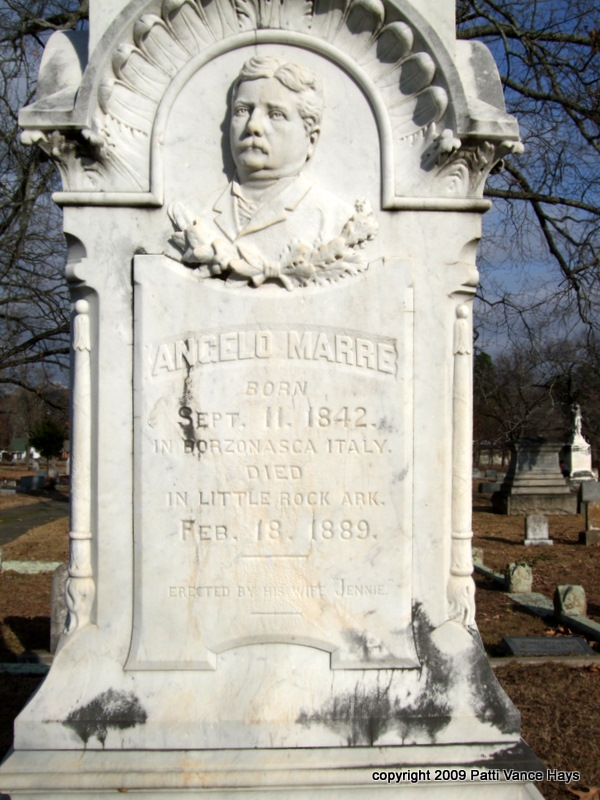
villamarreAngelo Marre died February 18, 1889, as a result of his infection.  He is buried at Calvary Cemetery in LR. His custom designed, marble monument was ordered from Florence, Italy, and cost $5,000.

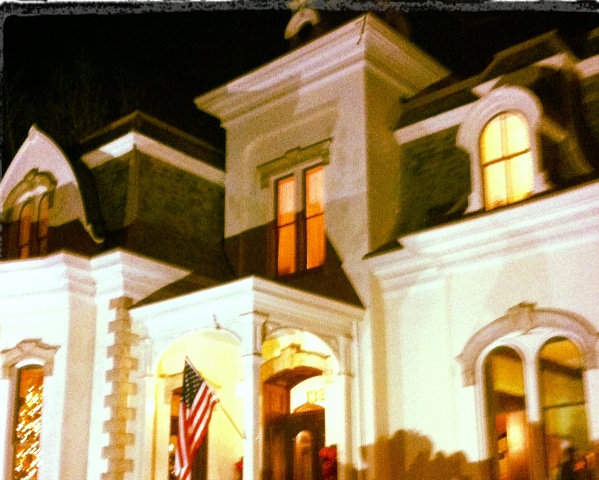
Marre is probably best known today as the builder of the structure now known as the Villa Marre.  Built in 1881, it is designed in the Italianate and Second Empire styles.  It was built in 1881 and 1882 on Block 21, Lots 5 & 6 of the Original City of Little Rock.  The cost was $5,000.

It was originally a red brick structure and has been modified and expanded several times as well as painted white.  It did not bear the name Villa Marre until the 1960s when historic preservation advocate Jimmy Strawn gave it that name.

After serving as the headquarters for the Quapaw Quarter Association for several years, it was returned to a private residence.  It is now available for special events and rentals.

The Villa Marre is probably best known locally and nationally for serving as the facade for the Sugarbaker design firm on the CBS sitcom “Designing Women.”  Though the interior of the house does not match the interior on TV, the building was featured in the opening credits as well as in exterior shots each week.

2nd Friday Art Night at Historic Art Museum has Joe Barry Carroll exhibit

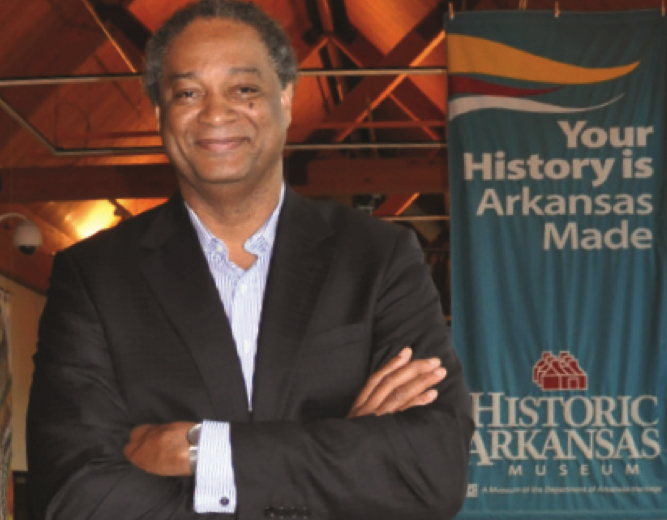
HAM 0915Historic Arkansas Museum has a special 2nd Friday Art Night with the free opening reception of Joe Barry Carroll: Growing Up..In Words and Images. It includes a gallery talk at 6 pm followed by a book signing. Enjoy live music by The Gentlemen Jazz and #ArkansasMade brews as our Year of Arkansas Beer continues with Vino’s Brewpub. The Year of Arkansas Beer is presented by the Arkansas Brewers Guild and sponsored by the Historic Arkansas Museum Foundation.  

Joe Barry Carroll: Growing Up…In Words and Images 

NBA All Star Joe Barry Carroll’s story begins in Pine Bluff, shooting baskets through a scavenged bicycle rim he nailed to the backyard shed. In Growing Up, Carroll’s colorful and evocative paintings from his memoir of the same name peer into facets of what he refers to as “shared humanity” – childhood, dreams, family ties, southern culture and self-discovery. “The best parts of my character and moral fiber flow from my family, my people and my early life experiences in Arkansas.”

Carroll led the Purdue University Boilermakers to the Final Four in 1980, graduated with a degree in Economics and was the No. 1 overall pick in the 1980 NBA Draft by the Golden State Warriors. He is now a wealth adviser, philanthropist, painter and writer. 


Little Rock Look Back: The City responds to September 11

The Little Rock arts and culture community responded to September 11 as all sectors did.

Two of the groups in particular come to mind. When airspace was closed on September 11, several flights were grounded in Little Rock. The passengers on those planes became unexpected visitors to Little Rock.   Little Rock Mayor Jim Dailey and Assistant City Manager Bruce Moore led efforts to make sure that everyone had a place to stay that evening.

The Arkansas Rep had opened its production of You Can’t Take It with You on Friday, September 7. The show was already scheduled to be dark on September 11, but on Wednesday, September 12, 2001, the performances resumed. That night the Rep offered these unexpected Little Rock guests free tickets to the performance.  Seeing a play which was both heartwarming, comic and full of Americana was the perfect balm for audiences who were weary, confused and nervous in the wake of the terrorist attacks. Most of the cast of that production was from New York City. Luckily, all of their friends and family back in New York were all safe.

Also on September 12, 2001, the Arkansas Symphony Orchestra presented a previously scheduled concert with Michael Bolton.  He had been traveling by bus so was able to get to Little Rock.  His concert was cathartic for the 2000 plus attendees at Robinson Center Music Hall. It offered not only a communal experience but also a welcome break from 24 hour coverage.  Three days later, on September 15, the ASO kicked off its MasterWorks series.  As has been tradition since the days of Francis McBeth as conductor, that first concert of the season began with the National Anthem.  The audience and musicians gathered and sang and played with unprecedented gusto that night.