Little Rock Look Back: Plans for a new City Hall finally move forward

City Hall circa 1908

City Hall circa 1908

After a judge ruled in August 1906 that the City of Little Rock could not build a new City Hall and Auditorium complex, it looked like Little Rock would be stuck with its existing inadequate building.

However on September 10 it became obvious that much work had been taking place behind the scenes after that ruling.  On that day, the Board of Public Affairs (a City body charged with overseeing municipal government construction projects and comprised of the mayor and two citizens approved by the City Council) voted to ask the aldermen to cancel plans and rescind legislation for the city hall, jail and auditorium complex.  The Board of Public Affairs then offered up a new plan for a city hall and jail building.  Because no auditorium was involved, these plans would not be in violation of the Chancery Court.

That same evening the City Council followed suit and revoked the plans for the original project.  The aldermen then voted to proceed with building a new city hall and jail without the auditorium.  There was only one dissenting vote; Alderman Jonathan Tuohey voted no.  He explained his negative vote was not a lack of support for the project, but he was not comfortable with the way it was rushed through.

Mayor Warren E. Lenon told the Gazette, “The Chancery Court has enjoined us from erecting an auditorium and the Board of Public Affairs has consequently rescinded all resolutions and orders pertaining to that structure.” He noted that there would “be no appeal from the injunction granted by Chancellor Hart, because there is nothing to appeal.”

The coverage of the actions of the City Council that night was in keeping with the manner in which the two daily newspapers had covered the lawsuit and the trial.  The Gazette headline cried “City Hall Ordinance Railroaded Through” while the staid Democrat merely stated “New $175,000 City Hall Provided by City Council.”  The tone of theGazette’s article matched the headline while the Democrat’s story was more straightforward.

Architect Charles Thompson adjusted his plan for the new City Hall by removing the auditorium wing.  With the revised Th0mpson plan and the approval of the City Council, Little Rock was at last on its way to a new City Hall.  This was over two years after Mayor Lenon had first broached the subject.

Originally slated to open in 1907, the building officially opened in April 1908.

Final Day to Explore Mindbender Mansion at the Museum of Discovery!

Mindbender_logo_CMYKAfter enthralling visitors for months, the Museum of Discovery today bids a fond farewell to Mindbender Mansion. But visitors still have until 5pm!

Mister E. and the Mindbender Society invite you to enter the wonderfully puzzling world of Mindbender Mansion, an eclectic place full of puzzles, brainteasers, and interactive challenges guaranteed to test the brain power and problem solving skills of even the most experienced puzzlers. Adults and children alike will enjoy exercising their minds as they try to master each of the 11 individual brain teasers and the three group activities in this fun and unconventional new exhibit.

Visitors to Mindbender Mansion will be greeted by the wacky Mr. E., master brainteaser and puzzler extraordinaire, and current curator of the Mindbender Society. He will explain the mysteries of Mindbender Mansion and how to become a member of the eccentric Mindbender Society by gathering hidden clues and secret passwords. The clues can only be found by solving key puzzles found in select themed areas.

Throughout the exhibit visitors will find a combination of tabletop brainteasers they can solve on their own and larger group challenges that require assistance from their fellow mansion guests.

The group challenges include:

  • Feeding Frenzy-Kitchen mayhem is guaranteed in a race to beat the clock by filling T.V. dinner trays (with five kinds of food) on a fast moving conveyer belt.
  • Spelling Fever-Hopscotch meets Scrabble® in this race to spell correct words within a limited amount of time by hopping on letter squares that light up.
  • Amazing Maze-In this version of the classic steel ball labyrinth game visitors must work together to tilt a table in different directions, guiding a ball into six holes as quickly as possible.

Upon completing each of the select brainteasers and group challenges, visitors will have gathered the necessary clues and secret passwords to become a member of the Mindbender Society and add their portrait to the “Wall of Fame.”

Dollar Day at Museum of Discovery today from 1pm to 5pm

modToday from 1pm to 5pm, admission to the Museum of Discovery is only $1 because it is Dollar Day.

It is a great time to visit Mindbender Mansion before it closes on Monday!

Mister E. and the Mindbender Society invite you to enter the wonderfully puzzling world of Mindbender Mansion, an eclectic place full of puzzles, brainteasers, and interactive challenges guaranteed to test the brain power and problem solving skills of even the most experienced puzzlers. Adults and children alike will enjoy exercising their minds as they try to master each of the 11 individual brain teasers and the three group activities in this fun and unconventional new exhibit.

Throughout the exhibit visitors will find a combination of tabletop brainteasers they can solve on their own and larger group challenges that require assistance from their fellow mansion guests.

Upon completing each of the select brainteasers and group challenges, visitors will have gathered the necessary clues and secret passwords to become a member of the Mindbender Society and add their portrait to the “Wall of Fame.”

Runaway Planet at Ron Robinson Theater tonight at 7 with Arkansas Sounds

arksounds runaway_planetTonight at 7pm, the Arkansas Sounds Music Series features Runaway Planet.

Traditional string band Runaway Planet performs hard-driving bluegrass, three-part harmonies, complex arrangements, and original songs. Runaway Planet is an Arkansas four-piece bluegrass group that has performed nearly 15 years. The band’s original music features traditional bluegrass instrumentation with modern lyrics, three-part harmonies, and highly skilled playing showing their rock, folk, and jazz influences.

The concert will take place at the CALS Ron Robinson Theater, 100 River Market Avenue.  General Admission: $10.  Refreshments will be available for purchase.

Founded in 2001, Little Rock bluegrass band Runaway Planet evolved out of a long-time friendship between members and a mutual love for traditional string-band music. Their music is a mix of hard-driving bluegrass, three-part harmonies, complex arrangements and original songs.  The musicians are Greg Alexander, guitar and vocals; Steve Brauer, banjo, guitar, vocals; Matthew Stone, mandolin, dobro; Michael Proveaux, bass, vocals.

Drawing from traditional influences like Bill Monroe, Flatt & Scruggs and the Stanley Brothers, they are also inspired by more progressive bluegrass bands like The Country Gentlemen, The Seldom Scene and New Grass Revival.

Arkansas Sounds is a project of the Butler Center for Arkansas Studies, a department of the Central Arkansas Library System. Focused on Arkansas music and musicians both past and present, Arkansas Sounds presents concerts, workshops, and other events to showcase Arkansas’s musical culture.

Sandwich in History at Shiloh Baptist Church today at noon

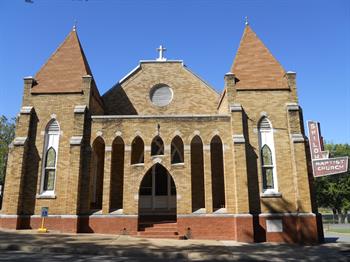
ahpp Shiloh Baptist ChurchThe monthly architectural history program “Sandwiching in History” visits Shiloh Baptist Church, located at 1200 Hanger Street. The program begins at noon today.  A historian with the Arkansas Historic Preservation Program delivers a brief lecture about the church before leading guests on a tour.

The historically black congregation of Shiloh Baptist Church was organized in 1886 by Rev. O. H. Redicks and occupied an earlier building at the southwest corner of Hanger and E. Twelfth streets in Little Rock’s Hanger Hill neighborhood. The current buff brick church features elements of the Gothic Revival style.

Sandwiching in History is a program of the Arkansas Historic Preservation Program, an agency of the Department of Arkansas Heritage.  The AHPP is responsible for identifying, evaluating, registering and preserving the state’s cultural resources. Other DAH agencies are the Arkansas Arts Council, the Delta Cultural Center in Helena, the Old State House Museum, the Mosaic Templars Cultural Center, the Arkansas Natural Heritage Commission and the Historic Arkansas Museum.

Little Rock Look Back: Ike in Little Rock

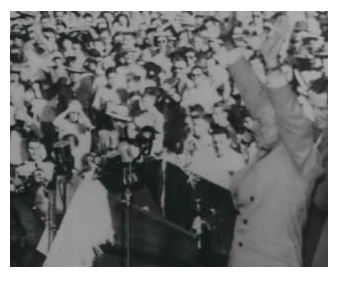
Detail from UPI photo of General Eisenhower following his address.

Detail from UPI photo of General Eisenhower following his address.

If Ike, Little Rock and September are considered, it is usually in reference to his role in the desegregation of Little Rock Central High in September 1957.  But five years earlier, he appeared in Little Rock on September 3, 1952.

General Eisenhower’s speech to 14,000 in MacArthur Park was the final leg in his swing through the South on his campaign for the White House.  He became the third presidential candidate to visit MacArthur Park in 1952 following General MacArthur (in his ill-fated attempt to gain traction as a GOP candidate during the delegate selection process) and Democratic nominee Adlai Stevenson.

He visited every southern state except Mississippi on this campaign jaunt.  In comments that neither he nor his audience could have foreseen as prescient, Eisenhower declared that he deplored the government meddling in areas in which it did not belong.  This remark was made in reference to race relations.  His stance was that some rights of minorities should be protected, but it was not necessarily the role of the federal government.

Ike proffered that if white southerners did not protect the rights of African Americans they were in danger of losing their own rights, too.  In the era of the Cold War when people were worried about the imminent loss of rights, this message seems to have crafted to appeal to those concerns.  While Eisenhower did not shy away from addressing civil rights, his Democratic opponent Adlai Stevenson was silent on the issue.  But with Alabama segregationist Senator John Sparkman as his running mate, it put Stevenson in a difficult position to try to bring it up.

In the end, Ike lost most of the South.  He did carry Maryland, Virginia, Tennessee and Florida. The only states Stevenson won were in the South.  Eisenhower’s 43.74% of the Arkansas popular vote was the highest any Republican had garnered since General Grant carried the state in 1868 and 1872.


Arts & culture advocate, Dr. Joel Anderson to retire as UALR Chancellor

jeasmile-444x668University of Arkansas at Little Rock Chancellor Joel E. Anderson announced today that he will retire following a 13-year tenure as chancellor and a 45-year career at the university. His retirement will be effective June 30, 2016.

Anderson became UALR chancellor in 2003, bringing with him more than 30 years of university and community service. He had previously served UALR as provost and vice chancellor for Academic Affairs and as founding dean of the Graduate School.

Chancellor Anderson’s announcement comes on the heels of a 1.2 percent increase in enrollment at UALR, including a 19 percent increase in first-time college students and a 7.1 percent increase in first-time transfer students.

“It has been a tremendous pleasure to see UALR grow and mature into the excellent, comprehensive university that it has become,” said Chancellor Anderson. “The faculty and staff of UALR deserve more credit than they will ever receive for their tireless efforts to help students achieve the dream of a college education that will enable students to adjust to a changing future and support themselves and their families.”

University of Arkansas System President, Donald R. Bobbitt will form a search committee in the coming weeks with the goal to complete the search by July 1, 2016.

One of the achievements he was most passionate about was the founding in 2011 of the Institute on Race and Ethnicity, a center designed to move Arkansas forward on the broad front of racial and ethnic justice through education, research, dialogue, community events, and reconciliation initiatives.

As professor, dean, provost, and chancellor, Anderson always related success of the university to success of the students UALR served. As chancellor, he launched numerous initiatives to recruit and retain more students and to reach out to underserved student populations. His signature is on more than 26,836 diplomas and the university’s fall-to-fall retention rate is the highest it has ever been.

“Joel is a true gentleman who cares about the university more than himself”, said Dr. Dean Kumpuris, chair of the UALR Board Visitors.  “He has no ego and has sought our advice and support more than he probably had to,” “His primary goal has been to shepherd the university to a better place, which he has done. We are lucky to have had him as a leader for so many years.”

Anderson, who grew up on a farm east of Swifton in northeast Arkansas, received a BA degree in political science from Harding University, an MA degree in international relations from American University, and a Ph.D. in political science from the University of Michigan. He also completed the Institute for Educational Management at Harvard University.

“The university has good momentum. I need time to catch up on a backlog of books and also to see my grandchildren more often,” Anderson said.  “All the while I will watch with pride as UALR grows and changes.”

Highlights of his service as chancellor include:

  • The Windgate Charitable Foundation awarded UALR a grant of $20.3 million for a new Visual Arts and Applied Design center.
  • Since 2003, UALR has purchased the University Plaza shopping center which is now home of KUAR-KLRE Public Radio as well as the current home of the applied design center.

  • As part of the Coleman Creek Greenway project, the Trail of Tears Park was completed in 2011 to recognize the historical significance of the location on the south end of campus where the Choctaw and Chickasaw tribes stopped for water along Coleman Creek.

  • Establishment of a Dance major, the only one in the state, within the Department of Theatre Arts and Dance.
  • Much of the campus’s infrastructure has undergone substantial renovations including the Stella Boyle Smith Concert Hall. Likewise, there has been an added emphasis on the promotion and maintenance of public art on campus.

  • Chancellor Anderson served as a “Scholar in Residence” in 2010 at the Center on Community Philanthropy at the Clinton School for his work on issues of race and ethnicity.

  • Dr. Anderson launched the Institute on Race and Ethnicity in 2011 to move Arkansas forward on the broad front of racial and ethnic justice through education, research, dialogue, community events, and reconciliation initiatives.  One of their projects has been the annual Civil Rights Heritage Trail installation.

  • In 2015, as part of its 40th anniversary celebration, the Winthrop Rockefeller Foundation honored Chancellor Anderson as one of 40 Community Leaders in the categories of community, education, nonprofits, and prosperity.