
RIP Gertrude Hadley Jeannette

bhm gertrudeA reader pointed out that the April 26, 2018, New York Times had an obituary for Gertrude Hadley Jeannette.  This native Arkansan (and inductee into the Arkansas Black Hall of Fame) died at the age of 103.  Throughout her life she was a trailblazer in the arts but also was a trailblazer in other fields because of her race and her gender.

Here below is from a 2015 feature of her on this blog.

Playwright, producer, director, and actress of the stage and screen, Gertrude Hadley Jeannette, was born in Urbana, on November 28, 1914, to Willis Lawrence Hadley and Salley Gertrude Crawford Hadley. She attended Dunbar High School in Little Rock. Just before her high school graduation, Jeannette decided that she wanted to get married instead of attending Fisk University, as she had previously planned.  She and Joe Jeannette II, a prizefighter and the president of the Harlem Dusters, a motorcycle club, eloped to New York City in 1934.

In New York City, Jeannette learned to drive; in 1935 she became the first woman to get a license to drive a motorcycle. In 1942, because of the shortage of male taxicab drivers caused by the war, Jeannette became the first woman to drive a cab in New York City. During this time, Jeannette decided to further her education; she took bookkeeping classes in the basement of Abyssinian Baptist Church, and speech classes at the American Negro Theatre in order to remedy her speech impediments.

In 1950, she appeared on television in James Weldon Johnson’s Gods Trombone on CBS’s General Electric Hour; she had replaced Pearl Bailey, who was originally cast in that role. As a result, Jeannette continued to work both in the theatre and in film and television. Some of Jeannette’s film credits included ShaftBlack Girl, and Cotton Comes To Harlem.  Her Broadway credits include Lost in the Stars, The Long Dream, Nobody Loves an Albatross, The Amen Corner, Vieux Carre and a revival of The Skin of Our Teeth.  Off Broadway she starred in To Be Young, Gifted and Black.

In 1979, Jeannette founded the H.A.D.L.E.Y. Players (Harlem Artists Development League Especially for You) in the Harlem neighborhood of New York City. The mission of the H.A.D.L.E.Y. Players was to give artists a chance to develop their talents and skills in the theatre, and to enrich the cultural life in Harlem. Jeannette went on to direct, produce, and write her own plays, as well as the works of other playwrights.

Jeannette was presented with several awards for her work and accomplishments. In 1991, Jeannette was honored as a living legend at the National Black Theatre Festival in Winston-Salem, North Carolina, and in 1998, she was honored with the Lionel Hampton Legacy Award. Jeannette was inducted into the Arkansas Black Hall of Fame in 1999, and in 2002, she received the prestigious Paul Robeson Award from the Actor’s Equity Association. Jeanette, though retired, remained active and celebrated member of the New York theater scene well into her nineties.

For more on Gertrude Hadley Jeannette and other inductees into the Arkansas Black Hall of Fame, visit the permanent exhibit at the Mosaic Templars Cultural Center. That museum is an agency of the Department of Arkansas Heritage.

Little Rock Look Back: World Premiere of a movie in Little Rock

Dr Wassell adAll right Mr. DeMille, Little Rock was ready for its close up.

From April 24 to 26, 1944, Cecil B. DeMille was in Little Rock for the world premiere screening of The Story of Dr. Wassell.  This 1944 Paramount Pictures Technicolor release told the story of wartime hero Dr. Corydon Wassell.

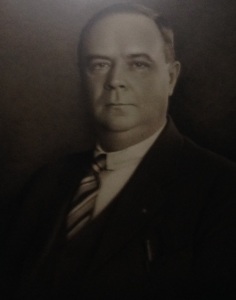
Why was Little Rock chosen?  It was the hometown of Dr. Wassell.  His paternal grandfather, John Wassell, was Little Rock’s 27th mayor.  His first cousin, Sam Wassell, was serving on the City Council at the time of the film’s release and would become Little Rock’s 51st mayor.

Based on a book by James Hilton, it was inspired by the heroic efforts of Dr. Wassell, a naval officer, as he led the evacuation of several sailors (and treated their wounds) in Java in February 1942.  President Roosevelt highlighted Dr. Wassell in his May 26, 1942, fireside chat.

Little Rock rolled out the red carpet (literally and figuratively) for DeMille and a contingency from Hollywood.  Dr. and Mrs. Wassell also returned to Little Rock for the festivities.  Unfortunately, Gary Cooper (who played Wassell in the film) was unable to attend due to illness.  His costar, Laraine Day, was making another film and could not attend either.    Those in attendance with DeMille (and Mrs. DeMille) included actresses Signe Hasso and Carol Thurston, and actor Melvin Francis.  The latter played himself; he had actually been one of the sailors saved by Dr. Wassell.

On April 24, 1944, DeMille and Dr. Wassell appeared on a radio program broadcast live from the music hall of Robinson Auditorium.  The next day, the troupe toured Camp Robinson and spoke to the soldiers there.  Later that day, Miss Hasso and Miss Thurston sold war bonds at Pfeiffers and M.M. Cohn’s.

April 26, 1944, was a full day for the DeMilles, the Wassells, and the others.  It started with a luncheon at the Hotel Marion, hosted by the Lions Club and Little Rock Chamber of Commerce.  Governor Homer Adkins presented DeMille with an Arkansas Traveler certificate.  DeMille, in return, presented Governor Adkins with a copy of the script.

When it was Dr. Wassell’s time to speak, he praised Little Rock’s efforts on the home front.  He also asked for a standing tribute to longtime Little Rock school superintendent R.C. Hall, who had died the day before.  Dr. Wassell had taught with Mr. Hall decades earlier.

Following the lunch, there was a parade on Main Street.  It started at 10th and Main and proceeded to Markham before ending at the War Memorial Building (now the Old State House Museum).  Newspaper accounts said that it was four miles long and featured many military units and marching bands.

Dinner that evening was at the Lafayette Hotel before screenings of the movie at the Capitol and Arkansas Theatres. Both screenings were sold out.  On April 27, 1944, a regular run of the movie started at the Capitol Theatre.  It would be released nationally on July 4, 1944, which also happened to be Dr. Wassell’s birthday.

Little Rock Look Back: Land Swap Lands Park for Little Rock

April 23, 1892, marked the beginning of the City of Little Rock’s public park sLR City Parkystem.  On that date, the City officially took possession of land which would become what is now known as MacArthur Park.
The park land had originally served as a horse racetrack in the early days of Little Rock.  By 1836, the federal government purchased the land for construction of a military arsenal.  The flagship building, the Arsenal Tower building, is the only remaining structure from that time period.

The land served as a military outpost until 1892.  On April 23, 1892, a land swap took place where in the City of Little Rock was given the property with the stipulation that it would be “forever exclusively devoted to the uses and purposes of a public park.” (Never mind that the federal government took part of the land back for the construction of the Wilbur Mills Freeway.)  In return for giving the City this land, the federal government took possession of land on the north side of the Arkansas River (then part of Little Rock) – that 1,000 acres became Fort Logan H. Roots.

After clearing most of the buildings from the land and preparing it for recreation, the park opened on July 4, 1893, with the name Arsenal Park. Since it was the City’s first and only park at the time, residents started referring to it as City Park. In time, the designation Arsenal Park fell from use.  In fact, it is referred to as City Park exclusively and officially in City documents throughout the first 42 years of the 20th Century.

The City Council’s action to name it MacArthur Park in March 1942, was accompanied by petitions encouraging the action which were submitted by the Arkansas Authors and Composers Society, the Arkansas Engineers Club and the Pulaski County Republican Central Committee.

City records do not indicate if anyone registered opposition to the name change. It would be another decade before General MacArthur would return to the site of his birth, a place he had not visited since his infancy.

Pulitzers Play Little Rock: IDIOT’S DELIGHT national tour

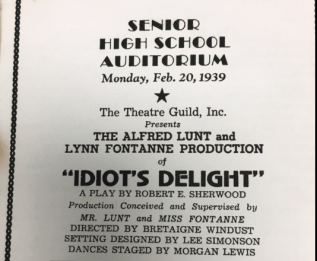
IdiotIn 1939, Alfred Lunt and Lynn Fontanne were undertaking two near-simultaneous national tours.  This brought them to Little Rock twice in less than a month.  The first, on February 20, 1939, was for Robert E. Sherwood’s Pulitzer Prize winning Idiot’s Delight.
Set in a European hotel on the eve of World War II, it concerns a group of disparate hotel guests who are trying to make sense of the future.  While the play was directed by Bretaigne Windust, the play carried the billing that the production was “conceived and supervised by Mr. Lunt and Miss Fontanne.”

The cast included many members of the original Broadway company including Richard Whorf, Sydney Greenstreet, Jacqueline Paige, George Meador and Barry Thomson.

The original production had run on Broadway in 1936. Their next Broadway show was Amphitryon ’38 in 1937 and 1938.  In 1939, they took these two shows on tour with their regular group of actors.  (They came back to Little Rock in March with Amphitryon ’38).

The Lunt’s next visit to to Little Rock after March 1939 would be to Robinson Memorial Auditorium in There Shall Be No Night.

2018 marks the 100th anniversary of the first Pulitzer Prize for Drama being given. To pay tribute to 100 years of the Pulitzer for Drama, each day this month a different Little Rock production of a Pulitzer Prize winning play will be highlighted.  Many of these titles have been produced numerous times.  This look will veer from high school to national tours in an attempt to give a glimpse into Little Rock’s breadth and depth of theatrical history.

Little Rock Look Back: 44th and 49th Mayor Charles Moyer

On April 18, 1880, future Little Rock Mayor Charles E. Moyer was born in Glenwood, Minnesota. A man of contradictions, he was both a candidate backed by (and probably personally involved in) the Ku Klux Klan, yet he also brought the Goodwill Industries organization to Little Rock and Arkansas to help those less fortunate.

He came to Little Rock shortly after the turn of the 20th century as a clerk in the Post Office, and later served as a mail carrier. He then worked for Plunkett-Jarrell Wholesale Grocer Company in Little Rock. On January 1, 1921, he took office as County Judge for Pulaski County. In 1924, he ran against incumbent mayor Ben Brickhouse in the Democratic primary. Since Brickhouse had displeased the Klan, which was an active part of Democratic politics in Little Rock and throughout the nation at the time, Moyer won the primary.

Mayor Moyer led the City of Little Rock from April 1925 through April 1929. In 1927, the last lynching in Little Rock took place. While race-baiting crowds were surrounding City Hall demanding an African American prisoner be released to them for vigilante justice, Mayor Moyer was in hiding at an undisclosed location. Not able to get the prisoner they wanted, they took out their venom on another man who had assaulted a white woman and her daughter.

After leaving office in 1929, Moyer moved for a time to Batesville. He returned to Little Rock and was a chief deputy sheriff. From 1937 to 1941, he served as Pulaski County Assessor. In 1941, he returned to the office of Little Rock Mayor after J. V. Satterfield opted to serve only one term and did not seek re-election. Mayor Moyer led Little Rock through most of World War II. He left office in April 1945 and died on May 29, 1945, barely one month after leaving City Hall.

Pulitzers Play Little Rock: Top Dog/Underdog at The Weekend Theater

TopDog-UnderDog-Poster-SmallWhile the Sondheim-Weidman musical Assassins is playing currently at The Weekend Theater, it is not the only title produced there with characters named Lincoln and Booth.
Suzan-Lori Parks’s Top Dog/Underdog is a two character play featuring brothers named Lincoln and Booth.  Winner of the 2002 Pulitzer Prize for Drama, this is a darkly comic fable of brotherly love and family identity.

The play tells the story of Lincoln and Booth, two African American brothers whose names were given to them as a joke, foretelling a lifetime of sibling rivalry and resentment.

In 2014, The Weekend Theater presented the play.  The brothers were played by Byron Thomas Jr. and Jermaine McClure.  The latter also directed the play.

2018 marks the 100th anniversary of the first Pulitzer Prize for Drama being given. To pay tribute to 100 years of the Pulitzer for Drama, each day this month a different Little Rock production of a Pulitzer Prize winning play will be highlighted.  Many of these titles have been produced numerous times.  This look will veer from high school to national tours in an attempt to give a glimpse into Little Rock’s breadth and depth of theatrical history.

Benjamin Harrison becomes first sitting president to visit Little Rock

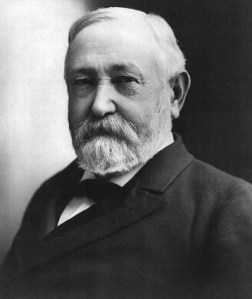
On April 17, 1891, Benjamin Harrison became the first sitting president to visit Arkansas.  He was on a cross-country railroad trip having left DC on April 13.

The morning of the 17th he spoke in Memphis and then took the train to Little Rock.  Accompanying him from Memphis to Little Rock were a delegation which included Governor and Mrs. James P. Eagle, Mayor H. L. Fletcher and Col. Logan H. Roots.  Also in the party was Mrs. W. G. Whipple, a former first lady of Little Rock.

They arrived in Little Rock in the afternoon.  A parade took them from the train station to the State House (now the Old State House Museum) where the Governor formally welcomed the President and his party.

In his brief remarks, President Harrison spoke of the hospitality and the natural resources available in Arkansas.  He also touched on the Civil War, which at the time was less than 30 years in the past. He noted “The commonwealth rests upon the free suffrage of its citizens and their devotion to the Constitution and the flag is the bulwark of its life.  We have agreed, I am sure, that we will do no more fighting among ourselves.” These remarks were met enthusiastically by the crowd assembled.

The President concluded is brief remarks thanking the State officials and the citizenry.  He then took the train to Texarkana where he made his third set of remarks of the day.

Benjamin Harrison was on the Presidential ticket two times. The first time he lost the popular vote but won the Electoral College defeating incumbent Grover Cleveland. The second time he lost both the popular and electoral votes to Cleveland.  He did not carry Arkansas in either election. Though he was the first sitting president to visit Little Rock, there is nothing here named for him.  Since there was already a Harrison Street named after his grandfather, he is skipped between Cleveland and McKinley in the presidential streets.