
Black History Month Spotlight – Mosaic Templars Cultural Center

The new Arkansas Civil Rights History Audio Tour was launched in November 2015. Produced by the City of Little Rock and the University of Arkansas at Little Rock allows the many places and stories of the City’s Civil Rights history to come to life an interactive tour.  This month, during Black History Month, the Culture Vulture looks at some of the stops on this tour which focus on African American history.

The Mosaic Templars Cultural Center and Museum collects, preserves, interprets and celebrates Arkansas’s unique African American political, economic, and social achievement from 1865 to 1950. The Center resides in the footprint of the original Mosaic Templars of America National Headquarters and Annex Buildings.

The permanent museum exhibits depict historic West Ninth Street as a thriving commercial and social hub, focusing on the black entrepreneurship, Templars organization, and the legacy of black legislators. Between 1868 and 1893, eighty-five African Americans served in the Arkansas General Assembly. The majority served in the House, with nine in the Senate. Election laws passed in 1891, together with a poll tax in 1832, ended the election of African Americans to the legislature. No black person served again until the General Assembly in 1973.

In addition to community educational programs, the Center offers a genealogy research room, an art collection created by local talent, and a well-stocked store. The Center’s third floor features a replica of the original Headquarters Building auditorium and the Arkansas Black Hall of Fame galleries.

The Center is a museum of the Department of Arkansas Heritage and admission is free.

The app, funded by a generous grant from the Arkansas Humanities Council, was a collaboration among UALR’s Institute on Race and Ethnicity, the City of Little Rock, the Mayor’s Tourism Commission, and KUAR, UALR’s public radio station, with assistance from the Little Rock Convention and Visitors Bureau.
Arkansas and the Southern Manifesto explored at Butler Center’s Legacies & Lunch today

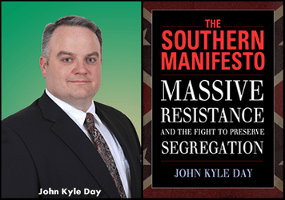
southern_manifestoAt Legacies & Lunch, John Kyle Day, associate professor of history at University of Arkansas at Monticello, will discuss the efforts of the United States Congress to delay desegregation in the 1950s and onward.  The program will take place today (February 3) at 12 noon at the Darragh Center on the CALS campus.

On March 13, 1956, ninety-nine members of the United States Congress promulgated the Declaration of Constitutional Principles, popularly known as the Southern Manifesto. This document formally stated opposition to the landmark United State Supreme Court decision Brown v. Board of Education, and the emergent civil rights movement. This allowed the white South to prevent Brown‘s immediate full-scale implementation and, for nearly two decades, set the slothful timetable and glacial pace of public school desegregation. The Southern Manifesto also provided the Southern Congressional Delegation with the means to stymie federal voting rights legislation, so that the dismantling of Jim Crow could be managed largely on white southern terms.

Day’s book, The Southern Manifesto: Massive Resistance and the Fight to Preserve Segregation, narrates this single worst episode of racial demagoguery in modern American political history and considers the statement’s impact upon both the struggle for black freedom and the larger racial dynamics of postwar America.

Legacies & Lunch is free, open to the public, and supported in part by the Arkansas Humanities Council. Programs are held from noon-1 p.m. on the first Wednesday of each month. Attendees are invited to bring a sack lunch; drinks and dessert are provided. For more information, contact 918-3033.

Little Rock Look Back: LR Mayor George Wimberly

https://www.meaningfulfunerals.net/fh_live/10300/10306/images/obituaries/1388392.jpgOn February 3, 1920, future Little Rock Mayor George Wimberly was born in Star City. He served his country first in the Civilian Conservation Corps and later aboard a U.S. Naval Department hospital ship in the Pacific during World War II.

Wimberly was first elected to the Little Rock City Board in November 1968.  He was re-elected in November 1972 and served until December 1976.  In January 1971, he was selected to serve as Little Rock Mayor through December 1972.  In a rare move, he was again selected to serve as Mayor from January 1975 through December 1976.  During the era of the City Board selecting one of their own members to serve as Mayor, George Wimberly was the only one selected to two non-sequential terms.

In 1978, he was elected to the State House of Representatives and served until December 1988.  While in the House he led the effort for smoking to be banned in the House chambers (a move that predated many public smoking bans of the 1990s and onward).

For over fifty years he was an employee and later owner of Buice Drugstore located on Markham in the Stifft Station neighborhood. In 1986 he received the Arkansas Pharmacist of the Year Award and the Lifetime Achievement Award in 2009.

Mayor Wimberly died on February 5, 2012, two days after his 92nd birthday.  He was survived by his wife, two sons, a grandson and several other relatives.

Little Rock Look Back: Little Rock Public Library opens in 1910

On February 2, 1910, the Little Rock Public Library officially opened its doors.  There had been an open house the night before, but this was the first day of acquiring a library card and checking out books.

Various private libraries had existed sporadically in Little Rock throughout the 19th Century.  In November 1900, a Little Rock School District committee made the first inquiry into the the creation of a Carnegie Library in Little Rock.  Over the next several years, numerous entreaties were made, but funding for the City’s portion was an obstacle.  On December 17, 1906, the Little Rock City Council passed an ordinance to move forward with building, furnishing and equipping a library.  Finally, in February 1908, the City approved acceptance of $88,100 from Andrew Carnegie.  The building would be designed by Edward Tilton, who designed Carnegie libraries, working with local architect Charles Thompson.

Mary Maud Pugsley was hired as the first librarian for Little Rock in May 1909. She began her duties on September 15, 1909, in order to get ready for the opening of the library at the southwest corner of 7th and Louisiana Streets.

On February 2, 1910, formal circulation of books began.  J. N. Heiskell was issued library card number 1.  He was secretary of the Library’s Board of Trustees and had long been an advocate for a public library in Little Rock.  He had often used his bully pulpit as editor of the Arkansas Gazette to advocate for a public library since arriving in Little Rock in 1902.  (Years later — he lived until 1972 — he received a replica of the library card made out of gold.)

That first day of operation, 500 people had applied for library cards. The application process required one to be a Little Rock property owner or to have a property owner sign the application.

Within the first year of operation, 2.5% of Little Rock’s population of 45,951 had applied for a library card.

For more on the history of the transformation of the Little Rock Public Library into the Central Arkansas Library System, read Shirley Schuette and Nathania Sawyer’s From Carnegie to Cyberspace — 100 Years at the Central Arkansas Library System, published by Butler Center Books.

Black History Month Spotlight – Mosaic Templars of America

The new Arkansas Civil Rights History Audio Tour was launched in November 2015. Produced by the City of Little Rock and the University of Arkansas at Little Rock allows the many places and stories of the City’s Civil Rights history to come to life an interactive tour.  This month, during Black History Month, the Culture Vulture looks at some of the stops on this tour which focus on African American history.
The Mosaic Templars of America was formed as a business in the late 1870s by Arkansas freedmen John E. Bush and Chester W. Keatts to provide insurance and other services to black people, and was incorporated as a fraternal organization in 1882. The Mosaic Templars name was derived from the biblical Moses who led his people out of bondage and relates to black America’s journey out of slavery.

By the 1920s the Templars’ organization extended to 26 states and six Caribbean nations. At the time, as one of the largest black-owned business enterprises in the world, Templars’ holdings included the original insurance company, a building and loan association, a publishing company, a business college, a nursing school and a hospital. For more than 40 years, the Templars Headquarters Building and the adjoining Annex and State Temple buildings on Broadway anchored the city’s black business district on West Ninth Street. Like many businesses, black and white, the Templars did not survive the era of the Great Depression.

Though the original Headquarters building burned in 2005, the Mosaic Templars Cultural Center is modeled on the original design. Exhibits highlight black business and self-achievement from Reconstruction to the 1950s in Arkansas and the nation.

The app, funded by a generous grant from the Arkansas Humanities Council, was a collaboration among UALR’s Institute on Race and Ethnicity, the City of Little Rock, the Mayor’s Tourism Commission, and KUAR, UALR’s public radio station, with assistance from the Little Rock Convention and Visitors Bureau.


Black History Month Spotlight – West Ninth Street

BHM16 W9thThe new Arkansas Civil Rights History Audio Tour was launched in November 2015. Produced by the City of Little Rock and the University of Arkansas at Little Rock allows the many places and stories of the City’s Civil Rights history to come to life an interactive tour.  This month, during Black History Month, the Culture Vulture looks at some of the stops on this tour which focus on African American history.

As early as the 1840s and reaching 1880, the businesses of both black and white races existed in what is now known as Downtown Little Rock. In the last years of the 1800s, a prolific business broker and social center for African Americans dominated West Ninth Street.

In 1898, D. B. Gaines, a local black doctor who also served as pastor of the Mt. Pleasant Baptist Church, wrote a book called Racial Possibilities as Indicated by the Negroes of Arkansas. The last chapter, “Colored Business Directory of Little Rock,” documents the existence of a vibrant commercial center with almost twenty churches and hundreds of dealers of black people.

The black district was home to doctors, dentists, lawyers and entrepreneurs such as restaurant owners, newspaper editors, pharmacists, barbers, tailors, and merchants.

This city within a city, met the needs of the black community since the early 1880 to the 1950s. West Ninth Street saw its peak between 1870 and 1950. Since the 1960s, a number of factors including desegregation, urbanization, urban renewal and the construction of I-630 caused its decline.

The app, funded by a generous grant from the Arkansas Humanities Council, was a collaboration among UALR’s Institute on Race and Ethnicity, the City of Little Rock, the Mayor’s Tourism Commission, and KUAR, UALR’s public radio station, with assistance from the Little Rock Convention and Visitors Bureau.

Little Rock Look Back: Movie Stars send LR fans in frenzy at Robinson Auditorium

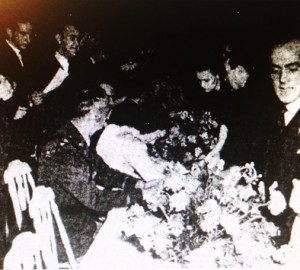
Autograph seekers crowd around the actors at the Movie Ball (photo from Arkansas Gazette)

Autograph seekers crowd around the actors at the Movie Ball (photo from Arkansas Gazette)

As final preparations were being made for the opening of the Joseph Taylor Robinson Municipal Auditorium in early 1940, a glamorous evening took place in Robinson’s lower level convention hall on February 1.

In conjunction with a meeting of film executives and movie theatre owners sponsored by Robb and Rowley Theaters (which later became the United Artists theatre chain), several Hollywood actors were in Little Rock and headlined a Movie Ball. While in Little Rock, Maureen O’Hara, Phyllis Brooks, Arleen Whelan, Tim Holt and Gene Autry had also made a variety of public appearances.

Mr. Autrey had to miss the ball because he had to return to Hollywood early to attend to business matters. Actress Ilona Massey had also been scheduled to attend the events but was unable due to illness.

The quartet who did appear at the Movie Ball caused quite a scene. Upon their entrance, so many of the attendees crowded around for autographs that the evening’s grand march could not take place (a newspaper headline in the Democrat innocently used the word “orgy” to describe the crowd). After two attempts, Little Rock Mayor J. V. Satterfield (who was escorting Miss O’Hara) and the other members of the Little Rock host delegation led the Hollywood foursome to their reserved table. For quite a while that evening, the table was besieged by autograph seekers.

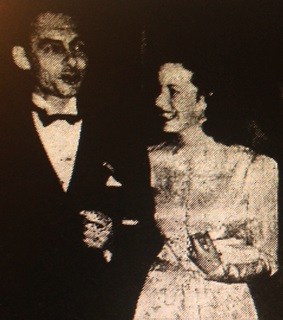
Mayor J V Satterfield escorting actress Maureen O'Hara at the Movie Ball (photo from Arkansas Democrat)

Mayor J V Satterfield escorting actress Maureen O’Hara at the Movie Ball (photo from Arkansas Democrat)

Though it is unknown as to whether he sought an autograph, photos from the evening showed a very satisfied Mayor Satterfield with Miss O’Hara on his arm. Satterfield family lore joked that Mrs. Satterfield (who had stayed home that night to tend to a sick son) was not a fan of Miss O’Hara’s films after that evening.

The Movie Ball showed Little Rock citizens the value of Robinson Auditorium even before it had been officially dedicated. The film industry meetings had taken place at the Albert Pike Hotel which did not feature a ballroom large enough to host the ball. Without the auditorium’s availability for the gala, organizers might not have chosen Little Rock for the meeting.

With the auditorium’s convention hall not attached to any hotel, it opened up the chance for Little Rock to host more events. This had been one of the key arguments for an auditorium since Mayor W. E. Lenon’s first proposal back in 1904. Having a glamorous event this early in the auditorium’s life validated that contention. After having endured the challenges to open the building, it was a nice lagniappe for the auditorium’s proponents who were present.

The actor Tim Holt would again be connected to Little Rock. In September 1951, he tried to obtain a divorce in Arkansas and stated that he had been a resident of the state for at least six weeks. He also had someone else testify to that fact. In October 1951, the divorce was granted. Later Mr. Holt was charged with perjury and fined $200 for falsely representing his length of residence in Arkansas. Judicial sanctions for his legal team, which included a State Senator, were eventually reviewed by the Arkansas Supreme Court.