Collegiate Sports during Great Depression focus of Clinton School address tonight

Democratic SportsDisparity in collegiate sports has been around since, well, the beginning of collegiate sports. Tonight at 6pm at the Clinton School, Brad Austin discusses “Democratic Sports: Men’s and Women’s College Athletics during the Great Depression.”


Austin is a professor of history at Salem State University, where he teaches undergraduate and graduate courses in modern American history, sports history, and history education, and has served as the chairperson of the American Historical Association’s Teaching Prize Committee.


In his new book “Democratic Sports: Men’s and Women’s College Athletics during the Great Depression,” Austin explores the funding cuts that America public universities suffered while they were also responsible for educating an increasing number of students. University leaders used their athletic programs to combat the crisis of mounting financial troubles, coupled with a perceived increase in the number of “radical” student activists, and to preserve “traditional” American values and institutions, prescribing different models for men and women.


In the book, Austin discusses the stark contrast of educators emphasizing the individualistic, competitive nature of men’s athletics in order to reinforce the existing American political and economic systems, while the prevailing model of women’s college athletics taught a communal form of democracy, denying women individual attention and high-level competition. “Democratic Sports” tells the important story of how men’s and women’s college athletic programs survived, and even thrived, during the most challenging decade of the twentieth century.

Still on the Hill in concert at Historic Arkansas Museum

HAMstillonthehillHistoric Arkansas Museum will host award-winning story-telling songwriters, Kelly Mulhollan and Donna Henschell Stjerna of Still on the Hill for a concert in the museum theater!  The concert is from 6pm to 7pm, doors open at 5:30pm.  It is free for museum members; $5 for non-members as space allows.

Kelly and Donna of Still on the Hill embellish their songs with a host of unique instruments—many of which were hand-made by old-timers and have amazing stories behind them.

Still on the Hill has been described as “Ambassadors of the Ozarks” for the work they do to preserve a rich culture that is quickly disappearing. They have produced several full-length albums, many of which will be available in the Museum Store. Their most recent album,Once A River (2014), is the culmination of a year spent researching stories about the people and places along the Beaver Lake watershed.

Historic Arkansas Museum is an agency of the Department of Arkansas Heritage.

Little Rock Look Back: LR Mayor Donald Mehlburger

Mayor D L MehlburgerOn October 19, 1937, future Little Rock Mayor Donald Lee Mehlburger was born in Little Rock.  His parents were Max A. Mehlburger and Mary Lou Covey Mehlburger who also had another son Max C. Mehlburger.

Mehlburger’s first run for the City Board of Directors was in November 1968 when there was an open seat.  At the time he was 30, the youngest one could be and be elected to the City Board.  He lost that race, but eight years later ran again.  This time Mehlburger won the race.  At his first meeting on the City Board, Mehlburger was selected as Mayor of Little Rock by his colleagues.

Prior to running for the City Board the second time, Mehlburger had been appointed to the Planning Commission.  Planning and growth were two important emphases for Mayor Mehlburger, in addition to public safety.  He stressed the importance of quality growth in the edges of the city and a push for a revitalized downtown.  Mayor Mehlburger was also an advocate for public mass transit.

Due to business interests taking up too much of his time, he resigned from the City Board a few months before his term was up.  But he remained engaged in civic affairs.  Historic preservation was important to Mehlburger.  In addition to owning historic properties, he was a founding board member of the Historic Preservation Alliance of Arkansas.  He had graduated from the University of Arkansas and was a member of Trinity Episcopal Cathedral.  He had also been active with the Junior Chamber of Commerce (Jaycees) and Rotary Club 99.

Mehlburger died on May 25, 1992 and was buried at Mount Holly Cemetery.  His grave marker features an engraved sextant which pays tribute to his career as an engineer.  It also notes that he was Mayor of Little Rock.  Mayor Mehlburger was survived by his wife Susan and his three children – Donald Lee Jr., Harry and Katherine.

Little Rock Look Back: Little Rock becomes the Capital of Arkansas

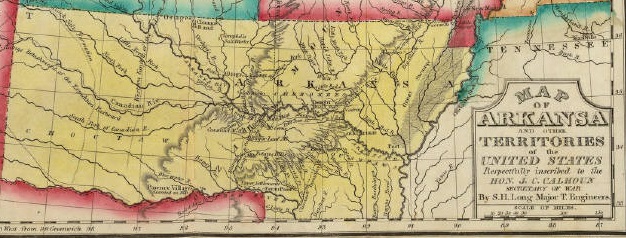
Arkansas TerritoryOn October 18, 1820, Territorial Governor James Miller signed legislation designating Little Rock as the new capital for Arkansas.  This was a mere 10 months after the first permanent settlement was established in Little Rock.

While Little Rock became the Capital, technically it was not the Capital City, since it would not be incorporated as a City until 1835. It wasn’t even incorporated as a town until 1831.

The Act provided that after June 1, 1821, the sessions of the Legislature and the Superior Court would be held at Little Rock.  This caused Arkansas Post, the first territorial capital, to fade from prominence.

The move was made based on the lobbying of Amos Wheeler, Chester Ashley and William Russell.  These men all owned land in the Little Rock area and would benefit from the move of the Capital to Little Rock. The official reason given was Little Rock’s geographical center to the Arkansas Territory and that it was elevated land less prone to flooding.

But as important, Messrs. Wheeler, Ashley and Russell promised to donate land for a capitol building and a guarantee of $20,000 for construction of a suitable building. (That would be the equivalent of $408,000 today.)

Around the time the legislation was approved, several members of the Territorial legislature purchased land around Little Rock.  When a subsequent effort to relocate the Capital upstream was launched, it failed due to the financial ties of these legislators to land in Little Rock.

Little Rock Look Back: LR City Flag Adopted

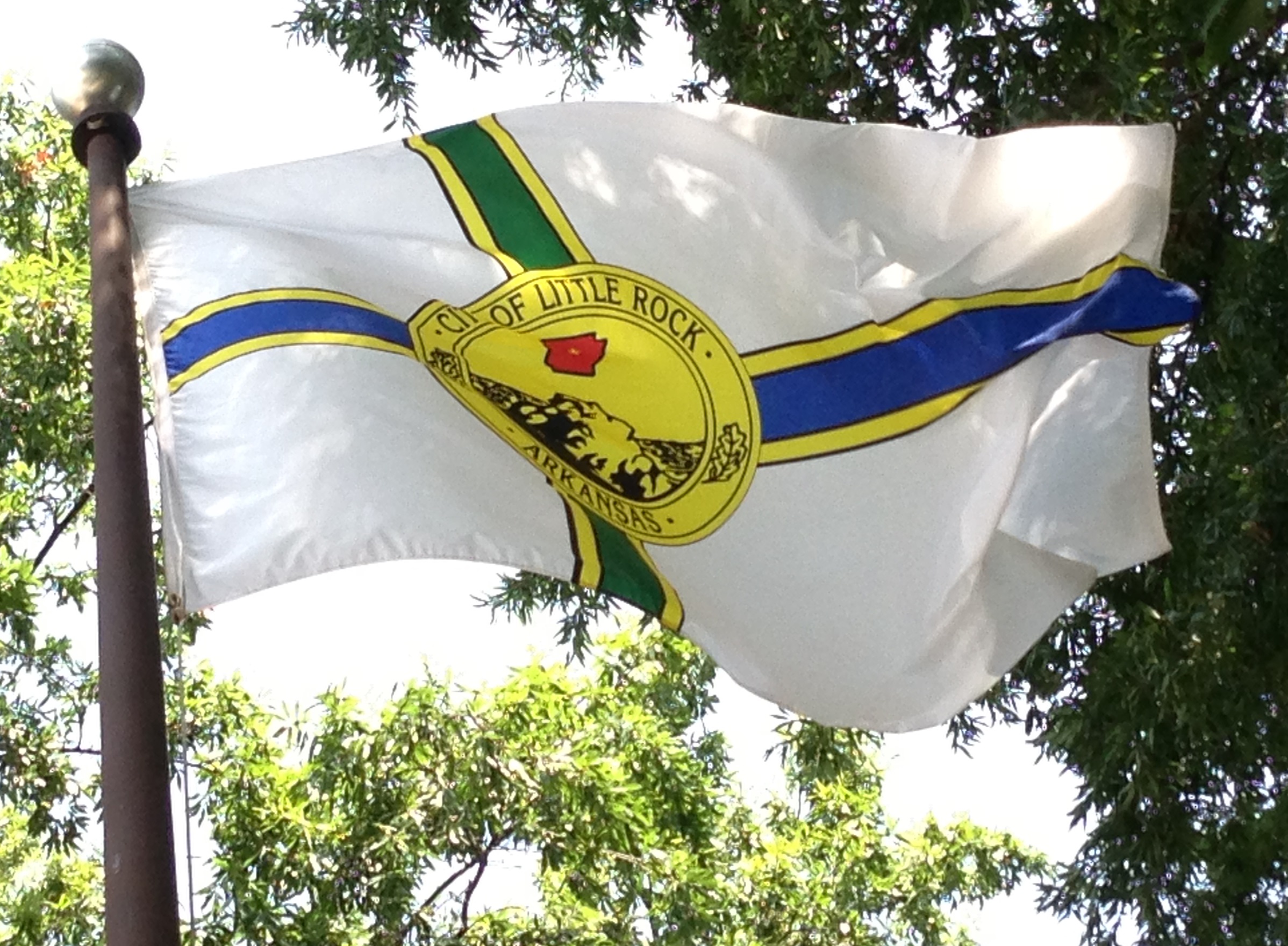
City FlagOn October 18, 1988, the City of Little Rock Board of Directors adopted the first official flag for the City of Little Rock.

The adoption of Ordinance No. 15,566 was the culmination of a design competition which had been spearheaded by Little Rock City Director Sharon Priest (later Little Rock Mayor, Arkansas Secretary of State and Executive Director of the Downtown Little Rock Partnership).

Prior to the Official Board of Directors meeting that day, a press conference was held in the Little Rock City Board Chambers for presentation of the City’s flag.  The City Beautiful Commission, a commission of the Department of  Parks and Recreation, sponsored a the contest which received a total of fifteen flag designs.

The flags were judged October 12, 1988, by City Directors and City Beautiful Commission Members. Director Sharon Priest presented the winning flag and introduced David Wilson, a law clerk at the Mitchell Law Firm, who designed the flag chosen for the $1,000 first prize. The second-place winner was Craig Rains, who received $500; and the third-place recipient was David Tullis, who received $250.

The flag was adopted by the City Board that night by a 6-0 vote; former mayor and current director Charles Bussey was absent.  Those voting to adopt the flag were Mayor Lottie Shackelford and directors Sharon Priest, Tom Prince, Buddy Villines, Buddy Benafield and Tom Milton.  Priest would be a future mayor while Prince, Villines and Benafield had all served as mayor.

The official description of the flag is as follows:

As the official flag of the City of Little Rock, its symbolism is described as follows: A clean white background of the banner represents the optimism and open potential that the city has to offer. The royal blue horizontal broad stripe symbolizes the Arkansas River which borders Little Rock, and has served as an economical and historical emblem since the city’s beginning. The forest green stripe runs vertical to the royal blue stripe, creating a cross which symbolizes the location and statute of Little Rock—a city serving not only as the crossroads of Arkansas, but a crossroad of the mid-southern United States as well.

The strong forest green color depicts the fields, parks and forests which contribute to the natural beauty of the city. The seal of the flag is a modernized adaptation of the current Little Rock seal. The razorback red silhouette of the great State of Arkansas shows her capitol, the City of Little Rock, represented by the centered star. The star rises directly above “The Little Rock”—the protruding cliff along the Arkansas River, which was discovered in 1722 by French explorer La Harpe, when the city was given the name. The Arkansas River behind the rock and the symmetrical oak leaves in the border of the seal are a stylized illustration of what the flag’s stripes represent—the natural beauty of the city. Finally, the gold color of the seal and bordering stripes symbolize the superior economic history, and the future economic potential that is available in the City of Little Rock, Arkansas.

Musical Legacy of Sister Rosetta Tharpe celebrated tonight by Arkansas Sounds, AETN at CALS Ron Robinson Theater

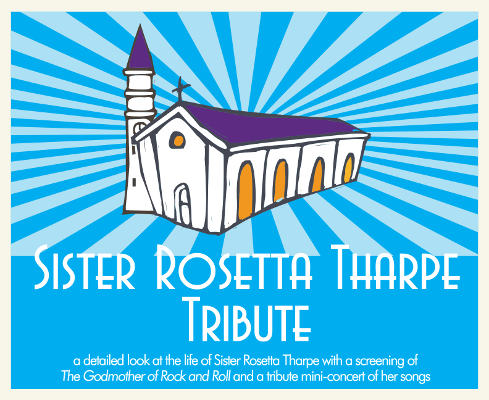
sister_rosettaTonight at 7pm at the CALS Ron Robinson Theater, Arkansas Sounds presents a detailed look at the life of Sister Rosetta Tharpe with a screening of The Godmother of Rock and Roll and a tribute mini-concert of her songs.

Arkansas native Rosetta Nubin Tharpe (Sister Rosetta Tharpe) was one of gospel music’s first superstars, the first gospel performer to record for a major record label (Decca), and one of the first artists to cross over from gospel to secular music. Tharpe has been cited as an influence by numerous musicians, including Bob Dylan, Little Richard, Elvis Presley, and Arkansan Johnny Cash.

In partnership with AETN, Arkansas Sounds will celebrate the 100th anniversary of her birth with a screening of the PBS American Masters documentary The Godmother of Rock and Roll, followed by a musical tribute performance of her songs.

Creative Class of 2015: Clea Hupp

C-HuppDr. Clea Hupp is the new Chair of the UALR History Department.  She joined the UALR History Department in 2006 and received her Ph.D. at the University of Arkansas, Fayetteville in 2004.

Hupp specializes in the history of the Modern Middle East and U.S. – Middle Eastern relations. She has received grants from numerous institutions including the John F. Kennedy Foundation, the Lyndon Johnson Foundation, the Society for Historians of American Foreign Relations, and the American Center of Oriental Research.

Her latest book was recently published from I. B. Tauris and is entitled “The United States and Jordan: Middle East Diplomacy during the Cold War.” She has traveled extensively in the Middle East and she speaks both Arabic and French.  She has made numerous presentations both in Arkansas and throughout the US on Middle East relations.

Hupp serves on the Board of Directors of Ballet Arkansas. She is also an active supporter of many arts organizations in Little Rock. Arguably, her favorite cultural institution is the Arkansas Rep, which is led by her husband Bob.