31 years of Little Rock’s flag

On October 18, 1988, the City of Little Rock Board of Directors adopted the first official flag for the City of Little Rock.

The adoption of Ordinance No. 15,566 was the culmination of a design competition which had been spearheaded by Little Rock City Director Sharon Priest (later Little Rock Mayor, Arkansas Secretary of State and Executive Director of the Downtown Little Rock Partnership).

Prior to the Official Board of Directors meeting that day, a press conference was held in the Little Rock City Board Chambers for presentation of the City’s flag.  The City Beautiful Commission, a commission of the Department of  Parks and Recreation, sponsored a the contest which received a total of fifteen flag designs.

The flags were judged October 12, 1988, by City Directors and City Beautiful Commission Members. Director Sharon Priest presented the winning flag and introduced David Wilson, a law clerk at the Mitchell Law Firm, who designed the flag chosen for the $1,000 first prize. The second-place winner was Craig Rains, who received $500; and the third-place recipient was David Tullis, who received $250.

The flag was adopted by the City Board that night by a 6-0 vote; former mayor and current director Charles Bussey was absent.  Those voting to adopt the flag were Mayor Lottie Shackelford and directors Sharon Priest, Tom Prince, Buddy Villines, Buddy Benafield and Tom Milton.  Priest would be a future mayor while Prince, Villines and Benafield had all served as mayor.

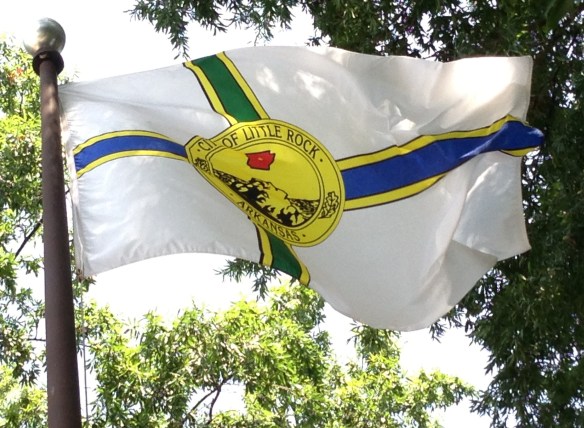
The official description of the flag is as follows:

As the official flag of the City of Little Rock, its symbolism is described as follows: A clean white background of the banner represents the optimism and open potential that the city has to offer. The royal blue horizontal broad stripe symbolizes the Arkansas River which borders Little Rock, and has served as an economical and historical emblem since the city’s beginning. The forest green stripe runs vertical to the royal blue stripe, creating a cross which symbolizes the location and statute of Little Rock—a city serving not only as the crossroads of Arkansas, but a crossroad of the mid-southern United States as well.

The strong forest green color depicts the fields, parks and forests which contribute to the natural beauty of the city. The seal of the flag is a modernized adaptation of the current Little Rock seal. The razorback red silhouette of the great State of Arkansas shows her capitol, the City of Little Rock, represented by the centered star. The star rises directly above “The Little Rock”—the protruding cliff along the Arkansas River, which was discovered in 1722 by French explorer La Harpe, when the city was given the name. The Arkansas River behind the rock and the symmetrical oak leaves in the border of the seal are a stylized illustration of what the flag’s stripes represent—the natural beauty of the city. Finally, the gold color of the seal and bordering stripes symbolize the superior economic history, and the future economic potential that is available in the City of Little Rock, Arkansas.

199 years ago, Little Rock named capital of Arkansas

On October 18, 1820, Territorial Governor James Miller signed legislation designating Little Rock as the new capital for Arkansas.  This was a mere 10 months after the first permanent settlement was established in Little Rock.

While Little Rock became the Capital, technically it was not the Capital City, since it would not be incorporated as a City until 1835. It wasn’t even incorporated as a town until 1831.

The Act provided that after June 1, 1821, the sessions of the Legislature and the Superior Court would be held at Little Rock.  This caused Arkansas Post, the first territorial capital, to fade from prominence.

The move was made based on the lobbying of Amos Wheeler, Chester Ashley and William Russell.  These men all owned land in the Little Rock area and would benefit from the move of the Capital to Little Rock. The official reason given was Little Rock’s geographical center to the Arkansas Territory and that it was elevated land less prone to flooding.

But just as important, Messrs. Wheeler, Ashley and Russell promised to donate land for a capitol building and a guarantee of $20,000 for construction of a suitable building. (That would be the equivalent of $432,000 today.)

Around the time the legislation was approved, several members of the Territorial legislature purchased land around Little Rock.  When a subsequent effort to relocate the Capital upstream was launched, it failed due to the financial ties of these legislators to land in Little Rock.

Final ARKANSAS GAZETTE published on October 18, 1991

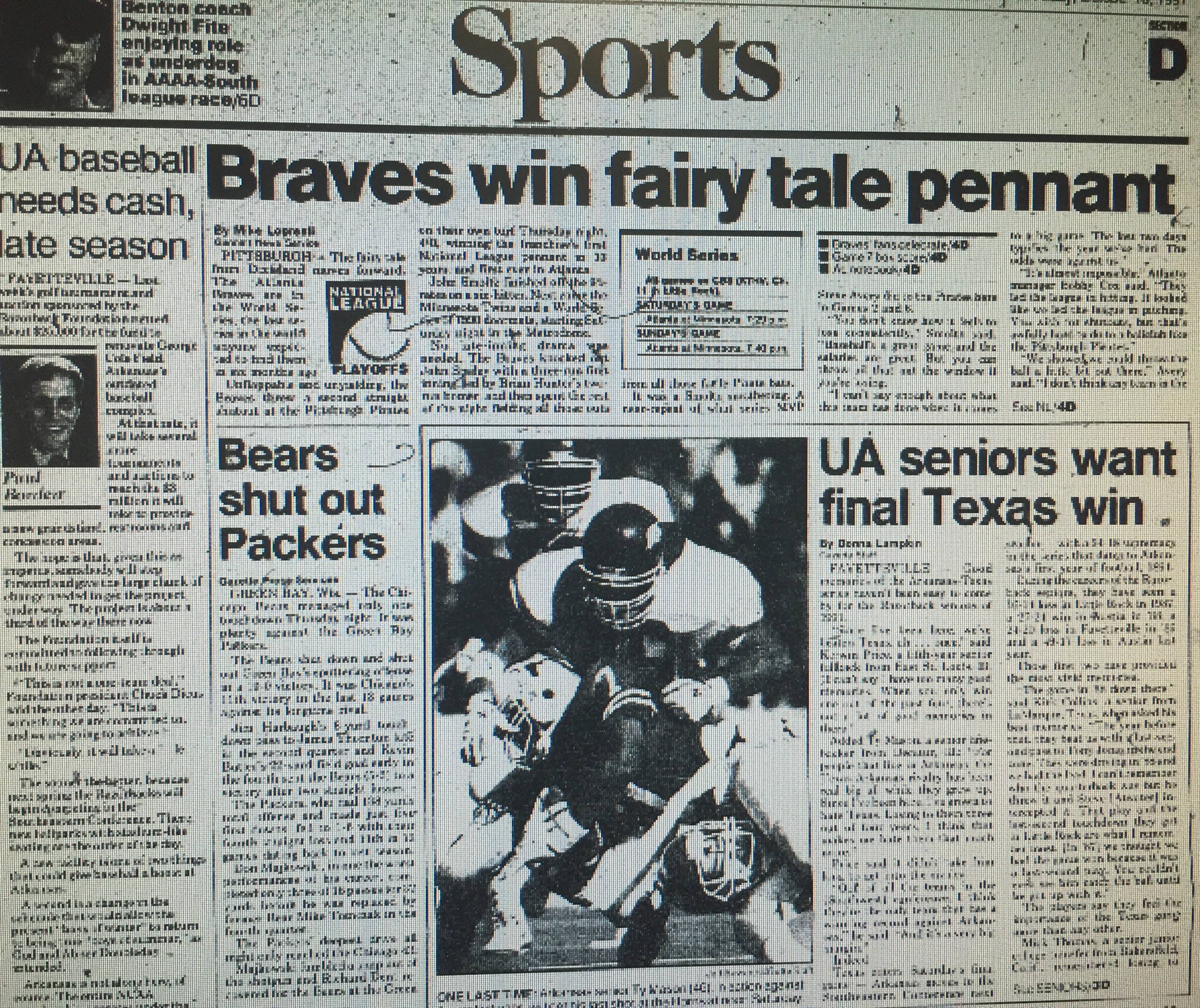
Twenty-seven years ago today, on October 18, 1991, the final edition of the Arkansas Gazette was delivered.
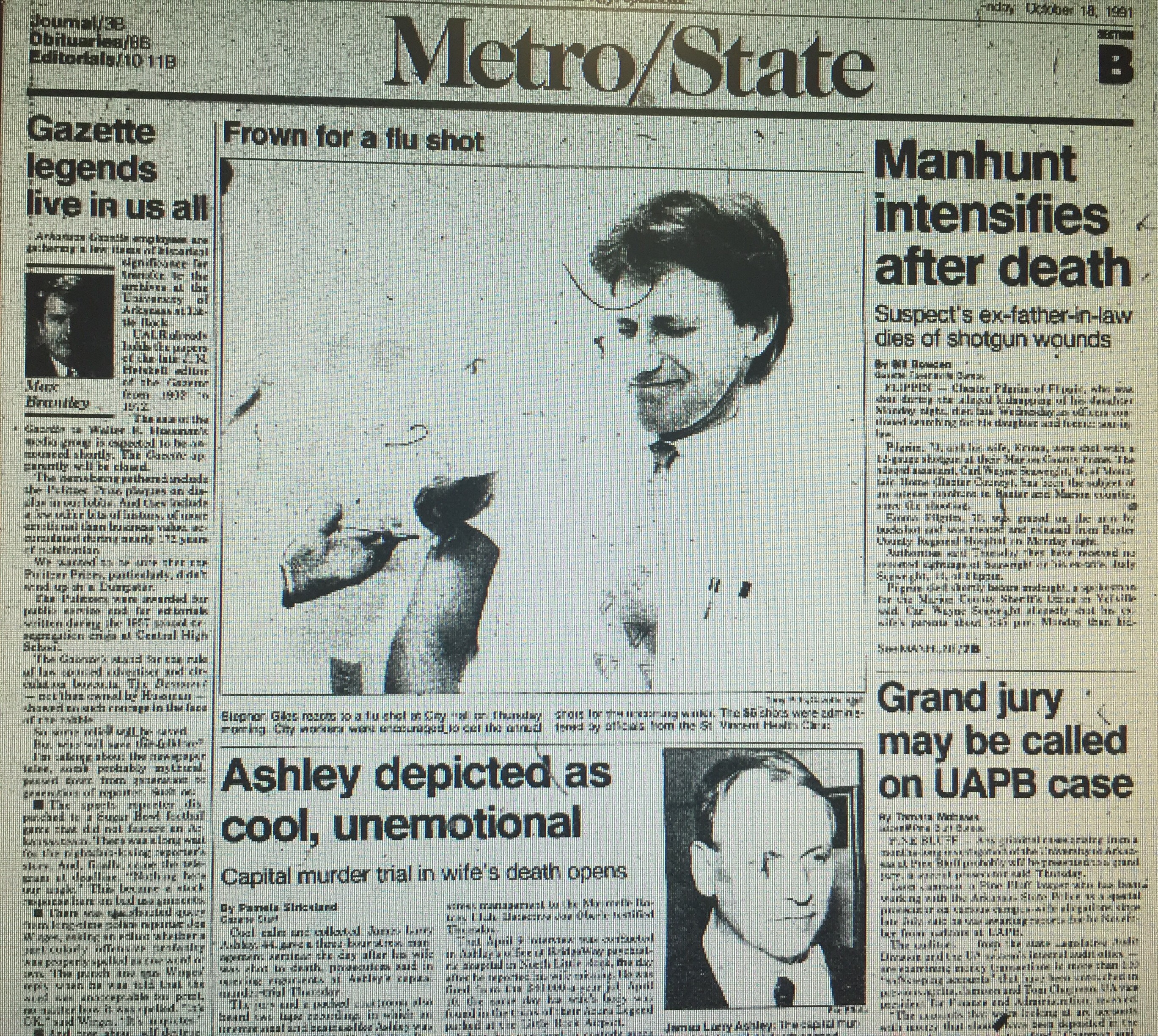
The front page featured a story on the demise of a Gazette employee effort to buy the paper.

Max Brantley’s column on the front page of the B section also addressed the then-eminent end of the paper. However, as a newspaper all of the sections spent most of their space on the news of the day. While Gazette staffers felt the end was likely near, few felt that the paper on October 18, 1991, would be the final edition.

The back page of the last section of the Gazette featured an ad for Premiere Pontiac Nissan Audi which was throwing a “Beat Texas” party featuring Craig O’Neill.  The Arkansas Razorbacks were scheduled to play the Texas Longhorns on Saturday, October 19.

Here are the top halves of the front pages of sections B, C, D, and E for the final Arkansas Gazette.  They tell the stories of trials, football games, corporate earnings, and cultural events.

Artober – Arts After Dark

October is Arts and Humanities Month nationally and in Little Rock. Americans for the Arts has identified a different arts topic to be posted for each day in the month.  Next up is “Arts after Dark”

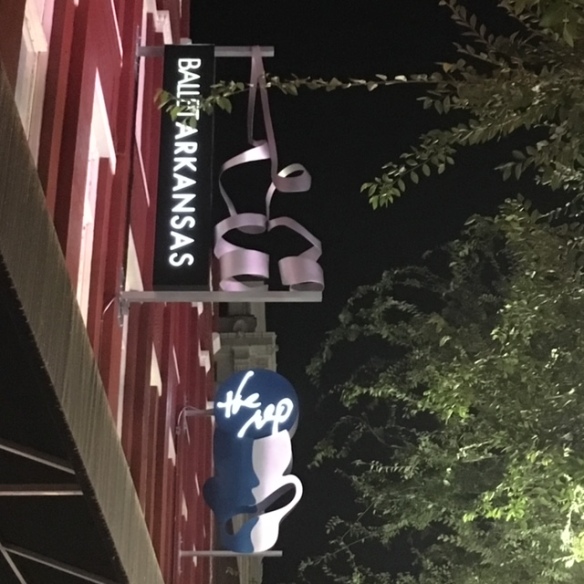
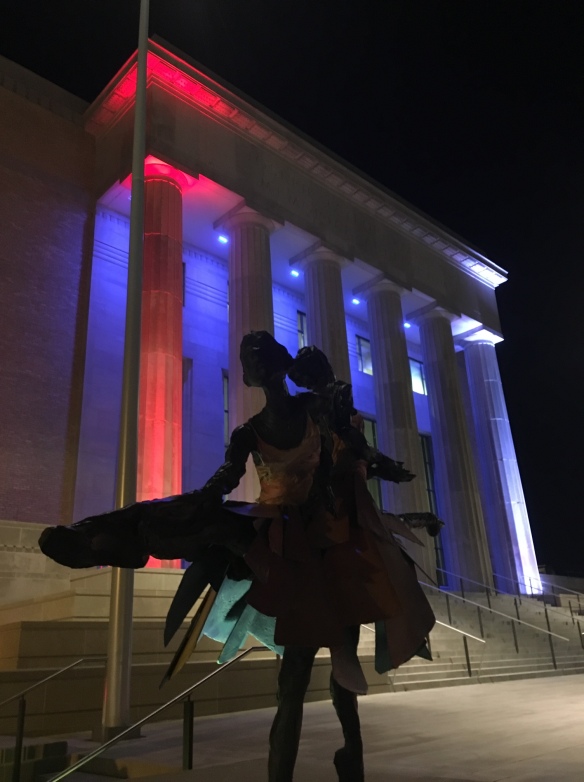
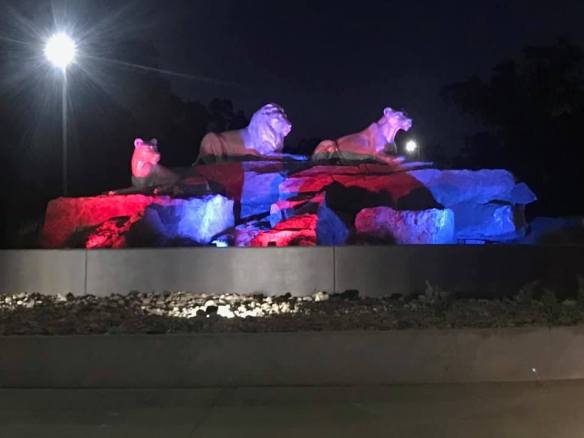
This theme, like many of them, could go in many different directions.  I’ve chosen to highlight some cultural institutions lit up at night.

Ballet Arkansas and the Annex of Arkansas Rep on Main Street

Jane DeDecker and Alyson Kinkade’s IN THE WINGS in front of Robinson Center Performance Hall.

Darrell Davis’ Lions Pride in War Memorial Park


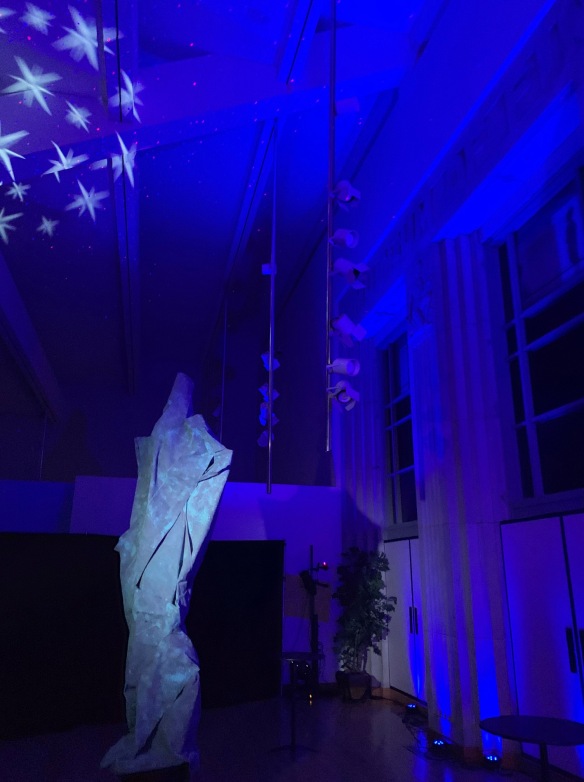
Lastly, while this photo took place indoors, it is a recreation of what the entrance to the Arkansas Arts Center will look like in 2022 when Henry Moore’s STANDING FIGURE KNIFE’S EDGE is located in front of the 1937 entrance to the AAC, which will once again be the main entrance. This was created for the AAC’s Farewell Party in August 2019.

Once and Future Arkansas Arts Center 9th Street entrance

Artober – Patterns….Quilts at Historic Arkansas Museum

Stitched Together: A Treasury of Arkansas Quilts

Rocky Mountain Road by Elizabeth Rogers Manning and Martha Manning. part of Historic Arkansas Museum collection.

October is Arts and Humanities Month nationally and in Little Rock. Americans for the Arts has identified a different arts topic to be posted for each day in the month.  Next up is Patterns.

One way to highlight patterns is to look at some in the Stitched Together exhibit at Historic Arkansas Museum. Quilting is a skill that was carried to the New World by immigrants.  However, in the almost two and half centuries since the colonies became states, quilting has evolved into a uniquely American tradition.

Quilting is all about patterns, sometimes repeating, sometimes in response. But it is all about patterns.

Here are a few from the exhibit:

The first features my favorite fabric pattern: PLAID!

Log Cabin, a pieced quilt ca. 1950 by Clara Baker.  Part of Historic Arkansas Museum collection.


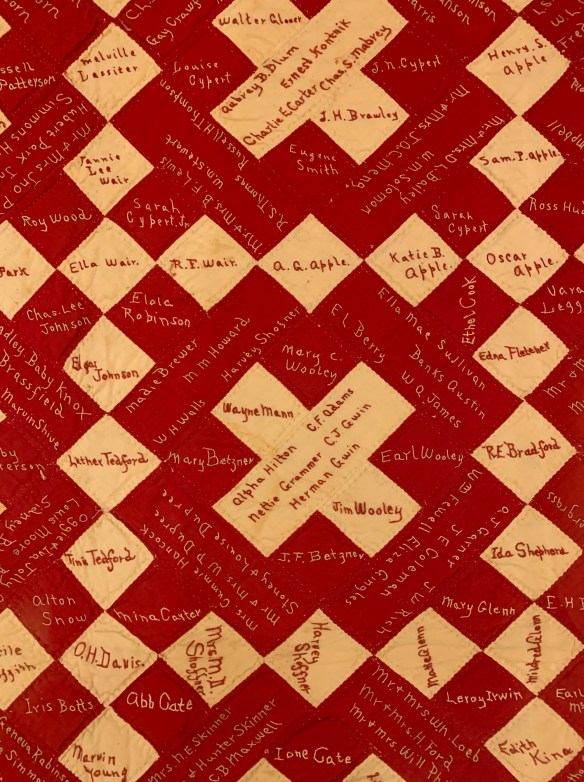
Signature. Made by members of the Women’s Missionary Society of Lonoke County. 1907. Part of the Historic Arkansas Museum collection.

Star of Bethlehem and unnamed pattern. Pieced and appliqued quilt. Mary Jane Vincent, ca. 1860. Part of Historic Arkansas Museum collection.

BLACK HAWK DOWN: THE UNTOLD STORY is October’s Movies at MacArthur

Image result for black hawk down untold story

Black Hawk Down: The Untold Story presents the heroic efforts of soldiers from the 2nd Battalion 14th Infantry Regiment, 10th Mountain Division.  The movie will be shown tonight (October 15) at the MacArthur Museum of Arkansas Military History.

These men demonstrated extraordinary courage, skill, and discipline as they fought their way into a “baited ambush” to rescue special operations forces pinned down at the crash site of Super Six-One while also attempting a rescue a the crash site of Super Six-Four. Two soldiers were killed and eighteen wounded in what many have described as the most ferocious urban combat since the Battle for Hue during the Tet Offensive in 1968.

The movie is this month’s Movies at MacArthur at the MacArthur Museum of Arkansas Military History.  It starts at 6:30 pm.  The film series is presented in partnership with AETN, the Bruce Family Endowment, Stone’s Throw, and the City of Little Rock Parks and Recreation Department.

Special guest at the screening will be, Colonel Randall Larsen, USAF (Ret) who is the documentary’s Executive Producer/Director. He served in both the Army and Air Force for a combined total of 32 years of active duty military service and as military attaché at the US Embassy in Bangkok, the chief of legislative liaison at the US Transportation Command, and the commander of America’s fleet of VIP aircraft at Andrews AFB MD. His decorations include the Legion of Merit, Distinguished Flying Cross, Bronze Star, and 17 awards of the Air Medal (3 with “V” Device for Valor).

Admission is free. Popcorn and Beverages will be provided.