Historian Dr. John Kirk is new director of UALR Institute on Race and Ethnicity

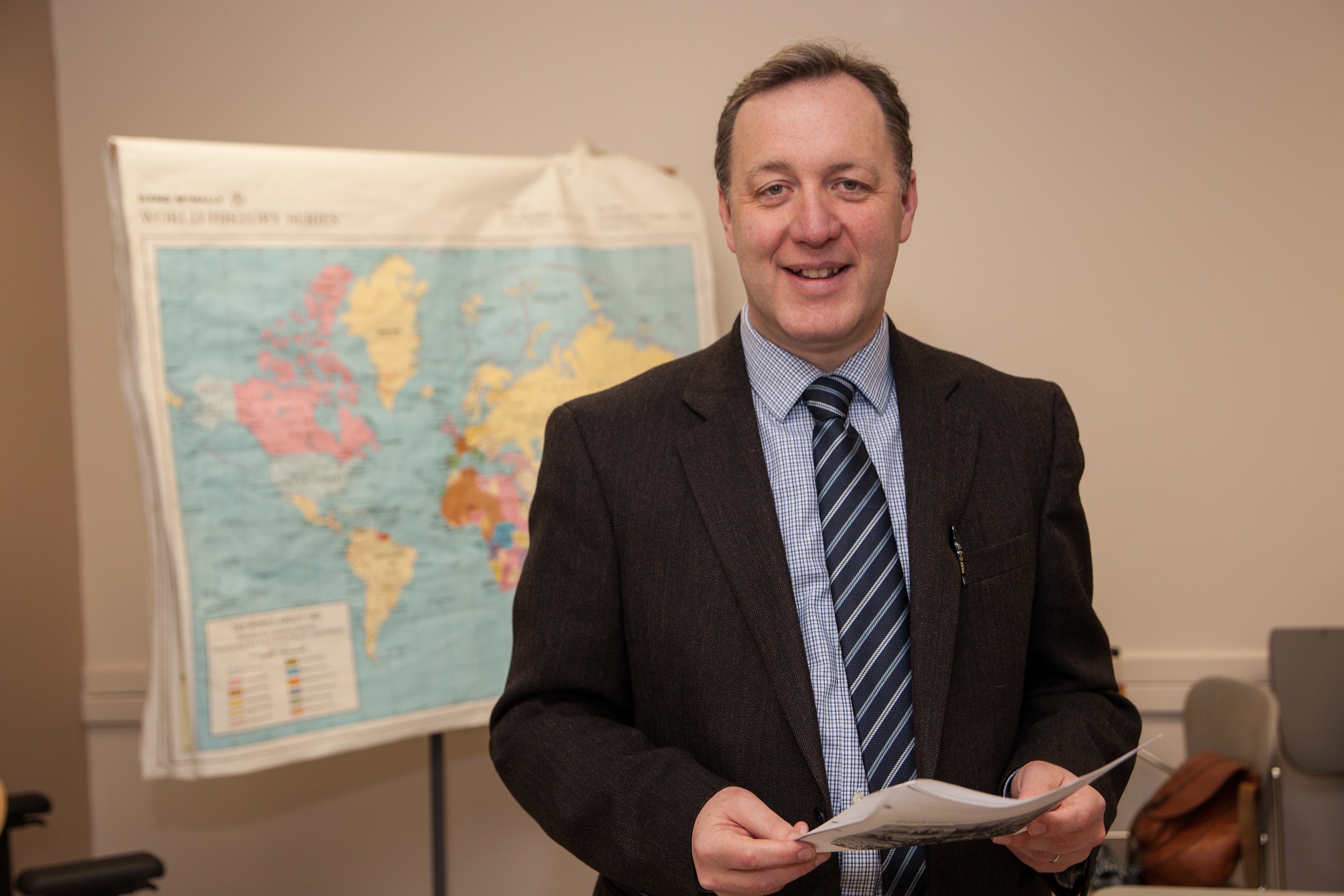
JohnKirk_history1aDr. John A. Kirk has been named the new director of the University of Arkansas at Little Rock’s Institute on Race and Ethnicity.  A native of Great Britain, he has garnered international acclaim for his research and writings on race and the civil rights movement — with a particular focus on Little Rock.

Kirk has been a member of the Chancellor’s Committee on Race and Ethnicity since he arrived at the university more than five years ago and has been involved with the institute since its inception about four years ago.

“I have a deep personal and professional commitment to the pursuit of racial and ethnic justice, and I think that should be the primary reason anyone takes on the job of director of UALR’s Institute on Race and Ethnicity — it is at the very heart of what the institute does,” Kirk said.

Kirk plans to connect with and engage as many students, faculty, and community members as possible in achieving the goals of the institute, which include:

  • Raising awareness of race and ethnicity issues
  • Providing research-based information and policy recommendations
  • Building bridges and seeking reconciliation through interracial and interethnic dialogue
  • Engaging students
  • Serving as a clearinghouse for on- and off-campus initiatives related to race and ethnicity
  • Holding UALR accountable for becoming a more diverse and multi-ethnic community.

For the past 25 years, Kirk has researched and written about issues of race and ethnicity in the United States, especially in Little Rock and Arkansas. He’s the author of numerous books, including “Race and Ethnicity in Arkansas: New Perspectives,” “Martin Luther King, Jr. and the Civil Rights Movement,” and “Beyond Little Rock: The Origins and Legacies of the Central High Crisis.” He also recently partnered with the BBC on its Martin Luther King Jr. web display that serves as an information resource for an international audience.

In announcing Kirk’s appointment, UALR Chancellor Joel E. Anderson noted the professor’s knowledge and passion for civil rights-related topics were ideal fits for the institute’s leadership role.

“It is a rare opportunity to work with someone who grew up in Great Britain but whose knowledge of Arkansas civil rights history is probably greater than anyone else’s in Arkansas or the United States,” Anderson said.  “Dr. John Kirk is a well-known resource in our community for his expertise on the many ways race has shaped our city and state. I am confident that under his leadership the UALR Institute on Race and Ethnicity will continue to grow in influence and will help shape a better future for the people of Arkansas.”

Kirk replaces Dr. Michael R. Twyman, who resigned in July to take a position at the Indiana Black Expo organization.

With Kirk’s new director responsibilities, he will remain the Donaghey Distinguished Professor of History  but no longer will serve as the UALR History Department chair.

“I am excited by the challenges and opportunities that the director’s job brings with it,” Kirk said. “I particularly look forward to getting to know more about and working with students, faculty, and community members who are learning, teaching, researching and serving on issues of race and ethnicity.”
Little Rock Look Back: The Quapaw Line

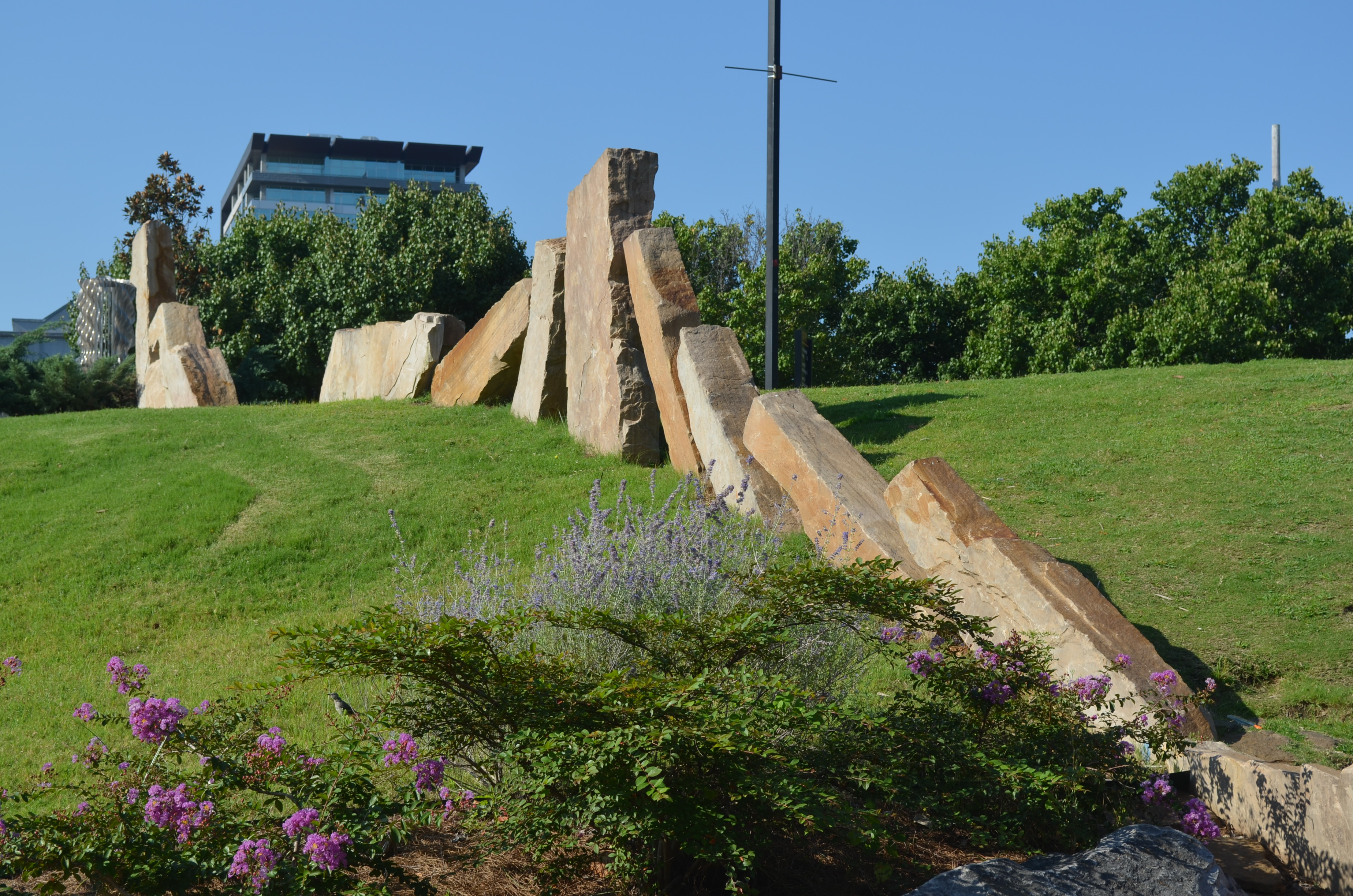
Stones placed in Riverfront Park denote where there Quapaw Line started from La Petite Roche

Stones placed in Riverfront Park denote where there Quapaw Line started from La Petite Roche

On August 24, 1818, the Quapaw Line was drawn.  Starting at La Petite Roche and heading due south, this line formed the boundary between the Quapaw tribe lands and public lands available for settlement.  Though by 1824, the Quapaw were forced to give up all of their lands, the line continued serve as an important marker.  In the ensuing six years, the first permanent settlement of Little Rock took place and streets were planned.

It is interesting to note that the 1818 treaty referred to La Petite Roche as the Little Rock.  Some have speculated that this is the first official use of “Little Rock” to designate the outcropping.  When the Post Office was established in March 1820, it was given the name Little Rock.

There is a marker commemorating the beginning of the Quapaw Line located at La Petite Roche in Riverfront Park.  The first segment of the line is also noted in the park.  There are also sunken markers place along the line at various points.  In MacArthur Park, at the corner of 9th and Commerce Streets, there is a marker noting that the line passed through at that location.

A good account of walking the Quapaw Line through downtown Little Rock can be found on this website.

Most of what is now called the Quapaw Quarter was located to the west of the Quapaw Line.  However, it did take its name from the fact that the tribe had once lived in that area and was later sequestered to lands near it.  The name for the area was chosen by a committee composed of David D. Terry, Peg Newton Smith, Mrs. Walter Riddick Sr., Dr. John L. Ferguson, and James Hatcher. They had been appointed to a Significant Structures Technical Advisory Committee to advocate for preservation of important structures as a component of the City of Little Rock’s urban renewal efforts.

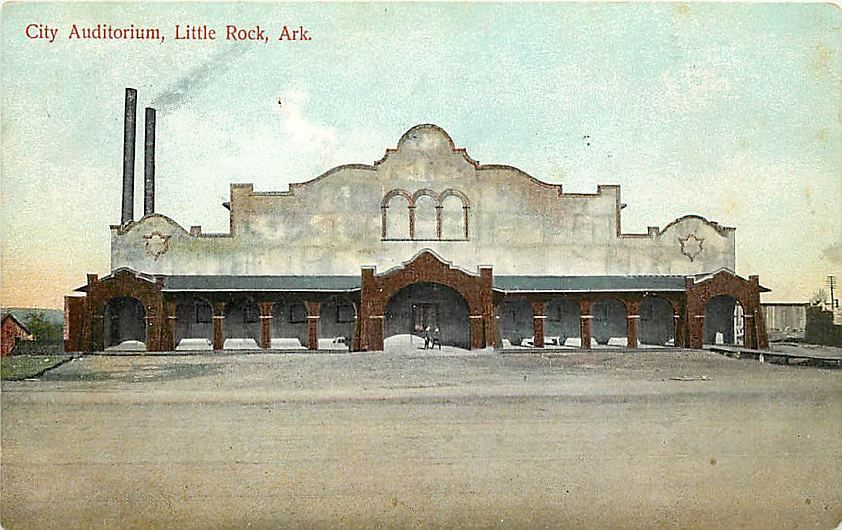
Little Rock Look Back: First City Auditorium Approved

1906 auditoriumOn August 20, 1906, the Little Rock City Council approved plans for the City’s first municipal auditorium.

A week earlier, businessman A. C. Read petitioned the City for the right to construct a skating rink.  The matter was referred to the Street & Fire Committee, the Superintendent of Public Works and Aldermen Louis Volmer and Benjamin S. Thalheimer, who represented the Sixth Ward, in which the structure would be located.

Neither the Gazette nor the Democrat carried a mention of this petition in their coverage of that meeting.  By the next Council meeting a week later, the committee had reported back with a recommendation for approval.  Resolution 288 was adopted giving Mr. Read the right to build the skating rink.  Interestingly, the resolution did not contain the words “skating rink” though the original petition had.  Instead it permitted Mr. Read to construct a building “suitable for purposes as defined” by the City.  The resolution also stated that within three years the building would become property of the City.

Based on photos and postcards, the exterior of the building appears to have been covered in stucco.  It was said to be modeled after San Antonio’s Alamo, but what that really meant was that it was in the Spanish Revival style.  It was shorter and had more entrances than the Texas building did.  The Markham Street façade featured faux windows and a front portico which extended the length of the building only interrupted by three entrance archways. The center one was taller and wider than the eastern and western entrances.  All three, which projected southward from the building, mimicked the outline of the auditorium building.

The building was located on the western half of the City Hall property (and was constructed before City Hall).  In 1912, the new Little Rock Central Fire Station (now the City Hall West Wing) was built between the auditorium and Markham Street.  The auditorium stood until 1920.  During that time it was used as a roller rink, opera house, rifle range, National Guard armory, convention hall, and gymnasium.

Happy Birthday Maureen O’Hara – In 1940 she set off a stampede of fans at Robinson Center

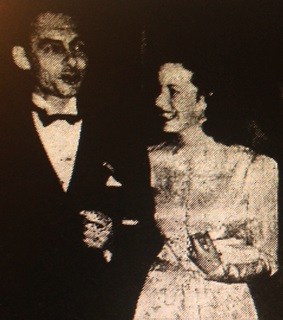
Mayor J V Satterfield escorting actress Maureen O'Hara at the Movie Ball (photo from Arkansas Democrat)

Mayor J V Satterfield escorting actress Maureen O’Hara at the Movie Ball (photo from Arkansas Democrat)

Oscar winner Maureen O’Hara turns 95 today.  With her elegance and beauty, she still turns heads. Seventy-five years ago, in February 1940, a nineteen year old Miss O’Hara turned many heads and set off a frenzy of autograph seekers when she came to Little Rock to attend a series of events.

In conjunction with a meeting of film executives and movie theatre owners sponsored by Robb and Rowley Theaters (which later became the United Artists theatre chain), several Hollywood actors were in Little Rock and headlined a Movie Ball. While in Little Rock, Maureen O’Hara, Phyllis Brooks, Arleen Whelan, Tim Holt and Gene Autry had also made a variety of public appearances.

On the evening of February 1, 1940, Robb and Rowley hosted the Movie Ball in the lower level of Robinson Auditorium. So many of the attendees crowded around for autographs that the evening’s grand march could not take place (a newspaper headline in the Democrat innocently used the word “orgy” to describe the crowd). After two attempts, Little Rock Mayor J. V. Satterfield (who was escorting Miss O’Hara) and the other members of the Little Rock host delegation led the Hollywood stars to their reserved table. For quite a while that evening, the table was besieged by autograph seekers.

Though it is unknown as to whether he sought an autograph, photos from the evening showed a very satisfied Mayor Satterfield with Miss O’Hara on his arm. Satterfield family lore joked that Mrs. Satterfield (who had stayed home that night to tend to a sick son) was not a fan of Miss O’Hara’s films after that evening.

The Movie Ball showed Little Rock citizens the value of Robinson Auditorium even before it had been officially dedicated. The film industry meetings had taken place at the Albert Pike Hotel which did not feature a ballroom large enough to host the ball. Without the auditorium’s availability for the gala, organizers might not have chosen Little Rock for the meeting.

Remember end of WWII with a visit to MacArthur Museum of Arkansas Military History

With this month marking the 70th anniversary of the end of World War II, it is a good time to remember the museum in Little Rock dedicated to preserving Arkansas’ rich military history.

Located in the historic Arsenal Tower in MacArthur Park, the MacArthur Museum of Arkansas Military History honors the Arkansans who have served in the armed forces.  Exhibits feature artifacts, photographs, weapons, documents, uniforms and other military items that vividly portray Arkansas’s military history at home and abroad.

Undaunted Courage, Proven Loyalty:
Japanese American Soldiers in World War II
This exhibit focuses on the military experience of Japanese Americans during World War II including stories from veterans of the 100th Infantry Battalion and the 442nd Regimental Combat Team, and the Military Intelligence Service. To prove their loyalty to the United States government, many Japanese American men joined the army as part of the 442nd Regimental Combat Team or as part of the Military Intelligence Service.

Other exhibits include:

  • From Turbulence to Tranquility: The Little Rock Arsenal
  • Capital In Crisis and Celebration: Little Rock and the Civil War
  • Alger Cadet Gun
  • Camden Expedition
  • David Owen Dodd
  • Through the Camera’s Eye: The Allison Collection of World War II Photographs
  • By the President in the Name of Congress: Arkansas’ Medal of Honor Recipients
  • Conflict and Crisis: The MacArthur- Truman Controversy
  • Duty, Honor and Country: General Douglas MacArthur
  • The Sun Never Sets on the Mighty Jeep: The Jeep During World War II
  • War and Remembrance: The 1911 United Confederate Veterans Reunion
  • First Call – American Posters of World War I

The MacArthur Museum of Arkansas Military History is a museum of the City of Little Rock.  It is led by executive director Stephan McAteer who works with the MacArthur Military History Museum Commission.

Hours of Operation
Monday – Saturday; 9:00 a.m. – 4:00 p.m.
Sunday; 1:00 p.m. – 4:00 p.m.

Clinton Center admission is FREE today for President Clinton’s Birthday

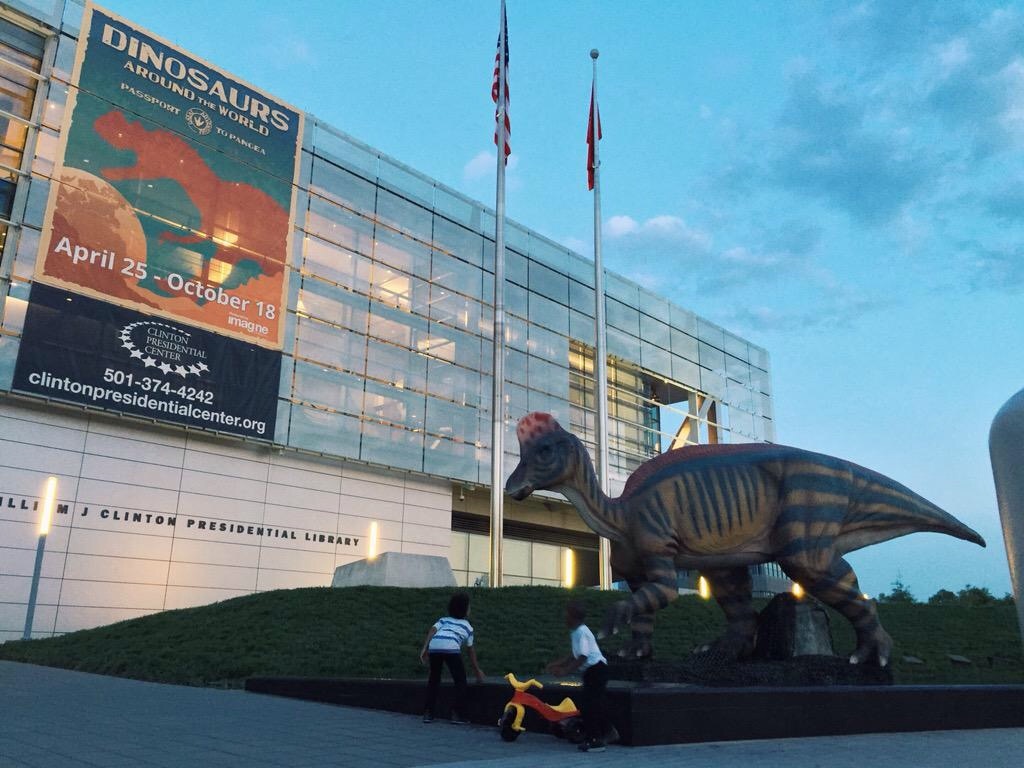
Clinton DinosPresident Clinton’s birthday is next week.  But the Clinton Presidential Center is offering visitors the present.  Today from 9am to 5pm, the Clinton Presidential Center admission fees will be waived.  Also offered for free will be the audiotour featuring President Clinton’s narration.

In addition to the chance to visit the Dinosaurs exhibit and the permanent exhibits, the Clinton Center is hosting a special event today from 9am to 2pm.

Kick off the new school year at our Annual Head of the Class Bash. The first 1,500 students will receive FREE backpacks and back-to-school supplies! The Clinton Center will also provide immunizations, haircuts, fun activities, ACT/SAT/PSAT prep coupons, and much more. New this year, there will be “Hour of Code” computer science tutorials. The Head of the Class Bash is sponsored by the Clinton Foundation in partnership with the 3M Company, Arkansas Department of Health, Arkansas STEM Coalition, AT&T Arkansas, New Tyler Barber College, and the Office of Governor Asa Hutchinson.

WHEN:
Saturday, August 15, 2015
Head of the Class Bash: 9 a.m. – 2 p.m.
Free Admission Day: 9 a.m. – 5 p.m.

Little Rock Look Back: A (Tom) Prince of a Mayor

Mayor PrinceFuture Little Rock Mayor Tom Prince was born on August 13, 1949.  After graduating high school in 1967 (where he was on the state championship golf team), he attended the United States Naval Academy.  He later received his law degree from the University of Arkansas at Little Rock and began practicing law in Little Rock.

In 1984 he ran for the City of Little Rock Board of Directors and was elected.  In January 1985, he was selected by his fellow City Directors to serve as Mayor of Little Rock.  He served as Mayor until January 1987.  During his term in office, Arkansas celebrated its Sesquicentennial. Mayor Prince oversaw the City’s participation in the celebratory activities.  As Mayor he was also a strong advocate for expanding the city’s involvement in quality of life issues through enhanced parks and arts while maintaining a commitment to public safety and public works issues. After the completion of his four year term on the City Board, he did not seek a second term.

City of Little Rock races are non-partisan.  After leaving office, he became involved in Democratic Party politics.  In 1992, he campaigned for Bill Clinton’s presidential bid in Iowa and other Midwest states.  When his law partner, Sheffield Nelson, ran for Governor in 1994 as a Republican, Prince resigned from his Democratic Party positions and worked on the Nelson campaign.  In 1997, he was elected chair of the Pulaski County Republican Committee.  In 1998, he ran for the United States Senate as a Republican.

In 1999, Prince experienced a family tragedy and took a sabbatical from practicing law. In 2000, he moved to St. Louis to become general counsel for a securities firm located there.  Following several years with the securities firm, he joined a St. Louis law firm in private practice.  After spending over a decade in St. Louis, Prince returned to Central Arkansas and is managing business interests.