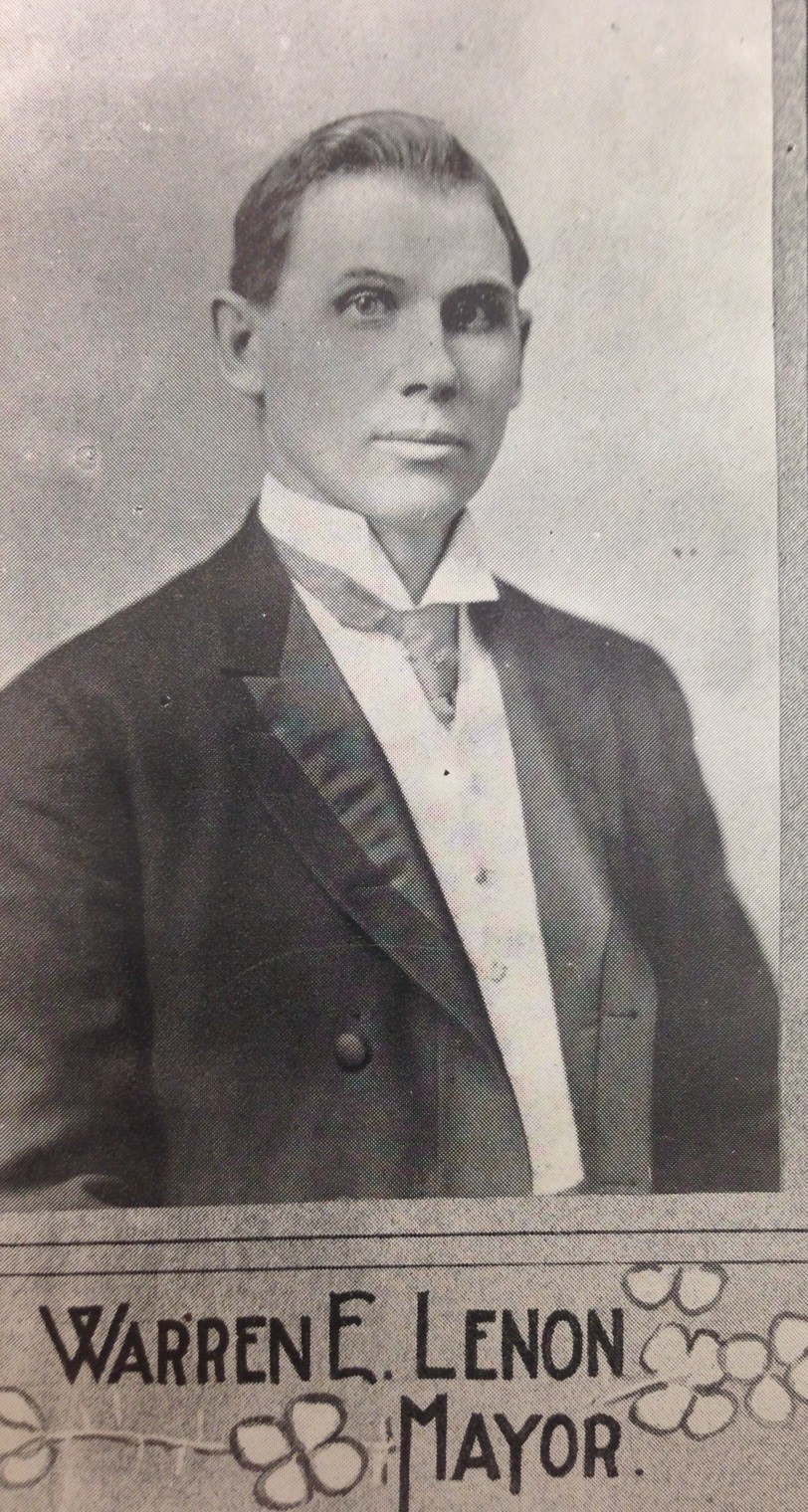
Birth of Little Rock’s 39th Mayor, W. E. Lenon, on October 8, 1867

OMayor Lenonn October 8, 1867 in Panora, Iowa, future Little Rock Mayor Warren E. Lenon was born.  He was one of eleven children of John D. and Margaret M. Long Lenon.

Lenon came to Little Rock in 1888 after finishing his schooling in Iowa.  He helped set up an abstract company shortly after his arrival.  In 1902 he organized the Peoples Savings Bank.  Among his other business interests were the City Realty Company, the Factory Land Company, the Mountain Park Land Company, and the Pulaski Heights Land Company.

From 1895 to 1903, he was a Little Rock alderman, and in 1903, he was elected Mayor of the city. A progressive Mayor, he championed the construction of a new City Hall which opened in 1908.  At the first meeting of the City Council in that building, Mayor Lenon tendered his resignation.  His duties in his various business interests were taking up too much of his time.

Mayor Lenon had been a champion for the establishment of a municipal auditorium. He had wanted to include one in the new City Hall complex. But a court deemed it not permissible under Arkansas finance laws at the time.  He also worked to help establish the first Carnegie Library in Little Rock which opened in 1912.

Mayor Lenon continued to serve in a variety of public capacities after leaving office.  In the 1920s, he briefly chaired a public facilities board for an auditorium district. It appeared he would see his dream fulfilled of a municipal auditorium.  Unfortunately the Arkansas Supreme Court declared the enabling legislation invalid.

In 1889, he married Clara M. Mercer.  The couple had three children, two of whom survived him: a son W. E. Lenon Jr., and a daughter Vivion Mercer Lenon Brewer.  Together with Adolphine Fletcher Terry (also a daughter of a LR Mayor), Mrs. Brewer was a leader of the Women’s Emergency Committee.

Mayor Lenon died June 25, 1946 and is buried at Roselawn Cemetery.  Lenon Drive just off University Avenue is named after him..

Tales of the Crypt tonight at Mount Holly Cemetery

Image may contain: 10 people, people smiling, people standing, wedding and outdoor

Tales of the Crypt – Spend an evening in Mount Holly Cemetery meeting its residents!

No, they aren’t ghosts. No, they don’t rattle chains or scare anyone. These residents are students from the Drama Department of Parkview Arts & Science Magnet High School in Little Rock.

Drama students research a person buried in Mount Holly. Then, on the second Tuesday evening of October, they dress in period costumes and deliver short monologues or dialogues to highlight the history and lives of their character.

Audiences are led through the cemetery by guides with candles, stopping at the graves where student actors are stationed. Many local teachers award extra credit to students who attend.

Over a thousand people attend Tales of the Crypt every year.

The fun starts at 6:00pm and runs until 8:00pm.

Admission is free to the public. We gladly accept donations!

Tonight, the Clinton School presents Dr. Ibram X. Kendi discussing his book HOW TO BE AN ANTIRACIST, in partnership with Philander Smith College and Mosaic Templars Cultural Center

Image result for how to be an antiracistIn partnership with Philander Smith College and Mosaic Templars Cultural Center, the Clinton Schoool of Public Service presents Ibram X. Kendi discussing his book How to be an Antiracist tonight (October 7) at 6pm.

The event will take place at Mosaic Templars Cultural Center. A booksigning will follow.

Ibram X. Kendi is one of America’s foremost historians and leading antiracist voices. He is a New York Times-bestselling author and the Founding Director of The Antiracist Research & Policy Center at American University in Washington, D.C. A professor of history and international relations, Kendi is an ideas columnist at The Atlantic. He is the author of “The Black Campus Movement,” which won the W.E.B. Du Bois Book Prize, and “Stamped from the Beginning: The Definitive History of Racist Ideas in America,” which won the National Book Award for Nonfiction.

His recently released book, “How to be an Antiracist,” weaves an electrifying combination of ethics, history, law, and science with his own personal story of awakening to antiracism. This is an essential work for anyone who wants to go beyond the awareness of racism to the next step: contributing to the formation of a just and equitable society.

Kendi takes readers through a widening circle of antiracist ideas—from the most basic concepts to visionary possibilities—that will help readers see all forms of racism clearly, understand their poisonous consequences, and work to oppose them in our systems and in ourselves.

This event is in partnership with JusticeCon 2019 and the Mosaic Templars Cultural Center. JusticeCon is organized by the Social Justice Institute at Philander Smith College, which brings together students, activists, thought-leaders, knowledge-seekers and renowned speakers to share ideas and inspire one another in the pursuit of social justice. Limited seating is available.

EVENT CATEGORIES

CALS Announces Organizational Changes at Roberts Library

This spring, the Central Arkansas Library System (CALS) unveiled a new strategic plan effective through 2022. The CALS strategic plan describes the library system’s mission, core values, and vision while also identifying goal areas where CALS will direct its energy and resources over the next several years.

The Roberts Library is CALS special collections branch composed of the Encyclopedia of Arkansas, Butler Center for Arkansas Studies, Genealogy Department, and the Galleries at Library Square.

Beginning October 1, two key changes took place at Roberts Library in alignment with the strategic plan: Director of the Roberts Library David Stricklin will become Director of Strategic Partnerships & Community Engagement for the CALS system as a whole, where he will help guide the implementation of the Strategic Plan and strengthen relationships with governments, elected officials, community leaders and centers of influence; and Glenn Whaley will serve as Manager of the Roberts Library, expanding her role as operational leader for the past five years.

“The staffing changes will allow the library to benefit more from the unique gifts of two talented leaders,” said CALS Executive Director Nate Coulter. “David will be invaluable in driving the strategic evolution of our organization, and Glenn has already demonstrated her organizational and management skills as second-in-command of the Roberts Library. She’ll be an excellent leader to continue the vital and important work being done by the Roberts Library team.”

The CALS strategic plan is the result of broad-based community input, executive team engagement, consultation from national library planning experts, and board review and approval. The plan outlines seven organizational goals in the areas of (1) Extending Community Connections, (2) Services and Collections, (3) Facilities and Spaces, (4) Resource Allocation and Integration, (5) Public Awareness and Marketing, (6) Resource Development, and (7) Organizational Culture.

TV’s Annie Oakley – Little Rock native Gail Davis born on October 5, 1925

Gail Davis is best known as TV’s Annie Oakley.  She was born Betty Jeanne Grayson on October 5, 1925. Her mother was a homemaker and her father, W. B. Grayson, was a physician in McGehee (Desha County), which did not have a hospital, so her birth took place in Little Rock (Pulaski County).
When her father became the state health officer, the family moved from McGehee to Little Rock, where Grayson attended Little Rock High School. Grayson rode horses and was a tomboy growing up. Grayson also held various beauty titles in high school and college, and she sang and danced in local shows from the time she was eight.

While studying dramatics at the University of Texas in Austin, she married Robert Davis in 1945, with whom she had a daughter, Terrie (the couple divorced in 1952). After World War II, they moved to Hollywood, where she worked as a hatcheck girl until being discovered by an agent who obtained an MGM screen test for her. She was signed to a contract, with her first appearance in 1947’s The Romance of Rosy Ridge, starring Van Johnson.

She worked steadily in movies, including fourteen films with Gene Autry in the late 1940s and early 1950s. He was impressed with her, changed her name to Gail Davis, and cast her as the star of the Annie Oakley TV show, which he produced. The show ran for eighty-one episodes from 1954 through 1956.

After her TV series ended, she appeared as Annie Oakley in the 1959 film Alias Jesse James starring Bob Hope. In that film, she appears in an uncredited role along with such other stars, also uncredited, as Gary Cooper, Bing Crosby, Roy Rogers, James Garner (as Bret Maverick), and Fess Parker (as Davy Crockett).

Her television appearances include guest roles on The Lone Ranger, The Gene Autry Show, The Cisco Kid, and Death Valley Days, as well as a 1961 episode of the Andy Griffith Show (Episode 37, “The Perfect Female”), her final appearance as a performer and in which she demonstrated her trademark sharpshooting.

Gail toured with Gene Autry’s Wild West show and made appearances as herself on TV programs such as Wide, Wide World: “The Western” (1958) with fellow Arkansan Ben Piazza. For her work in television, she was awarded a star on the Hollywood Walk of Fame, located at 6385 Hollywood Boulevard, and in 2004, she was inducted posthumously into the National Cowgirl Hall of Fame.

Gail Davis died of cancer in Los Angeles on March 15, 1997, and is buried in Hollywood’s Forest Lawn cemetery.  In 2007, she was posthumously inducted into the Arkansas Entertainer’s Hall of Fame.  In 2016, a room was named in her memory at the newly renovated Robinson Center.

Forerunner of Arkansas Arts Center, Little Rock’s Museum of Fine Arts opened on October 5, 1937

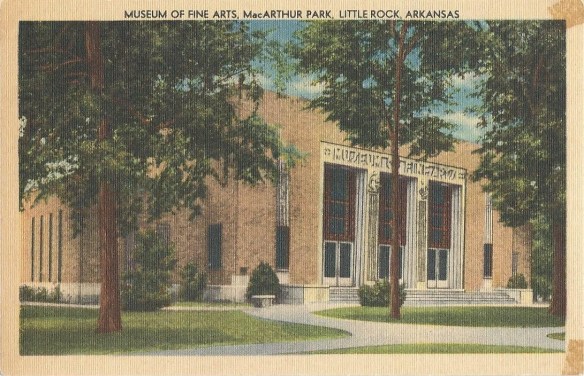
On Tuesday, October 5, 1937, the Fine Arts Club of Little Rock held its first meeting in the new Museum of Fine Arts.  But it was not a typical meeting. It was an Open House and Dedication for the new building.

Construction on the 10,140 square foot building had commenced with the January 3, 1936, groundbreaking.  By September 1937, the keys were presented to the City, marking the end of the construction process.

During the October 5 events, a letter of congratulations was read by President Franklin D. Roosevelt and WPA Administrator Harry L. Hopkins.  A letter which had been prepared by Sen Joe T. Robinson prior to his death was also read.  Mayor R. E. Overman, architect H. Ray Burks, and Fred W. Allsopp spoke at the event.  The latter was chair of the museum’s board.  Over 1,000 people were in attendance. At the time the city’s population was around 87,000.

The museum officially opened its doors to the public on October 28, 1937.  Nettie L. Robinson, a longtime member of the Fine Arts Club, was its first director and would serve in that capacity for two decades.

The original facade of the Museum can still be seen inside the Arkansas Arts Center.  Once the expansion and renovation of that building is complete in 2022, the original entrance will be highlighted even more with the new design.

Three months before construction complete, first event held in Robinson Auditorium on October 4, 1939

In October 1939, it looked as if Robinson Auditorium would never open.  The construction had run out of money.  But in an effort to generate a little revenue and give the public the chance to see the building, a few events were booked in the lower level.

At the time, the entrance to the lower level was off of Garland Street which ran to the north of the structure.

While Mayor J. V. Satterfield and other leaders were in Washington seeking additional funding, the Joseph Taylor Robinson Memorial Auditorium hosted its first event.  On October 4, 1939, the convention hall on the lower level was the site of a preview dance.  The pecan block flooring had been installed just the week before.

RC-dance-orchestraThe first four people to enter the building as paying guests were Mr. and Mrs. Alfred Wilheim, Frances Frazier and Bill Christian.  Reports estimated 3,200 people attended and danced to the music of Jan Garber and His Orchestra.

By happenstance, Garber and his musicians had also played in Little Rock on January 26, 1937, the date of the election which approved the auditorium bonds.  Since Little Rock then did not have a suitable space, that appearance had been on the stage of the high school auditorium.

The dance was a success.  But as the building had no heating or cooling mechanism at the time, there were limits as to how long even the lower level could be in use.  After a few weeks, the PWA, which was still in charge of the construction site, halted all future bookings.