Bike Through the Quapaw Quarter

QQAHelp the Quapaw Quarter Association celebrate its Fiftieth Spring Tour of Homes in May with a fun ride through the Quapaw Quarter. Led by Mason Ellis, the tour will include a preview of the 2014 Spring Tour homes and several sites from the original 1963 tour that helped galvanize the historic preservation movement in Little Rock. The tour will also highlight the diversity of the Quapaw Quarter neighborhoods and some of the positive changes that have occurred over the past five decades. Ride your own bike or borrow one for free from Bobby’s Bike Hike.

Space is limited to 20 participants, so RSVP early to qqa@quapaw.com or 501-371-0075.

QQA’s 50th Spring Tour of HomesHonorary Co-Chairs Arkansas First Lady Ginger Beebe and P. Allen Smith and the Quapaw Quarter Association Board of Directors invite you to join us for the 50th Spring Tour of Homes this Mother’s Day weekend, May 10-11, 2014.

On this year’s tour, the Arkansas Governor’s Mansion and five houses on surrounding streets will be open to the public for tours.  This year’s tour houses are:

The Mayer Cottage 1937-38
317 West Seventeenth Street

The Pierce House c. 1881
1704 Center Street

The Turner-Back House 1884-85
1722 Center Street

The Caruth-Cochran House c. 1882
320 West Eighteenth Street

The Old Methodist Parsonage c. 1927
401 West Eighteenth Street


Little Rock Look Back: A Man and a Rock (LaHarpe sees the Little Rock)

IMG_4805On April 9, 1722, French explorer Jean-Baptiste Bénard de La Harpe rounded the bend of the Arkansas River and saw La Petite Roche and Le Rocher Français.  He had entered the mouth of the Arkansas River on February 27 after traveling up the Mississippi River from New Orleans.

Though La Harpe and his expedition are the first Europeans documented to have seen La Petite Roche, the outcropping of rocks was well-known to the Quapaw Indians in the area.  The outcropping jutted out in the Arkansas River and created a natural harbor which provided a perfect place for boats to land.

The rock outcropping is the first one visible along the banks of the Arkansas River.  It marks the place where the Mississippi Delta meets the Ouachita Mountains.  Geologists now believe that the Little Rock is not the same type of rock as the Ouachita Mountains and more closely matches the composition and age of mountains in the western US.

In 1813, William Lewis became the first European settler to live near La Petite Roche but only stayed a few months.  Speculators and trappers continued to visit the area throughout the 1810s. During that time, the outcropping became known informally as the Little Rock.

La Petite Roche had become a well-known crossing when the Arkansas Territory was established in 1819. The permanent settlement of ‘The Rock’ began in the spring of 1820, and the first building has been described as a cabin, or shanty, and was built on the bank of the river near the ‘Rock.’ In March 1820, a Post Office was established at the ‘Rock’ with the name “Little Rock.”

Over the years, La Petite Roche was altered.  In 1872, Congress authorized the building of a railroad bridge. A pier for the bridge was built at the location of the La Petite Roche which caused the removal of several tons of rock.  The bridge was never built.  When the Junction Bridge was built in 1899, even more rock was removed in the process of erecting part of the bridge on top of the rock.  It was not viewed as being disrespectful of the City’s namesake at the time.  Indeed, it was viewed as a testament to the sturdiness of the rock.

In 2010, La Petite Roche plaza opened in Riverfront Park.  It celebrates the history of La Petite Roche and explores its importance to various aspects of Little Rock’s history and geography.

Little Rock Look Back: SOUTH PACIFIC opens on Broadway

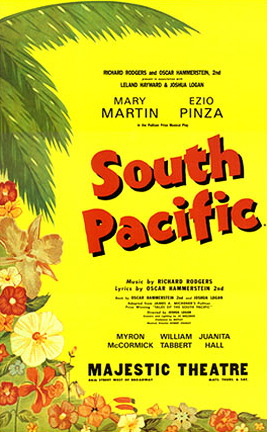
southpacific_obcSixty-five years ago today, a fictional Little Rock heroine took the stage of a Broadway megahit when South Pacific opened at the Majestic Theatre on April 7, 1949. It settled in for a run of 1925 performances. Based on the James Michener Pulitzer Prize winning novel Tales of the South Pacific, it featured a book by Oscar Hammerstein II and Joshua Logan, songs by Richard Rodgers and Hammerstein and direction by Logan. It was produced by Rodgers, Hammerstein, Logan and Leland Hayward. Set in the titular islands, it concerned the relationships of sailors, nurses, island natives and other island inhabitants.

The musical starred recent Tony winner Mary Martin as Little Rock native Nellie Forbush, opera star Ezio Pinza, stage veterans Myron McCormick and Juanita Hall, and stage newcomers William Tabbert and Betta St. John. Cloris Leachman was Martin’s understudy and would later succeed her in the part of Little Rock, Arkansas native Nellie Forbush.

Like other Rodgers and Hammerstein musicals, this show tackled tough themes – this one being prejudice. That did not set well with some theatergoers. Indeed, some potential investors did not put money into the show because of its stance. But Rodgers, Hammerstein, Logan and Hayward persisted. Their diligence paid off when the musical received the 1950 Pulitzer Prize in Drama, only the second musical to receive this designation. It is also the only Pulitzer Prize for Drama winner to be based on Pulitzer Prize winning source material. This was the first Rodgers & Hammerstein musical to not feature big dance numbers. In fact, there was no choreographer. The dance steps which existed were created by Martin, who had taught dance in her native Texas as a young mother.

Opening late in the season, South Pacific was named the 1949 New York Drama Critics Circle Best Musical, but was not part of the Tony Awards until 1950. (Though Jo Mielziner, who designed the set for South Pacific received a Tony for his set designs of shows during the 1948-49 season and South Pacific was one of the titles listed.) At the 1950 Tonys, it received six Tony Awards (sometimes listed as eight because Book and Score were not broken separate from Best Musical that year—but some sources incorrectly separate them.) It was named Best Musical, Actor in a Musical (Pinza), Actress in a Musical (Martin), Featured Actor in a Musical (McCormick), Featured Actress in a Musical (Hall), and Director (Logan). This is the only time that all four acting awards in the musical category went to performers in the same production. In fact, the other two acting trophies that year were incorrectly engraved as being from South Pacific out of habit.

Logan’s win was also the first time that the Director Tony went for a musical, since at the time that award was not separated out among plays and musicals. Hall was the first African American to win a Tony Award for Acting. Martin would reunite with Hayward, Rodgers & Hammerstein ten years later for The Sound of Music. Pinza and Tabbert reunited in 1954 for Fanny which would be the final Broadway credit for each gentleman. McCormick stayed with the show the entire run, except for vacations.

In 1999 for the 50th anniversary and in 2008 for the opening of the first Broadway revival remaining cast members from the original production had reunions in New York City. At the 50th anniversary ceremony, a proclamation from Little Rock Mayor Jim Dailey was read declaring it South Pacific day in Little Rock and honoring the show. It is interesting to note that in 1949, there were two heroines on the Broadway stage from Little Rock: Nellie Forbush from South Pacific and Lorelei Lee from Gentlemen Prefer Blondes.

In 2008, Lincoln Center Theatre produced the first revival of South Pacific on Broadway. It opened on April 3, just four days shy of the musical’s 59th anniversary.  The cast was led by Paulo Szot, Kelli O’Hara (as Little Rock girl Nellie Forbush), Matthew Morrison (before “Glee”), Danny Burstein and Loretta Ables Sayre.  The production restored a song which had been written for the original Broadway production that had been dropped. “My Girl Back Home” was featured in the movie version and in this Broadway revival. In it O’Hara and Morrison sang of their hometowns of Little Rock and Philadelphia.  The production was nominated for 11 Tony Awards and won 7: Best Musical Revival, Actor in a Musical (Szot), Director of a Musical (Bartlett Sher), Scenic Design (Michael Yeargan), Costume Design (Catherine Zuber), Lighting Design (Donald Holder) and Sound Design (Scott Lehrer).

ESSE Purse Museum Opens New Exhibit Today – On Hats

Esse Purse HatsThe ESSE Purse Museum & Store is opening a new temporary exhibit today. Entitled “The Milliner’s Art” it runs through Sunday, June 8.  Though the ESSE Purse Museum & Store mainly focuses on purses/handbags/clutches/etc., this exhibit looks at another fashion accessory which also tells the story of the changing roles and tastes of women through the years.

The exhibit features vintage hats (circa 1910-1960) from the collections of Anita Davis and Catherine Nugent.  Admission to the exhibit is $10, $8 seniors and students.

ESSE Purse Museum & Store is located at 1510 South Main.  It is the culmination of owner Anita Davis’ dream of sharing her love of purses, art and history — while honoring women and their struggles, accomplishments, hopes and dreams.

More than just a fashion history, ESSE shows the evolution of the 20th-century American woman — decade by decade — not only through the bags she carried but through their contents. More than a trip down memory lane or history lesson, ESSE Purse Museum is a don’t-miss experience.

ESSE grew out of a traveling exhibit selected from Davis’ extensive collection. From 2006 to 2011, “The Purse & the Person: A Century of Women’s Purses” (curated by Curatrix Group and managed by Smith Kramer Fine Art Services) traveled the country.  Now Davis has brought her handbags back to Little Rock for good and given them a home worthy of the part they have played in women’s lives and history. ESSE is housed in a historic building in SoMa, an up-and-coming, hip neighborhood in downtown Little Rock.


Old State House Museum presents new play THE BRIDEGROOM OF BLOWING ROCK

OSH logoThe Old State House Museum has partnered with the Torn Kite Theatre Company to present The Bridegroom of Blowing Rock, a play by Catherine Trieschmann. The production is supported from a $2,000 grant awarded by the Arkansas Civil War Sesquicentennial Commission. Performances will take place on Friday, April 4, and Saturday, April 5, at 7:30 p.m., and on Sunday, April 6, a matinee performance will be performed at 2 p.m.

All showings are free and open to the public, but seating is limited. To make reservations call 501-324-8645 or visit oldstatehouse.com/bridegroom.

The Bridegroom of Blowing Rock is a play set during the last days of the Civil War and uses humor and drama to tell the story of women who must keep their homes together in the absence of able-bodied men. Director Josh Sigal says the play is a unique opportunity to both entertain and educate audiences about life during the Civil War.

“This play is an ideal fit for the Old State House Museum because it sensitively looks at the war from a woman’s perspective,” said Sigal. “That viewpoint has been underserved.”

The play is the first collaboration between the Old State House Museum and the Torn Kite Theatre Company. The Torn Kite Theatre Company is a Little Rock-based group that aims to make thought-provoking pieces of theatrical art that focus on socially conscious and historically significant issues.

The Arkansas Civil War Sesquicentennial Commission is housed within the  Arkansas Historic Preservation Program. The AHPP is the Department of Arkansas Heritage agency responsible for identifying, evaluating, registering and preserving the state’s cultural resources.

The Old State House Museum is a museum of the Department of Arkansas Heritage and shares the goal of all seven Department of Arkansas Heritage agencies, that of preserving and enhancing the heritage of the state of Arkansas. The agencies are Arkansas Arts Council, Arkansas Historic Preservation Program, Arkansas Natural Heritage Commission, Delta Cultural Center in Helena, Historic Arkansas Museum, Mosaic Templars Cultural Center, and the Old State House Museum.

Charlotte Schexnayder Brings Salt to Legacies & Lunch

legaciesschexnayderCharlotte Tillar Schexnayder has been called a “salty old editor,” and she is indeed worth her salt. She will be interviewed about her life and work in the Arkansas Delta by David Stricklin, manager of the Butler Center for Arkansas Studies, at Legacies & Lunch on Wednesday, April 2, at noon in the Main Library’s Darragh Center, 100 Rock Street.

Schexnayder has been an influential voice in the life and politics of the Delta, a member of the Arkansas House of Representatives, and a pioneer among women in the professions of politics and journalism. She and her husband, Melvin, owned the Dumas Clarion newspaper for many years. Schexnayder has served as president of every professional journalism organization she has joined, including the National Federation of Press Women and the National Newspaper Association, and she was the first female president of the Dumas Chamber of Commerce.

Copies of her memoir, Salty Old Editor, published by Butler Center Books in 2012, will be available for sale at the program or may be purchased from River Market Books & Gifts, 120 River Market Avenue, or online at http://www.uapress.com. Schexnayder will sign books after her program.

Legacies & Lunch is free, open to the public, and supported in part by the Arkansas Humanities Council. Programs are held from noon-1 p.m. on the first Wednesday of each month. Attendees are invited to bring a sack lunch; drinks and dessert are provided. For more information, contact 918-3033.

Little Rock Look Back: Werner Knoop – LR’s 54th Mayor

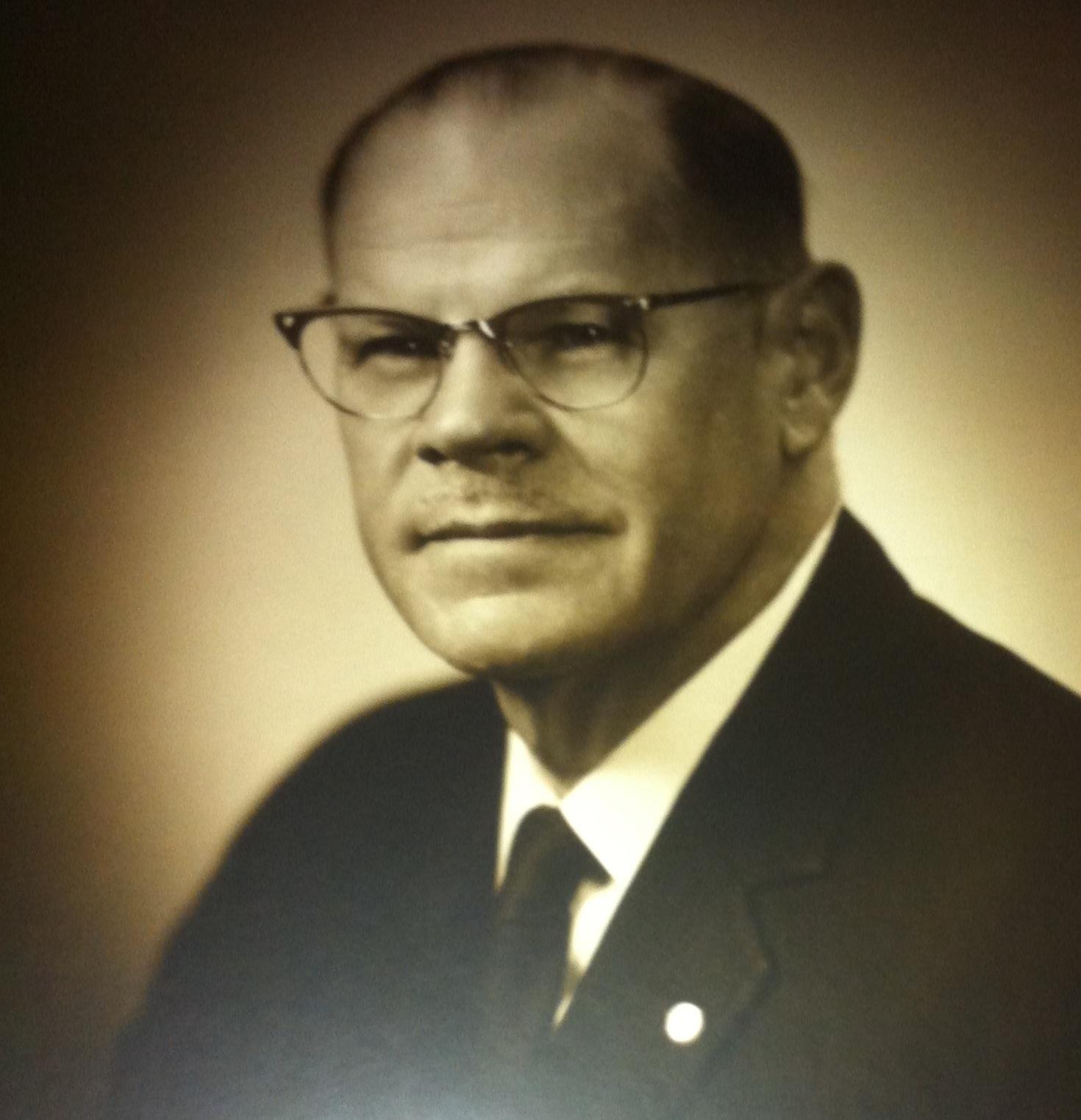
Mayor KnoopTo Little Rock citizens under a certain age, the name Knoop means Knoop Park — a picturesque park tucked away in a pocket of Hillcrest.  There are, however, still many who remember Werner C. Knoop as a business and political leader who helped shape Little Rock as a modern city.

Knoop was born on March 30, 1902.

In 1946, Knoop joined with Olen A. Cates and P. W. Baldwin to form Baldwin Construction Company in Little Rock.  Knoop had previously founded Capital Steel Company and established his business reputation there.  From 1945 through 1951, he served on the Little Rock School Board.

Following a series of political scandals, efforts were undertaken for Little Rock to shift from Mayor-Council to City Manager form of government.  Even before the desegregation of Little Rock Central put the city in the eyes of the world, an election for new leaders had been set for November 1957.  Knoop was on a “Good Government” slate and was one of the members elected.

At the first meeting of the new City Board, Werner C. Knoop was chosen by his fellow directors to serve as Little Rock Mayor.  Knoop served as Mayor until December 1962.  For the first several months in office, Little Rock had no City Manager so Knoop oversaw the transition of City staff as the forms of government changed.

Though City Hall generally stayed out of school district matters, that did not mean that the public viewed the two entities separately.  In September 1959, the Baldwin Construction offices were bombed as part of a series of terrorist activities protesting the desegregated reopening of all Little Rock high schools.

After two terms on the City Board, Knoop decided against seeking a third term.  He concluded his elected public service on December 31, 1962.  Following his time on the City Board, Knoop did not retire from Civic Affairs.  In 1970, he served as Chairman of the Little Rock Chamber of Commerce.   The previous year he served as President of the Arkansas Chapter of Associated General Contractors.

Mayor Knoop died in July 1983.  He is buried at Roselawn Memorial Park next to his wife Faith Yingling Knoop.

In the 1930s, Knoop moved into an Art Moderne house on Ozark Point in Hillcrest.  It was adjacent to Little Rock Waterworks property which was developed around the same time.  Eventually much of the land was deeded to the City for creation of a park.  In 1989, it was named in tribute to long-time neighbor Knoop in honor of his lifetime of service to Little Rock.

LR from Knoop Park

Downtown Little Rock as viewed from Knoop Park