11th Annual Arkansas Literary Festival Gets Underway Today

AR Lit Fest 2014The 11th annual Arkansas Literary Festival gets underway today and runs through Sunday, April 27. Unless otherwise specified the events are free.


Highlights for today are:

12 noon – Cox Creative Center
“Painting Forgiveness” featuring author Kathy Sanders (Now You See Me). The session will be moderated by Ann Nicholson.


12 noon – Oxford American Annex
“Cash” featuring author Robert Hilburn (Johnny Cash: The Life) and Rhett Miller. Maxwell George will be the moderator.


5:30 pm to 7:00 pm – Hearne Fine Art
“Words & Pictures” – Illustrated works by Kadir Nelson


6pm – Arkansas Arts Center
“Art & Food I” featuring Mary Ann Caws (The Modern Art Cookbook) with Brad Cushman as moderator. The author session is free. But at 7pm, a paid event will take place involving Ms. Caws and some foods inspired by art and artists.


6pm – Clinton School of Public Service at Sturgis Hall
“True Gratitude” featuring David Finkel (Thank You for Your Service) with Skip Rutherford as moderator.


8pm – South on Main
Rhett Miller will be in concert at South on Main. This is a paid event.


The Cox Creative Center will be having a used book sale on Thursday from 5pm to 7pm.

450 Years of the Bard

SHakes450Today is the traditionally observed birthday of William Shakespeare. It is known he was born in 1564, which makes this the 450th birthday.

The Arkansas Shakespeare Theatre earlier announced the lineup for the 2014 season.   The dates have now been announced.

Two Gentlemen of Verona by William Shakespeare – June 5, 6, 7, 13, 15, 19, 21, 22
Enjoy a romantic evening under the stars with Shakespeare’s comedy of best friends divided by love, featuring wise-cracking servants and a playful pup.  This will be performed outdoors at the Hendrix Village in Conway and in North Little Rock.  One of Shakespeare’s early plays, it features romantic mixups, disguises, deception and a happy ending, all of which would become hallmarks of Shakespeare’s comedies.

Pippin featuring libretto by Robert O. Hirson and score by Stephen Schwartz – June 11, 12, 13, 14, 15, 22, 25, 27
Based loosely on the lives of Charlemagne and Pepin, it tells the story of a young prince named Pippin who undertakes a musical journey of self-discovery that celebrates the magic of theatre. The current Broadway production was the winner of the 2013 Tony Award for Best Revival.  This will be presented in the Reynolds Center on the UCA campus.

Hamlet by William Shakespeare – June 20, 21, 24, 26, 28
Perhaps Shakespeare’s greatest tragedy, Prince Hamlet seeks to revenge his father’s death.  Directed by Robert Quinlan, who helmed the acclaimed 2012 production of Richard III, it will be presented in an intimate on-stage setting at the Reynolds Center.

The Comedy of Errors by William Shakespeare – June 24, 26, 28
This will be the touring production in a pared down special adaptation of Shakespeare’s rip-roaring farce, perfect for kids of all ages.


The Arkansas Repertory Theatre will be presenting The Compleat Wrks of Wllm Shkspr (Abridged) June 4 through 29.

A parody of the plays of William Shakespeare, this comic romp features all of the Bard’s plays being performed in shortened, and side-splitting, form.

Written by Adam Long, Daniel Singer, and Jess Winfield (former founding members of the Reduced Shakespeare Company) and first performed at the Edinburgh Festival Fringe in 1987, The Compleat Wrks of Wllm Shkspr (Abridged) later played at the Criterion Theatre in London, where it ran for nine record-breaking years.

It has become one of the world’s most popular shows, playing frequently in a variety of languages, and is most notable for holding the (self- proclaimed) world record for the shortest- ever performance of Hamlet, clocking in at just 43 seconds.

You don’t have to be a fan of Shakespeare, or even familiar with his plays, to enjoy this inventive, fast-paced comedy!

a parody of the plays of William Shakespeare, with all of them being performed in shortened, and side- splitting, form.

Written by Adam Long, Daniel Singer, and Jess Winfield (former founding members of the Reduced Shakespeare Company) and first performed at the Edinburgh Festival Fringe in 1987, The Compleat Wrks of Wllm Shkspr (Abridged) later played at the Criterion Theatre in London, where it ran for nine record-breaking years.

Rep Resident Director Nicole Capri

It has become one of the world’s most popular shows, playing frequently in a variety of languages, and is most notable for holding the (self- proclaimed) world record for the shortest- ever performance of Hamlet, clocking in at just 43 seconds.

You don’t have to be a fan of Shakespeare, or even familiar with his plays, to enjoy this inventive, fast-paced comedy!
– See more at: http://www.therep.org/attend/productions/CompleatWrksofWlmShkspr/#sthash.0dYAjSpc.dpuf

The Compleat Wrks of Wllm Shkspr (Abridged)

Little Rock Look Back: Charles E. Moyer, Little Rock’s 44th and 49th Mayor

Mayor MoyerOn April 18, 1880, future Little Rock Mayor Charles E. Moyer was born in Glenwood, Minnesota. A man of contradictions, he was both a candidate backed by (and probably personally involved in) the Ku Klux Klan, yet he also brought the Goodwill Industries organization to Little Rock and Arkansas to help those less fortunate.

He came to Little Rock shortly after the turn of the 20th century as a clerk in the Post Office, and later served as a mail carrier. He then worked for Plunkett-Jarrell Wholesale Grocer Company in Little Rock. On January 1, 1921, he took office as County Judge for Pulaski County. In 1924, he ran against incumbent mayor Ben Brickhouse in the Democratic primary. Since Brickhouse had displeased the Klan, which was an active part of Democratic politics in Little Rock and throughout the nation at the time, Moyer won the primary.

Mayor Moyer led the City of Little Rock from April 1925 through April 1929. In 1927, the last lynching in Little Rock took place. While race-baiting crowds were surrounding City Hall demanding an African American prisoner be released to them for vigilante justice, Mayor Moyer was in hiding at an undisclosed location. Not able to get the prisoner they wanted, they took out their venom on another man who had assaulted a white woman and her daughter.

After leaving office in 1929, Moyer moved for a time to Batesville. He returned to Little Rock and was a chief deputy sheriff. From 1937 to 1941, he served as Pulaski County Assessor. In 1941, he returned to the office of Little Rock Mayor after J. V. Satterfield opted to serve only one term and did not seek re-election. Mayor Moyer led Little Rock through most of World War II. He left office in April 1945 and died on May 29, 1945, barely only one month after leaving City Hall.

Little Rock Look Back: 106 Years at LR City Hall

CityHa78106 years ago today, Little Rock City Hall officially opened at the corner of Markham and Broadway.

On April 15, 1908, the Italian Renaissance Revival style building, which had been designed by local architect Charles Thompson, played host to an open house. Staff had started moving into the building in March of that year.   This was, as often is the case, behind schedule.  The date in the cornice toward the top of the building is 1907, but the building was not completed until 1908.

In 1903, W. E. Lenon became Mayor of Little Rock. Back then, the terms were two-year terms.  By the start of his second term in 1905, he realized that the City was outgrowing City Hall, which was, at the time, on the northeast corner of Markham and Louisiana – where part of the Statehouse Convention Center sits today.

In February 1906, Mayor Lenon appointed a committee of five aldermen to over see the planning for the building of a new City Hall. In July 1906, the City Council approved plans, which called for a City Hall with an municipal auditorium wing. There was some hue and cry about wasteful spending and a resulting lawsuit, so, in September 1906, those plans were scrapped and a simpler City Hall was approved for the cost of $175,000.

The last resolution in the old City Hall called for the banning of smoking in the new Council Chambers – while the Council was in session. This may well have been the first smoking ban in a public government building in the history of Arkansas.

When the building opened, the third floor was not finished out. The space was not needed. When the Museum of Natural History and Antiquities (now the Museum of Discovery) moved into City Hall in 1929, they had to finish out their space.

In 1913, the new Central Fire Station, designed in the Beaux Arts style, was constructed adjacent to City Hall. During the 1930s, as the City grew, more space was needed. A garage, designed in the “austere, utilitarian” style was built in 1936 and a City Jail Annex, built by the WPA in the modified Art Deco style was built in 1938.

City Hall prior to 1912

By 1955, the copper-clad dome which sat on top of City Hall needed severe repairs. The wooden supports and the copper cladding were both in dire shape. Mayor Pratt Remmel set aside money for the dome to be repaired. After defeating Remmel in his bid for a third term, Mayor Woodrow Mann scrapped plans for the repair and, indeed, scrapped the dome.

Following the lead of County Judge Arch Campbell who had removed the tower at the County Courthouse, Mann proposed removal of the dome. He had an informal survey which had three options: repair the dome, replace the dome with an aluminum one, or remove it. This was open to anyone to respond – voting eligibility or Little Rock residency did not matter. By a slim margin, remove the dome won – so the dome was removed.

In 1960, as air conditioning was installed, windows were bricked in to promote energy efficiency. At the time, the feeling was that a new City Hall would be constructed in the 1970s somewhere more central to the growing city. Relocation talk persisted throughout the 1970s and early 1980s. By that time, City Hall had been modified a great deal – with no thought about historic preservation. When the Police and Fire Department had moved out into their new facilities, their old spaces had become storage.

By 1984, the decision was made to stay at Markham and Broadway. An extensive renovation and restoration effort was undertaken. In 1988, the building reopened, and the interior had been restored to its 1908 appearance.

Little Rock Look Back: U S Grant speaks in Little Rock

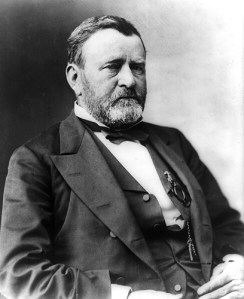
US_Grant_fOn April 15, 1880, former president Ulysses S. Grant spoke in Little Rock as part of his world tour. While here he made a couple of appearances and participated in a parade. It was Grant’s first visit to Arkansas either as a soldier or a politician.
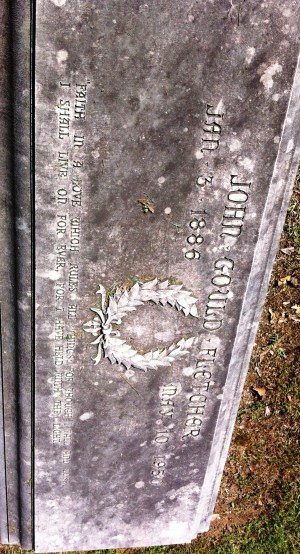
At his outdoor speech, his remarks followed brief comments by Governor William R. Miller and Mayor John Gould Fletcher (erroneously referred to as John C. Fletcher in the Memphis Appeal story the next day). Grant’s comments were brief and flowery. He thanked Arkansans for a warm welcome, praised the future prospects of Arkansas and discussed the demise of what he termed “sectionalism” which was undoubtedly a reference to the division between the Union and and former Confederate states.

Also that day, Grant addressed a banquet in Concordia Hall (now part of the Arkansas Studies Institute complex on the Central Arkansas Library downtown campus). His was one of fifteen toasts that evening. It was simply “The United States of America, forever United.” He expounded briefly on the theme of unity of citizens from all states. He also discussed immigration noting, “All foreigners find a welcome here. We make them American citizens. After we receive them, it is but one generation until they are Americans.” He noted that he could speak much more on the topic, but that since he was but one of fifteen toasts and that there was to be music after each toast, “It will be to-morrow (sic) orning when we get through if we all take as much time as the subjects admit of.”

Marker at the Capital Hotel noting Grant's visit. Note that it refers to him as General instead of President.  At the time, only sitting Presidents were referred to as President.

Marker at the Capital Hotel noting Grant’s visit. Notice that it refers to him as General instead of President. At the time, only sitting Presidents were referred to as President.

Grant arrived in Little Rock on the night of April 14 and lodged at the Capital Hotel. He undoubtedly enjoyed some whiskey and cigars while at the Capital. Grant had originally planned on departing in the afternoon of April 15, but Little Rock leaders pled with him to stay so that he could be honored at the banquet. He assented.

Not everyone was thrilled to have the former commander of the Union Army in Little Rock. The story goes that when he was parading down the street, some Little Rock women (in a display of Souther un-hospitality) sat in chairs with their backs to the parade route. But all in all, it appears to have been a successful visit for the man who was the only Republican in the 19th Century to win Arkansas’ Electoral votes.

A Prized Cemetery – Mount Holly on Pulitzer Day

The Pulitzer Prizes are to be announced today.  Mount Holly Cemetery not only touts that it is the site of a whole host of elected officials, it is also the only place in Arkansas where two Pulitzer Prize recipients are buried.

In 1939, John Gould Fletcher became the first Southern poet to win the Pulitzer Prize for Poetry.  He was born into a prominent Little Rock family in 1886.  Fletcher was awarded the prize for his collection Selected Poems which was published by Farrar in 1938.  Two years earlier, he had been commissioned by the Arkansas Gazette to compose an epic poem about the history of Arkansas in conjunction with the state’s centennial.

Fletcher is buried next to his wife, author Charlie May Simon and his parents (his father was former Little Rock Mayor John Gould Fletcher).  Other relatives are buried nearby in the cemetery.

The other Pulitzer Prize winner buried in Mount Holly is J. N. Heiskell, the longtime editor of the Arkansas Gazette.  It was Heiskell, in fact, who asked Fletcher to compose the poem about Arkansas.  Heiskell served as editor of the Gazette from 1902 through 1972.  He died at the age of 100 in 1972.
Under his leadership, the Gazette earned two Pulitzer Prizes for its coverage of the 1957 desegregation of Little Rock Central High.  One was for Harry Ashmore’s editorial writing and the other was for Public Service.

Heiskell remained in charge of the Gazette until his death in 1972.  He is buried alongside his wife with other relatives nearby.  Also not too far from Mr. Heiskell are two of his nemeses, proving that death and cemeteries can be the great equalizer. In the early days of his Gazette stewardship, he often locked horns with Senator (and former Governor) Jeff Davis. Later in Mr. Heiskell’s career, he vehemently disagreed with Dr. Dale Alford, who had been elected to Congress on a segregationist platform.

ROCKing the TONYS – Million Dollar Quartet

Rock the Tonys

Lewis, Perkins, Presley, Cash

Lewis, Perkins, Presley, Cash

Million Dollar Quartet – Johnny Cash, Jerry Lee Lewis, Carl Perkins, Elvis Presley

Little Rock connection: Though they never appeared onstage in Little Rock together, each of these four made various appearances in Little Rock throughout their careers – usually at Robinson Auditorium. Presley also appeared at Barton Coliseum, while one of Cash’s last appearances in Little Rock was at Wildwood Park for the Arts.

Tony Awards connection: A musical was written based on this quartet’s famous December 4, 1956 impromptu recording session at Memphis’ Sun Records. It opened on this date (April 11) in 2010 and ran for 489 performances. The show received three Tony nominations including one for Best Musical. Levi Kreis won the Featured Actor in a Musical Tony for his portrayal of Jerry Lee Lewis.

Celebrity Attractions will be bringing the national tour of Million Dollar Quartet to Central Arkansas next spring.