Sculpture Vulture: Bill Clinton

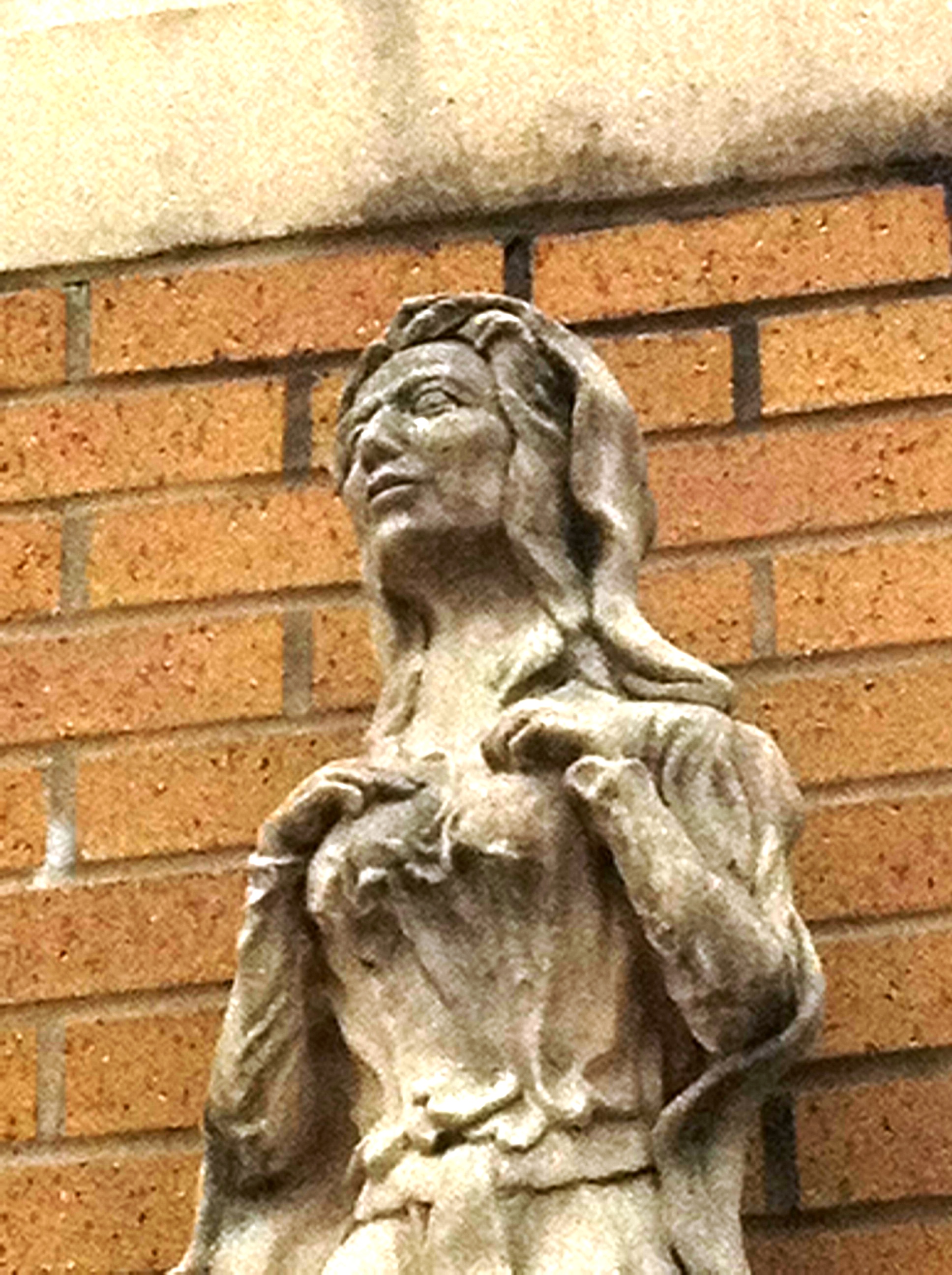
Tomorrow is not President’s Day, it is Washington’s Birthday.  But in honor of the only Arkansan to succeed Washington as President, today’s Sculpture Vulture highlights the bust of William Jefferson Clinton which is on the grounds of the Arkansas Governor’s Mansion.

The bust was commissioned in 1994 by the Little Rock Advertising and Promotion Commission.  It had originally been intended as more of a plaque featuring Clinton’s face. But sculptor Jan Woods, who had been selected to create the art, suggested turning it into a bust.  A bust does look more statesman-like and appropriate for the intention of honoring the only resident of the Governor’s Mansion who has also lived in the White House.

Woods created a very life-like, realistic depiction of Bill Clinton.  She captures the slight smile and intense gaze of his face which is part of what creates the feeling of empathy and personal connection even his harshest critics agree he possesses.  Unlike the JFK bust in the Kennedy Center which is abstract or the lifeless gazes so often found in busts and statues of earlier presidents, this bust captures the essence of the man.

The bust sits on the front lawn of the Arkansas Governor’s Mansion to the west of the main gate.  Even when the grounds are closed, it is visible to the public through the fence.

Old State House: Growing Up in Arkansas

The Old State House museum opens a new exhibit today – “Things You Need to Hear: Memories of Growing Up in Arkansas from 1890 to 1980.” The exhibit is a collective memory of growing up in Arkansas from 1890 to 1980 and is told by the people who did it.  Through the exhibit, Growing Up in Arkansas, curator Dr. Margaret Jones Bolsterli conveys the importance of passing family histories from one generation to another.

The exhibit is comprised of five themes: community, family, work, school, and leisure. Bolsterli said that she “envisions this exhibit as a collective memory of growing up in Arkansas told by the people who did it.” Oral histories will be a highlight of the exhibit, some included in surprising ways. Each theme of the exhibit will be encapsulated in its own vignette, detailing a special sense of time and place. Artifacts will be included in each of these settings, revealing the layers of what life was like for past generations. Visitors will experience these time capsules and reflect on the past in Arkansas.

The museum, a division of the Department of Arkansas Heritage, is open from9am to 5pm on Monday through Saturday. On Sunday it is open from 1pm to 5pm.

Time to Return to MacArthur Museum of Arkansas Military History

Tomorrow afternoon (2/16), the MacArthur Museum of Arkansas Military History will open a new exhibit on the life and career of General Douglas MacArthur.  The building which houses the museum was the birthplace of the future five star general.  As a part of the reception, a new painting will be unveiled in commemoration of the 136th anniversary of his birth.

The reception is from 4 p.m. to 6 p.m. on February 16 at the museum in historic MacArthur Park.

While at the museum, be sure and check out A Splendid Little War: Arkansas and the Spanish-American War which runs through April.  It explores America’s role in the brief war with Spain over territory, the destruction of the “USS Maine” and the many Arkansans who volunteered for service during the war. On display are uniforms, weapons, a battle flag from the 2nd Arkansas Volunteer Infantry, memorabilia surrounding the war and many other artifacts used by Arkansans serving in the war.

February Frieze Frame Friday, Part Deux

Today’s February Frieze Frame Friday is the entrance to the old Little Rock City Jail.  This building, which sits behind City Hall, was the jail from the 1930s through the early 1960s.  It now serves as a parking garage, Parks & Recreation maintenance area, and city employee fitness facility.

Though the entrance below the frieze has long been bricked in, the jail bars are still detectable above the frieze.

This building was constructed by the WPA. The classical meets deco style of the frieze is typical of the works from that era.

For decades a metal awning bisected the frieze making it undetectable to people who walked by it.  But in 2007, as part of some renovations to the building (spearheaded by city employee Susan K. Langley), the awning was removed and the frieze became more prominent.  (As prominent as can be when the frieze is right at Broadway street level and is blocked from Broadway traffic by balustrades.

Vote for LR Main Street!

dwell believes that designing for the modern world begins with honoring the precedents of the past. So it joined forces with Sub-Zero to conceive a contest dedicated to rethinking preservation!  Little Rock was nominated and now it is time to vote! A panel of judges selects the winner from the top ten that receive the most votes.  dwell donates $10,000 to a worthy preservation organization. To get in the preservation spirit read the special digital issue Rethinking Preservation presented by Sub-Zero.

This is what they say about Little Rock:

Main Street Little Rock, Arkansas represents a well-known story. In its heyday, it was filled with department stores, restaurants and offices. It was the center of commerce, close to government, and had architecturally renowned buildings. Arkansas’s history can be connected to Main Street for generations. Today, there are a handful of businesses along the street supported by loyal locals, but most former department store and office buildings are now vacant or have been demolished for surface parking. Main Street has struggled for the past few decades, but is now poised to be a leader in downtown redevelopment in the South.

Little Rock has seen significant success with the development of areas surrounding Main Street, and there are new tax incentives in place for historic rehabilitation projects. Sadly, several historic buildings have been lost unnecessarily, but many significant buildings remain. Main Street is worthy of preservation because it represents the heart of Arkansas and it presents a rare opportunity to make Little Rock a leader in sustainable development.

Imagine: well designed, environmentally sensitive infill buildings working in conjunction with LEED certified rehabilitated historic buildings.

UALR Evenings with History: How an Arkansan taught Chinese Nationalism

The UALR Evenings with History program resumes for 2012 tomorrow night (February 7) with Jeffrey Kyong-McClain’s “The Heavenly History of the Han, or How a Liberal Baptist from Green Forest, Arkansas Taught Racial and Ethnic Nationalism to the Chinese.”

In the early years of the twentieth century, Chinese (or “Han”) nationalists were searching for ways to convert a tradition-bound and multi-cultural empire into a modern nation-state. Although, in the minds of these nationalists, foreign missionaries were a big part of China’s problem, many such missionaries in fact aided the Chinese against the non-Chinese in questions over who had the historical right to rule the borderlands, thereby helping Chinese nationalists assert their purported rights over vast amounts of territory.

This talk looks at the case of one missionary particularly active in this regard, Arkansan D.C. Graham, who blended liberal theology with a Social Darwinian belief in the superiority of the Chinese over the other people groups in the region (southwest China). Graham propagated this belief as the pioneer of modern archaeology and ethnography in Sichuan province in the 1920s and 1930s, and his ideas remain influential in the region to this day.

A member of the UALR History faculty, Dr. Kyong-McClain was born and raised in Minneapolis. He received a BA in History from the University of Minnesota and an MA in Theology from Bethel Seminary, St. Paul, before beginning graduate work in Chinese History at the University of Illinois, Urbana-Champaign. He lived for three years in the city of Chengdu, in southwestern China, the last year on a Fulbright-Hays dissertation grant. His research centers on the place of archaeology in modern Chinese nation-building; teaching interests include modern China and modern Korea, and anything pertaining to Sino-Western interaction.

The Evenings with History take place in the Ottenheimer Auditorium in the Historic Arkansas Museum at 200 E. Third Street. Refreshments are served at 7:00 p.m., and the talk begins at 7:30 p.m.

Corporate sponsors for the 2011-2012 season are Delta Trust, Union Pacific Railroad, the Little Rock School District—Teaching American History Program; the law firms of Friday, Eldredge, & Clark and Wright, Lindsey & Jennings. Also thanks for support and gifts in kind from the Ottenheimer Library; Historic Arkansas Museum, a museum of the Department of Arkansas Heritage; UALR Public Radio–KLRE-KUAR; and Grapevine Spirits

Sculpture Vulture: The Spirit of Central High

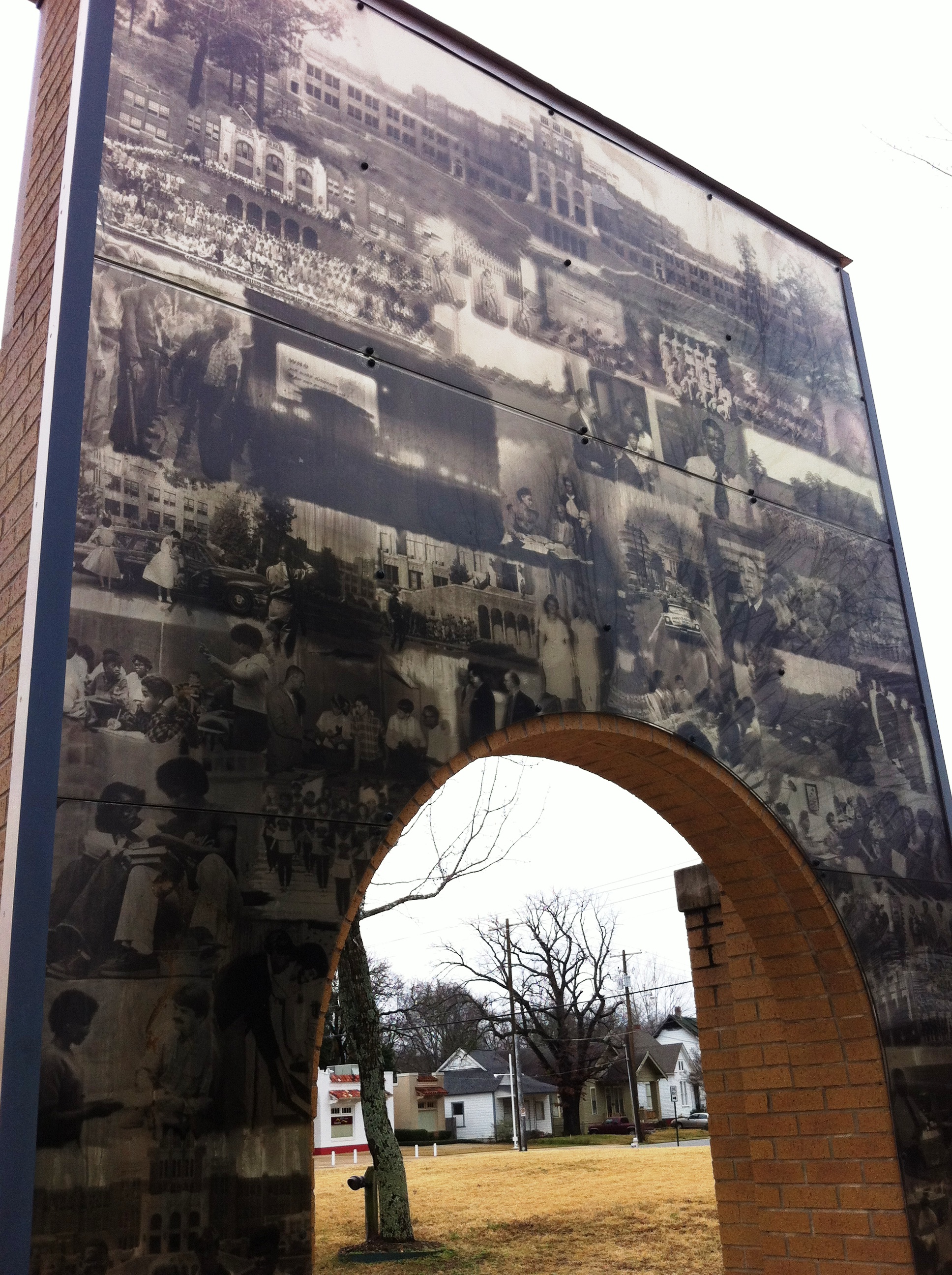
Located at the northwest corner of Park and Daisy L. Gatson Bates is the Central High School Commemorative Garden. The showcase of the garden is a sculpture created by Michael Warrick and Aaron P. Hussey.

The focal point of this piece is a pair of archways. The outward facing sides of each archway evokes the architecture of the historic high school through the buff bricks, cornice work and even statues.

On the reverse are a series of black and white photographs depicting the rich history and legacy of the school from its construction in 1927 through 2000.

By depicting a variety of decades and events, this sculpture does not shy away from 1957 there are images from that school year included. These several dozen photographs represent the hundreds of thousands of students who have gone to high school in this building since the doors first opened.

Nor does the sculpture try to explain away or justify actions. Instead it embraces the roots of excellence which gave birth to the school and shows the manifestation of that excellence in modern times which has been made possible by the crucible that was the flashpoint of 1957.