Elvis Lives – or at least he will be on stage of Arkansas Rep in September with MILLION DOLLAR QUARTET

August 16 marks the 42nd anniversary of the death of Elvis Presley.  (Or did he die?  Is he actually living in seclusion with JFK and others?)

In September, Elvis will come back to life as the Arkansas Repertory Theatre presents MILLION DOLLAR QUARTET.

Four musical legends. A one-in-a-million recording session.
On December 4, 1956, in the studios of Sun Records in Memphis, Elvis Presley, Johnny Cash, Carl Perkins, and Jerry Lee Lewis gathered to meet with legendary producer Sam Philips. What happened next was pure rock and roll magic.

A casual introduction of Lewis to Perkins unexpectedly evolved into an epic jam session of country, gospel and rock classics, captured on tape but not released until 1981.

With a collection of hit songs that includes “Blue Suede Shoes,” “Folsom Prison Blues,” “Great Balls of Fire,” and “Hound Dog,” this Tony Award-winning musical is guaranteed to blow the roof off!

The show, which won a Tony Award and was nominated for Best Musical, was written by Colin Escott and Floyd Mutrux.  The Rep’s production is directed by Hunter Foster who played Sam Phillips in the original Broadway cast.
The production opens on September 6 and plays through October 6.

Celebrate Country Music tonight at CALS Ron Robinson Theater

Join the Central Arkansas Library System as they celebrate country music with a screening of the 45-minute advance trailer of Ken Burns’ Country Music documentary.

The showing will be followed by a special performance of classic country songs by The Salty Dogs and special guests Buck TrentTim Crouch and Chuck Dodson.

The sixteen-hour Country Music film premieres September 15th on AETN/PBS.

This event is FREE and open to the public with general admission seating on a first come, first served basis. Doors open at 7:00pm and the event starts at 8:00pm.

Presented by CALS Arkansas Sounds and AETN/PBS.

Little Rock Look Back: Birth of longtime Arkansas Arts Center director Townsend Wolfe

Townsend Wolfe, who led the Arkansas Arts Center for 34 years, was born on August 15, 1935.  He was hired to lead the Arkansas Arts Center 50 years ago this month.

Though not the founding director of the Arkansas Arts Center, Wolfe was the director for well over half of the institution’s 57 year history. Hired in 1968 at the age of 32 (making him one of the youngest art museum directors in the US at the time), he retired in 2002.  That year he was honored with the Governor’s Arts Award for Lifetime Achievement by the Arkansas Arts Council.

A native of South Carolina, Wolfe held a bachelor’s degree from the Atlanta Art Institute and a master’s degree from the Cranbrook Academy of Art. He also received a certificate from the Harvard Institute of Arts Administration, and honorary doctoral degrees from two other institutions.  After teaching some classes and seminars at the AAC in the early 1960s, he was recruited to return full-time to the Arkansas Arts Center by Governor and Mrs. Winthrop Rockefeller.

During his tenure at the Arts Center, he first was responsible for creating financial stability. After drastic cost-cutting measures, he refocused programming which led to the creation of the current Museum School, a focus of works on paper for the collection, cultivating a thriving collectors group, establishment of a children’s theatre, expansion of statewide services, and several additions to the physical structure.  He encouraged others to collect art and expanded Arts Center programming into Little Rock neighborhoods.

In addition to serving on the National Council of the Arts, Wolfe was a member of the National Museum Services Board and the board of the Elizabeth Foundation for the Arts in New York. He was curator for an exhibition in the First Ladies’ Sculpture Garden at the White House in 1995, and was the recipient of the 1997 Distinguished Service Award (outside the profession) by the National Art Educators Association.

Over the years, Wolfe has served in a variety of capacities for the Association of American Museums, the National Endowment for the Arts, and the Institute of Museum and Library Services.

Wolfe, who died in 2017, was posthumously honored by the Arts Center in 2018 with one of its Portrait of a Patron awards.  In 1973, he received the first Winthrop Rockefeller Memorial Award from the Arkansas Arts Center.

Little Rock Look Back: The Culture Vulture Goes to School

The Little Rock School District and many area schools start back this week.  Here is a look back to Kindergarten and First Grade for me.

PS – Just because I am wearing turtlenecks in two of the three photos does not mean I have EVER liked them.  Hated them. But when your parents buy your clothes, you wear what you have.  And hey, it was the 1970s.  The collared shirt was from Singapore, it was a gift from an uncle I had who lived there for a few years. I liked it a lot – not just because it had a collar.

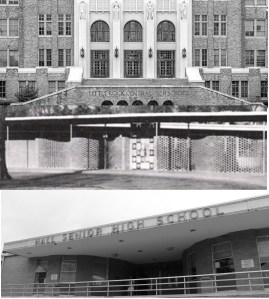
Little Rock Look Back: Classes resume in Little Rock high schools

On August 12, 1959, something remarkable and yet unremarkable happened.  Little Rock teenagers started the high school year.

After turmoil and no classes in 1958-1959 (dubbed the Lost Year), the state law allowing for schools to be shut down in order to keep them segregated had been overturned.

The six new school board members (all of whom had started since December 1958) decided to start classes in the middle of August instead of the traditional post-Labor Day start. The original start date of post-Labor Day was changed in an announcement on Monday, August 4.  Among the reasons was to get classes started before Gov. Faubus could convene the Arkansas General Assembly into special session and create more mischief in order to try to keep Little Rock’s high Schools segregated.

While it WAS important to have the schools reopened, the desegregation was minimal.  Originally, only three African Americans were admitted to Central High (Jefferson Thomas, Elizabeth Eckford, and Carlotta Walls, who had all been part of the Little Rock Nine) and only three were admitted to Hall High.  One of the three admitted to Central, Eckford, had enough credits due to correspondence courses, and did not enroll.

On August 12, about 1,000 segregationists attended a rally at the State Capitol hearing from Gov. Faubus and other speakers.  After it was over, about 250 marched or drove toward Central High School.  A block away from the school, they met a phalanx of police officers who turned them away.  When the marchers broke into rioters, the Fire Department turned its hoses on them. The police ended up arresting 24 people.  (This more active response by Police and Fire personnel was a marked difference from two years prior.)

After the school year started, the School Board interviewed over a dozen African American students who wished to transfer from Horace Mann to either Central, Hall, or Technical high schools.  Of these, three would be admitted to Central, including sophomore Sybil L. Jordan (now better known as Dr. Sybil Jordan Hampton).