
Little Rock Look Back: Post-Civil War government resumes for Little Rock

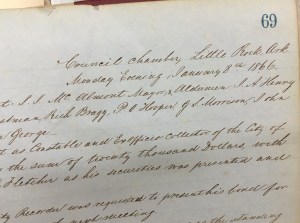
One hundred and fifty three years ago today (on January 8, 1866), Little Rock City Hall resumed functioning after the Civil War.  The City government had disbanded in September 1863 after the Battle of Little Rock.  From September 1863 through the end of the war (on on through part of Reconstruction), Little Rock was under control of Union forces.

Following the April 1865 conclusion of the Civil War, plans were made to restart local government in Little Rock.  Even though Arkansas would not have Congressional representation in Washington until June 1868 (becoming the second Confederate state after Tennessee), the establishment of local government took place in January 1866.  (It was supposed to have started earlier, but the local elections set for November 1865 were cancelled on the day they were originally set to take place.)

The first City Council meeting took place on Monday, January 8, 1866. The council met again on Tuesday, January 9 and Monday, January 15 as they were trying to establish committees and rules for the new government.

The first post-Civil War mayor was Dr. J. J. McAlmont, who was a physician and pharmacist. Following his service as the city’s chief executive, he would later be a co-founder of what is now UAMS.  The initial aldermen were I.A. Henry (who had been on the City Council when it ceased in 1863), Henry Ashley, M. H. Eastman, Rick Bragg, Dr. P. O. Hooper, G. S. Morrison, John Collins and Alexander George.

Their first action was to approve the bond of Thomas C. Scott as Constable and City Collector.  Vouching for him were S. H. Tucker and future LR mayor John Gould Fletcher.  The Recorder was asked to present his bond and the next meeting.

The Mayor then established several committees of the City Council and named his appointments. Among the committees were Finances, Streets, Ordinances, Mount Holly Cemetery, Fire Department and Police.

That meeting and the following two meetings, the City continued to approve motions, resolutions and ordinances to set up the duties and responsibilities of a government.

Ordinance Number 1 established the rates of Licenses for 1866.  Among those were:

  • $100 for the privilege of selling goods at auction
  • $20 for a one-horse wagon, paid quarterly
  • $35 for a two-horse wagon, paid quarterly
  • $50 for a four-horse wagon, paid quarterly
  • $25 to run a cab or bus (which would have been in some horse drawn conveyance), paid quarterly
  • $40 a month to sell liquor, wine, ale, beer, etc., by the glass or bottle to be consumed in a store, tavern, shop or store
  • $25 each quarter for each billiard table
  • $50 each quarter for each ten pin alley
Little Rock Look Back: First documented theatrical performance in Little Rock

On January 8, 1835, the Little Rock Town Council passed an ordinance granting the Society of Thalians a one year franchise to conduct performances in Little Rock.

That same day, the Thalians performed She Stoops to Conquer, Oliver Goldsmith’s 1773 comedy.

The following week, on January 17, they performed the comedy Ways and Means (by George Colman, Jr.) and David Garrick’s farce The Lying Valet.

The cost of the license to perform was $10 for the year. That would be the equivalent of $287 today. The ordinance also instructed the Town Constable to attend, by himself or a deputy, all theatrical performances to keep and preserve order.

There may well have been theatrical troupes come through Little Rock prior to January 1835, but records do not exist to any performances they may have given.  The performances by the Thalians are the first documented theatrical productions in Little Rock.

Elvis at 84

Elvis backstage at Robinson–photo by Wayne Cranford

Eighty-four years ago today, Elvis Presley was born in Tupelo, Mississippi. He would, of course, grow up to become a cultural phenomenon.

Elvis performed in Little Rock throughout his career. In April 1972, he played at Barton Coliseum (with tickets on the arena floor going for a whopping $10!). In the 1950s, he played three at Robinson Auditorium. His first appearance was as his career was just starting to take off. The final appearance on that stage, a mere 15 months later, was when he had become a national icon.

His first appearance at Robinson was on February 20, 1955. Billed as the “WSM Grand Ole Opry” show, Elvis Presley was third on the bill behind the Duke of Paducah and Mother Maybelle and the Carter Sisters as he began week long tour of Arkansas and Louisiana. On this date there were a pair of shows, at 3:00 and 8:15 p.m., at Robinson Auditorium. Tickets were 75-cents in advance, $1.00 at the box office and 50-cents for kids. It is believed that Gladys and Vernon Presley attended this performance, invited by Elvis who wanted to introduce them to the Colonel. Gladys was a big fan of the Duke of Paducah. Elvis Presley, Scotty Moore, and Bill Black receive $350 for these two shows instead of their usual $200 per day. In August 1955, he returned and played Robinson as part of the All-Star Jamboree.

His third and final appearance at Robinson Auditorium was on May 16, 1956. This time, the Auditorium was packed. The tickets were $1.50 in advance at Walgreens and $2.00 at the box office. The ads featured 8 great acts in “his” variety show which consisted of the Jordonaires; Rick and Emil Flaim and their orchestra; vocalists Frankie Conners and Jackie Little and comedian-magician Phil Maraquin. A second show was added to accommodate the ticket demand.

About 30 minutes late, due to a missed flight, Elvis appeared on stage in a purple blazer and started singing “Heartbreak Hotel.” The crowd rushed the stage. Little Rock police officers were able to control them eventually and get the teenagers back to their seats. While the crowd was impressed, the police officers were less so. One of the patrolmen told the Arkansas Gazette reporter: “I wouldn’t know him if I saw him. And I wouldn’t be here unless I was being paid.”

Little Rock Look Back: John Gould Fletcher, patriarch of Little Rock civic and cultural leaders

Future Little Rock Mayor John Gould Fletcher was born on January 6 in 1831.  He was a mayor and civic leader at a crucial time in Little Rock’s 19th century life. But his lasting legacy is probably more his remarkable children, grandchildren, great-grandchildren, and great-great-grandchildren. (Undoubtedly his great-great-great-grandchildren will be equally remarkable.)

The son of Henry Lewis and Mary Lindsey Fletcher, he later served as a Captain in the Capital Guards during the Civil War. One of his fellow soldiers was Peter Hotze. Following the war, he and Hotze began a general merchandise store in Little Rock. They were so successful that they eventually dropped the retail trade and dealt only in cotton. Peter Hotze had his office in New York, while Fletcher supervised company operations in Little Rock. In 1878 Fletcher married Miss Adolphine Krause, sister-in-law of Hotze.

John Gould Fletcher was elected Mayor of Little Rock from 1875 to 1881. He was the first Mayor under Arkansas’ new constitution which returned all executive powers to the office of the Mayor (they had been split under a reconstruction constitution). Following his service as Mayor, he served one term as Pulaski County Sheriff. Mayor Fletcher also later served as president of the German National Bank in Little Rock.

Mayor and Mrs. Fletcher had five children, three of whom lived into adulthood. Their son was future Pulitzer Prize winning poet John Gould Fletcher (neither father nor son used the Sr. or Jr. designation). Their two daughters who lived to adulthood were Adolphine Fletcher Terry (whose husband David served in Congress) and Mary Fletcher Drennan.

In 1889, Mayor Fletcher purchased the Pike House in downtown Little Rock. The structure later became known as the Pike-Fletcher-Terry House. It was from this house that Adolphine Fletcher Terry organized the Women’s Emergency Committee which worked to reopen the Little Rock public schools during the 1958-1959 school year.

In the 1960s, sisters Adolphine Fletcher Terry and Mary Fletcher Drennan deeded the house to the City of Little Rock for use by the Arkansas Arts Center. For several decades it served as home to the Arts Center’s contemporary craft collection. It now is used for special events and exhibitions.

Mayor Fletcher died in 1906 and is buried in Mount Holly Cemetery along with various members of his family. Several of his descendants still reside in Little Rock.

Little Rock Look Back: Voters annex Pulaski Heights into Little Rock

On January 4, 1916, voters in Little Rock and Pulaski Heights voted overwhelmingly to annex the latter into the former.

First platted in 1890, Pulaski Heights had been incorporated as a city in August 1905.  By 1915, Pulaski Heights was booming.  It was growing so fast, that its infrastructure and public safety needs were far outpacing the city’s ability to pay for them.  Though there was a ribbon of commercial businesses along Prospect Avenue (now Kavanaugh Boulevard), it did not produce enough sales tax revenue to pay for City services. Then, as now, property taxes were also an important part of city revenue sources but not sufficient without sales taxes.

The City of Little Rock, likewise, was looking for ways to grow physically. At the time, the City was hemmed in by a river to the north and low, marshy land to the east. Current development was to the south, but even that presented limits in the foreseeable future. The best option was to grow to the west, but Pulaski Heights was in the way.  In 1915, Little Rock Mayor Charles Taylor (after failing in a previous attempt to re-annex North Little Rock into Little Rock), approached Pulaski Heights leadership about the possibility of annexation.

010516 PH electionIn November 1915, there were public meetings in Little Rock and Pulaski Heights to discuss the issue.  As a part of the annexation, Little Rock promised to build a fire station in the area and to install traffic lights, sidewalks and pave more streets.

On January 4, 1916, Little Rock voters approved the annexation of Pulaski Heights by a ten-to-one margin. The majority of Pulaski Heights residents also approved the deal.  The suburb became the city’s ninth ward.

This established a couple of precedents for the City of Little Rock which are in effect to this day.  The first is that Little Rock would not be a central city surrounded by a variety of small incorporated towns (in the manner that St. Louis and other cities are).  It was this thought process which has led the City to continue to annex properties.

18 Cultural Events of 2018 – UA Little Rock unveils restored Joe Jones mural from 1930s

As curator Brad Cushman said at the unveiling of the Joe Jones mural, “There is absolutely no reason this mural should still exist.”  But it does.  And now fully restored Jones’s 1935 mural The Struggle in the South is a centerpiece of the new UA Little Rock Downtown Campus in the heart of the River Market.

First painted in the 1935 to be placed at Commonwealth College in Mena, it spent many years lining two closets in a house after it had been taken down from its original location. When that house was being torn down, someone called Bobby Roberts because they thought it might be something worth saving.

Dr. Roberts drove to west Arkansas, picked it up, and brought it back to Little Rock.  For years it sat in storage at UA Little Rock. While that probably stopped its deterioration, it did nothing to restore it.

In 2009, the St. Louis Art Museum restored one panel of it to include in an exhibition on Jones, a native of the Gateway City.  That prompted Cushman to push even harder to have the rest of it restored.  In 2012, the Arkansas Natural and Cultural Resources Council provided a grant which made restoration possible.  Additional funding came from the University and the National Endowment for the Humanities.  The 29 pieces of the mural were sent to Helen Houp Fine Art Conservation in Dallas.

The mural consists of three sections that brutally but honestly tell tales of the South in the first third of the 20th Century.  The first section depicts coal miners about to go on strike, the middle section shows a lynching of an African American man, and the third shows an African American family in fear inside a wooden shack – both in the shadow of the lynching and an impending tornado set to destroy the land they are working.

It is a difficult piece. It is intended to be disquieting. But UA Little Rock also sought to put the piece in context. They did not do this to explain away or make excuses. But they did it to relate it to events in Little Rock both during that time period and other times in the City’s history.  It is designed to encourage dialogue, scholarship, and collaborations.

The space in which the mural is displayed was designed by architect Steve Rousseau.  Credit goes to the UA Little Rock Board of Visitors, Chancellor Andrew Rogerson, and many other faculty and staff at the campus for making the UA Little Rock Downtown campus a reality and a showcase for this important mural.

18 Cultural Events from 2018 – Reopening of MacArthur Museum of Arkansas Military History

After several months of renovations to the building, the MacArthur Museum of Arkansas Military History reopened on September 29.

The museum closed in March 2018 for five months of extensive structural work.  The $1.5 million renovation for the 178-year old structure included both interior and exterior upgrades.  The first phase of the project, which began last December, involved renovation to the north and south porches and was partially funded by a Historic Preservation Restoration Grant from the Department of Arkansas Heritage. The interior renovation includes upgrades to the heating and cooling systems, installation of new lighting, and repainting of interior gallery spaces.

Funding for the renovations came from proceeds of a hotel tax which was approved by Little Rock voters in February 2016.

The MacArthur Museum of Arkansas Military History was created to interpret our state’s military heritage from its territorial period to the present. It is a program of the City of Little Rock’s Department of Parks and Recreation.

Located in the historic Tower Building of the Little Rock Arsenal–the birthplace of General Douglas MacArthur–the museum preserves the contributions of Arkansas men and women who served in the armed forces.  Exhibits feature artifacts, photographs, weapons, documents, uniforms and other military items that vividly portray Arkansas’s military history at home and abroad.

In conjunction with the reopening, there will be a belated 125th birthday party for MacArthur Park. (The park actually opened on July 4, 1893.)  Originally known as Arsenal Park, it became known as City Park shortly thereafter. In 1942, it was renamed in honor of Gen. Douglas MacArthur, who was born there. At the time he was commanding US troops in the Pacific Theatre of Operations during World War II.

At ten that day, Vice Mayor Kathy Webb and other officials cut the ribbon to officially reopen the facility.