
Little Rock Look Back: Basketball comes to Robinson Auditorium

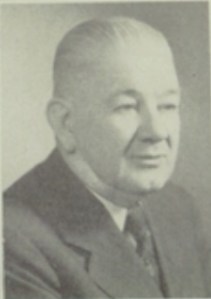
Coach Earl Quigley in the 1940s

While Joseph Taylor Robinson Memorial Auditorium is known today as a performance and meeting venue, in its early days it was also the home to sports. Seventy-eight years ago tonight the first basketball game was played at Robinson.

One of the first regular activities which took place in the lower level exhibition hall was a series of boxing and wrestling matches.  Building on the success of this, basketball came to the convention hall in January 1940.

A series of games featuring Little Rock High School and North Little Rock High School were announced by Tiger Coach Earl Quigley to take place from January 11 through February 16, the official opening day for the facility.

At that time, neither high school had a gymnasium; therefore both schools played their basketball games on their school auditorium stages with fans seated in the audience. The convention hall offered a regulation size floor (made of pecan block parquet) with seating for over 1,300 people along the sidelines and in the balcony.  The first men’s basketball game in Robinson Auditorium took place between the Little Rock High School Tigers and the North Little Rock High School Wildcats on January 11, 1940.

The Tigers lost the game before a crowd estimated to be 1,300.  Earlier in the evening there had been an exhibition between two women’s basketball teams.  The cost for admission to the games was 35 cents for the reserved seating and 25 cents for general admission.
2nd Friday Art Night – Old State House Museum

Celebrate the New Year with a musical journey!

During 2nd Friday Art Night on January 11, the Bob Boyd Sounds will perform a mix of popular standards, swing, and popular jazz spanning several decades.

Stone’s Throw Brewing will serve Arkansas-made brews, including the award-winning Pre-Prohibition Porter.


2nd Friday Art Night – Historic Arkansas Museum offers Dave Miller and Rocktown Revival

There may not be a Nog Off this month, but 2nd Friday Art Night at HAM still offers a lot of fun!

Historic Arkansas Museum is kicking off the first 2nd Friday Art Night of 2019 with Little Rock’s Dave Miller and Rocktown Revival!

Miller is a musical storyteller, evoking images of places and relationships in the Sotuh and who “entertains audiences with his ready wit and warm expression of a kind of Ozark-bred joy and wonder.”

The Water Buffalo and Buffalo Brewing Company will be serving up the brew for the evening.

Exhibits at the museum include:

  • Face to Face: Contemporary Portraits
  • More or Less: Liz Smith & Katherine Strause
  • History in Color: The Spectrum of Daily Life in Early America

Little Rock Look Back: End of City of Pulaski Heights

103 years ago today, the Pulaski Heights City Council held its final meeting.  Following the January 4 annexation election, Mayor L. H. Bradley convened the Pulaski Height City Council for the final time on January 10, 1916.

Five of the eight aldermen were present for the final meeting.  E. T. Reaves, R. G. Trickett, W.A. Turner, J. B. Webster, and H.C. Locklar.  Absent were J. S. Murphy, J.H. Hicks, and W. H. Keeton.

The City Recorder was A. M. Edwards, while O. E. White was Treasurer and Jonathan P. Streepey was City Attorney.

At the meeting, bills were paid and allowances were made for the transfer of assets and responsibilities to the City of Little Rock.  The minutes do not reflect if there were any valedictory addresses by any of the elected officials, which were common at that era.

Once Mayor Bradley and the Council had worked their way through the agenda, Alderman Reaves made the motion to adjourn the council sine die which was seconded by Alderman Webster. The motion passed unanimously.  With that, the Pulaski Heights City Council, which had first met in 1904, finished its business.

Tonight at 7, ACANSA presents EINSTEIN!

ACANSA does more than just present the annual festival in September. They are kicking off their 2019 programming with the one man play Einstein! ~ Celebrating 100 Years of General Relativity

This award-winning one-man show has it all: as dramatic as it is funny, as uplifting as it is contemplative, Albert Einstein comes to life before your very eyes.  This solo play is written and performed by Jack Fry and directed by Tom Blomquist.

This is the multi-award winning and critically acclaimed show that has over 150 performances under its belt.  This 80-minute show is designed for a general audience and has played in many venues around the country.   Einstein comes back from the beyond.

Frustrated that no one has heard the real science history behind General Relativity, Albert takes us back to Berlin in 1914 where he is sent sideways in a world crumbling around him due to The Great War, colleagues trying to steal his theories, being isolated for his pacifist views, a wife who won’t give him a divorce, his failing health, a huge scientific backlash, anti-Semitism, his own self destructive genius, and his 10-year old son fighting for his father’s affections.  Told with humor, 3D graphics that help give us an insight to his brilliant mind,  Albert Einstein comes to life as Jack Fry revitalizes one of the most intriguing icons of all time.

The program will be at the Argenta Community Theatre. Doors open at 6pm, the performance starts at 7pm. Tickets are $30.

Preservation Conversation tonight – Mason Toms discusses Little Rock’s built environment

Image may contain: house, tree, grass, sky, outdoor and text
A city’s built environment is a tangible link to the past. Walking the streets of cities can be a lesson in architectural history, if you know where to look. Due to the its economic and cultural prominence, Little Rock boasts the best collection of architectural styles in the state of Arkansas . The first Preservation Conversation of 2019 will explore the multitude of different forms that the architecture of the city has taken on over the last 189 years. Learn about what these styles meant to the people that built them and how they related to each other.

The event will take place in the Mixing Room at the Old Paint Factory in the East Village, 1306 East 6th Street, 72202
What Time: 5:30 pm (reception); 6:00 pm (lecture)
RSVP: The event is free and open to the public, but please RSVP. 
Parking: There is parking directly in front of the doors that are marked “live”, “print”, “meet.” If those spots are taken. park in the parking lot to the right. There is also street parking in front of the building.
Entrance: Enter the event space through the door facing 6th Street marked “Meet.”

Questions? Call 501-371-0075 ext. 3 or email qqa@quapaw.com

Speaker Bio: 

Mason Toms is an architectural historian and preservation designer at the Arkansas Historic Preservation Program. He works within the Main Street Arkansas program to assist building owners in historic downtowns to preserve their facades and storefronts, while still making them visually appealing to the changing demographics of the areas. Mason also works closely with the National Register and Survey staff to research and survey Mid-Century Modern architecture around Arkansas. To get the word out about the many remarkable Modernist structures in Arkansas to the general public, Mason created and continues to administer the Facebook group Mid-Century Modern Arkansas, which features a different Modernist building in the state every Friday.

Little Rock Look Back: First six Little Rock Police officers are hired

On January 9, 1866, the new Little Rock City Council held its second meeting after the post-Civil War resumption of municipal government.  At that meeting, a special committee was created to meet with Gen. Williams who was the military commander for Arkansas.  Mayor J. J. McAlmont, Alderman I. A. Henry, and Alderman Henry Ashley were authorized to discuss the creation of a permanent police force in Little Rock.

At the same meeting, the City Council hired the first Little Rock police officers. These six men were hired on a temporary basis until a department could be created. Their pay was $3.00 a day (that would be the equivalent of $47.55 a day in 2019). The first six officers were John O’Brien, Thomas Doyle, James Anderson, John Henry, Fred Kurtz, and Joseph Chears.

Prior to the Civil War, Little Rock had a Constable and volunteers, but no police force.  As the City had continued to grow, even during the Civil War, as the government was reorganizing, it was felt it was time for a permanent police force.

The Little Rock Police Department was officially created on January 15, 1866 by Ordinance 2 of 1866. Two days later, the salary was set at $2.00 a day.  No reason was given as to the reduction from the temporary pay base.