Little Rock Look Back: The City responds to September 11

The Little Rock arts and culture community responded to September 11 as all sectors did.

Two of the groups in particular come to mind. When airspace was closed on September 11, several flights were grounded in Little Rock. The passengers on those planes became unexpected visitors to Little Rock.   Little Rock Mayor Jim Dailey and Assistant City Manager Bruce Moore led efforts to make sure that everyone had a place to stay that evening.

The Arkansas Rep had opened its production of You Can’t Take It with You on Friday, September 7. The show was already scheduled to be dark on September 11, but on Wednesday, September 12, 2001, the performances resumed. That night the Rep offered these unexpected Little Rock guests free tickets to the performance.  Seeing a play which was both heartwarming, comic and full of Americana was the perfect balm for audiences who were weary, confused and nervous in the wake of the terrorist attacks. Most of the cast of that production was from New York City. Luckily, all of their friends and family back in New York were all safe.

Also on September 12, 2001, the Arkansas Symphony Orchestra presented a previously scheduled concert with Michael Bolton.  He had been traveling by bus so was able to get to Little Rock.  His concert was cathartic for the 2000 plus attendees at Robinson Center Music Hall. It offered not only a communal experience but also a welcome break from 24 hour coverage.  Three days later, on September 15, the ASO kicked off its MasterWorks series.  As has been tradition since the days of Francis McBeth as conductor, that first concert of the season began with the National Anthem.  The audience and musicians gathered and sang and played with unprecedented gusto that night.

Little Rock Look Back: Plans for a new City Hall finally move forward

City Hall circa 1908

City Hall circa 1908

After a judge ruled in August 1906 that the City of Little Rock could not build a new City Hall and Auditorium complex, it looked like Little Rock would be stuck with its existing inadequate building.

However on September 10 it became obvious that much work had been taking place behind the scenes after that ruling.  On that day, the Board of Public Affairs (a City body charged with overseeing municipal government construction projects and comprised of the mayor and two citizens approved by the City Council) voted to ask the aldermen to cancel plans and rescind legislation for the city hall, jail and auditorium complex.  The Board of Public Affairs then offered up a new plan for a city hall and jail building.  Because no auditorium was involved, these plans would not be in violation of the Chancery Court.

That same evening the City Council followed suit and revoked the plans for the original project.  The aldermen then voted to proceed with building a new city hall and jail without the auditorium.  There was only one dissenting vote; Alderman Jonathan Tuohey voted no.  He explained his negative vote was not a lack of support for the project, but he was not comfortable with the way it was rushed through.

Mayor Warren E. Lenon told the Gazette, “The Chancery Court has enjoined us from erecting an auditorium and the Board of Public Affairs has consequently rescinded all resolutions and orders pertaining to that structure.” He noted that there would “be no appeal from the injunction granted by Chancellor Hart, because there is nothing to appeal.”

The coverage of the actions of the City Council that night was in keeping with the manner in which the two daily newspapers had covered the lawsuit and the trial.  The Gazette headline cried “City Hall Ordinance Railroaded Through” while the staid Democrat merely stated “New $175,000 City Hall Provided by City Council.”  The tone of theGazette’s article matched the headline while the Democrat’s story was more straightforward.

Architect Charles Thompson adjusted his plan for the new City Hall by removing the auditorium wing.  With the revised Th0mpson plan and the approval of the City Council, Little Rock was at last on its way to a new City Hall.  This was over two years after Mayor Lenon had first broached the subject.

Originally slated to open in 1907, the building officially opened in April 1908.

Little Rock Look Back: The Battle of Little Rock

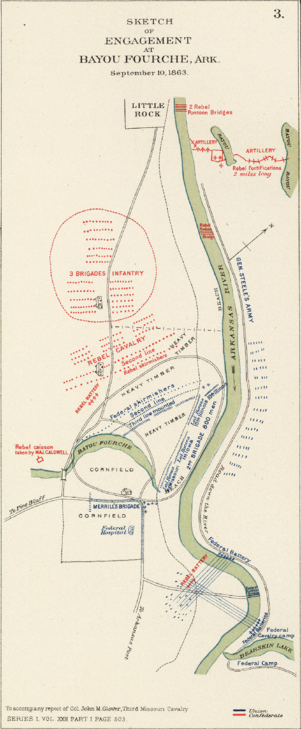
301px-Battle_of_Bayou_Forche_mapOn September 10, 1863, Confederate forces under General Sterling Price evacuated Little Rock in advance of Federal forces, thus ending the Little Rock Campaign. By 5:00pm, his forces had left the city and at 7:00pm, civil authorities formally surrendered. Little Rock became the fourth Southern capital to come under Federal control.

The battle was the culmination of a campaign launched by Maj. Gen. Fred Steele, on August 1, 1863 to capture Little Rock. The campaign includes engagements at Westport, on 14 August, Harrison’s Landing, on 16 August, Brownsville on 25 August, the Reed’s Bridge, on 27 August, and Ashley’s Mills on 7 September 1863. After the Union army affected a river crossing east of Little Rock, effectively flanking the Confederate defenses north of the river, the Confederates staged a brief delaying action at Bayou Fourche to allow for evacuation of Little Rock.

The Battle of Little Rock is also known as the Battle of Bayou Fourche.

Little Rock Look Back: Ike in Little Rock

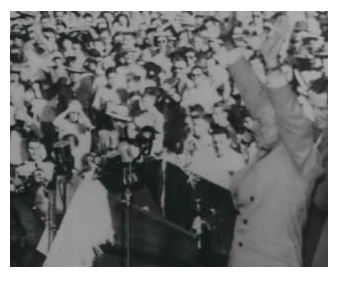
Detail from UPI photo of General Eisenhower following his address.

Detail from UPI photo of General Eisenhower following his address.

If Ike, Little Rock and September are considered, it is usually in reference to his role in the desegregation of Little Rock Central High in September 1957.  But five years earlier, he appeared in Little Rock on September 3, 1952.

General Eisenhower’s speech to 14,000 in MacArthur Park was the final leg in his swing through the South on his campaign for the White House.  He became the third presidential candidate to visit MacArthur Park in 1952 following General MacArthur (in his ill-fated attempt to gain traction as a GOP candidate during the delegate selection process) and Democratic nominee Adlai Stevenson.

He visited every southern state except Mississippi on this campaign jaunt.  In comments that neither he nor his audience could have foreseen as prescient, Eisenhower declared that he deplored the government meddling in areas in which it did not belong.  This remark was made in reference to race relations.  His stance was that some rights of minorities should be protected, but it was not necessarily the role of the federal government.

Ike proffered that if white southerners did not protect the rights of African Americans they were in danger of losing their own rights, too.  In the era of the Cold War when people were worried about the imminent loss of rights, this message seems to have crafted to appeal to those concerns.  While Eisenhower did not shy away from addressing civil rights, his Democratic opponent Adlai Stevenson was silent on the issue.  But with Alabama segregationist Senator John Sparkman as his running mate, it put Stevenson in a difficult position to try to bring it up.

In the end, Ike lost most of the South.  He did carry Maryland, Virginia, Tennessee and Florida. The only states Stevenson won were in the South.  Eisenhower’s 43.74% of the Arkansas popular vote was the highest any Republican had garnered since General Grant carried the state in 1868 and 1872.


Little Rock Look Back: The City welcomes Katrina evacuees

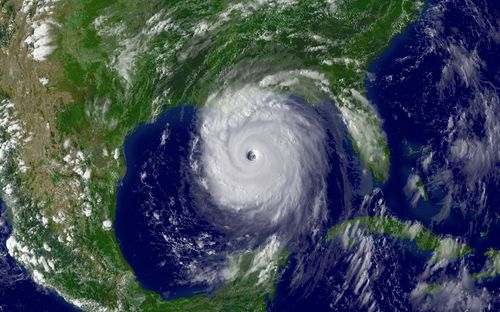
Hurricane KatrinaIn light of the landfall of Hurricane Katrina in August 2005, Little Rock Mayor Jim Dailey and City Manager Bruce Moore sprung into action to marshal resources to welcome visitors who found themselves in Little Rock. From greeting buses and aircraft that arrived with evacuees, to coordinating with churches and non-profits to distribute supplies, to working with area businesses to identify resources, Mayor Dailey, the City Manager and other City leaders worked diligently to offer assistance.

Mayor Dailey noted, “While we welcome these visitors to our City, obviously the timeframe for this stay was not of their own choosing. As they wait out the hurricane and its aftereffects, I wanted to extend this hospitality to them on behalf of all our citizens.”

One of the things the City did was distribute a list of the cultural institutions which had free admission. These museums offered a respite for people who were spending time in hotel rooms or temporary shelters. With economic futures uncertain, spending money on entertainment was not an option for many.  The chance to see exhibits for free was a break from the monotony of television coverage and endless waiting.

In addition to providing information on free and low-cost Little Rock attractions, the Convention & Visitors Bureau worked around the clock to identify available hotel rooms and other places where evacuees could stay.  Little Rock’s Animal Services division worked to find places to keep animals since some could not stay in hotel rooms.

With the breaking of the levee and the subsequent flooding, it became obvious that what many had expected to be a three-day absence from New Orleans and the Gulf Coast, was going to be much longer.  The days turned into weeks; subsequently, the City shifted its focus into helping people find housing and jobs.

“I am proud of how Little Rock has responded,” said Mayor Dailey at the time. “From volunteers to utility workers, a number of our citizens are poised to go down there and help restore those basic necessities to the areas hit by Hurricane Katrina. I am also proud to know that our hospitality and attraction industries in Little Rock are working to offer comfort and relief here. Perhaps most importantly, the compassionate smiles and words of encouragement extended by everyday men and women in Little Rock to our newest visitors are so significant.”

“I think we can never underestimate the value of helping our neighbors. When Little Rock has been beset by disaster, it has been the knowledge that other people cared about us that has helped as we worked to return to daily routines. While I am sorry that this situation has occurred, I am grateful that we can repay in some small way, all that others have done for us,” said the Mayor.

Ten years on, much has changed in Little Rock because of Katrina.  Some people who came here “temporarily” have stayed.  Others who returned have maintained ties with Central Arkansas friends.  Little Rock’s culinary and hospitality industry have benefitted from several of the newcomers who were brought here by Katrina.  There is perhaps a bit more diversity of beliefs, tastes, and accents because of this storm.

As they did with people stranded in Little Rock after September 11, the City’s cultural institutions opened their doors, their arms and their hearts to the Katrina visitors.  It proved again the healing power of not only the arts but also of hospitality.

Little Rock Look Back: City Council approves 1935 auditorium plan

An August 25, 1935, rendering in the ARKANSAS GAZETTE of the proposed Little Rock auditorium at Capitol and Scott Streets.

An August 25, 1935, rendering in the ARKANSAS GAZETTE of the proposed Little Rock auditorium at Capitol and Scott Streets.

On August 26, 1935, the City of Little Rock took its first significant step in a decade for the creation of a City auditorium..  Under the leadership of Mayor R. E. Overman, the City Council approved authorization for the City to apply for $1,000,000 from the Federal Emergency Administration of Public Works (PWA) for the construction of an auditorium.  The PWA had issued a September 16, 1935, deadline for applications to be received as it sought to spend $4.8 billion in construction projects.

The auditorium plan was announced on Saturday, August 24, 1935.  Much preparation had already been undertaken before the project was publicly unveiled.  Private presentations hhad taken place, a team of architects had been chosen (Eugene Stern and the firm of Wittenberg & Delony), and a location had been selected.

The auditorium complex was slated for a block bounded by Capitol, Scott, Fourth and Cumberland Streets.  The Women’s City Club building on that block would remain with the new structure being built to wrap around two sides of the existing structure. The site was chosen because it was one block east of the Main Street business corridor and near existing meeting locations such as the Boys Club, Albert Pike Hotel, Albert Pike Masonic Lodge and several churches.

As planned by the architects, this structure’s front façade would have run the length of the Capitol Avenue side of the block.  The building was proposed to be constructed of concrete, stone and steel.  It would have a large hall with a proscenium stage and seating capacity of 4,000 with overflow of an additional 500.  The adjoining exhibition hall could seat 3,500 people.  The plan called for 150 cars to be parked in the building, and an additional 100 cars to be parked on a surface lot on the site.

Following an August 26 closed door meeting to discuss the project from which members of the public and press were excluded, in open session the City Council voted to pursue the funding for the million dollar auditorium.  If approved by the PWA, the funds would be provided in grants and loans, to be paid by over a 35 year period.

The auditorium proposal was filed with the PWA in Washington in September 1935.  Throughout the next several months, Mayor Overman and the city were engaged in a series of conversations and negotiations with the PWA for the expansion of both the water system and the sewer system. This diverted attention from pursuing the auditorium immediately.  This specific auditorium project stalled.  But because the plan had been filed by the September 16 deadline, it allowed the City to make use of PWA funds a few years later which would lead to the construction of Robinson Auditorium.


Little Rock Look Back: The Quapaw Line

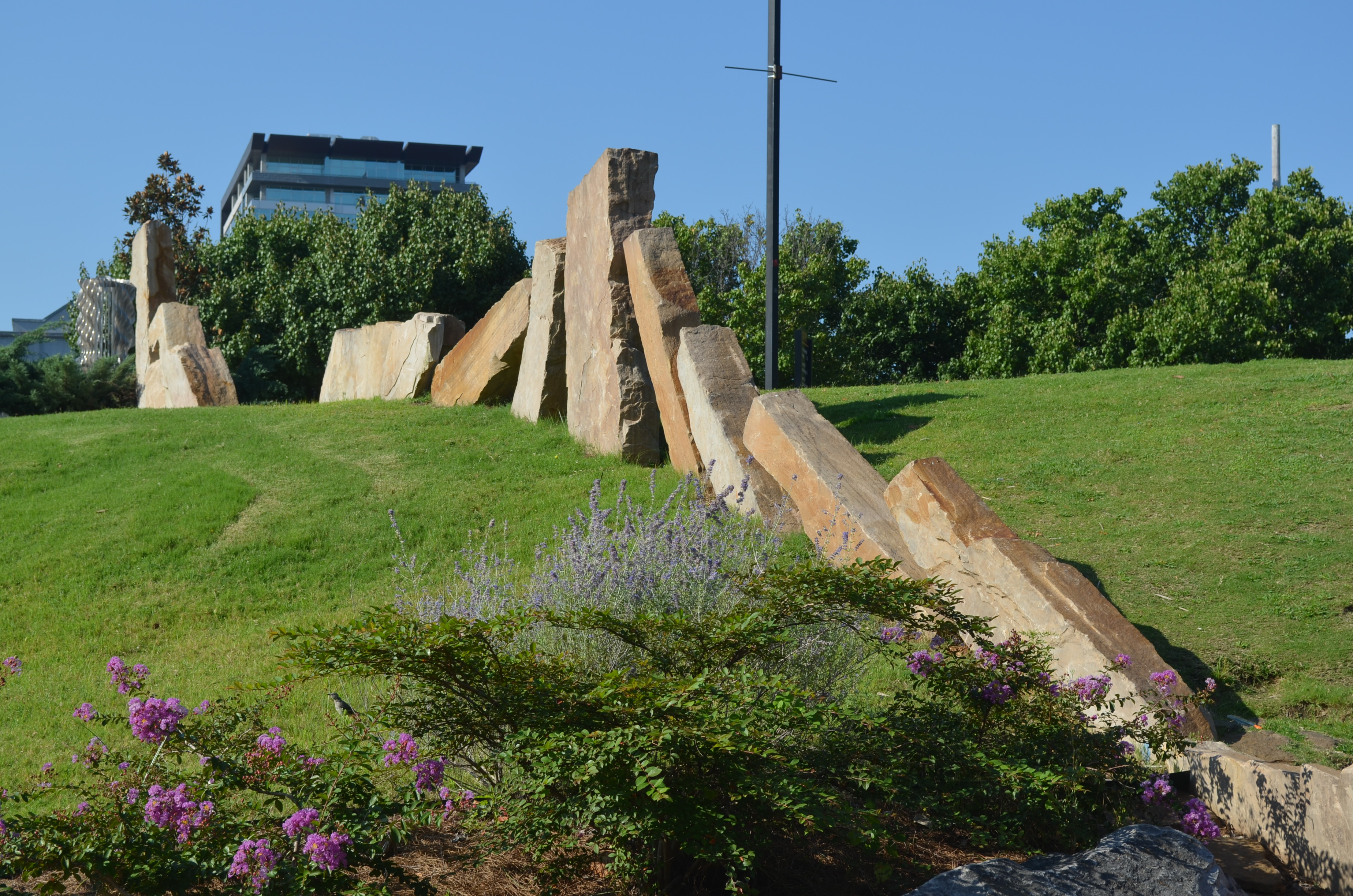
Stones placed in Riverfront Park denote where there Quapaw Line started from La Petite Roche

Stones placed in Riverfront Park denote where there Quapaw Line started from La Petite Roche

On August 24, 1818, the Quapaw Line was drawn.  Starting at La Petite Roche and heading due south, this line formed the boundary between the Quapaw tribe lands and public lands available for settlement.  Though by 1824, the Quapaw were forced to give up all of their lands, the line continued serve as an important marker.  In the ensuing six years, the first permanent settlement of Little Rock took place and streets were planned.

It is interesting to note that the 1818 treaty referred to La Petite Roche as the Little Rock.  Some have speculated that this is the first official use of “Little Rock” to designate the outcropping.  When the Post Office was established in March 1820, it was given the name Little Rock.

There is a marker commemorating the beginning of the Quapaw Line located at La Petite Roche in Riverfront Park.  The first segment of the line is also noted in the park.  There are also sunken markers place along the line at various points.  In MacArthur Park, at the corner of 9th and Commerce Streets, there is a marker noting that the line passed through at that location.

A good account of walking the Quapaw Line through downtown Little Rock can be found on this website.

Most of what is now called the Quapaw Quarter was located to the west of the Quapaw Line.  However, it did take its name from the fact that the tribe had once lived in that area and was later sequestered to lands near it.  The name for the area was chosen by a committee composed of David D. Terry, Peg Newton Smith, Mrs. Walter Riddick Sr., Dr. John L. Ferguson, and James Hatcher. They had been appointed to a Significant Structures Technical Advisory Committee to advocate for preservation of important structures as a component of the City of Little Rock’s urban renewal efforts.