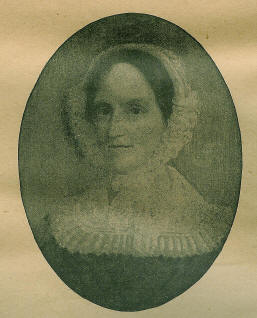
Mother’s Day Little Rock Look Back: Eliza Bertrand Cunningham, Founding Mother of Little Rock

Eliza CunninghamEliza Wilson Bertrand Cunningham was the First Lady of Little Rock.  She literally was the first lady and the founding mother.

She became the first permanent female resident when she joined her husband Matthew Cunningham in Little Rock.  She gave birth to Chester Ashley Cunningham, the first baby born in Little Rock, as well as several other children with Cunningham.  When he became the first Mayor of Little Rock, she was the first First Lady of Little Rock. They hosted the first Little Rock Council meeting at their house on what is now the block downtown bounded by Third, Main, Fourth and Louisiana Streets.  Her son Charles P. Bertrand, from her first husband, later served as Mayor of Little Rock, making her the only woman to be married to a Mayor and be mother of a Mayor.

Born in Scotland in December 1788, she emigrated with her parents to the United States as a young girl.  In 1804 or 1805, she married a French businessman, Pierre Bertrand in New York City.  She lived in New York City, while he traveled to his various business ventures.  He never returned from a trip to his coffee plantation in Santo Domingo and was presumed to have died in 1808 or 1809.  She and Bertrand had three children, Charles Pierre, Arabella and Jane. (Jane may have died in childhood, because records and lore only indicated Charles and Arabella coming to Little Rock with their mother.)

Eliza married Dr. Matthew Cunningham in New York City.  He later moved to Saint Louis and settled in Little Rock in early 1820.  Eliza and her two children came to Little Rock in September 1820.  In 1822, she gave birth to Chester Ashley Cunningham, the first documented baby born in Little Rock.  (There are unsubstantiated reports that at least one slave child may have been born prior to Chester.)  She and Matthew also had Robert, Henrietta, Sarah and Matilda.  The latter married Peter Hanger, after whom the Hanger Hill neighborhood is named.

Dr. Cunningham died in June 1851.  Eliza died in September 1856. They and Chester (who died in December 1856) are buried in the Hanger family plot at Mount Holly Cemetery.

Little Rock Look Back: Harry S. Truman

HST in LR2

Truman speaking at War Memorial Park

On May 8, 1884, future US President Harry S. Truman was born in Lamar, Missouri.

Truman spent most of his youth on the family farm.  Serving in World War I, he saw combat in France and rose to the rank of Captain.  After the war, he returned to Missouri and became involved in Democratic Party politics.  After serving as a county official, he was elected US Senator in 1935 backed by the powerful Kansas City Pendergast machine.

In 1941, he headed a Senate Committee which exposed corruption and fraud in wartime contracts.  He also worked to show he was not just a puppet of the Pendergast machine (which was crucial once Pendergast went to prison).  In 1944, Democratic leaders were trying to knock the incumbent Vice President, Henry Wallace, off the ticket as FDR’s running mate.  Wallace was viewed as too far to the left.  Truman was a compromise candidate and was chosen to serve as FDR’s running mate.

He took office as Vice President in March 1945.  When President Roosevelt died in April 1945, they had spent little time together.  He oversaw the dropping of the atomic bomb on Japan in his hopes of ending World War II with fewer soldier casualties.

Following the war, he supported the creation of the United Nations, sought to contain communism through the Truman Doctrine, and worked to rebuild Europe.  In his quest to stem the spread of communism, he involved the US in the Korean War.

Domestically, he struggled with civil rights issues (including integrating the military) and labor issues (including the threat to draft striking railway workers into the military). His election in 1948 for a full four-year term is often seen as the biggest upset in US Presidential political history.

At the time he became President, Truman was still living in a small apartment with his wife and daughter.  Though they lived in the White House for a bit, they later vacated it for the Blair House so that the structure could be completely renovated.

By the approach of the 1952 presidential election, Truman’s popularity had waned again.  He half-heartedly ran in the New Hampshire primary because he did not like any of the candidates currently in the field.  After finishing second to Sen. Estes Keafauver, he announced he would not be a candidate.  He left office in 1953 and returned to Missouri.

From 1953 onward, he served as the senior statesman and father confessor of the Democratic Party.  Many political leaders made pilgrimages to visit him.  In 1965, President Johnson signed the bill establishing Medicare at the Truman Library with President and Mrs. Truman in attendance.

He died on December 26, 1972, after having been admitted to the hospital earlier in the month for pneumonia.

Truman made two visits to Little Rock while President.  In June 1949, he attended an Army division reunion and spoke at the dedication of War Memorial Park.  In 1952, he visited Little Rock while in the state to speak at the dedication of Bull Shoals Dam and Norfork Dam.


Little Rock Look Back: Rabbi Ira Sanders

SandersIraE_fOn May 6, 1894, Ira Eugene Sanders was born in Missouri.  After receiving an undergraduate degree and rabbinate degree in Cincinnati, he was ordained a rabbi in 1919.  He served congregations in Pennyslvania and New York before coming to Little Rock in September 1926.

Shortly after arriving to lead the B’nai Israel congregation, Rabbi Sanders became active in the Little Rock community.  Among his projects were the Little Rock Community Fund, Little Rock School of Social Work (which he founded), Central Council of Social Agencies, and University of Arkansas Extension Department. During the Great Depression, he helped organize the Pulaski County Public Welfare Commission.  Other areas of involvement over his career included the Arkansas Human Betterment League, Urban League of Greater Little Rock and Arkansas Lighthouse for the Blind.  On November 3, 1930, Rabbi Sanders debated Clarence Darrow about the existence of God in front of a packed house at Little Rock High School.

For his many involvements, he received an honorary Doctor of Humanities degree in 1951 from the University of Arkansas.  Three years later he received an honorary Doctor of Divinity degree from Hebrew Union College’s Jewish Institute of Religion.

A lifelong supporter of a Jewish state, he participated in nineteen bond drives for the state of Israel.  In August 1963, he retired as the leader of B’nai Israel after over 35 years. He would remain as Rabbi Emeritus until his deal in 1985.

In January 1978, Rabbi Sanders tendered his resignation from the Central Arkansas Library board of directors.  The City Board of Directors passed resolution 5873 which noted that he had served for 51 years on the Library Board. He was first appointed in 1926.  He served during 19 different Mayoral administrations from Charles Moyer’s first term through Donald Mehlburger’s.

On April 8, 1985, Rabbi Ira Eugene Sanders died of natural causes.  He is buried in the City’s Oakland Jewish Cemetery.  The Central Arkansas Library System honors his memory with an annual distinguished lecture series.

Little Rock Look Back: STAR WARS comes to Little Rock

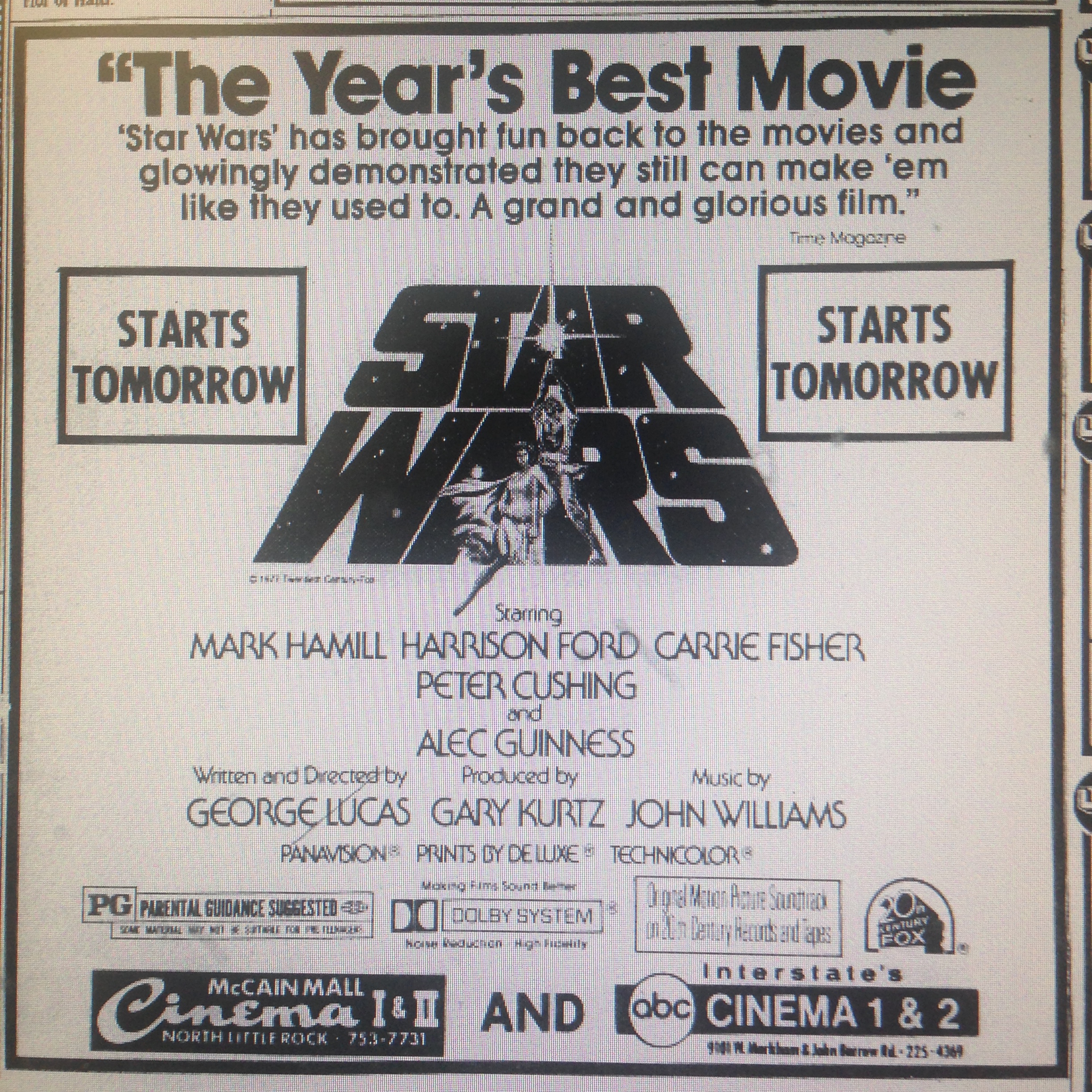
First ad in Arkansas Gazette (June 23, 1977)

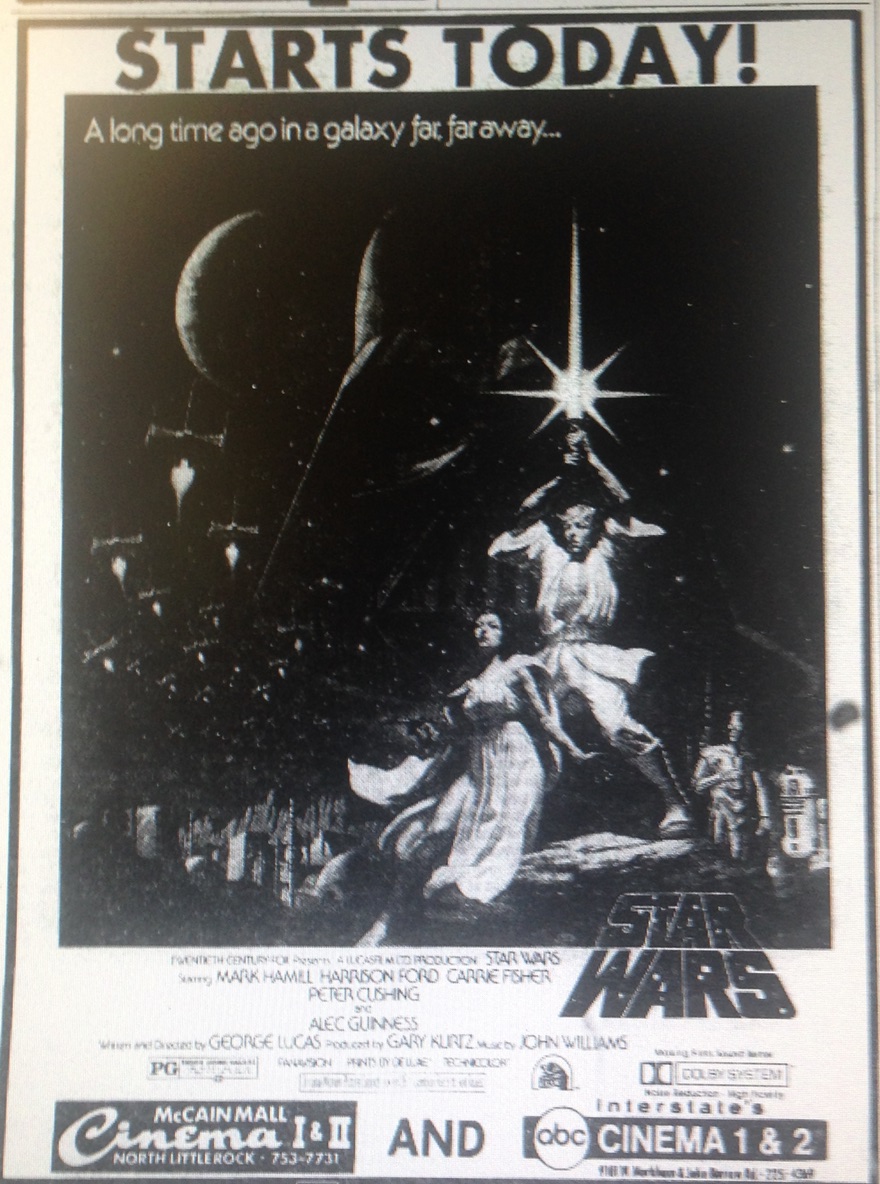
First ad in Arkansas Gazette (June 23, 1977)

Today, May the 4th, is Star Wars Day.

The classic film first opened in May 1977 (though after May 4).  It did not reach Little Rock until June 24, 1977.

Given its status as a sleeper hit, it is no surprise that it came into Little Rock largely unnoticed.  In that day, major films opening on a Friday would be heralded the previous Sunday with a substantial advertisement.  The first Star Wars ad ran on Thursday, June 23, 1977, the day before it opened.  By contrast, Herbie Goes to Monte Carlo, which would play at the same theatre, had a large ad on Sunday, June 19.

While Star Wars would seem like the perfect movie for the great UA Cinema 150, it did not play there.  The film playing at the 150 was A Bridge Too Far, which was, at least an action movie.  Star Wars did not even open at a UA theatre.  It opened at the ABC Cinema 1 & 2 (located at Markham and John Barrow) and at the McCain Mall Cinema.  (The ABC Cinema location is now home to discount cellphone and discount clothing businesses; a cinema has returned to McCain Mall, but now in the location of the former MM Cohn’s store.)

The day it opened, there was a fairly large ad which incorporated the familiar beefcake Luke, Leia in flowing gowns, and Darth Vader mask.  On the Sunday after it opened, there was a slightly smaller ad with the same artwork.  McCain Mall also ran a small add for both Star Wars and Herbie. It noted that Star Wars was a film that management “does not recommend for children.”

IMG_5919

Little Rock Look Back: Mayor Lottie Shackelford

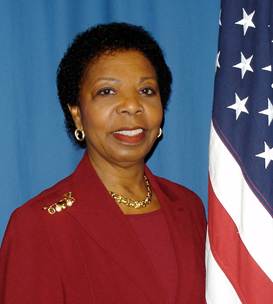
Mayor Lottie_ShackelfordOn April 30, 1941, future Little Rock Mayor Lottie Shackelford was born. Throughout her career in public service she has been a trailblazer.

Active in community activities and politics, she ran for the City Board in 1974 and lost.  But she was appointed to the Little Rock City Board in September 1978 to fill a vacancy.  This made her the first African American woman to serve on he City Board, and indeed on any governing board for the City (during Reconstruction, there were at least three African Americans on the City Council, but they were all men.) She was subsequently elected to a full-term on the City Board in 1980 winning 55% of the vote over three male candidates.

She was subsequently re-elected in 1984 (unopposed) and in 1988 (with 60% of the vote).

In January 1987, Shackelford became the first female mayor of Little Rock when she was chosen by her colleagues on the City Board to serve in that position. She was Mayor until December 1988.

From 1982 until 1992, she served as Executive Director of the Arkansas Regional Minority Purchasing Council.  She left that position to serve as Deputy Campaign Manager of Clinton for President.  She subsequently served on the Clinton/Gore transition team. She later served on the Overseas Private Investment Corporation from 1993 to 2003. She was the first African American to be in that position.

A graduate of Philander Smith College, she has also studied at the Arkansas Institute of Politics at Hendrix College and the Kennedy School of Government at Harvard University.

Mayor Shackelford has also served on numerous boards including the Little Rock Airport Commission, Philander Smith College, Chapman Funds (Maryland) and Medicis Pharmaceutical Corporation (Arizona).  She has been the longest serving Vice-Chair of the Democratic National Committee.

Mayor Shackelford was in the first class of inductees for the Arkansas Black Hall of Fame.

Little Rock Look Back: James Monroe

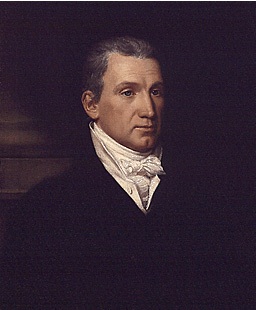
Jamesmonroe-npgalleryOn April 28, 1758, future U.S. President James Monroe was born in Virginia.  It was during his Presidency that Arkansas was surveyed and platted. Little Rock was also officially settled during the Monroe Presidency.  The Quapaw Line was drawn during his presidency. This document was the first official document to use the name “Little Rock” to describe this settlement.

Monroe was the last president who was a Founding Father.  A soldier in the Revolutionary War, he studied law under Thomas Jefferson and served as a delegate in the Continental Congress.  Although he felt the new Constitution gave too much power to a central government, Monroe served in the first US Senate before serving as Governor of Virginia.  As a diplomat, he helped negotiate the Louisiana Purchase.

He was easily elected president in 1816.  During his first term in office, the US acquired Florida from the Spanish and jointly occupied Oregon with the British. He was the first president to preside over land from the Atlantic to the Pacific.  Because of successes abroad (including the Monroe Doctrine) and domestically, the Monroe Presidency was known as the “Era of Good Feeling.”

Following his retirement in 1825, Monroe was plagued by financial difficulties. He died in New York City on July 4, 1831.

Monroe Street in Little Rock is named after him.

Little Rock Look Back: Major Nicholas Peay

LR sealOn April 28, 1784, in Virginia, future Little Rock Alderman (and acting Mayor) Major Nicholas Peay was born the eleventh of at least thirteen children.  (His gravestone lists a May date for his birth, but other records indicate April 28, 1784.) A veteran of the War of 1812 and the Indian Wars, he later moved to Kentucky (where he met and married his wife, Juliet Neill, in 1814) before settling in Arkansas on September 18, 1825.  At the time, they were the ninth family to set up residence in Little Rock.

After arriving in Little Rock, he bought the Little Rock Tavern. This started a fifty year tradition of his family owning taverns and hotels in Little Rock. In 1828, he was appointed Assistant Postmaster of Little Rock.  From 1825 to 1831, Little Rock residents were allowed to elect five Trustees prior to the formal incorporation. Major Peay was one of those who served on the Board of Trustees.

He later served on the Little Rock City Council, and in 1839 served for seven months as Acting Mayor due to the prolonged absence of Mayor Jesse Brown.  In 1841, his friend Gen. Zachary Taylor, paid a visit to Little Rock and stayed with him on the General’s way to Fort Smith.

Nicholas and Juliet Peay had at least eleven children, though only five appeared to have lived until adulthood. One of those, Gordon Neill Peay, served as Little Rock’s 23rd Mayor from 1859 to 1861. Other descendants of Nicholas Peay who followed him into public service include his grandson Ashley Peay, who was an Alderman in the 1920s (son of John Coleman Peay) and great-great-grandson Joseph B. Hurst (a great-grandson of Mayor Peay), who was a City Director from 1967 to 1970. In addition, Hurst’s daughter-in-law, Stacy Hurst served three terms on the City Board from 2003 to 2014; she is now Director of the Department of Arkansas Heritage.

Major Peay’s egg-nog recipe has been passed down for generations. It is the inspiration for the Historic Arkansas Museum yearly Nog-Off.  This past year, museum director Bill Worthen and his daughter were the sixth and seventh generation of the family to make Peay’s egg-nog. The Worthens are descended from Mayor Peay’s son who was also named Gordon Neill Peay.

Major Nicholas Peay is buried with his wife and many other family members in Mount Holly Cemetery.