
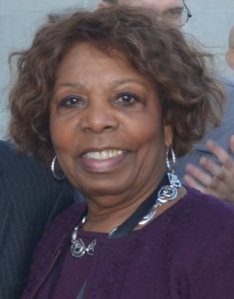
 While this headline may say “Little Rock Look Back,” Lottie Shackelford is still very much focused on the present and the future!
On April 30, 1941, future Little Rock Mayor Lottie Shackelford was born. Throughout her career in public service she has been a trailblazer.
Active in community activities and politics, she ran for the City Board in 1974 and lost. But she was appointed to the Little Rock City Board in September 1978 to fill a vacancy. This made her the first African American woman to serve on he City Board, and indeed on any governing board for the City (during Reconstruction, there were at least six African Americans on the City Council, but they were all men.) She was subsequently elected to a full-term on the City Board in 1980 winning 55% of the vote over three male candidates.
She was subsequently re-elected in 1984 (unopposed) and in 1988 (with 60% of the vote).
In January 1987, Shackelford became the first female mayor of Little Rock when she was chosen by her colleagues on the City Board to serve in that position. She was Mayor until December 1988. During that time, Mayor Shackelford invited the Little Rock Nine back to the City to be recognized for the 30th anniversary of their integration of Central High School.
From 1982 until 1992, she served as Executive Director of the Arkansas Regional Minority Purchasing Council. She left that position to serve as Deputy Campaign Manager of Clinton for President. She subsequently served on the Clinton/Gore transition team. She later served on the Overseas Private Investment Corporation from 1993 to 2003. She was the first African American to be in that position.
A graduate of Philander Smith College, she has also studied at the Arkansas Institute of Politics at Hendrix College and the Kennedy School of Government at Harvard University.
Mayor Shackelford has also served on numerous boards including the Little Rock Airport Commission, Philander Smith College, Chapman Funds (Maryland) and Medicis Pharmaceutical Corporation (Arizona). She has the longest tenure of any serving as Vice-Chair of the Democratic National Committee.
Mayor Shackelford was in the first class of inductees for the Arkansas Black Hall of Fame. In 2015, she was inducted into the Arkansas Civil Rights Heritage Trail.
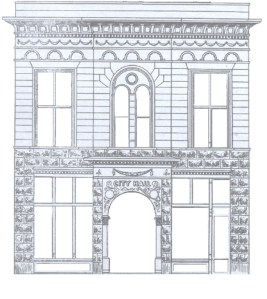 2018 marks 150 years since the opening of the 1868 Little Rock City Hall, which was located at 120 to 122 West Markham. This two story building was the home to Little Rock civic life from 1868 until 1908, when the current building was opened.
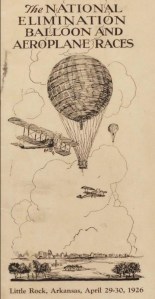 On April 29, 1926, nine hot air balloons took off from Little Rock’s airport (which was actually just an airfield at the time) in a national race to win the Litchfield Trophy. In addition to the trophy, the winner would be on the American team in an international balloon race in Belgium.
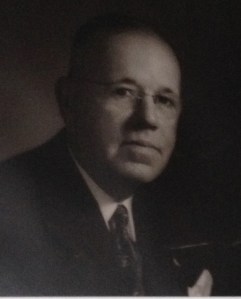 On April 28, 1883, future Little Rock Mayor Sam M. Wassell was born. His grandfather John W. Wassell had been appointed Mayor of Little Rock in 1868. He is the only Little Rock Mayor to be a grandson of another Little Rock Mayor.
 On April 28, 1784, in Virginia, future Little Rock Alderman (and acting Mayor) Major Nicholas Peay was born the eleventh of at least thirteen children. (His gravestone lists a May date for his birth, but all other records indicate April 28, 1784.) A veteran of the War of 1812 and the Indian Wars, he later moved to Kentucky (where he met and married his wife, Juliet Neill, in 1814) before settling in Arkansas on September 18, 1825. At the time, they were the ninth family to set up residence in Little Rock.
 ystem. On that date, the City officially took possession of land which would become what is now known as MacArthur Park.
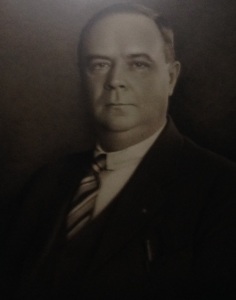 On April 18, 1880, future Little Rock Mayor Charles E. Moyer was born in Glenwood, Minnesota. A man of contradictions, he was both a candidate backed by (and probably personally involved in) the Ku Klux Klan, yet he also brought the Goodwill Industries organization to Little Rock and Arkansas to help those less fortunate.
