Cleveland County native Johnny Cash is focus of UALR exhibit, concert

cash-image1-1-204x264The Center for Arkansas History and Culture (CAHC) at the University of Arkansas at Little Rock has announced plans to premier a new exhibit on Johnny Cash’s relationship with Arkansas. The exhibit, “Johnny Cash: Arkansas Icon,” will open in the Underground Gallery at the Arkansas Studies Institute on October 10, 2014, and run through January 24, 2015. The physical exhibit will be accompanied by a virtual exhibit with educational materials for teachers.

Opening Night

The exhibit opens Friday, Oct. 10, in the Ron Robinson Theatre.

A free concert will be at 7:30 p.m. featuring the W.S. Holland Band, with special guests Jeff Coleman and the Feedersbeginning at 6:45 p.m. Seating is limited.

Johnny Cash: Arkansas Icon

The exhibit explores the musician’s Arkansas connections over the decades, covering his 1930s childhood in Dyess, Arkansas (though he was born in Kingsland in Cleveland County), through his comeback at the turn of the 21st-century. The exhibit places special emphasis on connections between his Arkansas roots and his music from his first performance in Little Rock in 1955 to a 2002 music video. Though Cash’s career took him far from Arkansas, the exhibit argues, he never quite severed his Arkansas roots. This exhibit tells that story through narrative and archival photographs from CAHC’s own collections, as well as others.

According to Colin Woodward, the CAHC archivist who proposed the exhibit and wrote its narrative, “While writing an article about Johnny Cash’s work with Governor Winthrop Rockefeller on prison reform, I began to see the thread of Arkansas in Cash’s music and life. He was such a dynamic artist, who persevered through many personal and professional challenges. He was a great Arkansan, and I wanted to show that through historical research and archival images.”

The exhibit will cover the walls of the unique Underground Gallery and immerse visitors in an artistic representation of Cash’s life in pictures and text. Designed by Bachelor of Fine Arts student Nick Sosnoski under the direction of Tom Clifton, Department of Art Chair, the exhibit makes use of key design elements like variety, unity, and texture on a large scale. The exhibit uses rare images from family albums and other sources and incorporates Cash’s lyrics into the design. According to Sosnoski, “The design is meant to reflect Johnny Cash as a man who never forgot his roots.”

The accompanying virtual exhibit will offer deeper exploration of the topics covered in the physical exhibit. The website will include a media gallery and behind-the-scenes information on the exhibit development. Educational materials, including full lesson plans and PowerPoint presentations, will be available for Arkansas teachers to use with students before and after visiting the exhibit. Stan James, an undergraduate Social Studies Education major, worked on the project and says, “It was really exciting to be able to prepare materials that will teach students important world concepts, and at the same time, expose them to one of Arkansas’ true treasures, Johnny Cash.  These materials, along with the exhibit and related events, will guide the students through an exciting journey towards learning about key issues in our state and nation, as well as how celebrities use their influence and talent to further issues that are important to them.”

On opening night, the W. S. Holland Band will perform a free concert in the Ron Robinson Auditorium. Holland spent 40 years performing with Cash’s band, Tennessee 3, and is the only band member to stay with the group until Cash’s retirement in 1997. In his long career, Holland has toured with Elvis, Jerry Lee Lewis, Roy Orbison, and Carl Perkins. The Holland Band performance will start at 7:30, following an opening performance by Jeff Coleman and the Feeders at 6:45. Seating is limited. Also on opening night, Shape Note Singers from Mountain Home, Arkansas, will perform for Second Friday Art Night visitors to the Arkansas Studies Institute.

This project is supported in part by a grant from the Arkansas Humanities Council and the National Endowment for the Humanities.

Additional funding provided by the Arkansas Community Foundation. The Arkansas Community Foundation is a nonprofit organization that fosters smart giving to improve communities. The Community Foundation offers tools to help Arkansans protect, grow and direct their charitable dollars as they learn more about community needs. By making grants and sharing knowledge, the Community Foundation supports charitable programs that work for Arkansas and partners to create new initiatives that address the gaps. Contributions to the Community Foundation, its funds and any of its 27 affiliates are fully tax deductible.

The UALR Center for Arkansas History and Culture collects, preserves, and enables access to Arkansas records of enduring value; prepares students and the region for the 21st century through academic leadership and education on archival practices and technologies; and engages the community through outreach, programming, and exhibitions.

For more information on the exhibit or CAHC, contact us atcahc@ualr.edu or 501.320.5780.

LR Cultural Touchstone: Ann Chotard

Ann P ChotardAnn Chotard grew up in Little Rock singing.  After graduating from Little Rock High School, she attended Henderson State University and received a Bachelor of Music degree.  She would later receive her a master’s and doctorate in music from the University of Colorado.  In 1966, she returned to Henderson on the music faculty.

In 1973, she formed Arkansas Opera Theatre in Little Rock. By 1976, it was a full-time focus for her as she left Henderson.  From 1973 to 1990, she led the AOT as it performed at various venues around Little Rock and the state.  As the state’s only professional opera company, it presented operas in English in an effort to be accessible to a broader audience.

By the late 1980s, she started looking for a permanent home for the AOT.  Settling on land west of Little Rock, in 1990, Wildwood Park for the Performing Arts was established.  Instead of doing year-round programming, it now presented opera and other arts in a month-long festival format.

The first few years, performances took place in a black box space in the park.  (It later became the backstage area.) In June 1995, the Cabe Festival Theatre opened.  With a thrust stage and over 700 seats, it set performers near the audience.

In 2007, she retired from Wildwood after 34 years leading a professional opera company.  By the mid 1990s, arts education and youth training were capturing more of her attention.  After retirement, she founded the Chotard Institute. It specializes in offering college preparatory training for aspiring young classical singers.

A free Capital Hotel concert tonight at 5:15 by Arkansas Symphony musicians

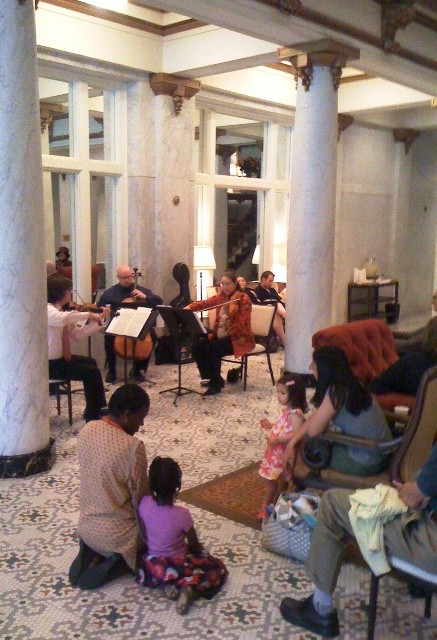
ASO at CHMusicians from the Arkansas Symphony Orchestra will be performing this evening in the lobby of the historic Capital Hotel. The music will start at 5:15 pm.

In 2011, the ASO started these free concerts in the lobby of the Capital Hotel.  The marble and tile of this historic lobby provide a wonderful acoustic backdrop for the musicians.

The concert will feature the Rockefeller String Quartet.  Members of the quartet will introduce the pieces to be performed.

Unlike concerts in music halls, guests here are encouraged to bring drinks to their seats or to stand and move around while the musicians are playing.  It is a relaxed, informal atmosphere where the audience and musicians alike are able to interact with each other.

This concert is part of the ASO’s ongoing efforts to play throughout the community under the leadership of Music Director Philip Mann and Executive Director Christina Littlejohn.  In addition to the Capital Hotel concerts, they offer occasional free concerts at UAMS and have recently started the INC (Intimate Neighborhood Concerts) subscription series.

Energy and Reflection highlight tonight’s LR Wind Symphony concert

LRWSThe Little Rock Wind Symphony returns to kick off the 2014-2015 season.  Entitled “Energy and Reflection” it features guest artist Christopher Wilson on trumpet as well as the musicians of the LRWS.  Following the departure of music director Karen Fannin, concerts this year are featuring conductor candidates.  Tonight’s concert is under the baton of Timothy Oliver.  The program includes:

Robert Jager: Esprit de Corps
Vincent Persichetti: Divertimento for Band, Op. 42
Gordon Jacob: “Intermezzo” from An Original Suite
arr. Mendez and Koff: La Virgen de la Macarena
     Christopher Wilson, trumpet
Paul Basler: Mangulina
David Maslanka: Requiem
Frank Ticheli: “Apollo Unleashed” from Symphony No. 2

The concert is sponsored by Bob Bidewell in honor of the LRWS musicians.  It begins at 7:30pm at Second Presbyterian Church.  Tickets are available at the door.

The Wind Symphony performs concerts each fall, winter, and spring in addition to its vastly popular Christmas Concert in December. All concerts are held at Second Presbyterian Church. Another annual seasonal highlight is the “Stars and Stripes Celebration” in honor of Flag Day, held  outdoors in June in MacArthur Park.

The Wind Symphony has performed in cities throughout Arkansas. Out of town concerts are usually sponsored by arts and education groups.

The Wind Symphony is supported financially by donations received from concert attendees and from individuals’ and corporations’ concert sponsorships. The musicians donate their time, effort, and talent as a gift to the city and to the audiences who hear them play.

LR Cultural Touchstone: Lucy Lockett Cabe

lucy-cabeLucy Lockett Cabe grew up in Missouri and died in Texas, but made an enormous impact on the cultural life of Little Rock and Arkansas.

While best known as the major benefactor of Wildwood Park for the Performing Arts, she also supported many other cultural organizations including the Arkansas Arts Center, Ballet Arkansas, Arkansas Symphony Orchestra, Arkansas Repertory Theatre and many smaller organizations. For over 30 years, it was rare for there to be a musical performance in Little Rock without Lucy as either a performer or in the audience.

A lifelong musician, as she aged, her voice shifted from soprano to alto to tenor while singing. She also served as a church organist. She studied piano from the age of eight.  Meeting her future husband Harold Cabe while summering in Michigan, she moved to Arkansas in 1940. From that time until 1975, she lived in Gurdon but was actively involved in the arts scenes of Arkadelphia and Little Rock.  The couple moved to Little Rock in 1975.  Harold died in 1984.

In 1971 she was one of the original appointees to the state Arts and Humanities Council. For her work with musical and volunteer groups, she was honored as the Arkansas Democrat-Gazette Woman of the Year in 1986. In 1993 she received the Arkansas Arts Council’s Lifetime Achievement Award and the Little Rock Arts and Humanities Ed Hanlin Memorial Award for Outstanding Individual Contribution to the Arts.

Lucy was an honorary life member of the Arkansas Symphony, the Community Theatre of Little Rock and Wildwood Park for the Performing Arts. She was involved in every step of the formation of the Arkansas Opera Theatre, which subsequently evolved into the Wildwood Park. She supported and was honored by Wildwood with the 625-seat Lucy L. Cabe Festival Theatre on the grounds.

In the early 2000s she moved to Dallas to be closer to her family.  She died in 2005.

It is fitting that she be remembered in October, as Halloween was her favorite holiday.  Starting on October 1, the Halloween jewelry, socks and shirts would be donned.

LR Cultural Touchstone: Phyllis D. Brandon

phyllisbrandon_t180Phyllis D. Brandon has played a unique role in shaping and supporting Little Rock’s cultural life.  As the first and longtime editor of the Arkansas Democrat-Gazette‘s High Profile section, she promoted cultural institutions, supporters and practitioners.

Since it started in 1986, being featured in High Profile has been akin to the Good Housekeeping Seal of Approval.  It exposes cultural institutions and events to new and wider audiences.  There is no way to put a monetary measure on the support Brandon gave to Little Rock’s cultural life during her time leading High Profile from 1986 to 2009.  From 2009 to 2011, she served as editor of Arkansas Life magazine, again supporting and promoting cultural life.

With her unassuming manner, she coaxed stories out of interview subjects and captured photos which highlighted events.  A journalist since her junior high school days in Little Rock, Brandon has also been a witness to history.  As a recent graduate of the University of Arkansas, Brandon returned to her alma mater, Little Rock Central High, to cover the events in early September 1957 for the Arkansas Democrat.  Eleven years later, she was in Chicago for the contentious and violent 1968 Democratic National Convention as a delegate.

From 1957 until 1986, she alternated between careers in journalism and the business world, as well as being a stay-at-home mother.  Upon becoming founding editor of High Profile, she came into her own combining her nose for news and her life-long connections within the Little Rock community.  As a writer and photographer, she created art in her own right. A look through High Profile provides a rich historical snapshot of the changes in Little Rock and Arkansas in the latter part of the 20th Century and start of the 21st Century.

Since retiring in 2011, Brandon has kept a relatively low profile. She can be seen from time to time spending time with friends and family and enjoying attending events. Only this time she generally does not have her trusty camera or notepad.

LR Cultural Touchstone: Deborah Baldwin

9 Deborah BaldwinAs a historian, arts patron, and administrator, Deborah Baldwin has had a hand in shaping Little Rock’s cultural scene for nearly thirty years.   As Chair of the UALR History Department from 1986 to 1992, she lead the department as it created the History Institute which sponsors the “Evenings with History” lecture series.  At the time it was started, it was one of the few lecture series in Little Rock (if not the only one).

A member of the UALR faculty since 1980, Baldwin is a specialist in modern Mexican history with a Ph.D. from the University of Chicago. She has published a book on the Mexican Revolution of 1910 and a variety of articles, primarily on Mexican social history topic.

As a History Department faculty member, she has lead the Public History seminar. This program has documented the history of several Little Rock cultural institutions over the years including the Arkansas Arts Center, Arkansas Symphony Orchestra and Museum of Discovery.  The Public History program has trained many of the museum professionals working in Little Rock today.  The Central High Museum, a private forerunner of the National Park Service Central High National Historic Site Visitor Center, was lead in a large part by persons associated with the UALR Public History Program.

Starting in the mid-1990s, Baldwin led the College of Arts, Humanities and Social Sciences.  In that capacity, she oversaw the visual and performing arts programming at UALR.  Under her leadership, the Departments of Art, Music, and Theatre & Dance were all revitalized.  As a part of this, she ensured that cutting-edge technology was being integrated to arts curriculum.  She also led efforts to upgrade the performance facilities.  During her tenure as Dean, the College also played leading roles in the commemoration of the 40th and 50th anniversaries of the integration of Central High School, the centennial of the Mexican Revolution, and the “Life Interrupted” exhibit which highlighted the Japanese-American internment experience in Arkansas.  She also oversaw the creation of Finale!, an event each spring which celebrates the arts in Little Rock and honors arts patrons.

With the creation of the Arkansas Studies Institute (a collaboration between UALR and Central Arkansas Library System), Baldwin took on additional duties as UALR’s supervisor on the project.

In 2014, UALR underwent a campus-wide administrative and academic reorganization.  In conjunction with that, Baldwin became Associate Provost for UALR Collections and Archives.  In that capacity she oversees the campus library system, Center for Arkansas History and Culture and the Sequoyah National Research Center.  She continues to teach in the Department of History.

She is a past member of the board of the Arkansas Humanities Council and the MacArthur Military History Museum Commission.