Tony Awards Week – Japhy Weideman

Weideman

Weideman

Last month former Arkansas Rep resident lighting designer Japhy Weideman was recognized with an Obie Award for his continuous outstanding lighting design Off Broadway.  While he was at the Rep, he lit several shows including The Grapes of Wrath, All My Sons and God’s Man in Texas.

Sunday, Weideman is nominated for the Tony for Lighting Design of a Play for Airline Highway. He is also nominated for the Tony for Lighting Design of a Musical for The Visit.  In an even rarer feat, both shows opened the same night.  He is one of a handful of people to ever have two shows open on the same night.

Weideman was nominated in 2013 for Lighting Design of a Play for The Nance which starred Nathan Lane.  Last season he was nominated for his design of Of Mice and Men which starred James Franco, Chris O’Dowd, Leighton Meester and Jim Norton.

Other Broadway credits include The Snow Geese and a Lincoln Center production of The Scottish Play which starred Ethan Hawke.  This season he also designed the lighting for a revival of The Heidi Chronicles which starred Elisabeth Moss, Jason Biggs and Bryce Pinkham.   One of the producers of that revival was Little Rock native Will Trice.  Weideman and Trice will reunite next season in a revival of A. R. Gurney’s comedy Sylvia which is to star Tony winner (and current nominee) Julie White and two-time Tony nominee Annaleigh Ashford.

Prize winning AUGUST: OSAGE COUNTY now on stage at Arkansas Rep

August Osage CastoBefore it was a movie, Tracy Letts’ August: Osage County was a Pulitzer and Tony winning play.  Running for over 600 performances on Broadway, it first enraptured audiences in Chicago.  Now, Little Rock audiences have the chance to laugh, cringe, be surprised and nod knowingly as the Weston family gathers to comfort and confront each other.

Directed by Rep Producing Artistic Director Bob Hupp, August: Osage County opens tonight and runs through June 21.

When the patriarch of the Weston clan disappears one hot summer night, the family reunites at the Oklahoma homestead, where long-held secrets are unflinchingly and uproariously revealed, dramatizing three generations of unfulfilled dreams and leaving each family member changed forever.

Rep founder Cliff Baker, who starred in the Rep’s first production of The Threepenny Opera returns to the stage as an actor to portray the mysterious patriarch of the Weston clan.  Joining him are Susanne Marley as matriarch Violet and LeeAnne Hutchison, Kathy McCafferty and Brenny Rabine as their three daughters.  Marc Carver, Michael McKenzie,  and Mary Katelin Ward are family members of the three daughters.  Natalie Canerday, Richard Waddingham and Michael Patrick Kane play another branch of the family. Grant Neale and Cassandra Seidenfeld play two other residents of Osage County who are drawn into the family drama.

The design team includes Mike Nichols (set), Marianne Custer (costumes), Yael Lubetzky (lighting), Allan Branson (sound) and Lynda J. Kwallek (props).  Other members of the creative team include fight director D. C. Wright (and there is plenty of physical sparring in addition to the verbal sparring) and dialect coach Stacy Pendergraft.

Go see the show and decide for yourself “who’s in charge” of this family.

Tony Awards Week – Tony Titles at Arkansas Rep

ark repNext year the Arkansas Repertory Theatre celebrates its 40th anniversary season.  Since its first season, the Rep has often programmed plays and musicals which have been recognized with the Tony for Best Play or Best Musical of the season.

Many other Rep productions have been titles which have also won Tony Awards in some Broadway production.  But this list only looks at those which won or were nominated for the Tony for Best Play and Best Musical.

The first Rep production was The Threepenny Opera.  While it did not win the Tony for Best Musical, it goes on this list because it received a Special Tony in 1956 for its production.  The original production in the 1930s ran for just a few performances. So this production was not eligible for the Best Musical award. But it was so outstanding, it received a Special Tony.

That 1976-77 season also included a Best Play winner – The Persecution and Assassination of Marat as Performed by the Inmates of the Asylum of Charenton under the Direction of the Marquis de Sade, which took home the silver medallion for Best Play in 1966.

Rep SalesmanOther Tony Best Play winners produced by the Rep have been:

(Tony Year; Title; Rep season)

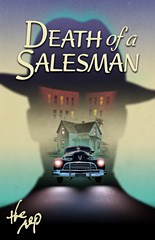
  • 1949 – Death of a Salesman – 2012-13
  • 1955 – The Diary of Anne Frank – 1977-78; 1981-82
  • 1960 – The Miracle Worker – 2004-05
  • 1963 – Who’s Afraid of Virginia Woolf? – 1978-79
  • 1965 – The Subject Was Roses – 1981-82
  • 1973 – That Championship Season – 1984-85
  • 1979 – The Elephant Man – 2008-09
  • 1981 – Amadeus – 1995-96
  • 1984 – The Real Thing – 1986-87
  • 1985 – Biloxi Blues – 1987-88
  • 1986 – I’m Not Rappaport – 1989-90
  • 1987 – Fences – 2006-07
  • 1990 – The Grapes of Wrath – 2000-01
  • 1991 – Lost in Yonkers – 1994-95 (featuring future Tony winner Will Trice in the cast)
  • 1993 – Angels in America: Millennium Approaches – 1995-96; 1996-97
  • 1994 – Angels in America: Perestroika – 1996-97
  • 1997 – The Last Night of Ballyhoo – 1998-99
  • 1998 – Art – 2001-02
  • 2001 – Proof – 2002-03 (written by LR Hall graduate David Auburn)
  • 2005 – Doubt – 2007-08
  • 2008 – August: Osage County – 2014-15
  • 2010 – Red – 2013-14
  • 2012 – Clybourne Park – 2013-14


Next season the Rep will produce Peter and the Starcatcher which was nominated for Best Play in 2012.  Other Best Play nominees produced by the Rep include: Barefoot in the Park; Broadway Bound; Cat on a Hot Tin Roof; Crimes of the Heart; Frost/Nixon; The Gin Game; Glengarry Glen Ross; Having Our Say; Home; Lend Me a Tenor; A Lesson from Aloes; ‘Night, Mother; The Night of the Iguana; Noises Off; The Piano Lesson; The Rainmaker; A Raisin in the Sun; The Retreat from Moscow; Talley’s Folly; The 39 Steps; and A Walk in the Woods.

The Rep also produced House of Blue Leaves six years before it was nominated for Best Play at the Tonys. In addition, it produced All My Sons which received a Special Tony for playwright Arthur Miller at the first ceremony and is sometimes erroneously listed as being the Best Play of 1947. There was none that year.


THEREP_MEMPHIS (no credits)-page-001The 1971 Best Musical Company was part of the Rep’s inaugural season in 1976-77.  Other Tony Best Musicals winners produced by the Rep have been:

(Tony Year; Title; Rep season)

  • 1951 – Guys and Dolls – 1989-90
  • 1952 – The King and I – 2006-07
  • 1956 – Damn Yankees – 1999-2000
  • 1957 – My Fair Lady – 2004-05
  • 1960 – The Sound of Music – 2001-02
  • 1964 – Hello, Dolly! – 2007-08
  • 1967 – Cabaret – 2001-02
  • 1975 – The Wiz – 2011-12
  • 1976 – A Chorus Line – 2005-06
  • 1977 – Annie – 2002-03
  • 1978 – Ain’t Misbehavin’ – 1984-85; 2004-05
  • 1980 – Evita – 1989-90; 2010-11
  • 1986 – The Mystery of Edwin Drood – 1988-89
  • 1987 – Les Miserables – 2008-09; 2013-14
  • 2003 – Hairspray – 2010-11
  • 2004 – Avenue Q – 2012-13
  • 2010 – Memphis – 2014-15 (produced at Rep and on Broadway by LR native Remmel T. Dickinson)

In addition, the Rep has produced staged concert versions of 1958 Best Musical The Music Man and 1973 Best Musical A Little Night Music in collaboration with the Arkansas Symphony Orchestra.

Next season the Rep will produce The 25th Annual Putnam County Spelling Bee which was nominated for Best Musical in 2005.  Other Best Musical nominees produced by the Rep include: The Best Little Whorehouse in Texas; Blues in the Night; Chicago; Dreamgirls; Five Guys Named Moe; The Full Monty; Gypsy; Into The Woods; Joseph and the Amazing Technicolor Dreamcoat; Mary Poppins;  Next to Normal; Oh What A Lovely War; Once On This Island; Peter Pan; Pump Boys and Dinettes; Quilters; Side by Side by Sondheim; Smokey Joe’s Café; Stop the World, I Want To Get Off; Sweet Charity; West Side Story; and The Who’s Tommy.

Merry Wives and Falstaff kick off 2015 Arkansas Shakespeare Theater season

AST 2015 MWWLove and deception are the name of the game in the small town of Windsor when Shakespeare’s famous larger-than-life anti-hero Falstaff comes for a visit.  Falstaff sets out to woo the Housewives of Windsor for some quick cash, but finds himself outfoxed by the wise Windsor Wives, becoming the buffoon instead of the leading man in his own ambitious tale of romance.  The entire family will laugh their way through this energetic and charming farce.

The Merry Wives of Windsor kicks off the 2015 season of the Arkansas Shakespeare Theatre.  Performances are at 7:30 tonight, Friday, Saturday, June 11 and June 13 at the Hendrix Village.  It will be performed at the Argenta Farmer’s Market space on June 25, 26 & 28.

The cast is led by Paul Kiernan, Chad Bradford, Stacy Pendergraft, Paige Reynolds, Courtney Bennett, Matthew Duncan, Jordy Neill, Jeff Gonzalez, Jenna Hokanson, Austin Larkin, Ferginho Pilippe-Auguste, Ricky Pope and Matthew Schmidli.  The youth ensemble consists of Aaron Eley, Jack Ghormley, Sarah Guinee, Ethan Hemphill, Anna Beth Jeane, Camille Lambert, Madeline Leicht, Simon Marotte, Maddie Meek, Kate Parrack, Anna Reynolds, Henry Whisenhunt and Zeke Whisenhunt.

All performances are “pay what you can,” with a suggested donation of $15.

Today at Clinton School – Ark Rep production of AUGUST: OSAGE COUNTY

THEREP_AUGUST (no credits)-page-001The Arkansas Repertory Theatre works in partnership with the Clinton School of Public Service to participate in the UACS’s Distinguished Speaker Series, hosting educational panel discussions on various Rep productions.

The latest in these takes place today, Thursday, June 4 at 12 noon at Sturgis Hall in Clinton Presidential Park.  It focuses on the Rep’s upcoming production of Tracy Letts’ August: Osage County.

Arkansas Repertory Theatre producing artistic director, Bob Hupp, will host a panel discussion on the upcoming production of August: Osage County, winner of the 2008 Pulitzer Prize, Tony Award for Best Play, New York Drama Critics Circle Award for Best Play, and virtually every other theatre award possible.

The play focuses around the large Weston family when they unexpected reunite after dad disappears and their Oklahoman family homestead explodes in a maelstrom of repressed truths and unsettling secrets. Mix in Violet, the drugged-up, scathingly acidic matriarch, and you’ve got a major new play that unflinchingly – and uproariously – exposes the dark side of the Midwestern American family.

August: Osage County opens officially on Friday evening and runs through Sunday, June 21.

Tony Awards Week – SOUTH PACIFIC – “How Far Away from Little Rock A-r-k”

southpacific_obcSeveral Tony Awards have been won by a show with a main character from Little Rock.

South Pacific opened at the Majestic Theatre on April 7, 1949 and settled in for a run of 1925 performances. Based on the James Michener Pulitzer Prize winning novel Tales of the South Pacific, it featured a book by Oscar Hammerstein II and Joshua Logan, songs by Richard Rodgers and Hammerstein and direction by Logan. It was produced by Rodgers, Hammerstein, Logan and Leland Hayward. Set in the titular islands, it concerned the relationships of sailors, nurses, island natives and other island inhabitants.

The musical starred recent Tony winner Mary Martin as Little Rock native Nellie Forbush, opera star Ezio Pinza, stage veterans Myron McCormick and Juanita Hall, and stage newcomers William Tabbert and Betta St. John. Cloris Leachman was Martin’s understudy and would later succeed her in the part of Little Rock native Nellie Forbush.

Like other Rodgers and Hammerstein musicals, this show tackled tough themes – this one being prejudice. That did not set well with some theatergoers. Indeed, some potential investors did not put money into the show because of its stance. But Rodgers, Hammerstein, Logan and Hayward persisted. Their diligence paid off when the musical received the 1950 Pulitzer Prize in Drama, only the second musical to receive this designation. It is also the only Pulitzer Prize for Drama winner to be based on Pulitzer Prize winning source material. This was the first Rodgers & Hammerstein musical to not feature big dance numbers. In fact, there was no choreographer. The dance steps which existed were created by Martin, who had taught dance in her native Texas as a young mother.

Opening late in the season, South Pacific was named the 1949 New York Drama Critics Circle Best Musical, but was not part of the Tony Awards until 1950. (Though Jo Mielziner, who designed the set for South Pacific received a Tony for his set designs of shows during the 1948-49 season and South Pacific was one of the titles listed.) At the 1950 Tonys, it received six Tony Awards: Best Musical, Actor in a Musical (Pinza), Actress in a Musical (Martin), Featured Actor in a Musical (McCormick), Featured Actress in a Musical (Hall), and Director (Logan).

This is the only time that all four acting awards in the musical category went to performers in the same production. In fact, the other two acting trophies that year were incorrectly engraved as being from South Pacific out of habit. Logan’s win was also the first time that the Director Tony went for a musical, since at the time that award was not separated out among plays and musicals. Hall was the first African American to win a Tony Award for Acting.

In 1999 for the 50th anniversary and in 2008 for the opening of the first Broadway revival remaining cast members from the original production had reunions in New York City. At the 50th anniversary ceremony, a proclamation from Little Rock Mayor Jim Dailey was read declaring it South Pacific day in Little Rock and honoring the show. It is interesting to note that in 1949, there were two heroines on the Broadway stage from Little Rock: Nellie Forbush from South Pacific and Lorelei Lee from Gentlemen Prefer Blondes.

In 2008, Lincoln Center Theatre produced the first revival of South Pacific on Broadway. It opened on April 3, just four days shy of the musical’s 59th anniversary.  The cast was led by Paulo Szot, Kelli O’Hara (as Little Rock girl Nellie Forbush), Matthew Morrison (before “Glee”), Danny Burstein and Loretta Ables Sayre.  The production restored a song which had been written for the original Broadway production that had been dropped. “My Girl Back Home” was featured in the movie version and in this Broadway revival. In it O’Hara and Morrison sang of their hometowns of Little Rock and Philadelphia.  The production was nominated for 11 Tony Awards and won 7: Best Musical Revival, Actor in a Musical (Szot), Director of a Musical (Bartlett Sher), Scenic Design (Michael Yeargan), Costume Design (Catherine Zuber), Lighting Design (Donald Holder) and Sound Design (Scott Lehrer).

Sher, Yeargan, Zuber, Holder and Lehrer are all reuniting again next season to work on a revival of Fiddler on the Roof.  One of the producers of that is Little Rock native (and three time Tony winner) Will Trice.

While Trice has not starred in a production of South Pacific, his mother Judy Trice starred in a statewide tour in the 1970s. A few years later, his sister Kathryn Pryor, starred in the Central High production.

Tony Awards Week – Trouble with a capital T and that rhymes with…. HAIR?

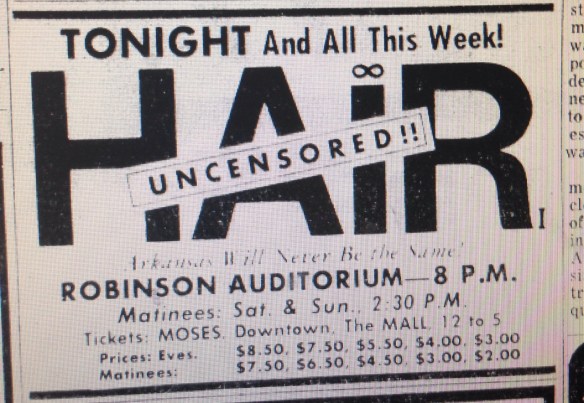
Ad for the original production of HAIR in Little Rock. Note the ticket prices. And that they could be purchased at Moses Music Shops.

Ad for the original production of HAIR in Little Rock. Note the ticket prices. And that they could be purchased at Moses Music Shops.

The Tony winning musical The Music Man may have featured a song about “Trouble in River City” but the Tony nominated musical Hair brought trouble to this “river city” in 1971 and 1972.

In February 1971, a young Little Rock attorney named Phil Kaplan petitioned the Little Rock Board of Censors to see if it would allow a production of Hair to play in the city. He was asking on behalf of a client who was interested in bringing a national tour to Arkansas’ capital city. The show, which had opened on Broadway to great acclaim in April 1968 after an Off Broadway run in 1967, was known for containing a nude scene as well for a script which was fairly liberally sprinkled with four-letter words. The Censors stated they could not offer an opinion without having seen a production.

By July 1971, Kaplan and his client (who by then had been identified as local promoter Jim Porter and his company Southwest Productions) were seeking permission for a January 1972 booking of Hair from the City’s Auditorium Commission which was charged with overseeing operations at Robinson Auditorium. At its July meeting, the Commissioners voted against allowing Hair because of its “brief nude scene” and “bawdy language.”

Kaplan decried the decision. He stated that the body couldn’t “sit in censorship of legitimate theatrical productions.” He noted courts had held that Hair could be produced and that the Auditorium Commission, as an agent for the State, “clearly can’t exercise prior censorship.” He proffered that if the production was obscene it would be a matter for law enforcement not the Auditorium Commission.

The Commission countered that they had an opinion from City Attorney Joseph Kemp stating they had the authority. One of the Commissioners, Mrs. Grady Miller (sister-in-law of the building’s namesake the late Senator Robinson who had served on the Commission since 1939), expressed her concern that allowing Hair would open the door to other productions such as Oh! Calcutta!

On July 26, 1971, Southwest Productions filed suit against the Auditorium Commission. Four days later there was a hearing before Judge G. Thomas Eisele. At that hearing, Auditorium Commission member Lee Rogers read aloud excerpts from the script he found objectionable. Under questioning from Kaplan, a recent touring production of Neil Simon’s Tony winning play Plaza Suite was discussed. That play has adultery as a central theme of one of its acts. Rogers admitted he found the play funny, and that since the adultery did not take place on stage, he did not object to it.

Judge Eisele offered a ruling on August 11 which compelled the Auditorium Commission to allow Hair to be performed. Prior to the ruling, some of the Auditorium Commissioners had publicly stated that if they had to allow Hair they would close it after the first performance on the grounds of obscenity. To combat this, Judge Eisele stated that the Commission had to allow Hair to perform the entire six day engagement it sought.

Upon hearing of the Judge’s ruling, Commissioner Miller offered a succinct, two word response. “Oh, Dear!”

In the end, the production of Hair at Robinson would not be the first performance in the state.  The tour came through Fayetteville for two performances in October 1971. It played Barnhill Arena.

On January 18, 1972, Hair played the first of its 8 performances over 6 days at Robinson Auditorium.  In his review the next day, the Arkansas Gazette’s Bill Lewis noted that Hair “threw out all it had to offer” and that Little Rock had survived.

The ads promoting the production carried the tagline “Arkansas will never be the same.”  Tickets (from $2 all the way up to $8.50) could be purchased at Moses Melody Shops both downtown and in “The Mall” (meaning Park Plaza). That business is gone from downtown, but the scion of that family, Jimmy Moses, is actively involved in building downtown through countless projects. His sons are carrying on the family tradition too.

Little Rock was by no means unique in trying to stop productions of Hair.  St. Louis, Birmingham, Los Angeles, Tallahassee, Boston, Atlanta, Charlotte NC, West Palm Beach, Oklahoma City, Mobile and Chattanooga all tried unsuccessfully to stop performances in their public auditoriums.  Despite Judge Eisele’s ruling against the City of Little Rock, members of the Fort Smith City Council also tried to stop a production later in 1972 in that city. This was despite warnings from City staff that there was not legal standing.

Within a few years, the Board of Censors of the City of Little Rock would be dissolved (as similar bodies also were disappearing across the US). Likewise, the Auditorium Commission was discontinued before Hair even opened with its duties being taken over by the Advertising and Promotion Commission and the Convention & Visitors Bureau staff.  This was not connected to the Hair decision; it was, instead, related to expanding convention facilities in Robinson and the new adjacent hotel.  Regardless of the reasons for their demise, both bygone bodies were vestiges of earlier, simpler and differently focused days in Little Rock.

Over the years, Hair has returned to the Little Rock stage. It has been produced two more times at Robinson Center,  UALR has produced it twice, and the Weekend Theater has also mounted a production.   The most recent visit to Little Rock at Robinson Center, which was the final Broadway show before the building closed for renovations, was based on the 2009 Broadway revival.  That production, was nominated for eight Tony Awards, and captured the Tony for Revival of a Musical.  Several members of the production and creative team are frequent collaborators of Little Rock native Will Trice.