
Little Rock Look Back: Groundbreaking of Vogel Schwartz Sculpture Garden

Wayne Salge’s SIZZLING SISTERS, one of the original sculptures installed in the Vogel Schwartz Sculpture Garden

On June 25, 2009, members of the Sculpture at the River Market committee and City leaders broke ground on the Vogel Schwartz Sculpture Garden in Riverfront Park.

The groundbreaking followed an unveiling of the design plans for the new sculpture garden, which will be located east of the Peabody Hotel near the Forever a Rose garden and the Jack Fleischauer Garden.

“As part of the continuing improvements to Riverfront Park, we wanted to put more sculpture into the park to complement the new gardens, Peabody Park, and the upcoming La Petite Roche plaza,” said City Director Dean Kumpuris. “At the 2008 Sculpture at the River Market, six pieces were bought through proceeds from the show and sale to be placed in the park in 2009.”

According to Kumpuris, seven new pieces will join a dozen other sculptures in the park and along President Clinton Avenue that have been installed since 2004.

The sculpture garden features natural terraces and walkways. The design creates a space to host receptions, weddings or other events as well as to allow visitors to enjoy the sculptures in solitude.

The seven pieces which will be installed are “Full of Himself” by Jan Woods, “Cascade” by Chapel, “Bateleur Eagle” by Pete Zaluzec, “Sizzling Sister” by Wayne Salge, “Conversation with Myself” by Lorri Acott,  “First Glance” by Denny Haskew, and “Straight and Narrow” by Lisa Gordon.

“This is only the start,” said Sculpture at the River Market Chair Jane Rogers. “In addition to continuing to place sculpture in Riverfront Park, the committee is discussing ways to place public art throughout the city. In the months to come, we hope to be able to make some more announcements about sculpture and public art in Little Rock.”

The sculpture garden is made possible through the support of the Vogel Schwartz Foundation. Robert Vogel represented the family during the ground-breaking ceremony commending the city of Little Rock on their efforts to support the art community.

A Sculptural Father’s Day

Today is Father’s Day.   Little Rock has at least five sculptures which reflect the theme of the day.

In Riverfront Park, Jane DeDecker’s THE TIES THAT BIND shows a father helping his son tie his shoes.  It was installed in tribute to longtime Little Rock KATV executive Dale Nicholson.  He had been an active supporter of Sculpture at the River Market.  It is placed near another sculpture by Jane DeDecker, which Nicholson had selected as a memorial to his wife.
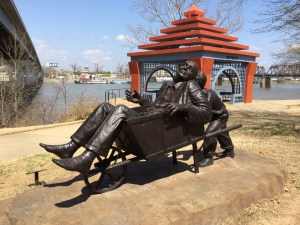
Not far from THE TIES THAT BIND is Kevin Kresse’s BREAKING THE CYCLE.  Installed in 2013, it shows a son pushing his father in a wheelbarrow.  At the time of the dedication, Kresse commented the piece is meant to show a father and son who have decided to “switch things up” for a new perspective on life.  Kresse and his son were the models for the piece.
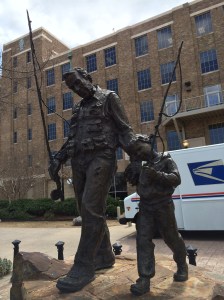
One of the first sculptures placed in Riverfront Park in 2004 was DeDecker’s ANGLERS. It shows a grandfather and granddaughter going off to fish.  This sculpture is located near the Witt Stephens Jr. Central Arkansas Nature Center.

The sculpture was dedicated in November 2004 a few days before the opening of the Clinton Presidential Center.  it was selected, in part, because it paid tribute to the natural habitat of the area.  Since the sculpture was installed, not only has the Nature Center opened, but the Bill Clark Presidential Park Wetlands were created.

Near the Marriott Hotel, in the Vogel Schwartz Sculpture Garden, is C. T. Whitehouse’s HUDSON’S VOYAGE.  This sculpture is a tribute to his father.

Located near the Arkansas River, it reflects not only the boats and barges which travel by it daily, but is also symbolic of Whitehouse’s father’s service in the Navy and the possibilities that opened up for him.

Lastly, Tim Cherry’s RABBIT REACH is located near the Museum of Discovery.  The sculpture is a gift from Whitlow Wyatt and the Carey Cox Wyatt Charitable Foundation. It was given in memory of George Wyatt and Frank Kumpuris.  Those two gentlemen were the fathers of Whitlow Wyatt and Dean & Drew Kumpuris.

Open Studios Little Rock today (6/2) from 10am to 4pm

The City of Little Rock Arts+Culture Commission is hosting the second annual Open Studios Little Rock on Saturday, June 2, from 10 a.m. to 4 p.m.
A map of participating artists is available here: 2018 OSLR Map FINAL.

Guests can gain access to over 20 artist studios and cultural institutions that will open their doors and give you a firsthand look at their creative process. The lineup of studios visits includes artists working in the visual and performing arts, plus cultural institutions that will open their respective studios for guided tours and demonstrations.

The public can participate in FREE, self-guided tours of art-related studios, live-in/work studios and homes, galleries, schools, and other creative spaces. (Please note, some of the participating cultural institutions may have admission fees for specific exhibits.)

Referred to as a city-wide exhibition, Open Studios gives you unparalleled access to artists living and working in Little Rock. Studio visits are free and open to the public.

Artists who are unable to welcome the public into their studios will showcase their work at the Alternative Space hosted at the Bobby L. Roberts Library of Arkansas History and Art at 401 President Clinton Ave.  A welcome station will also be set up there with maps of all the participating artists and information on them.

During Open Studios, the colorful “Open Studio” signs will alert you to Open Studio spaces.

Participating Artists:

  • Co-Op Art – 7509 Cantrell Rd (back side)
  • Creative Art Studio – 7509 Cantrell Rd (back side)
  • Jennifer Cox Coleman Fine Art – 2207 Hidden Valley Dr., Suite 203
  • Amanda Heinbockel – 1701 Louisiana St, Apt 2
  • The Little Rock Violin Shop – 316 E. 11th St.
  • McCafferty Academy of Irish Dance – 6805 W 12th Street, Suite D
  • Daniella Napolitano – 916 Scott St, Apt A
  • Jenn Perren Studio – 1701 Louisiana St, Apt 4
  • Catherine Rodgers Contemporary Art – 2207 Hidden Valley Dr., Suite 202
  • Liz Smith’s Ceramics Studio – 125 Dennison St.
  • South Main Creative – 1600 Main St
  • Michael Warrick – 19 Mohawk Circ.
  • Elizabeth Weber – 11901 Hilaro Springs Rd

 Alternative Space (401 President Clinton Avenue):

  • Jericho Way Art Class
  • MNHenry Artwork
  • Paintings by Glenda McCune
  • Sheri Simon
  • Michael Ward

 Participating Cultural Institutions:

  • Arkansas Arts Center
  • Esse Purse Museum
  • Historic Arkansas Museum
  • Mosaic Templars Cultural Center
  • Old State House Museum

The Little Rock Arts+Culture Commission cultivates connections between diverse audiences and the City’s creative community. More information (including maps and artist bios) available at https://lrartsculturecommission.com/open-studios-little-rock/.

Little Rock Look Back: May 31, 1968 – a day of transition for the Arkansas Arts Center

AAC Logo in 1963

An arts organization in financial crisis.
Programming abandoned
Summer education programming for students
Staff laid off
A challenge grant from donors
A community fundraising drive

Sound familiar?

In January 1968, the Arkansas Arts Center made the decision to cease operating a degree-granting education program effective May 31 of that year.  Sixteen faculty members lost their jobs, though a couple were retained for other positions within the organization.

After opening in May 1963 and beginning the degree-granting program in September 1964, the Arkansas Arts Center found itself operating at a deficit each year.  While Jeannette and Winthrop Rockefeller made up the deficits, it was not a sustainable model.  (Mrs. Rockefeller had been the president of the AAC board for several years after she and her husband played leadership roles in the statewide fundraising efforts to establish the AAC.)

Though the degree-granting programs were bringing national recognition to the AAC, they had essentially taken over the entire facility.  The theatre was rarely available for children’s programming or community groups. The galleries were given over largely to the displaying the works of the students and faculty.  What had been envisioned as a facility melding world-class arts with community arts, was not functioning that way.

As such, the statewide membership program was suffering. Without the creation of programming in Little Rock, it was difficult to take any substantial arts offerings out to the membership clusters throughout the state. This resulted in the decline of memberships being purchased.

Following the announcement of the cessation of the degree-granting program, the AAC Board sought ways to more fully engage the public.  Part of this was due to the fact that the Arts Center had a deficit of $295,216 (the equivalent of $2.15 million today).  The only profitable part of the AAC operation was the gift shop.  With that level of deficit, the permanent closure of the AAC was certainly a possibility on people’s minds.

A committee studying the future of the AAC decided to focus on five (5) areas.  (And of course, AAC founding mother Jeane Hamilton was part of this effort.)  The areas were Education (community classes for children and adults), Exhibits (a return to a mix of permanent and traveling exhibitions), Theatre (partnerships with Community Theatre of Little Rock and the creation of children and teen theatre productions), State Services (refocusing the Artmobile to include educational instruction), and Membership. This would result in a net budget of $260,000.

In April 1968, a fund drive was announced led by former Little Rock Mayor Byron Morse.  The goal was $130,000, to be matched dollar-for-dollar by the Rockefellers.  As of May of that year, it had raised $108,731.

There are many parallels between the AAC in 1968 and the Arkansas Repertory Theatre’s current predicament. While the causes of the financial woes may be different, the cures are very much the same.

Then, as now, the citizens of Little Rock and Arkansas had to step up and financially support an arts organization in financial crisis.  Whereas the Rockefellers were matching gifts in 1968, the Windgate Foundation is matching gifts now.  Just as the Arts Center renewed its focus on the community and redefined the way it did business, the Rep is now facing these same processes and predicaments.

What the future Rep will look like in terms of numbers and types of productions remains to be seen.  But the core leadership team is touting a mantra of Professional, Affordable, and Sustainable.  All of these are laudable. All are attainable. But all will require continued community commitment year in and year out.

An interesting side note: a key Arts Center Board member in 1968 was William Rector, the father of longtime Rep Board member Bill Rector who is currently part of the interim leadership team at the Rep.  Let’s hope Bill has the same success in his endeavor as his father did.

Viva Center Artium
Repertorium Praeter Theatrum

Little Rock Look Back: Dedication of the Arkansas Arts Center on May 18, 1963

AAC Logo in 1963

On Saturday, May 18, 1963, amidst fanfare and fans of the arts, the Arkansas Arts Center officially opened its doors.  (This was thirty-five years and three days after the Fine Arts Club had opened the first permanent art gallery in Arkansas in the Pulaski County Courthouse).

The 11:00 am dedication ceremonies on took place in the Arts Center Theatre and featured U.S. Senator J. William Fulbright (who was in the midst of championing what would soon be known as the John F. Kennedy Center for the Performing Arts), Congressman Wilbur Mills, Governor Orval Faubus, Little Rock Mayor Byron Morse, Winthrop Rockefeller and Jeanette Rockefeller.

The dedication ceremony was chaired by Jane McGehee, now known as Jane McGehee Wilson.  Earlier this month she was honored at the Arkansas Arts Center with an outstanding patron award in recognition of her work supporting the Arkansas Arts Center for close to six decades.   More information on her work for the AAC can be found here.

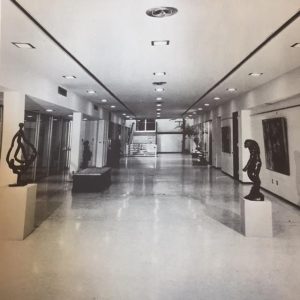
The Arts Center lower level in 1963

Among the exhibits at the Arkansas Arts Center for the grand opening was a special exhibit from the Metropolitan Museum of Art in New York entitled Five Centuries of European Painting.  In Little Rock for six months, this exhibit featured works by El Greco, Titian, Claude Monet, Odilon Redon, Pierre Renoir, Paul Signac, Edgar Degas, and Paul Gauguin among many others and spanned from the fifteenth century Early Renaissance era to the nineteenth century.

Prior to the opening, a profile on the Arts Center in The Christian Science Monitor touted the building as one of the first regional arts centers in the country to be completed. Benefiting from national ties of the Rockefeller family, the events in May 1963, set a high standard for the institution, and for other regional art museums.

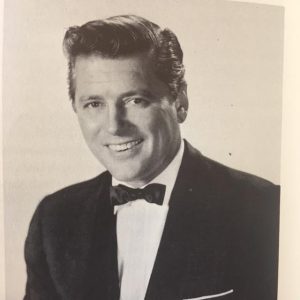
Little Rock Look Back: Media preview, Gordon MacRae concert prior to Arkansas Arts Center Opening

Photo of singer Gordon MacRae from the 1963 Arkansas Arts Center dedication booklet

On Friday, May 17, 1963, Little Rock’s media were treated to a preview of the new Arkansas Arts Center.  It was set to open to the public the next day.  The media were invited to attend between 6:30pm and 10:00pm.

One of the highlights was the chance to view the exhibit:  Five Centuries of European Painting.  The works were from the collection of the Metropolitan Museum of Arts.  The exhibition featured works by Titian, El Greco, van Dyck, Murillo, Gainsborough, Monet, Courbet, Renoir, Degas, Pissarro, and Gauguin.  Another artist featured was Paul Signac.  Today the Arts Center has one of the largest collections or works by Signac due to the generosity of collector James T. Dyke.

At 8pm that evening, there was a concert appearance by film and recording star Gordon MacRae.  This took place in the Arts Center’s theatre for Arts Center patrons. (Or at least the 389 who could get tickets to it.)  At 10pm, the press were treated to an encore performance by Mr. MacRae.

After it concluded around 11pm, it was time for the staff and volunteers to wind down for the evening and get ready for two major events on May 18, 1963.

Mother’s Day Sculpture: PATTY CAKE by Jane DeDecker

Happy Mother’s Day!

This sculpture is Jane DeDecker’s PATTY CAKE which is located in Riverfront Park. It was donated by the late Dale Nicholson in memory of his wife, Pat.