Artist Kevin Kresse at “Tales from the South” Tuesday, March 5

kevinselfportrait

Kevin Kresse in a self-portrait

Tuesday, March 5 , the Starving Artist Cafe will come alive with Tales from the South’s monthly “Tin Roof Project” which features a Southerner in conversation. This month the featured guest is artist Kevin Kresse.

Artist Kevin Kresse, a native Arkansan, supports his family as a painter and sculptor in Little Rock. He has exhibited his work around Arkansas and in New York, NY, Washington D.C., Memphis, TN, and Atlanta, GA.

Kresse has been awarded painting fellowships from the National Endowment for the Arts-Mid America Arts Alliance and the Arkansas Arts Council. He has also won several awards in the Arkansas Arts Center annual Delta competition.

He has been featured in the Arkansas Times, Arkansas Democrat-Gazette, the North Little Rock Times, the Little Rock Free Press, Active Years Magazine, and Soiree Magazine.

Kresse has also been featured in pieces produced by the local affiliates of ABC, CBS, and PBS television, as well as a film short by Garret Lakin. Kevin lives in Little Rock with his wife Bridget and their three children.

Brad Williams and blues guitarist Mark Simpson will provide musical entertainment.

Dinner 5pm-6:30pm
Show starts at 7pm
Admission is $7.50.  You MUST purchase your ticket before the show.

Tales From the South is a radio show created and produced by Paula Martin Morell, who is also the show’s host. The show is taped live on Tuesday. The night is a cross between a house concert and a reading/show, with incredible food and great company. Tickets must be purchased before the show, as shows are usually standing-room only.

“Tales from the South” is a showcase of writers reading their own true stories. While the show itself is unrehearsed, the literary memoirs have been worked on for weeks leading up to the readings. Stories range from funny to touching, from everyday occurrences to life-altering tragedies.

Tales from the South airs on KUAR Public Radio on Thursdays at 7pm.

Edward Weston: Leaves of Grass continues at Arkansas Arts Center

Contraband Bayou, Louisiana - 1941

Contraband Bayou, Louisiana – 1941

As America awaited the declaration of war in the spring of 1941, photographer Edward Weston set out on a cross-country photographic expedition.  Now through April 21, the Arkansas Arts Center is playing host to an exhibit of his photos from that expedition.  Edward Weston: Leaves of Grass was organized by the Museum of Fine Arts in Boston.

Weston, one of America’s leading modernist photographers, was making photographs for a new edition of Walt Whitman’s Leaves of Grass. The Limited Editions Club of New York commissioned these images to bring together the great nineteenth-century poet’s verbal celebration of America with the great twentieth-century photographer’s visual odyssey.

In accepting the assignment, Weston declined to literally illustrate Whitman’s words, yet the two portraits of America echo one another. Where Whitman’s nineteenth-century verse was shaped by the Civil War, Weston’s images anticipated World War II.

Weston’s trip lasted almost ten months, covering 24 states and nearly 25,000 miles. Weston and his wife, Charis Wilson, drove their trusty Ford, “Walt,” throughout the South, the Mid-Atlantic, New England, and back home to California after the Japanese bombing of Pearl Harbor brought about America’s entry into the war. Weston’s photographs include studies of decaying southern mansions, the Boulder Dam, a homely display of old bottles, the Grand Canyon, New Orleans cemeteries, and haunting portraits of people the photographer met along the way.

Weston’s images form no detached national survey; rather they embody an idiosyncratic personal meditation on selected American places, objects, and people. Edward Weston: Leaves of Grass includes 53 photographs chosen from the approximately 700 negatives Weston developed from the trip.

Arkansas Arts Center features Wendy Maruyama’s Executive Order 9066

Watchtower

Wendy Maruyama
Watchtower, 2008

Exhibits look at Japanese-American internment camps during WWII

This exhibition combines two projects of Wendy Maruyama, a studio furniture maker and head of the studio furniture program at San Diego State University. These projects, the Tag Project and Executive Order 9066, together tell the story of the Japanese-American internment camps during World War II.

In the Tag Project, Maruyama replicated 120,000 individual identification tags worn by the internees in the ten relocation camps, including two in Arkansas. Maruyama assembled the re-created paper tags in ten groups, each group representing all the internees at a specific camp. Each of these groupings hangs from the gallery ceiling and is about 11 feet tall. Maruyama has folded the Tag Project into a parallel project of hers titled Executive Order 9066 to show them together in this exhibition.

Executive Order 9066 was the directive signed by President Franklin D. Roosevelt ordering the incarceration of all people of Japanese ancestry then resident in the United States. For the parallel project, Maruyama created work that explores ethnicity and identity through suitcases, footlockers and steamer trunks, artifacts from their owners’ forced relocation journey in 1942.

The exhibits were organized by The Society of Arts and Crafts in Boston.

The Arts Center has collaborated with the Butler Center for Arkansas Studies and the Arkansas Center for History and Culture to organize Relics of Rohwer: Gaman and the Art of Perseverance, a related exhibition documenting the experiences and artwork of Japanese Americans at Rohwer, one of two internment camps located in Arkansas.The artwork is on loan from the Mabel Rose Jamison Vogel/Rosalie Santine Gould Collection, Butler Center for Arkansas Studies, Central Arkansas Library System.

Reception on Feb 15 for New Exhibit at MacArthur Museum of Arkansas Military History

macmuseLast April, the MacArthur Museum of Arkansas Military History launched a new temporary exhibit program entitled “American Heroes” to recognize individuals from our city and state for their military service.

On Friday, February 15, there will be a public reception for the next unveiling of “Arkansas Heroes.”

The exhibit, entitled “Veteran’s Photo Voice,” places cameras in the hands of veterans and gives them an opportunity to express their feelings and thoughts through photography. Displayed photos are accompanied by a brief narrative.

During the process, veterans document in pictures and words their own perceptions of their experiences and values. It is amazing to watch participants grow in confidence as they become adept at shooting photos expressive of their own lived experience.

The exhibit was developed by the Arkansas Department of Veterans Affairs, and the Museum is hosting the reception for its opening.

The MacArthur Museum of Arkansas Military History was created to interpret our state’s military heritage from its territorial period to the present.

Located in the historic Tower Building of the Little Rock Arsenal–the birthplace of General Douglas MacArthur–the museum preserves the contributions of Arkansas men and women who served in the armed forces.

Exhibits feature artifacts, photographs, weapons, documents, uniforms and other military items that vividly portray Arkansas’s military history at home and abroad.

Friday Faces of February: Andrew Carnegie

andrewcarnegieThis Friday’s face is a bronze plaque of Andrew Carnegie. It can be found in the first floor of the main building of the Central Arkansas Library System.

A Scottish immigrant to the US, he amassed a great wealth as an industrialist, chiefly in the steel industry.  He started funding libraries in the 1880s.  He set up the Carnegie Corporation and used that as one of his avenues for philanthropy, especially for the establishment of libraries.

There were several Carnegie Libraries built in Arkansas.  Little Rock’s first public library, which opened in 1910, was one of these libraries.  It was located at the southwest corner of 7th and Louisiana.

The original building was razed in 1964, but the four columns which were on the front facade now stand outside the current Main Library building at 100 Rock Street.

Friday Faces of February: Native Knowledge

In the month of February the LR Culture Vulture will highlight four different faces found in sculpture and architecture in Central Arkansas.

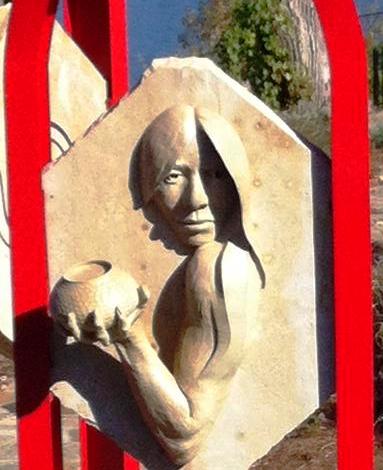
Native American Face

To start things off is one of the faces from the new sculpture Native Knowledge which is located in Riverfront Park.  The installation was created by Denny Haskew.  Native Knowledge is a tribute to the Caddo, Osage, and Quapaw Native American Cultures of Arkansas.

It is sited near the Quapaw Line and La Petite Roche.  The location is important because the Quapaw Line was used as demarcation to separate the Quapaw Tribe from land available for white settlers.  It ran from La Petite Roche due south.  In addition, La Petite Roche was a stop along the “Trail of Tears” as Native American tribes were resettled from their original homes in the American Southeast to points west.


GEE’S BEND at Arkansas Rep

Quilts are not just coverings for warmth, they often tell a story.  The quilts and quilters of Gee’s Bend, Alabama are the focus of the play Gee’s Bend, which opened on Friday night at the Arkansas Rep and continues through February 1

Gee’s Bend was written by Elyzabeth Gregory Wilder.  It follows a group of women as they turn to quilting to provide comfort and creative expression to their lives. Pieced together from discarded clothes and seasoned with laughter and tears, the women sew a patchwork of inventive abstract designs in rich, blazing colors.

The play opens in 1939, with the beginning of the era of African-American land ownership. The story then advances to 1965, in the midst of the Civil Rights movement and the historic visit to Gee’s Bend by the Rev. Martin Luther King, Jr. The production concludes in 2002, on the eve of the unveiling of “The Quilts of Gee’s Bend” exhibition organized by the Museum of Fine Arts in Houston, Texas.

Gee’s Bend was commissioned by the Alabama Shakespeare Festival’s Southern Writers Project, where it received a staged reading in 2006 and premiered in January 2007. A graduate of the dramatic writing program at New York University, Wilder received the American Theatre Critics Association’s 2008 Elizabeth Osborn New Play Award for an emerging playwright.

Gee’s Bend is directed by Gilbert McCauley, who has directed several plays previously at the Rep.  The cast features Corey Jones, Nambi E. Kelley, Shannon Lamb and Monica Parks.   The design team includes Mike Nichols (scenery), Yslan Hicks (costumes), John Horner (lighting), Allan Branson (sound) and Lynda J. Kwallek (props). Robert Hupp is the Producing Artistic Director of the Arkansas Rep.

The Rep’s production of Gee’s Bend is supported and sponsored by The Design Group, Philander Smith College, Arora, Delta Airlines and the Little Rock Convention and Visitor’s Bureau.  It is also made possible in part by a grant from the Arkansas Black Hall of Fame Foundation, a component fund of the Arkansas Community Fund.