Little Rock Look Back: 1961 Groundbreaking for Arkansas Arts Center

On a warm Sunday afternoon, ten golden shovels turned dirt to mark the start of construction for the new Arkansas Arts Center.  The activity followed a series of speeches that day, August 20, 1961.

The speakers and dignitaries sat on the front portico of the original Museum of Fine Arts in MacArthur Park. That building would be incorporated into the new structure.

Among those who took part in the speeches and groundbreaking were Winthrop Rockefeller, Jeannette Edris Rockefeller, Gov. Orval Faubus, Congressman Dale Alford, and Little Rock Mayor Werner Knoop.

The efforts to create the Arkansas Arts Center started in the mid-1950s when the Junior League of Little Rock started an effort to establish a new art museum.  Next, the business community founded a Committee for a Center of Art and Science to accept funds donated.

When a suitable location within Little Rock could not be found, the decision was made to join with the Fine Arts Club and the Museum of Fine Arts.  Under the leadership of the Rockefellers, the drive to form the Arkansas Arts Center was launched. In September 1960, the City of Little Rock formally established the Arkansas Arts Center.

Little Rock Look Back: Townsend Wolfe

Townsend Wolfe, who led the Arkansas Arts Center for 34 years, was born on August 15, 1935.  He was hired to lead the Arkansas Arts Center 50 years ago this month.

Though not the founding director of the Arkansas Arts Center, Wolfe was the director for well over half of the institution’s 57 year history. Hired in 1968 at the age of 32 (making him one of the youngest art museum directors in the US at the time), he retired in 2002.  That year he was honored with the Governor’s Arts Award for Lifetime Achievement by the Arkansas Arts Council.

A native of South Carolina, Wolfe held a bachelor’s degree from the Atlanta Art Institute and a master’s degree from the Cranbrook Academy of Art. He also received a certificate from the Harvard Institute of Arts Administration, and honorary doctoral degrees from two other institutions.  After teaching some classes and seminars at the AAC in the early 1960s, he was recruited to return full-time to the Arkansas Arts Center by Governor and Mrs. Winthrop Rockefeller.

During his tenure at the Arts Center, he first was responsible for creating financial stability. After drastic cost-cutting measures, he refocused programming which led to the creation of the current Museum School, a focus of works on paper for the collection, cultivating a thriving collectors group, establishment of a children’s theatre, expansion of statewide services, and several additions to the physical structure.  He encouraged others to collect art and expanded Arts Center programming into Little Rock neighborhoods.

In addition to serving on the National Council of the Arts, Wolfe was a member of the National Museum Services Board and the board of the Elizabeth Foundation for the Arts in New York. He was curator for an exhibition in the First Ladies’ Sculpture Garden at the White House in 1995, and was the recipient of the 1997 Distinguished Service Award (outside the profession) by the National Art Educators Association.

Over the years, Wolfe has served in a variety of capacities for the Association of American Museums, the National Endowment for the Arts, and the Institute of Museum and Library Services.

Wolfe, who died in 2017, was posthumously honored by the Arts Center earlier this year with one of its Portrait of a Patron awards.  In 1973, he received the first Winthrop Rockefeller Memorial Award from the Arkansas Arts Center.

RIP Ron Robinson

News has broken that longtime Little Rock ad man Ron Robinson has died.

His contributions to the advertising profession in Arkansas would be worthy of note in and of themselves. But Ron was much more than that.  He was a collector — of stamps, of movie posters, of sheet music, of many things.

If Arkansas was included in a piece of music or a film, Ron Robinson wanted it represented in his collection. The Central Arkansas Library System (CALS) houses and is in the process of cataloging Robinson’s vast collection of sheet music, film posters, and other memorabilia connecting those industries with Arkansas’s history and culture.

The Ron Robinson Theater in the Arcade Building on the Library Square campus, the newest performance space in the River Market district bears Robinson’s name. Programming in the 325-seat multi-purpose event venue is designed for all ages and includes films, music performances, lectures, and children’s activities.

The Ron Robinson Collection includes a large number of pieces of sheet music of songs about Arkansas or with the state’s name in the song’s title, containing everything from Tin Pan Alley tunes describing the state to hits by Arkansas musicians such as Patsy Montana and the Browns to would-be state songs. The collection also includes a number of vintage recordings-including Edison disks of the “Arkansas Traveler”-and other materials depicting the state’s music. It will include Robinson’s huge collection of Arkansas-related movie posters, from which the Butler Center co-produced with him an exhibition last year called “Ark in the Dark,” as well as a vast number of pieces of Arkansas political memorabilia.

A native of Little Rock, Robinson has been an avid collector of all things Arkansas for the past fifty years. He is past chairman and chief executive officer of Cranford Johnson Robinson Woods, a full-service advertising, marketing, and public relations firm. He has served on numerous boards and committees including the Friends of Central Arkansas Libraries (FOCAL), Arthritis Foundation, United Way, American Red Cross Public Information Committee, Arkansas Arts Center, and Arkansas Children’s Hospital.

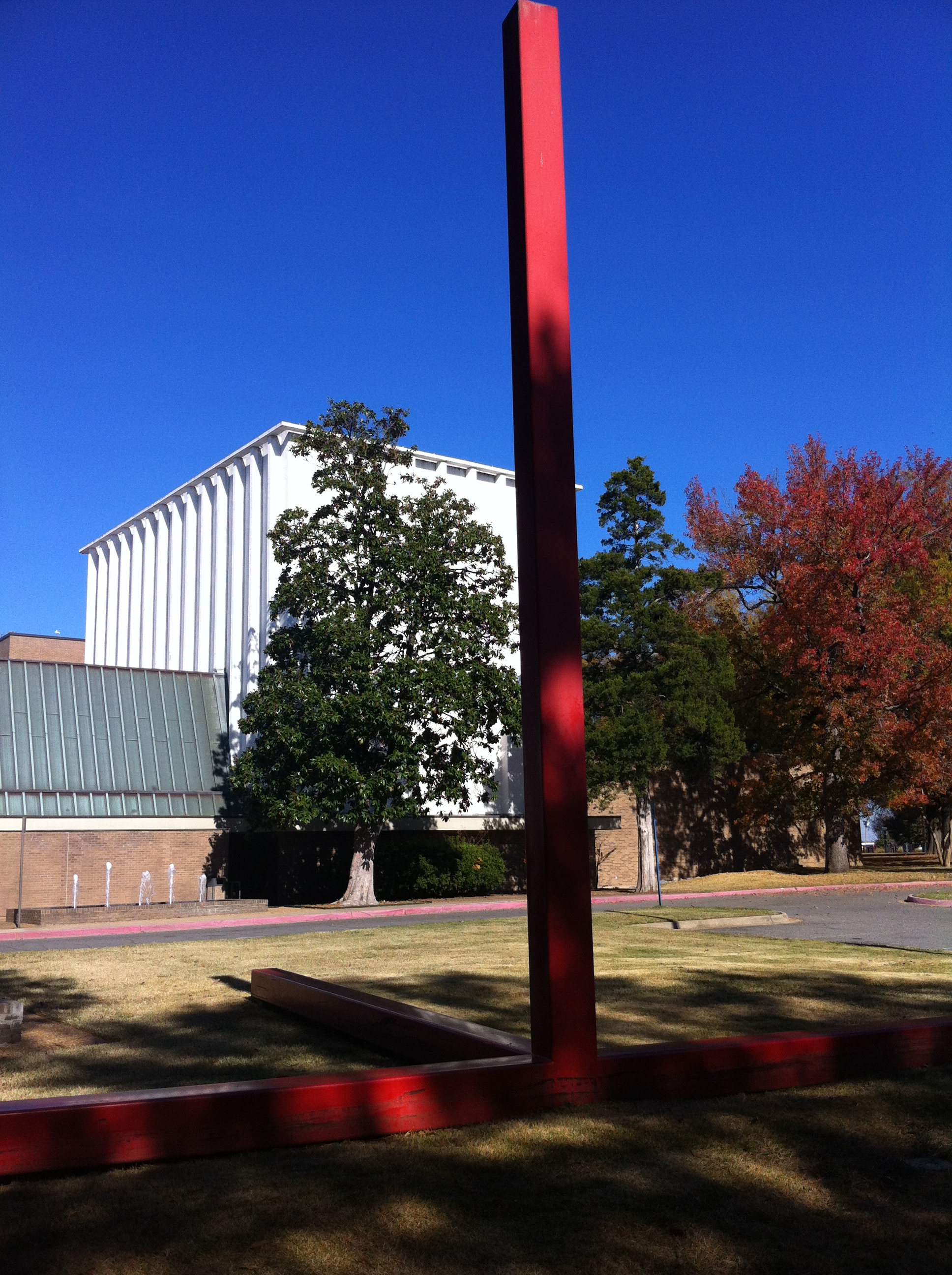
Birth of sculptor Tal Streeter who has a piece in MacArthur Park as part of Arkansas Arts Center collection

On August 1, 1934, Tal Streeter was born in Oklahoma City.  After graduating from the University of Kansas, he worked as a sculptor and artist.  He died in 2014.

In 1970, Streeter and the Arkansas Arts Center Board of Trustees donated Streeter’s sculpture Standing Red in honor of Jeannette Edris Rockefeller.  Mrs. Rockefeller had been a champion of the Arkansas Arts Center and had served as longtime chair of the Board.  She had also been instrumental in the recruitment and hiring of Townsend Wolfe who would be the longtime director of the Arkansas Arts Center.

Streeter’s sculpture stands 27 feet tall and is 54 feet from one end to another.  It consists of a T-shaped base and a perpendicular pedestal.  It is in the Minimalist style of art.  In creating it, Streeter focused on the placement of a thin red line into a setting.  It was placed near the then-entrance of the Arkansas Arts Center (which still serves as the entrance for the Museum School and Children’s Theatre).

This was one of the earliest pieces of abstract art in Little Rock.  A silkscreen by Streeter is also in the Arkansas Arts Center collection.

The late Bob Dorough, Arkansan and musical genius, named a 2019 NEA Jazz Master

Earlier this week, the National Endowment for the Arts announced the 2019 Jazz Masters.  Among them was the late Bob Dorough, who died on April 23 of this year.  The other three recipients are big band leader Maria Schneider, pianist Abdullah Ibrahim, and writer Stanley Crouch.

Dorough’s career spanned more than 70 years in jazz as a singer, pianist, composer, and arranger. His distinctive vocals, clever lyrics, and strong melodies were well-known in the jazz world even before his compositions and vocals for the animation series “Schoolhouse Rock!.”

Born in Arkansas and raised in Texas, hepivoted toward jazz after hearing Benny Goodman and Harry James recordings. During a three-year-stint in the U.S. Army from 1943-45, he worked as an arranger and musician in a Special Services band, then earned a bachelor’s degree in composition at North Texas State Teachers College (now known as the University of North Texas) in 1949.

Dorough relocated to New York City to continue his studies at Columbia University and immersed himself in the vibrant local jazz scene.  After spending six months working at the famed Mars Club in Paris, France, he returned to the U.S. and settled in Los Angeles, performing as pianist-vocalist in clubs and as supporting act between sets for comedian Lenny Bruce. Dorough’s first album, Devil May Care, was released in 1956.

In 1962, Dorough was working on the East Coast when he received a call from Miles Davis who he had met several years before in Los Angeles, asking him to write a Christmas song for him to record. Dorough composed “Blue Xmas (To Whom It May Concern)” and sang it with Davis as well as another track, “Nothing Like You,” used as the closing track of Davis’ album Sorcerer in 1967.

In 1972, Dorough was hired by a New York advertising firm to set the multiplication tables to music to make them easier to learn. It was decided that the songs would make good animation, and Tom Yohe put artwork with the music to create Schoolhouse Rock! Dorough became the musical director of the television series, enlisting other well-known jazz musicians to help write and perform the songs. The animated educational series became a staple of the ABC network’s children’s programming for more than two decades.

In 1998, he was inducted into the Arkansas Jazz Hall of Fame.  The Arkansas Arts Center Children’s Theatre has performed the stage adaptation of “School House Rock Live!” (which was created by Arkansan and AAC alum Scott Ferguson and performed all over the country).

On April 15, 2019, the NEA will host a free concert celebrating the Jazz Masters at the John F. Kennedy Center for the Performing Arts in Washington, D.C.

Beginning in 1982, NEA has bestowed the Jazz Master honor on more than 150 people connected to the jazz genre, including Ella Fitzgerald, Miles Davis, Dianne Reeves and George Wein. Individuals first are nominated by the public, with an NEA-convened panel assessing the nominations before the National Council on the Arts reviews the recommendations and forwards them along to the NEA chairman, who makes the final decision.

Todd Herman departs Arkansas Arts Center

On Wednesday, July 11, 2018, Dr. Todd Herman, announced to Arkansas Arts Center staff that he will be leaving to take a position in North Carolina.  His last day at Little Rock’s art museum will be August 10.

Formal announcement of the new position is expected to be made on Thursday, but local media broke the story on Wednesday evening.

Herman, who joined the AAC in 2011, succeeded Nan Plummer as director, who served from 2002 to 2010. She was preceded by longtime director Townsend Wolfe, who led the AAC from 1968 to 2002. Between 1961 and 1968, the Arts Center had a revolving door of directors and acting directors including Muriel Christison (1961), Alan Symonds (1962-1964), William H. Turner (1964-1965), and Louis Ismay (1966-1968).  William Steadman (1958) and George Ware (1959-1960) lead the museum as it transitioned from the Museum of Fine Arts to the Arkansas Arts Center.  Nettie L. Robinson was the director of the original Museum of Fine Arts from its opening in 1937 until her retirement in 1957.

T. Laine Harber, the Arts Center’s Chief Operations Officer/Chief Financial Officer will be Interim Director while a search is conducted for Herman’s replacement.

Work continues on the planning for the expansion and enhancement of the Arts Center which is currently slated to be completed in 2022.

Little Rock Look Back: LR City Council authorizes expansion of Museum of Fine Arts

Twenty-two years after authorizing the creation of the Museum of Fine Arts in City Park, the Little Rock City Council was asked to consider expanding the facility.
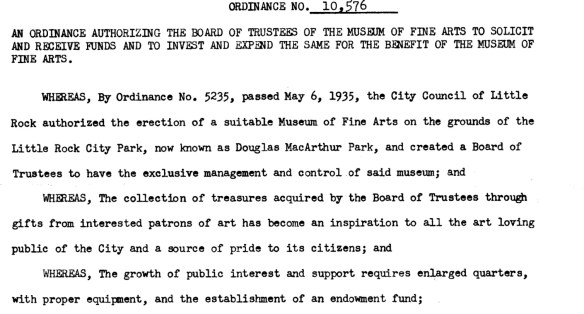
By 1957, the existing structure was felt to be inadequate.   There was a desire for more gallery space as well as for more space for educational programming.

On July 8, 1957, the Little Rock City Council passed an ordinance authorizing the Board of the Museum of Fine Arts to be able to raise the funds for an expansion.  This was merely the start of the process which would eventually lead to the creation of the Arkansas Arts Center.

The ordinance allowed for the expansion or extension of the building. It also authorized the museum’s board to accept gifts for the project and to invest those gifts for the purpose of the museum.  Since the museum only received City funds for maintenance and salary, the ability to raise funds for the expansion was key to the future of the institution.

Lastly, the ordinance gave the museum’s board the ability to increase its membership by up to six positions without having to get additional approval by the City Council.  With a fundraising drive underway and a larger facility planned, these additional board members could certainly prove to be key.

The ordinance passed with nine Ayes, zero Noes, and one absent.