
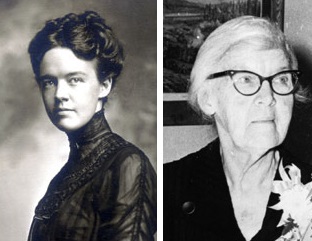
Little Rock Look Back: Adolphine Fletcher Terry

Photos from the collection of the Butler Center

Photos from the collection of the Butler Center

Adolphine Fletcher Terry was born on November 3, 1882 to former Little Rock Mayor John Gould Fletcher and his wife Adolphine Krause Fletcher.

Raised in Little Rock, in 1889 she moved into the Albert Pike House on East 7th Street, when her aunt transferred the title to her father. That house would be her primary residence the rest of her life.  Her sister Mary Fletcher Drennan never lived in Arkansas as an adult after marriage. Her brother John Gould Fletcher spent much of his adulthood in Europe before returning to Little Rock and establishing his own house, Johnswood.

At age 15, Adolphine attended Vassar. She later credited that experience as broadening her views on many issues.  After graduating at age 19, she returned to Little Rock.  Her parents both died prior to her 1910 wedding to David D. Terry, which took place at what was then known as the Pike-Fletcher House (and today is known as the Pike-Fletcher-Terry House).

She is perhaps best known today for establishing the Women’s Emergency Committee in 1958 and for her subsequent deeding of the family house to the City for use by the Arkansas Arts Center.  But her entire life was based on civic engagement.

She was instrumental in establishing the first juvenile court system in Arkansas and helped form the first school improvement association in the state. She was long an advocate for libraries, serving 40 years on the Little Rock public library board.  Through her leadership, the library opened its doors to African Americans in the early 1950s. Today a branch of the Central Arkansas Library System (the successor the Little Rock public library) is named after her.  Another branch is named after her Pulitzer Prize winning brother.

Adolphine formed the Little Rock chapter of the American Association of University Women, the Pulaski County tuberculosis association and the Community Chest.

In 1958, when the Little Rock public high schools were closed instead of allowing them to be desegregated again, she called Harry Ashmore the editor of the Gazette and exclaimed, “the men have failed us…it’s time to call out the women.”  With this, she formed the Women’s Emergency Committee to Open Our Schools. This group played a major role in getting the four high schools open the following year.

From 1933 to 1942, David Terry served in the U.S. Congress. During that time, Adolphine alternated her time between Washington DC and Little Rock. But she spent much time in Little Rock raising her five children.

After her husband’s death in 1963, she continued to remain active in civic affairs. In the 1960’s, she and her sister deeded the Pike-Fletcher-Terry House to the City of Little Rock for use by the Arkansas Arts Center upon both their deaths.  Following Adolphine Fletcher Terry’s death in 1976, Mary turned over the title to the City.

Adolphine Fletcher Terry is buried in Mount Holly Cemetery alongside her husband. Three of her children are also buried in that plot.  Her parents and brother are buried in a nearby plot.

Her son William Terry and his wife Betty continue to be active in Little Rock. Their daughters and their families also carry on Adolphine Fletcher Terry’s commitment to making Little Rock better.

Little Rock Look Back: J. N. Heiskell

At the age of 87, J. N. Heiskell in 1960.

At the age of 87, J. N. Heiskell in 1960.

John Netherland (J. N.) Heiskell served as editor of the Arkansas Gazette for more than seventy years.

He was born on November 2, 1872, in Rogersville, Tennessee, to Carrick White Heiskell and Eliza Ayre Netherland Heiskell. He entered the University of Tennessee at Knoxville before his eighteenth birthday and graduated in three years at the head of his class on June 7, 1893.

His early journalism career included jobs with newspapers in Knoxville and Memphis and with the Associated Press in Chicago and Louisville. On June 17, 1902, Heiskell’s family bought controlling interest in the Arkansas Gazette. Heiskell became the editor, and his brother, Fred, became managing editor.

Governor George Donaghey appointed Heiskell to succeed Jeff Davis in the United States Senate after Davis’s death in office. Heiskell served from January 6, 1913, until January 29, 1913, when a successor was elected.

On June 28, 1910, Heiskell married Wilhelmina Mann, daughter of the nationally prominent architect, George R. Mann. The couple had four children: Elizabeth, Louise, John N. Jr., and Carrick.

In 1907, he joined a successful effort to build the city’s first public library. He served on the library board from that year until his death and was issued the first library card.  He also served on the City’s Planning Commission for decades.

In 1912, he was instrumental in bringing John Nolen to Little Rock to devise a park plan. Heiskell was also largely responsible for the location of Robinson Auditorium. When City Council members had competing locations, he advocated for the corner of Markham and Broadway. And kept at it until the site was selected.

In the paper and in his own personal opinions, he crusaded on a variety of progressive causes.  Perhaps the most famous was the Gazette’s stance in the 1957 Central High desegregation crisis.  It was for this effort that the paper received two Pulitzer Prizes.

Although Heiskell stopped going to the office at age ninety-nine, he continued to take an active interest in the newspaper. He began by having a copy of the newspaper delivered to his home by messenger as soon as it came off the press each night. Eventually, he switched to having his secretary call him daily at his home and read the entire newspaper to him. He operated on the premise that “anyone who runs a newspaper needs to know what’s in it, even to the classified ads.”

A few weeks after turning 100, Heiskell died of congestive heart failure brought on by arteriosclerosis on December 28, 1972. He is buried in Little Rock’s Mount Holly Cemetery.  Interestingly, he is buried in the same cemetery as two of his most notable adversaries: Governor Jeff Davis, and segregationist Congressman Dale Alford.

Little Rock Look Back: Site selected for Robinson Auditorium

Potential rendering of new auditorium which appeared in October 30, 1937 ARKANSAS GAZETTE

Potential rendering of new auditorium which appeared in October 30, 1937 ARKANSAS GAZETTE

On October 29, 1937, the Little Rock City Council finally selected the site for the Municipal Auditorium.  It had been approved by voters in January of that year, but no site had been identified during the campaign.

During the early autumn, the City had engaged a consultant to evaluate several downtown locations as potential sites for the municipal auditorium.  One stipulation was that it had to be an entire city block.

The six sites were:

Broadway, Markham, Spring and Garland Streets; Center, Markham, Spring and Second Streets; Center, Eighth, Louisiana and Ninth Streets; Scott, Fourth, Cumberland and Capitol Streets; Scott, Tenth, Cumberland and Ninth Streets; and Third, State, Second and Gaines Streets


The top choice was the site bounded by Center, Markham, Spring and Second Streets.  It was felt that location’s proximity to public buildings made it ideal for a civic auditorium.  It was across the street from the former state capitol (then known as the Arkansas War Memorial) which was, at the time, housing state and federal offices.  The site was also adjacent to the county courthouse structures.

Half of the desired property was owned by the federal government.  Because it was being used for federal offices, it was uncertain as to the site’s availability.  Therefore a city committee recommended the site bounded by Center, Eighth, Louisiana and Ninth Streets be utilized as the auditorium location.

The City Council met on October 20 to make a decision. But were at a stalemate. They met again a few days later with still no resolution.

At an October 25 City Council meeting, Arkansas Gazette publisher (and chairman of the Planning Commission) J. N. Heiskell, advocated the site on Markham and Broadway Streets. The Council convened on October 29 to meet again.  The clock was ticking, a site had to be selected because ground had to be broken prior to January 1, 1938.


At the October 29th meeting, the discussion from previous meetings among the aldermen picked up where it had left off.  Again J. N. Heiskell spoke about the importance of employing city planning concepts in selecting the site.

“In the past, selection of a site for a public building has been merely a matter of who could sell the city some property.  I had hoped we were starting a new effort in starting selection of an auditorium site with the advice of Mr. Bartholomew.  Starting with the auditorium, we should be guided by competent advice and locate future buildings following a city plan.  Your vote today will determine the future of Little Rock so far as city building goes.”

After having engaged in discussions with various federal government agencies, Mayor Overman reported that the city could not obtain the recommended site.  It would not be possible for the federal government to relocate those agencies currently occupying half of that block within the time allowed.  The mayor also stated that he had been warned that if construction did not start by January 1, 1938, (which was just a few weeks away) then the money could be taken back and allocated to other projects.

Ultimately the City Council voted 16 to 1 with 1 absent to locate it at the corner of Markham and Broadway.  At last, Little Rock had a location for the new municipal auditorium!

Though it had not been anyone’s first choice (except Mr. Heiskell, who did not have a vote), in retrospect, the auditorium site finally chosen offered many advantages which were not identified during the marathon selection discussions.  The grade of the land sloped toward the Arkansas River from Markham Street down to Garland Street which allowed for a street level entrance to both the planned exhibition hall on a lower level and the music hall on an upper level.  Given the topography of the other sites under consideration, this was only possible at the chosen location.  By stacking the two major components the project did not take up an entire block, which had been the forecasted footprint.  Not using the entire block allowed for subsequent expansion of the complex’s footprint in the coming decades.  This would not have been possible at any of the other sites under consideration if the original structure had taken up the entire block.  In addition, both Markham and Broadway Streets are wider than normal city streets which allowed for better traffic flow and for easier access to a loading dock.

Interestingly, the Convention & Visitors Bureau, which oversees Robinson Center Music Hall, now has offices in the Cromwell Building. This building is located on the site which had been the first choice for the auditorium in 1937.


1897 UFO Sightings in Arkansas topic of Old State House Brown Bag Lecture today at noon

On Thursday, October 15, at noon, at the Old State House Museum, Brian Irby of the Arkansas History Commission will tell the story of one of the first waves of UFO hysteria that swept through the nation for a Brown Bag Lunch Lecture.

Between 1896 and 1897, the country was in the grips of what was one of the first major panics created by sightings of strange objects in the sky. Less than a decade before the Wright Brothers would fly the first powered flight, newspapers around the country began reporting on sightings of an airship, spotted in the wild.

In April of that year, the unidentified flying object stories came to Arkansas. In April, railroad conductor Jim Hooton told the Arkansas Gazette that he had seen the airship while hunting and provided a sketch to the paper. Just a few weeks later, mounted deputies near Hot Springs said they “noticed a brilliant light high in the heavens,” and drew their Winchesters on a man they said was traveling in an airship.

Brian Irby has a BA and MA from the University of Central Arkansas. He has been on staff at the Arkansas History Commission since 2008 as an archival assistant where he works on educational programs.

Admission is free, and attendees are welcome to bring a sack lunch. Soft drinks and water are provided.

The Old State House Museum is an agency of the Department of Arkansas Heritage.

CANCELLED – Jonathan Karl will present the CALS J.N. Heiskell Distinguished Lecture

jonathankarlJonathan Karl, ABC News’ chief White House correspondent, will present the Central Arkansas Library System’s (CALS) J.N. Heiskell Distinguished Lecture on Friday, October 9, at 6:30 p.m. in the Ron Robinson Theater, 100 River Market Ave.
 The event is free and open to the public. A reception will follow the program. Seating is general admission. Reservations are appreciated, but not required. RSVP at lellis@cals.org, or 918-3024.
Jonathan Karl, ABC News’ chief White House correspondent, covers the White House forWorld News Tonight, Nightline, and Good Morning America. Karl joined ABC News in January, 2004, and has also served as the network’s Senior Congressional Correspondent, Senior Foreign Affairs Correspondent, Senior National Security Correspondent, and Senior Political Correspondent.
Karl has covered political campaigns in virtually every state and has reported from more than 30 countries, including Iraq, Afghanistan, China, Pakistan, and Sudan. He traveled internationally with the President, Vice President, Secretary of State, and Secretary of Defense to cover topics such as three presidential elections, the wars in Iraq and Afghanistan, the intelligence community, and Congressional reaction to the September 11 terrorist attacks.
Jonathan Karl’s extensive experience and political knowledge allow him to discuss foreign affairs, America’s role in the post-September 11 world, national politics, and current events with insight and expertise. Karl also elaborates on what he has learned as moderator and organizer of Sustaining Democracy, a series of panel discussions on America’s changing political landscape. In 2001, Karl won the National Press Foundation’s Everett McKinley Dirksen Award, the highest honor for Congressional reporting and in 2013 was awarded with a Walter Cronkite Excellence in Journalism award.
The Heiskell Distinguished Lecture is named for J.N. Heiskell, the longest-serving member of the Library’s Board of Trustees and editor of the Arkansas Gazette for more than seventy years. J.N. Heiskell was the longest-serving member of the Library’s Board of Trustees, serving from 1910-1972, and he served as President from 1950 until his death in 1972. Speakers and programs honor Heiskell’s commitment to excellence in journalism as well as his support of the library. Past speakers include Helen Thomas, Ernest Dumas, Walter Mears, David Pryor, Dexter Filkins, and John O’Hara.

Little Rock Look Back: Mayor John E. Knight

Jno E Knight sigOn September 20, 1816, future Little Rock Mayor John Elliott Knight was born in Newburyport, Massachusetts. In 1843 he married Hannah Donnell in New York, and came to Little Rock that same year.

Knight was editor of the Arkansas Democrat from 1846 to 1850. He was also associated with the Arkansas Gazette and published the short-lived Chronicle. In 1851, Knight served as Mayor of Little Rock. In 1855, he served as a member of the City Council.

In 1858 a song was published entitled “I Am Near to Thee” which featured music by Arkansan Benjamin Scull and lyrics by Knight.  The song was dedicated to Mary Woodruff.

During the Civil War, he served as a Colonel.  During the 1850, 1860 and 1880 census, he was listed as an attorney.

He had one daughter, Elizabeth Knight, who married James S. Pollock, a banker in Little Rock. Knight died in Little Rock, Arkansas, on October 28, 1901, and was buried in Mount Holly Cemetery. Elizabeth Knight Pollock died in 1910.

As an attorney and newspaper editor, John E. Knight collected documents about the settlement of Little Rock. Those papers are now part of a collection at the Arkansas History Commission.  The majority of these papers are from William Russell to Chester Ashley, pertaining to pre-emption claims in and around Little Rock. Other material concerns the 1819-1822 dispute related to the the New Madrid Certificate and pre-emption claims of James Bryant, Stephen F. Austin, and William M. O’Hara.

Little Rock Look Back: Plans for a new City Hall finally move forward

City Hall circa 1908

City Hall circa 1908

After a judge ruled in August 1906 that the City of Little Rock could not build a new City Hall and Auditorium complex, it looked like Little Rock would be stuck with its existing inadequate building.

However on September 10 it became obvious that much work had been taking place behind the scenes after that ruling.  On that day, the Board of Public Affairs (a City body charged with overseeing municipal government construction projects and comprised of the mayor and two citizens approved by the City Council) voted to ask the aldermen to cancel plans and rescind legislation for the city hall, jail and auditorium complex.  The Board of Public Affairs then offered up a new plan for a city hall and jail building.  Because no auditorium was involved, these plans would not be in violation of the Chancery Court.

That same evening the City Council followed suit and revoked the plans for the original project.  The aldermen then voted to proceed with building a new city hall and jail without the auditorium.  There was only one dissenting vote; Alderman Jonathan Tuohey voted no.  He explained his negative vote was not a lack of support for the project, but he was not comfortable with the way it was rushed through.

Mayor Warren E. Lenon told the Gazette, “The Chancery Court has enjoined us from erecting an auditorium and the Board of Public Affairs has consequently rescinded all resolutions and orders pertaining to that structure.” He noted that there would “be no appeal from the injunction granted by Chancellor Hart, because there is nothing to appeal.”

The coverage of the actions of the City Council that night was in keeping with the manner in which the two daily newspapers had covered the lawsuit and the trial.  The Gazette headline cried “City Hall Ordinance Railroaded Through” while the staid Democrat merely stated “New $175,000 City Hall Provided by City Council.”  The tone of theGazette’s article matched the headline while the Democrat’s story was more straightforward.

Architect Charles Thompson adjusted his plan for the new City Hall by removing the auditorium wing.  With the revised Th0mpson plan and the approval of the City Council, Little Rock was at last on its way to a new City Hall.  This was over two years after Mayor Lenon had first broached the subject.

Originally slated to open in 1907, the building officially opened in April 1908.