

Rock The Tonys: Tony Award winners at The Rep

Will Trice at the 2014 Tony Awards

The 72nd Tony Awards take place on Sunday, June 10 at Radio City Music Hall (broadcast on CBS).

Over the years, the Arkansas Repertory Theatre has had several Tony winner work on stage and backstage.

Among these are:

Jason Alexander – In 1989, he won the Tony Award for Actor in a Musical for Jerome Robbins’ Broadway. The play Windfall, which closed the Rep’s 2015-2016 season, was directed by Alexander.

Bill Berloni – One of the 2011 Tony Honors went to Berloni, who has made a career out of training animals for the stage. It started with the original 1977 Tony winning Annie. He put his skills to work at the Arkansas Rep in 2013 for the musical Because of Winn Dixie.

Cleavant Derricks – The 1982 Tony ceremony recognized Derricks with the Featured Actor in a Musical award for his role as James “Thunder” Earley in the original production of Dreamgirls. 31 years later he appeared in the Arkansas Rep production of Treasure Island.

Remmel Dickinson – As a producer, Dickinson has won Tony Awards in 2009 for The Norman Conquests (Revival of a Play), Memphis (Musical) and War Horse (Play). In 2014, he produced Memphis at the Rep.

Ann Duquesnay – At the 50th Tony Awards in 1996, Ms Duquesnay won the Featured Actress in a Musical for Bring in ‘da Noise/Bring in ‘da Funk. (She was also nominated for contributing to the show’s score.). In 1999, she starred at the Rep in Cookin’ at the Cookery: The Music and Times of Alberta Hunter.

Peter Schneider – The 1998 Tony for Best Musical went to The Lion King. Peter Schneider was the Disney executive who led the effort to produce it. In 2013, he directed Pal Joey at the Arkansas Rep.

Will Trice – In 1994, Trice appeared on the Rep stage as a young actor in the production of Lost in Yonkers. As an adult, he has received Tony Awards as a Broadway producer, including: Porgy and Bess (2012 Revival of a Musical), Who’s Afraid of Virginia Woolf? (2013 Play Revival) and All the Way (2014 Play). He has received five additional producing nominations.

In addition, both Tony winning actress Jane Alexander and Tony winning producer Rocco Landesman each appeared on the Arkansas Rep stage as chair of the National Endowment for the Arts in conjunction with appearances in Little Rock.

The fact that the Arkansas Repertory Theatre has been able to work with theatre artists of this calibre is a testament to the quality of work it has produced.  Giving the opportunity for Arkansas audiences to have this interaction without leaving the state is one of the values of the Rep.

Repertorium Praeter Theatrum

Rocking the Tony Awards – Past Tony nominees at Arkansas Rep

Photo by Peter Kramer/ Getty Images Entertainment

The 72nd Tony Awards take place on Sunday, June 10 at Radio City Music Hall (broadcast on CBS).

Over the years, the Arkansas Repertory Theatre has had several Tony nominees work on stage and backstage.

Among these are:

Julie Andrews, who headlined a 2002 fundraiser for Arkansas Rep.  That evening she shared stories about her life and career.  A two-time Tony Award host, she has been nominated three times for Actress in a Musical: My Fair Lady (1957), Camelot (1961) and Victor/Victoria (1996).

Jane Lanier, who choreographed Ring of Fire at Arkansas Rep.  In 1989, she was nominated as Featured Actress in a Musical for her work in Jerome Robbins’ Broadway.  

Mercedes McCambridge, who appeared in ‘night, Mother at the Rep in the spring of 1986.  She was nominated as Featured Actress in a Play for The Love Suicide at Schofield Barracks for the 1972 awards.

Austin Pendleton, who directed A Loss of Roses at Arkansas Rep.  After appearing in the original cast of Tony winning Best Musical Fiddler on the Roof, he later received a Tony nomination for directing the 1981 revival of The Little Foxes which starred Elizabeth Taylor and Maureen Stapleton.

Jane Summerhays, who starred in the Arkansas Rep production of A Loss of Roses.  In 1987, she was nominated for Featured Actress in a Musical for Me and My Girl.

John Tartaglia, who directed 2013’s Because of Winn Dixie.  He was nominated for the 2004 Tony for Actor in a Musical for his performance in Avenue Q.

Japhy Weideman, who was the Rep’s lighting designer in the early 2000’s.  While he was at the Rep, he lit several shows including The Grapes of Wrath, All My Sons and God’s Man in Texas.  He has received Tony nominations for lighting design for his work on The Nance (2013), Of Mice and Men (2014), Airline Highway (2015), The Visit (2015), and Dear Evan Hansen (2017).

The fact that the Arkansas Repertory Theatre has been able to work with theatre artists of this calibre is a testament to the quality of work it has produced.  Giving the opportunity for Arkansas audiences to have this interaction without leaving the state is one of the values of the Rep.

Repertorium Praeter Theatrum

An Update on Plans to #SaveTheRep!

Since the Arkansas Repertory Theatre made the announcement on April 24, 2018, that the theatre were suspending operations, several important steps have been taken.

Overall, they can be summarized by the mantra which is guiding the Rep leadership during this time:  PROFESSIONAL, AFFORDABLE, & SUSTAINABLE.

  • Within just the first few weeks since the news broke, the Rep has received more than 550 gifts totaling almost $220,000.  Every dollar given right now is being matched by the Windgate Charitable Foundation, and monthly and multi-year pledges make it possible to be even more generous with giving.
  • The Rep Board has appointed a volunteer Interim Leadership Team consisting of Rep founder Cliff Baker and Rep board members Bill Rector and Ruth Shepherd.
  • The Rep has formed an “Our Next Act” Steering Committee of board and community leaders who are examining every facet of Rep operations and make recommendations to The Rep Board for action. The aim is to have a plan by mid-August about how to reopen The Rep after this brief intermission.
  • The theatre is in the process of selling the building which was used as actor housing.  That will reduce our property debt by nearly half.  There are many more options for housing actors downtown near the Rep than there were when those apartments were originally acquired.
  • The Rep is planning community listening sessions to get Little Rock’s best thinking and ideas. Check soon on the Rep’s website to learn how you can participate.  (Also, make plans to attend the Clinton School presentation on the future of the Rep featuring Ruth Shepherd on Thursday, June 7 at 12 noon at Sturgis Hall.)
  • The education programs will continue throughout the summer with programming for rising K-12 students. There are still a few slots left, so check the education section of the Rep’s website for class information.

While much progress has been made, the work is far from over.  The Rep still needs support from the public, financial and otherwise.

Repertorium Praeter Theatrum

Little Rock Look Back: May 31, 1968 – a day of transition for the Arkansas Arts Center

AAC Logo in 1963

An arts organization in financial crisis.
Programming abandoned
Summer education programming for students
Staff laid off
A challenge grant from donors
A community fundraising drive

Sound familiar?

In January 1968, the Arkansas Arts Center made the decision to cease operating a degree-granting education program effective May 31 of that year.  Sixteen faculty members lost their jobs, though a couple were retained for other positions within the organization.

After opening in May 1963 and beginning the degree-granting program in September 1964, the Arkansas Arts Center found itself operating at a deficit each year.  While Jeannette and Winthrop Rockefeller made up the deficits, it was not a sustainable model.  (Mrs. Rockefeller had been the president of the AAC board for several years after she and her husband played leadership roles in the statewide fundraising efforts to establish the AAC.)

Though the degree-granting programs were bringing national recognition to the AAC, they had essentially taken over the entire facility.  The theatre was rarely available for children’s programming or community groups. The galleries were given over largely to the displaying the works of the students and faculty.  What had been envisioned as a facility melding world-class arts with community arts, was not functioning that way.

As such, the statewide membership program was suffering. Without the creation of programming in Little Rock, it was difficult to take any substantial arts offerings out to the membership clusters throughout the state. This resulted in the decline of memberships being purchased.

Following the announcement of the cessation of the degree-granting program, the AAC Board sought ways to more fully engage the public.  Part of this was due to the fact that the Arts Center had a deficit of $295,216 (the equivalent of $2.15 million today).  The only profitable part of the AAC operation was the gift shop.  With that level of deficit, the permanent closure of the AAC was certainly a possibility on people’s minds.

A committee studying the future of the AAC decided to focus on five (5) areas.  (And of course, AAC founding mother Jeane Hamilton was part of this effort.)  The areas were Education (community classes for children and adults), Exhibits (a return to a mix of permanent and traveling exhibitions), Theatre (partnerships with Community Theatre of Little Rock and the creation of children and teen theatre productions), State Services (refocusing the Artmobile to include educational instruction), and Membership. This would result in a net budget of $260,000.

In April 1968, a fund drive was announced led by former Little Rock Mayor Byron Morse.  The goal was $130,000, to be matched dollar-for-dollar by the Rockefellers.  As of May of that year, it had raised $108,731.

There are many parallels between the AAC in 1968 and the Arkansas Repertory Theatre’s current predicament. While the causes of the financial woes may be different, the cures are very much the same.

Then, as now, the citizens of Little Rock and Arkansas had to step up and financially support an arts organization in financial crisis.  Whereas the Rockefellers were matching gifts in 1968, the Windgate Foundation is matching gifts now.  Just as the Arts Center renewed its focus on the community and redefined the way it did business, the Rep is now facing these same processes and predicaments.

What the future Rep will look like in terms of numbers and types of productions remains to be seen.  But the core leadership team is touting a mantra of Professional, Affordable, and Sustainable.  All of these are laudable. All are attainable. But all will require continued community commitment year in and year out.

An interesting side note: a key Arts Center Board member in 1968 was William Rector, the father of longtime Rep Board member Bill Rector who is currently part of the interim leadership team at the Rep.  Let’s hope Bill has the same success in his endeavor as his father did.

Viva Center Artium
Repertorium Praeter Theatrum

New play LITTLE ROCK, inspired by 1957 events, with roots at Arkansas Rep begins performances tonight in NYC

Tonight in New York City, a new play starts previews.  It is entitled Little Rock and is written and directed by Rajendra Ramoon Maharaj.

Eleven years ago, Maharaj was in a residency at the Arkansas Repertory Theatre creating It Happened in Little Rock, which was performed at the Rep in September 2007.  It was their contribution the community events commemorating the fiftieth anniversary of the integration of Little Rock Central High.

Though Maharaj’s current production is different from the 2007 Rep production, it was inspired by his time in Little Rock and the connections he made during his residency.

Here is the official description of Little Rock:

LITTLE ROCK tells the riveting true story of the Little Rock Nine, the first black students to attend their city’s formerly segregated central high school. What began as their quest for a better education soon became a national crisis, igniting the passions of a divided country and sparking a historic fight for justice in the Jim Crow South.

On the cusp of the Civil Rights Movement, a changing world watched as these nine children from Arkansas battled for their rights with only a book and pencil.

The cast includes Rebekah Brockman, Justin Cunningham, Charlie Hudson III, Ashley Robinson, Stephanie Umoh (who starred in the Arkansas Rep production of Pal Joey), Shanice Williams, Peter O’Connor, Damian Jermaine Thompson (who starred in the Arkansas Rep productions of The Whipping Man and the Scottish Play), Kea Trevett and Anita Welch.

The production officially opens on June 6 and is scheduled for a limited run through September 8.

This production illustrates why theatre is important and Arkansas Repertory Theatre specifically is important.  One, theatre is a chance to explore and explain moments from our past and present.  The Rep saw a role it could play in telling a variety of stories and perspectives while molding a narrative about events in 1957 and progress that had been made (or not) since then.

Additionally, it is important that the Arkansas Repertory Theatre provided an artistic home for a playwright and director to learn.  In addition to working on It Happened in Little Rock, over the years Maharaj directed A Raisin in the Sun, Dreamgirls, and Intimate Apparel for Arkansas Rep.  It was through his experiences in Little Rock in 2004 and 2006, that he was inspired to collaborate with Bob Hupp, Leslie Golden and the Rep staff on It Happened in Little Rock.  Developing a play is not easy, cheap, or quick.  It is vital to the future of theatre to have artistic homes which can support these initiatives.

As the Arkansas Rep is preparing for its “Next Act” it is important to remember the impact it has had artistically and as an agent for community conversation on not only Little Rock but the state of Arkansas.  Sometimes theatre sparks ideas that no other art-form can, or no amount of reading or listening to speeches can.

Repertorium Praeter Theatrum

UPDATE – on the afternoon of May 30, the producer announced that due to some technical difficulties, the production was being delayed a few days.

$644,600 from NEA is going to the Arkansas Arts Council

In pursuit of its commitment to advance the creative capacity of people and communities across the nation, the National Endowment for the Arts announces its second round of funding for FY 2018.
This funding round includes annual partnerships with state, jurisdictional, and regional arts agencies as well as the categories of Art Works, Creativity Connects, Our Town, and Research: Art Works.

One of the grantees was the Arkansas Arts Council which will receive $644,600.  This will support arts programs, services, and activities associated with carrying out the Arkansas Arts Council’s NEA-approved strategic plan.  The Arts Council is an agency of the Department of Arkansas Heritage.

There were a total number of six (6) grants to entities in Arkansas.  These grants are worth $814,600.  As noted yesterday in a post, one of the grantees was the Arkansas Arts Center.

Earlier this year, the NEA announced its first round of grants which included $10,00 for the Arkansas Repertory Theatre to support production of The Call; $12,500 to the Arkansas Symphony Orchestra to support the Canvas Festival, which combined visual arts and the performance of live symphonic music; $10,000 to the Chamber Music Society of Little Rock to support a series of chamber music performances and related educational programming; and $25,000 to the Oxford American to support the publication and promotion of the magazine.

Dr. Jane Chu, who is the Chairman of the NEA, has announced she will be stepping down on June 4, 2018, at the conclusion of her four year term.  A graduate of Arkadelphia High School and Ouachita Baptist University, she has visited Little Rock during her tenure at the helm of the NEA.

Repertorium Praeter Theatrum

It was two weeks ago yesterday that the Arkansas Rep announced suspension of operations.  It was a week ago yesterday that the Rally at the Rep was held which raised money and community spirit for the Rep.
Supporters of the Rep have made a good start in donating over $113,000 towards the goal of $750,000.  The John & Robyn Horn and Windgate Charitable Foundations have generously extended matching grants to make donated dollars stretch even further.  It does not mean the money woes are eliminated. It just means there is a clearer pathway to reaching the goal.

Yesterday was the final day of employment at the Rep for many folks.  These are good people.  Some grew up here. Others came here to work.  All became a part of Arkansas in addition to becoming part of the Arkansas Rep.

A few staff members remain.  Even when operations are in suspension, there are still tasks to accomplish.

And excitingly the Rep’s Education Department is continuing its summer programming under the leadership of Anna Kimmell.  From June 18 through August 3, there will be a series of age-based sessions for kids ranging in age from kindergarten up to 2018 high school graduates.

The education programming illustrates a key reason the Rep is important.  Yes, the final two-week program is geared toward high school kids and offers a conservatory-style training. It is a wonderful opportunity for those who think they might be interested in pursuing a career in the performing arts.

But a key aspect of all the sessions is the use of the performing arts as forms of self-expression.  Even if the students never set foot on stage again, they have learned confidence. They have learned arts appreciation. They have learned to respect themselves and others.

This is what theatre does. This is what the arts do.

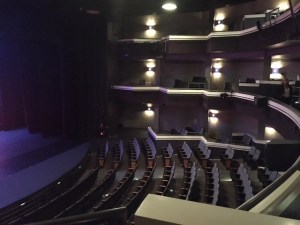
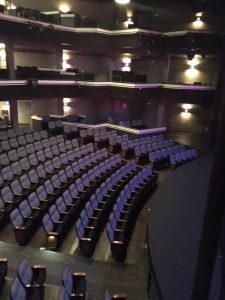
Last weekend, I was in the Rep’s auditorium for the Ballet Arkansas performance.  After it was over, I unexpectedly found myself lingering in the space.  I then realized why.  I wanted to soak in the atmosphere of the room.  So I went up to the lower balcony and walked around.  I snapped the photos which accompany this entry.

I hope I am back in the space for a performance in the coming months.  But I realized it could be even longer in the future.  So I relished the chance to wander around.  And wonder about the future.

In the coming weeks, key supporters of the Rep will be working out a vision for the future of the institution.  Many tough discussions will be had. Many difficult decisions will be made. What will the future look like? Only St. Genesius probably knows. And as the patron saint of actors and comedians, he is not yet telling.

It is said (though it is likely apocryphal) that the Roman Senator Cato the Elder ended each of his speeches with “Ceterum censeo Carthaginem delendam esse” or some variation. Meaning, of course, Carthage must be destroyed.

Since learning that fact from my mother sometime in elementary school (that’s what happens when your mother is a world history teacher), I have been fascinated by Latin phrases.   (When I grow up, I want to be Jed Bartlet who can spout the proper Latin phrase at the right time.)

I especially like the idea of a battle cry in Latin.  It somehow seems more forceful.

So I end this entry, and plan on ending future entries about the Rep with the Latin for “Save the Repertory Theatre” (sorry, Arkansas does not translate well into Latin.)

Repertorium Praeter Theatrum