Black History Month Spotlight – TESTAMENT sculpture on State Capitol grounds

Testament 006The new Arkansas Civil Rights History Audio Tour was launched in November 2015. Produced by the City of Little Rock and the University of Arkansas at Little Rock allows the many places and stories of the City’s Civil Rights history to come to life an interactive tour.  This month, during Black History Month, the Culture Vulture looks at some of the stops on this tour which focus on African American history.

In 1957, nine African-American students enrolled at Little Rock’s Central High School, beginning the process of desegregating Little Rock’s public schools and marking a seminal event in America’s civil rights movement. This sculptural grouping was dedicated in August 2005 to honor the courage of those students, known collectively as the Little Rock Nine. Quotations from each of the Nine are featured around the bronze figures, which are the work of artists John and Cathy Deering.

The site for the statues was selected to face the end of the building which contains the Arkansas Governor’s Office.  It was from those windows that then-Governor Orval Faubus would have looked as he was making decisions to deny the Little Rock Nine entry into Little Rock Central. It is out those windows now that any governor since 2005 looks to see the statues.

The app, funded by a generous grant from the Arkansas Humanities Council, was a collaboration among UALR’s Institute on Race and Ethnicity, the City of Little Rock, the Mayor’s Tourism Commission, and KUAR, UALR’s public radio station, with assistance from the Little Rock Convention and Visitors Bureau.

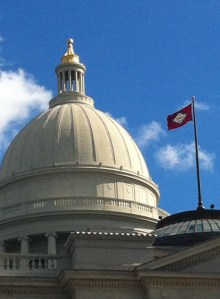
Black History Month Spotlight – Arkansas State Capitol

Arkansas birthdayThe new Arkansas Civil Rights History Audio Tour was launched in November 2015. Produced by the City of Little Rock and the University of Arkansas at Little Rock allows the many places and stories of the City’s Civil Rights history to come to life an interactive tour.  This month, during Black History Month, the Culture Vulture looks at some of the stops on this tour which focus on African American history.

The Arkansas state capitol has been the site of a number of civil rights events over the years. In 1964, Ozell Sutton, a local African American leader, was denied service at the capitol’s basement cafeteria because of his race. The cafeteria then reincorporated as a private members-only club to avoid integration. A number of conflicts occurred when local black students from Philander Smith College and an interracial group of Arkansas Student Nonviolent Coordinating Committee members tried, on several occasions, to desegregate the cafeteria. In 1965, the courts finally ordered the cafeteria to open its doors to blacks and whites on an equal basis.

In 1968, after the assassination of Martin Luther King, Jr., Arkansas governor Winthrop Rockefeller held a memorial service on the capitol steps for the slain civil rights leader—the only southern governor to make such a gesture of reconciliation. His actions are credited with limiting the impact of the violence that rocked other cities in the wake of the King assassination. In 2005, John and Cathy Deering’s “Testament” bronze sculpture of the Little Rock Nine was dedicated on the north side of the building. It was the first civil rights monument erected on the grounds of a southern state capitol.

The app, funded by a generous grant from the Arkansas Humanities Council, was a collaboration among UALR’s Institute on Race and Ethnicity, the City of Little Rock, the Mayor’s Tourism Commission, and KUAR, UALR’s public radio station, with assistance from the Little Rock Convention and Visitors Bureau.

Little Rock Look Back: Rev. Dr. Martin Luther King, Jr.

Ernest Green, Dr. King and Daisy Bates share a relaxed moment -- which was probably rare for the three in 1958

Ernest Green, Dr. King and Daisy Bates share a relaxed moment — which was probably rare for the three in 1958

Today is the Martin Luther King Jr. Holiday.  It is an apt time to think about Dr. King and Little Rock.  A friend of L. C. and Daisy Bates, he attended the 1958 Central High School graduation to witness Ernest Green receiving a diploma. Each senior only received eight tickets to the ceremony at Quigley Stadium. Dr. King was in the state to address the Arkansas AM&N (now UAPB) graduation.

His attendance was briefly mentioned in the local press, but there was no media photo of him at the ceremony.  The Little Rock School District limited the press to one Democrat and one Gazette photographer. Other press were limited to the press box.

Ernest Green has a photo of him with Daisy Bates and Dr. King (pictured on this entry).

In 1968, when Dr. King was assassinated, Little Rock did not see the unrest that many cities did.  Part of that was probably due to quick action by Governor Winthrop Rockefeller. The Governor released a statement fairly quickly expressing his sorrow at the tragedy and calling for a day of mourning. He also made the State Capitol available for the NAACP to have a public memorial, as well as worked with a group of ministers to host an interdenominational service.

Little Rock Mayor Martin Borchert issued a statement as well:

We in Little Rock are disturbed about the incident in Memphis. We are disturbed regardless of where it had happened.  Killing is not the Christian solution to any of our problems today.

In Little Rock, we feel we have come a long way in 10 years toward solving some of our problems of living and working together regardless of race, creed or color.

The city Board of Directors in Little Rock has pledged itself toward continuing efforts to make Little Rock a better place in which to live and work for all our citizens.

We feel the efforts of all thus far have proved we can live in harmony in Little Rock and are confident such an incident as has happened will not occur in Little Rock.  We will continue our most earnest efforts toward the full needs of our citizens.

The day after Dr. King was assassinated, a group of Philander Smith College students undertook a spontaneous walk to the nearby State Capitol, sang “We Shall Overcome” and then walked back to the campus.  President Ernest T. Dixon, Jr., of the college then hosted a 90 minute prayer service in the Wesley Chapel on the campus.

On the Sunday following Dr. King’s assassination, some churches featured messages about Dr. King.  As it was part of Holy Week, the Catholic Bishop for the Diocese of Little Rock had instructed all priests to include messages about Dr. King in their homilies. Some protestant ministers did as well. The Arkansas Gazette noted that Dr. Dale Cowling of Second Baptist Church downtown (who had received many threats because of his pro-integration stance in 1957) had preached about Dr. King and his legacy that morning.

Later that day, Governor Rockefeller participated in a public memorial service on the front steps of the State Capitol. The crowd, which started at 1,000 and grew to 3,000 before it was over, was racially mixed. At the conclusion of the ceremony, Governor and Mrs. Rockefeller joined hands with African American ministers and sang “We Shall Overcome.”

That evening, Trinity Episcopal Cathedral was the site of an interdenominational service which featured Methodist Bishop Rev. Paul V. Galloway, Catholic Bishop Most Rev. Albert L. Fletcher, Episcopal Bishop Rt. Rev. Robert R. Brown, Rabbi E. E. Palnick of Temple B’Nai Israel, Gov. Rockefeller, Philander Smith President Dixon, and Rufus King Young of Bethel AME Church.

Earlier in the day, Mayor Borchert stated:

We are gathered this afternoon to memorialize and pay tribute to a great American….To achieve equality of opportunity for all will require men of compassion and understanding on the one hand and men of reason and desire on the other.

Mayor Borchert pledged City resources to strive for equality.

Another Little Rock Mayor, Sharon Priest, participated in a ceremony 24 years after Dr. King’s assassination to rename High Street for Dr. King in January 1992.  The name change had been approved in March 1991 to take effect in January 1992 in conjunction with activities celebrating Dr. King’s life.  At the ceremony, Daisy Bates and Annie Abrams joined with other civil rights leaders and city officials to commemorate the name change.

2015 In Memoriam – Parker Westbrook

1515 WestbrookParker Westbrook WAS Mr. Preservation for Arkansas. But even though he is gone, it does not mean that preservation efforts in Arkansas are dormant.  Quite the contrary.  Like any good teacher, Parker used his knowledge to inspire others to share his interest in preservation.

It is no surprise that the organization he helped found, the Historic Preservation Alliance of Arkansas (now called Preserve Arkansas), names its lifetime achievement award after him.  He was not only the founding President of Preserve Arkansas, he was active in it until his final days.  It was not his only founding: he was a founder of Pioneer Washington Foundation (the oldest historic preservation organization in the state), the Main Street Arkansas Advisory Board, Historic Arkansas Museum Commission, the Arkansas State Capitol Association, and the Arkansas State Review Board for Historic Preservation. He served on the latter board from 1975 until his death this year, with the exception of five years from 2002 to 2007.  In recognition of his work in the field of heritage tourism, he was a 2007 inductee into the Arkansas Department of Parks and Tourism’s Hall of Fame.

His work was not limited by the boundaries of his home state.  He was an Advisor Emeritus to the National Trust for Historic Preservation and a 2001 recipient of a Preservation Honor Award from the Trust. Rep. Mike Ross declared him a “National Treasure” in the Congressional Record. He also served for two terms on the President’s Advisory Council on Historic Preservation and was named Chairman of the Committee on National Historic Landmarks on the National Park System Advisory Board.

A public servant, he worked for several federal officials from Arkansas, most notably Senator J. William Fulbright. He returned to Arkansas to work for Governor David Pryor.  But whether he worked in Washington DC; Little Rock; or his beloved hometown of Nashville, he was always interested in ensuring the past came alive. It might be through historic preservation, or it might be recounting a colorful moment of Arkansas history. Either way, Parker was a proponent of living history. He did not want it to be relegated to a musty, dusty book or building.
In 2007, he donated papers collected by his late sister Lucille and himself. The Lucille and Parker Westbrook Arkansas and Genealogy Collection is housed in the $20 million Arkansas Studies Institute, a joint project of the Central Arkansas Library System (CALS) and the University of Arkansas at Little Rock.  This collection has three parts: the first part focuses on Southwest Arkansas and contains genealogical sources and 3,000 historic photographs; the second highlights his public service and political career including much about the state’s architectural history; the third part consists of family papers, letters and photographs which document the Westbrooks’ deep roots in Arkansas.
He was the epitome of the Southern gentleman.  Not only did he look the part, he acted it. He was gracious in sharing credit with others; generous with his time, labor and talent; and did his best to keep up the lost art of writing letters and notes.

Big Jingle Jubilee Holiday Parade today

 Dust off your holiday wreaths, shine up the jingle bells and head down this afternoon to the 2015 Little Rock Big Jingle Jubilee Holiday Parade.

Sponsored by the Little Rock Convention & Visitors Bureau, the parade starts today (December 5) at 3:00 p.m. in Downtown Little Rock.

The Parade will begin at 2nd and Broadway, follow Broadway to Capitol Avenue, then proceed down Capitol Avenue to the State Capitol.

This is a great opportunity to enjoy and celebrate the holiday season with your friends, so bring the entire family and join the fun!

Continuing this annual community tradition, this year’s parade is sure to be an afternoon of festive fun! Santa and Mrs. Claus will be joined by various entries such as marching bands, floats, cars, animals and much more!

Following the parade at dark (approximately 6pm), enjoy the Lighting of the State Capitol Ceremony (Sponsored by the Arkansas Secretary of State Office) with entertainment and fireworks)

What about BREAKFAST AT TIFFANY’S? See it tonight at 7 at the CALS Ron Robinson Theater

215px-Breakfast_at_TiffanysYou can’t eat breakfast at Tiffany’s, but you can enjoy the classic film tonight at the Ron Robinson Theater which presents the 1961 classic Blake Edwards film. (Be sure and pay attention to a passing reference to Arkansas, too.)

Based on Truman Capote’s novella, the film was one of Audrey Hepburn’s iconic roles.  Joining her in the cast were George Peppard, Patricia Neal, Martin Balsam, Buddy Ebsen and Mickey Rooney.  The film features the famous song “Moon River” which Hepburn sings at one point in the movie.  The film was nominated for five Academy Awards including Best Actress (Hepburn), Best Adapted Screenplay (George Axelrod) and Best Art Direction. It won the Oscars for Best Song – “Moon River” (Johnny Mercer and Henry Mancini) and Best Score (Mancini again).

The movie starts at 7pm tonight. Admission is $5. Concessions are available for purchase as well.

(You may not be able to shop at a Tiffany & Co. in person in Little Rock, but you can see Tiffany stained glass at City Hall and the State Capitol, as well as other Tiffany furnishings at the latter.)

Little Rock Look Back: B47 Bomber explodes over Little Rock

An LRPD officer talks to bystanders next to a piece of debris

An LRPD officer talks to bystanders next to a piece of debris

The peaceful morning of March 31, 1960, was interrupted by a horrendous noise over Hillcrest around 6:00am.  A six-engine B47 from the Little Rock Air Force Base exploded mid-air.

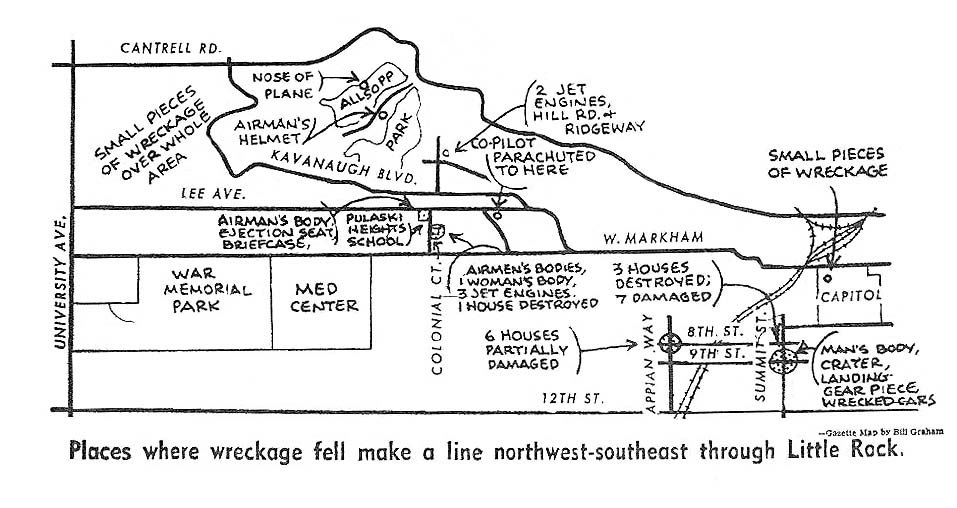
Flaming debris fell from Allsopp Park all the way to the State Capitol grounds and stretched from Cantrell to 12th Street.  Other debris was found as far away as the Country Club of Little Rock.  The next day the Arkansas Gazette ran a map which showed the extent of the damage.

Three airmen died in the explosion and two civilians were killed when debris fell on their homes.  The only survivor from the crew, 1st Lieutenant Thomas Smoak, was found dangling from a tree in his parachute at Kavanaugh and Martin.  He was treated by a nurse, Jimmye Lee Holeman, in whose yard he had landed.

Many vehicles and homes were damaged, some were destroyed by debris.  The damage estimate was put around $4 million.

Police and fire crews were quickly on the scene to secure impacted areas, fight fires and rescue injured persons.

The Strategic Air Command’s edited account of the incident noted:

A B-47 was climbing after takeoff in day VFR weather.  At about 15,000 feet, the copilot suddenly realized that the aircraft was in a very steep left bank, that the nose was well below the horizon, and that the airspeed was excessive.  He pulled the throttles to idle, punched the interphone button and shouted at the aircraft commander.

Almost immediately, the nose came up, the wings leveled, and the aircraft disintegrated.  In the cockpit section, which had separated intact from the rest of the aircraft, the copilot tried to eject, but the clamshell initiator pin had not been removed.  The copilot then unfastened his seat belt.  The canopy blew off at about 10,000 feet.  The unconscious copilot was thrown out at 4,000 feet and his parachute opened automatically.

The aircraft commander ejected at 2,000 feet, but his parachute had been fused by fire and he died upon impact.  The fourth man was found near the wreckage and did not survive.  The navigator was killed in his position.  The falling wreckage killed two civilians and caused serious damage to property.”

Those who perished were Captain Herbert Aldridge, Lieutenant Colonel Reynolds Watson, Staff-Sergeant Kenneth Brose, and civilians Alta Lois Clark and James Hollabaugh.

Arkansas Gazette map of debris and damage

Arkansas Gazette map of debris and damage