Artober – Sustainable Art. WASHED ASHORE exhibit at Clinton Presidential Library

Image result for shark clinton center

October is Arts and Humanities Month nationally and in Little Rock. Americans for the Arts has identified a different arts topic to be posted for each day in the month. Today’s focus is Sustainable Art.

For a few days more, visitors to the Clinton Presidential Center can experience Washed Ashore is a family-friendly exhibit that will feature more than 20 giant sea life sculptures – made entirely of trash and debris collected from beaches. This exhibit poignantly illustrates the toll trash takes on our oceans and waterways.

The incredible marine life sculptures will be accompanied by educational signage allowing visitors to learn about the fascinating species, environmental stewardship, responsible consumer habits, and how “every action counts” to help save our waterways.

Washed Ashore is a visual reminder of the disposable products that end up in our waters, and that each of us can take action to prevent further pollution. “Hope, creativity, [and] imagination will be required to meet the challenges that we face with our oceans,” said President Bill Clinton to the National Oceans Conference in June 1998. “But they are the traits that first enabled and inspired explorers to take to the sea. They are traits that allowed us to look at our inextricable ties to our environment and invent new ways to protect our natural wonders from harm in the last three decades. In the 21st century, these traits – hope, creativity, imagination – they must lead us to preserve our living oceans as a sacred legacy for all time to come.”

The Washed Ashore exhibit will be primarily displayed inside two of the Clinton Center’s
galleries. Visitors will see Eli the Eel, walk through the Reef at Risk, and be able to play the Styrofoam Drum Set. The exhibit opened to the public on April 27; a second phase featuring additional sculptures opened in June, when Priscilla the Parrot Fish, a 16-foot-long, 1,500-pound brightly-colored sculpture was installed to greet visitors from the water fountains located outside the front doors.

“The sculptures are beautiful, truly works of art, but they are a poignant reminder that our oceans and waterways are precious resources that need our attention now more than ever,” said Stephanie S. Streett, executive director of the Clinton Foundation.

“From the student visitor to the grand parent, we hope that everyone who has the opportunity to enjoy Washed Ashore walks away with a renewed sense of awe and responsibility.”

Washed Ashore presents an opportunity to reflect on the Clinton administration’s efforts to safeguard essential bodies of water and promote environmental stewardship. “President Bill Clinton’s administration took strong action to protect our coasts and waterways,” said Terri Garner, director of the William J. Clinton Presidential Library. “He signed crucial legislation and issued key executive orders designed to improve water quality, protect wetlands and coasts, and reduce waste while increasing the use of recycled products.”
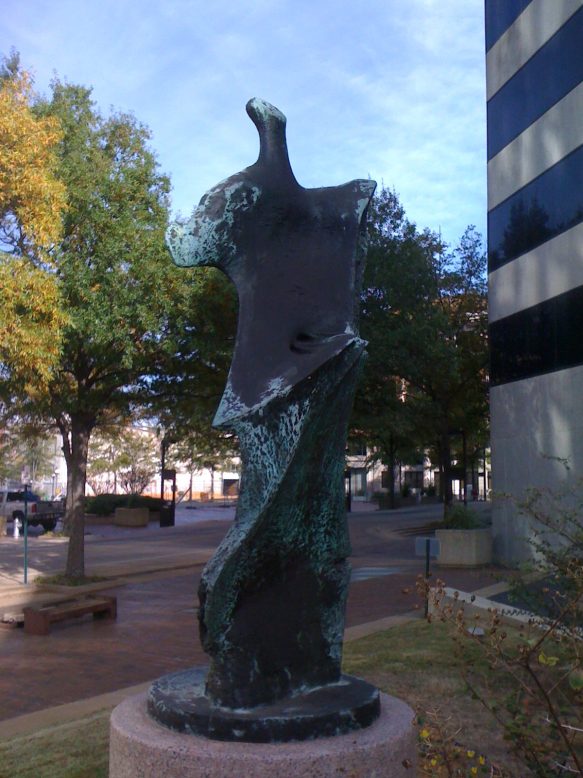
Artober – Public Art: Henry Moore’s Large Standing Figure Knife Edge

Arguably Little Rock’s most famous piece of public art is Henry Moore’s 1961 creation Large Standing Figure: Knife Edge, which is known locally as “The Henry Moore Sculpture.”

The original model was created in 1961; this sculpture was cast in 1976 and purchased in June 1978 by the Little Rock Metrocentre Improvement District.

The purchase price was $185,000 — a princely sum at the time but now a bargain for a Henry Moore sculpture. (Adjusted for inflation, that amount would be the equivalent of $705,000 today.)

A committee consisting of Townsend Wolfe (then the director and chief curator of the Arkansas Arts Center), James Dyke and Dr. Virginia Rembert traveled to England to meet with Moore about the sculpture.

It was originally placed on Main Street when the street had been bricked over as part of the Metrocentre Mall pedestrian mall plan. As portions of the street became unbricked and reopened to vehicular traffic, it was moved to the intersection of Capitol and Main. Finally, when the last segment was reopened to vehicular traffic, it was put at its current location of the southeast corner of Capitol and Louisiana. Because it was purchased by the Improvement District, it must stay within the boundaries of the district.

On March 20, 2018, the City of Little Rock and the Metrocentre Improvement District swapped the Henry Moore sculpture for the land on which the District’s parking deck stands. The City will relocate the Henry Moore piece to be in front of the Arkansas Arts Center once that reconstruction project is completed.

A replica of the sculpture is featured in the 1980s classic The Breakfast Club.

Bill Clinton announces for Presidency on October 3, 1991

The Clintons following his remarks.

On October 3, 1991, Governor Bill Clinton strode out the front doors of the Old State House Museum and announced his intentions to seek the 1992 Democratic Party’s nomination for President of the United States.

(While Clinton was a major fan of JFK, it is doubtful he realized that his announcement took place on the 28th anniversary of JFK speaking in Little Rock.)

Clinton was the fifth major Democrat to announce for the office. That there were that many by early October was somewhat surprising considering that the first half of 1991 saw many national Democrats announce they were NOT seeking the office.

Jerry Brown, Bob Kerrey, Paul Tsongas, and Tom Harkin were also in the race.  Clinton was seen as a centrist, along with Senator Kerrey while the others were viewed as being from the far-left wing of the Democratic Party.

In its coverage of the announcement, The New York Times noted the significance of Gov. Clinton’s remarks on race.  In the speech he referenced his desire to strengthen relations and remove barriers between the races.  As the Times pointed out, it was at the Old State House that Arkansas held two conventions on the issue of secession prior to the state’s entry into the Civil War.

At the time of the announcement, Gov. Clinton was far from a front-runner. His national profile was probably the lowest of any of the announced candidates. Most of the knowledge of him outside of Little Rock came from his lengthy speech about Michael Dukakis at the 1988 Democratic Convention and the subsequent appearance on “The Tonight Show” where both he and Johnny Carson poked fun as his loquaciousness.

Regardless of their views on his chances, the Governor’s family, friends, and fans packed the front lawn of the Old State House to cheer him.  The national media treated him as a serious, albeit largely unknown, candidate.  After having had Wilbur Mills, Dale Bumpers and others flirt with running and then backing out, the local media were probably thrilled to finally have someone from Arkansas actually running for the presidency.

One local media outlet would not see much of the campaign. Just fifteen days later, the Arkansas Gazette would close. As a paper which had covered nearly two decades of his career, the Gazette was often Clinton’s champion, though the paper was not afraid to point out times the two differed.  However, there would be no Gazette headline about Clinton in New Hampshire, at the Democratic Convention, or a general election victory.

On Election Day in 1992 and again in 1996, Bill Clinton would repeat the stride out the front doors of the Old State House accompanied by his wife and daughter.  Those two times the crowds would spill down the streets in all directions. Instead of a handful of media outlets there would be scores of them.

But it all started on a sunny autumn day in Little Rock in early October 1991.

Clinton Park Bridge and Bill Clark Wetlands dedicated on September 30, 2011

On a very warm Friday, September 30, 2011, the Clinton Presidential Park Bridge was dedicated.  This completed the eastern loop of the Arkansas River Trail as well as created another feature in Clinton Presidential Park.
The ceremony featured remarks by both President Bill Clinton and the incumbent Secretary of State Hillary Rodham Clinton.  Chelsea Clinton also took part in the ceremony.  Former US Senators (and Arkansas Governors) Dale Bumpers and David Pryor were in attendance as was Jim Guy Tucker who followed Clinton into the Arkansas Governor’s Office.  Current Governor Mike Beebe was also present and took part in the ceremony, which was emceed by Stephanie Streett, executive director of the Clinton Foundation.  Many other former and current elected officials were present.

In addition to dedicating the bridge, the ceremony officially dedicated the William E. “Bill” Clark Presidential Wetlands which are adjacent to the bridge.  City Director Dean Kumpuris joined Clark’s widow, Margaret, and son, William, in the dedication of the wetlands.

This Clinton Presidential Park Bridge is over 2,600 ft. long.  It was constructed in 1899 as the Rock Island Bridge.  After the Rock Island stopped using the bridge, the lift span was permanently raised.  It had to stay this was for the Clinton redevelopment.  Therefore a new surface was built that slopingly takes persons from park level up to the span level and back down.

The bridge’s “rusty” structure is complemented by a well-lit 12-18-foot walkway flanked on both sides by silver galvanized steel handrails.

The total investment for this area is over $13.5 million.

Later that weekend, the Clinton Foundation hosted an event to commemorate the 20th anniversary of Clinton’s announcement that he was seeking the Presidency.