
Little Rock Look Back: Plans for new City Hall finally proceed

City Hall circa 1908

City Hall circa 1908

After a judge ruled in August 1906 that the City of Little Rock could not build a new City Hall and Auditorium complex, it looked like Little Rock would be stuck with its existing inadequate building.

However on September 10 it became obvious that much work had been taking place behind the scenes after that ruling.  On that day, the Board of Public Affairs (a City body charged with overseeing municipal government construction projects and comprised of the mayor and two citizens approved by the City Council) voted to ask the aldermen to cancel plans and rescind legislation for the city hall, jail and auditorium complex.  The Board of Public Affairs then offered up a new plan for a city hall and jail building.  Because no auditorium was involved, these plans would not be in violation of the Chancery Court.

That same evening the City Council followed suit and revoked the plans for the original project.  The aldermen then voted to proceed with building a new city hall and jail without the auditorium.  There was only one dissenting vote; Alderman Jonathan Tuohey voted no.  He explained his negative vote was not a lack of support for the project, but he was not comfortable with the way it was rushed through.

Mayor Warren E. Lenon told the Gazette, “The Chancery Court has enjoined us from erecting an auditorium and the Board of Public Affairs has consequently rescinded all resolutions and orders pertaining to that structure.” He noted that there would “be no appeal from the injunction granted by Chancellor Hart, because there is nothing to appeal.”

The coverage of the actions of the City Council that night was in keeping with the manner in which the two daily newspapers had covered the lawsuit and the trial.  The Gazette headline cried “City Hall Ordinance Railroaded Through” while the staid Democrat merely stated “New $175,000 City Hall Provided by City Council.”  The tone of the Gazette’s article matched the headline while the Democrat’s story was more straightforward.

Architect Charles Thompson adjusted his plan for the new City Hall by removing the auditorium wing.  With the revised Th0mpson plan and the approval of the City Council, Little Rock was at last on its way to a new City Hall.  This was over two years after Mayor Lenon had first broached the subject.

Originally slated to open in 1907, the building officially opened in April 1908.
Little Rock Look Back: Plans for new City Hall go on trial

The 1906 plans for City Hall with the Municipal Auditorium on the left portion.

The 1906 plans for City Hall with the Municipal Auditorium on the left portion.

The Little Rock City Council approved Charles Thompson’s plans for a new city hall, auditorium and jail on July 9, 1906, by the adoption of Resolution 281 and Ordinance 1,295.  This did not set well with the powers that be at the Arkansas Gazette.  A lawsuit was filed against the City. The lead plaintiff was J. N. Heiskell, the owner and editor of the Gazette.  From July 24 through July 27, the Arkansas Gazette featured stories and editorials on its front page decrying the action.  (It most likely stems from the fact that the editor was trying to get the City Council to construct a public library.  He ostensibly felt that money spent on a new city hall and auditorium would divert funds from construction of a library.)

In response to the lawsuit, a temporary restraining order was issued on July 24 stopping the City from any further action on the new building plans until the trial had taken place.  The plaintiffs’ four main points were that state law did not authorize a city government to construct an auditorium, that the contract exceeded the amount authorized by the City Council, that the City did not own the land on which the city hall and auditorium would be built, and that “the city of Little Rock now has a city hall sufficient for all necessary purposes.”

The trial started on Friday, July 27, 1906.  Among the legal team for the plaintiffs were J. H. Harrod and former Arkansas Governor Daniel Webster Jones.  The City’s legal team included City Attorney W. Burt Brooks joined by three attorneys from prominent Little Rock families: former City Attorney Ashley Cockrill, John Fletcher and Thomas Mehaffy.

The trial began on a Friday, continued on Saturday (!) and concluded on a Monday.

Architect Frank W. Gibb (who had applied for but not been selected to design the new city hall and auditorium) was called as a witness by the prosecution.  He stated that, based on his review, the capacity for the auditorium would be between 1,700 and 2,000.  This was used to bolster claims by the plaintiffs that the auditorium, if built, would be insufficient to the meet the needs offered by proponents.  Mr. Gibb also estimated that the auditorium wing was about forty-two percent of the cost for the entire project.  He was asked by the defense about the adequacy of the existing City Hall.  The architect replied that the current seat of municipal government was not large enough to meet all the present needs.

Mayor Lenon was the only defense witness; in his testimony he addressed the inadequacies of the current City Hall which echoed the points raised by Mr. Gibb. The mayor also detailed the purchase of the land for the new project.  While the plaintiffs charged the city had not purchased the land, Mayor Lenon pointed out the land was under contract.  He further stated that the work was done through a third party for fear that if the land owners had known the city was the interested buyer, the price might have been inflated by the potential sellers.

Next up were the closing arguments.  More on those and the verdict next week.

Little Rock Look Back: New City Hall approved

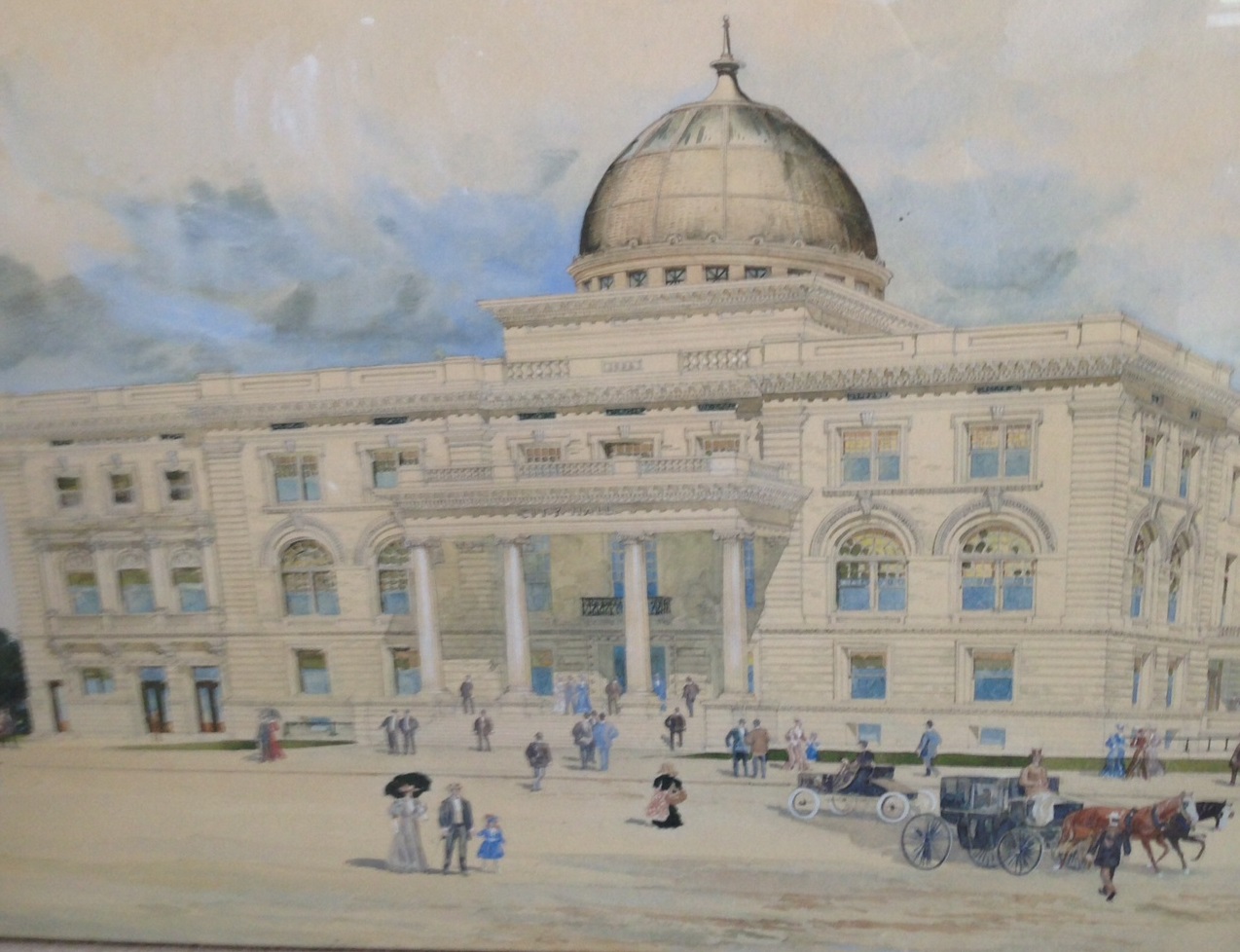
1906 City Hall watercolor

Watercolor of Charles Thompson’s original plan for a Little Rock City Hall complex

On July 9, 1906, the Little Rock City Council approved Resolution 281 and Ordinance 1,295. These actions approved the plans for a new City Hall complex to be constructed on land at the northwest corner of Markham and Broadway Streets.  A few days later, the contract was awarded for the construction of the new building.

Mayor Warren E. Lenon had first called for a new city hall complex in his annual address in April 1904. He repeated his request in April 1905.   The City Council took up Mayor Lenon’s quest for a new city hall in December of 1905.  The Council appropriated money for the purchase of land for a city hall, jail and auditorium.

In response to this, the Arkansas Gazette daily newspaper ran a story featuring the viewpoints of a few civic leaders weighing in on the need for a new city hall complex which would also include a new jail and a city auditorium.  Two of the respondents, L. B. Leigh and P. Raleigh, stressed the need for paved streets and better sewers instead of a new city hall and auditorium.

The other three businessmen interviewed were more favorable to Mayor Lenon’s proposal.  Morris M. Cohn, a former Little Rock City Attorney, stated “I do not think we can make a better investment than in a fine city hall and auditorium.”  (Mr. Cohn, though an M. M. Cohn, was not related the M. M. Cohn who was the namesake for the longtime Little Rock department store.) County Judge William Marmaduke Kavanaugh offered his satisfaction with the action of the City Council on that matter.  R. E. Walt, a banker, opined that he thought $150,000 was not enough; he suggested $200,000 should be spent.

Later that month the Gazette reported that a site had been selected for the city hall and auditorium complex.  The proposed location was most of a city block located at the corner of Markham and Broadway Streets.  Mayor Lenon was vague as to the details of the deal because negotiations were still underway with the property owners

As 1906 dawned, Mayor Lenon and other city leaders continued to take steps to build the new city hall and auditorium.  They invited three local architects to make presentations for the chance to design the new complex.  The three were Charles L. Thompson, Frank W. Gibb and George R. Mann.  Mr. Thompson was chosen to receive the assignment.

On February 5, 1906, Mayor Lenon announced the creation of a special committee to work on the planning for a future city hall complex.  This committee consisted of Aldermen Louis Walther, A. B. Poe, L. N. Whitcomb, Christopher Ledwidge, and John A. Adams.

Mayor Lenon further stated that the new city hall complex and several private developments would “put us in that march of progress with which nothing can prevent us from having a 100,000 population in a few years.”

The saga to get the building built was just starting.

Architects of Little Rock the focus of June’s Legacies & Lunch

Architects of LR bookCharles Witsell and Gordon Wittenberg, retired principals of Little Rock architecture firms and co-authors of the newly released Architects of Little Rock: 1833-1950, will discuss Little Rock’s architectural history at Legacies & Lunch on Wednesday, June 4, noon-1 p.m. in the CALS Main Library’s Darragh Center, 100 Rock Street.

Witsell and Wittenberg are retired principals of WER Architects/Planners (Witsell, Evans and Rasco) and WD&D (Wittenberg, Delony and Davidson). Architects of Little Rock: 1833-1950 profiles thirty-five architects, including George R. Mann, Thomas Harding, Charles L. Thompson, and more. Famous buildings such as the Arkansas State Capitol, St. Andrews Cathedral, the Pulaski County Court House, Central High School, and Robinson Auditorium are showcased as well. Copies of the book will be available for purchase; Wittenberg and Witsell will sign copies after their talk.

Legacies & Lunch, the Butler Center’s monthly lecture series, is free, open to the public, and supported in part by the Arkansas Humanities Council. Programs are held from noon-1 p.m. on the first Wednesday of each month. Attendees are invited to bring a sack lunch; drinks and dessert are provided. For more information, contact 918-3033.

Book on LR Architects celebrated tonight

Architects of LR bookTonight, the Historic Arkansas Museum will be hosting a lecture and book signing for the recently released Architects of Little Rock: 1833–1950, penned by Little Rock architects, Charles Witsell and Gordon Wittenberg.

The evening will begin at 5:30 with a special presentation and lecture discussing the book. Speakers will include Bill Worthen, Historic Arkansas Museum; Tom Adams, WD&D; John Greer, WER Architects/Planners; Bobby Roberts, Central Arkansas Library and a special presentation will be given by Wesley Walls, President AIA Arkansas.

A reception and book signing will begin immediately following the lecture. All are invited to attend this special evening. “There are many ways of knowing the built environment. In their Architects of Little Rock, Mr. Witsell and Mr. Wittenberg explore the always complex relationship between buildings and the visionary thinkers—sometimes ordinary craftsman— who produced them. In so doing, they not only have uncovered the design rationales and circumstances of production that influenced a wide spectrum of Little Rock architecture but moreover have written a significant work of architectural scholarship that addresses the history of the architect’s profession,” Ethel Goodstein-Murphree, architectural historian and professor of architecture, University of Arkansas.

Architects of Little Rock: 1833–1950, is being released this month. The book is co-written by Little Rock architects, Charles Witsell and Gordon Wittenberg and edited by Marylyn Jackson Parins. Architects of Little Rock provides biographical and historical sketches of the architects at work in Little Rock from 1833 to 1950. It is the story of the people behind the city’s most important buildings. Thirty-five architects are profiled, including George R. Mann, Thomas Harding, Charles L. Thompson, Max F. Mayer, Edwin B. Cromwell, George H. Wittenberg, Lawson L. Delony, and others. Famous buildings, including the Historic Arkansas Museum, the Old State House, the Arkansas State Capitol, St. Andrews Cathedral, Little Rock City Hall, the Pulaski County Court House, Little Rock Central High School and Robinson Auditorium are showcased, bringing attention to and encouraging appreciation of the city’s historic buildings.

Charles Witsell and Gordon Wittenberg are retired principals of the Little Rock architecture firms WER Architects/Planners (Witsell, Evans and Rasco) and WD&D (Wittenberg, Delony and Davidson), respectively.

Little Rock Look Back: 106 Years at LR City Hall

CityHa78106 years ago today, Little Rock City Hall officially opened at the corner of Markham and Broadway.

On April 15, 1908, the Italian Renaissance Revival style building, which had been designed by local architect Charles Thompson, played host to an open house. Staff had started moving into the building in March of that year.   This was, as often is the case, behind schedule.  The date in the cornice toward the top of the building is 1907, but the building was not completed until 1908.

In 1903, W. E. Lenon became Mayor of Little Rock. Back then, the terms were two-year terms.  By the start of his second term in 1905, he realized that the City was outgrowing City Hall, which was, at the time, on the northeast corner of Markham and Louisiana – where part of the Statehouse Convention Center sits today.

In February 1906, Mayor Lenon appointed a committee of five aldermen to over see the planning for the building of a new City Hall. In July 1906, the City Council approved plans, which called for a City Hall with an municipal auditorium wing. There was some hue and cry about wasteful spending and a resulting lawsuit, so, in September 1906, those plans were scrapped and a simpler City Hall was approved for the cost of $175,000.

The last resolution in the old City Hall called for the banning of smoking in the new Council Chambers – while the Council was in session. This may well have been the first smoking ban in a public government building in the history of Arkansas.

When the building opened, the third floor was not finished out. The space was not needed. When the Museum of Natural History and Antiquities (now the Museum of Discovery) moved into City Hall in 1929, they had to finish out their space.

In 1913, the new Central Fire Station, designed in the Beaux Arts style, was constructed adjacent to City Hall. During the 1930s, as the City grew, more space was needed. A garage, designed in the “austere, utilitarian” style was built in 1936 and a City Jail Annex, built by the WPA in the modified Art Deco style was built in 1938.

City Hall prior to 1912

By 1955, the copper-clad dome which sat on top of City Hall needed severe repairs. The wooden supports and the copper cladding were both in dire shape. Mayor Pratt Remmel set aside money for the dome to be repaired. After defeating Remmel in his bid for a third term, Mayor Woodrow Mann scrapped plans for the repair and, indeed, scrapped the dome.

Following the lead of County Judge Arch Campbell who had removed the tower at the County Courthouse, Mann proposed removal of the dome. He had an informal survey which had three options: repair the dome, replace the dome with an aluminum one, or remove it. This was open to anyone to respond – voting eligibility or Little Rock residency did not matter. By a slim margin, remove the dome won – so the dome was removed.

In 1960, as air conditioning was installed, windows were bricked in to promote energy efficiency. At the time, the feeling was that a new City Hall would be constructed in the 1970s somewhere more central to the growing city. Relocation talk persisted throughout the 1970s and early 1980s. By that time, City Hall had been modified a great deal – with no thought about historic preservation. When the Police and Fire Department had moved out into their new facilities, their old spaces had become storage.

By 1984, the decision was made to stay at Markham and Broadway. An extensive renovation and restoration effort was undertaken. In 1988, the building reopened, and the interior had been restored to its 1908 appearance.

April 22 Architeaser

IMG_4937Last week’s Architeasers focused on the 1908 Little Rock City Hall.  This week’s will look at the five other buildings which have are connected to City Hall.  The first opened in 1913 and the most recent structure opened in 1986.

Today’s feature looks at some of the detail on the frieze above the former Central Fire Station.  The building was constructed in 1912 and opened in 1913.  When the Fire Department moved out in the 1970s (and moved to their current site at 7th and Chester), it was used for storage and a few City offices.

This building was designed in the Beaux Arts Classicism style by Charles Thompson (designer of City Hall) and his associate Tom Harding (who would later design several other Little Rock fire stations).

Following the mid-1980s renovations, it was retrofitted to house more City offices and is now known as the City Hall West Wing (the name predated the TV show by a dozen years). The cornice work and wrought-iron on the front facade reflect the original use of the building as a fire station.