
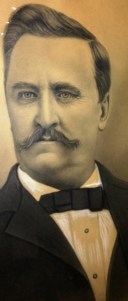
Birth of Little Rock Mayor James Woodson (aka – future Ron Swanson)

On July 14, 1848, future Little Rock Mayor James Alexander Woodson was born in North Carolina.  The son of two prominent eastern families, he and his parents moved to Pine Bluff in 1849.  His father died within two weeks of the family’s arrival in Arkansas.

With the outbreak of the Civil War, he enlisted as a drummer boy in the Ninth Arkansas infantry but was discharged because of his youth. He worked as a clerk at a general store in Pine Bluff. After the Civil War ended, he attended school in Virginia and Maryland before returning Pine Bluff. Upon his return he worked in the steamboat business and eventually started working in railroads. He was instrumental in putting together one of the forerunners of the Missouri Pacific Railroad and worked for them for 18 years.

Woodson moved to Little Rock in March 1881 and continued working for the railroad until 1891.  Working in the mercantile business allowed him more time to be engaged in civic affairs.  In 1895 he was elected mayor.   He handily defeated former mayor W. G. Whipple who was seeking to return to office.

During Mayor Woodson’s tenure, he oversaw renovations of the 1867 Little Rock City Hall (which was located at the time on the north side of Markham between Main Street and Louisiana Street).  He also championed the construction of a city hospital and the first free bridge across the Arkansas River.  Mayor Woodson was reelected in April 1897 and April 1899.

In April 1890, he resigned to take over the Arkansas and Southwestern Railway.  After restoring it to sound financial footing, he later led the Arkansas Asphalt Company.  That company provided the first asphalt for paving Little Rock city streets.

Woodson served as a director of the Little Rock board of trade (forerunner to the Little Rock Regional Chamber of Commerce), director of the Mercantile Trust Company and president of the state board of trade (forerunner of the Arkansas State Chamber of Commerce).

Woodson married Virginia Lanier in 1868.  They had six children, five of whom lived to adulthood.  Mayor Woodson died on October 19, 1908 and is buried in Mount Holly Cemetery.  His wife lived until 1937 and is buried next to him.  Also buried in Mount Holly are their children James Alexander Woodson, Benjamin Morehead Woodson and Gertrude Woodson Hardeman; each of whom died before their mother.  Mrs. Hardeman’s husband and son are also buried in Mount Holly.
Some have noted his resemblance to actor Nick Offerman of the show “Parks and Recreation.”

New sculpture dedicated in MacArthur Park

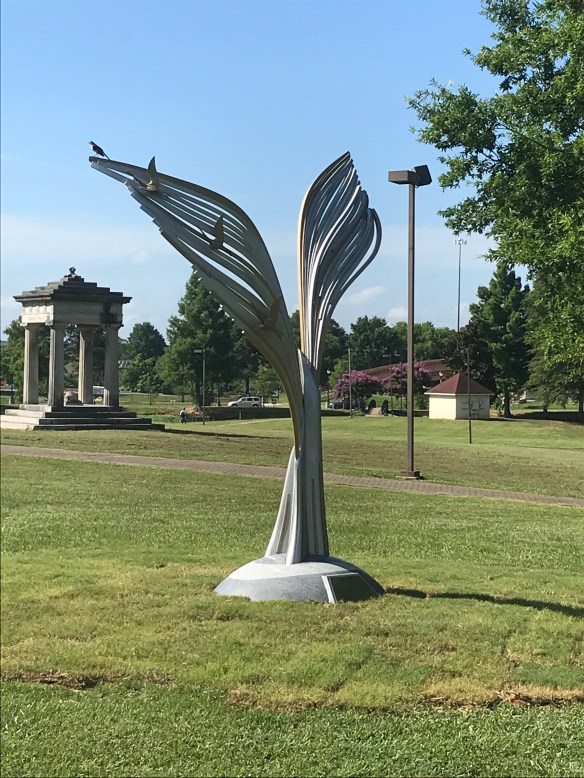
BLOOMING, a new sculpture, was dedicated in MacArthur Park today (July 11).  It is a gift from Hanam, South Korea, one of Little Rock’s Sister Cities.

In 2017, Little Rock sculptor Michael Warrick traveled to Hanam and installed a sculpture in a park there in commemoration of the 25th anniversary of the Sister City relationship between the two cities.  This new sculpture, which represents a ginkgo tree, is a reciprocal gift.

At the dedication ceremony, in addition to remarks by Mayor Frank Scott Jr., and Hanam May Kim Sang Ho, comments were given by former Little Rock mayors Sharon Priest, Jim Dailey, and Mark Stodola.  In addition, Mrs. Sun Cha Lee, chair of ATA International spoke.  Mrs. Lee and her late husband, Eternal Grand Master H. U. Lee, first suggested to Sharon Priest the possibility of a Sister City relationship between Little Rock and Hanam.

July 9, 1906 – plans for new Little Rock City Hall are approved. And the fun has just begun

The 1906 plans for City Hall with the Municipal Auditorium on the left portion.

On July 9, 1906, the Little Rock City Council approved Resolution 281 and Ordinance 1,295. These actions approved the plans for a new City Hall complex to be constructed on land at the northwest corner of Markham and Broadway Streets.  A few days later, the contract was awarded for the construction of the new building.

Mayor Warren E. Lenon had first called for a new city hall complex in his annual address in April 1904. He repeated his request in April 1905.   The City Council took up Mayor Lenon’s quest for a new city hall in December of 1905.  The Council appropriated money for the purchase of land for a city hall, jail and auditorium.

In response to this, the Arkansas Gazette daily newspaper ran a story featuring the viewpoints of a few civic leaders weighing in on the need for a new city hall complex which would also include a new jail and a city auditorium.  Two of the respondents, L. B. Leigh and P. Raleigh, stressed the need for paved streets and better sewers instead of a new city hall and auditorium.

The other three businessmen interviewed were more favorable to Mayor Lenon’s proposal.  Morris M. Cohn, a former Little Rock City Attorney, stated “I do not think we can make a better investment than in a fine city hall and auditorium.”  (Mr. Cohn, though an M. M. Cohn, was not related the M. M. Cohn who was the namesake for the longtime Little Rock department store.) County Judge William Marmaduke Kavanaugh offered his satisfaction with the action of the City Council on that matter.  R. E. Walt, a banker, opined that he thought $150,000 was not enough; he suggested $200,000 should be spent.

Later that month the Gazette reported that a site had been selected for the city hall and auditorium complex.  The proposed location was most of a city block located at the corner of Markham and Broadway Streets.  Mayor Lenon was vague as to the details of the deal because negotiations were still underway with the property owners

As 1906 dawned, Mayor Lenon and other city leaders continued to take steps to build the new city hall and auditorium.  They invited three local architects to make presentations for the chance to design the new complex.  The three were Charles L. Thompson, Frank W. Gibb and George R. Mann.  Mr. Thompson was chosen to receive the assignment.

On February 5, 1906, Mayor Lenon announced the creation of a special committee to work on the planning for a future city hall complex.  This committee consisted of Aldermen Louis Walther, A. B. Poe, L. N. Whitcomb, Christopher Ledwidge, and John A. Adams.

Mayor Lenon further stated that the new city hall complex and several private developments would “put us in that march of progress with which nothing can prevent us from having a 100,000 population in a few years.”

The saga to get the building built was just starting.

Planning to create Arkansas Arts Center authorized by City of Little Rock

Twenty-two years after authorizing the creation of the Museum of Fine Arts in City Park, the Little Rock City Council was asked to consider expanding the facility.
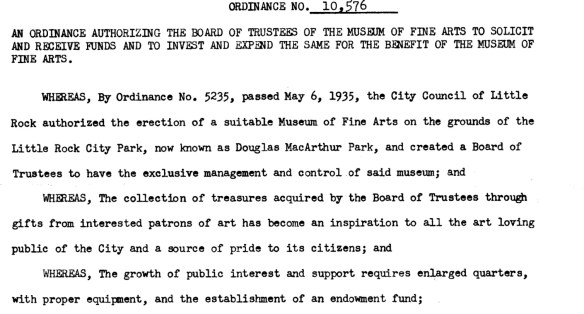
By 1957, the existing structure was felt to be inadequate.   There was a desire for more gallery space as well as for more space for educational programming.

On July 8, 1957, the Little Rock City Council passed an ordinance authorizing the Board of the Museum of Fine Arts to be able to raise the funds for an expansion.  This was merely the start of the process which would eventually lead to the creation of the Arkansas Arts Center.

The ordinance allowed for the expansion or extension of the building. It also authorized the museum’s board to accept gifts for the project and to invest those gifts for the purpose of the museum.  Since the museum only received City funds for maintenance and salary, the ability to raise funds for the expansion was key to the future of the institution.

Lastly, the ordinance gave the museum’s board the ability to increase its membership by up to six positions without having to get additional approval by the City Council.  With a fundraising drive underway and a larger facility planned, these additional board members could certainly prove to be key.

The ordinance passed with nine Ayes, zero Noes, and one absent.

Women’s World Cup Watch Party today at War Memorial Stadium

Image may contain: stripesThe City of Little Rock and War Memorial Stadium invite the public to watch Team USA take on the Netherlands in the FIFA Women’s World Cup final, today, July 7.

This is a free watch party, and the public is asked to bring blankets and/or lawn chairs to view the game from the field.

No cleats; shoes must be worn.

Concessions will be sold. Gates open at 9:30. The match begins at 10.

The Little Rock Zoo invites persons to stop by the Zoo for lunch and to see the exhibits there following the match.

Birthday of Little Rock first mayor, first physician, and many other firsts – Matthew Cunningham

Future Little Rock Mayor Dr. Matthew Cunningham was born on July 5, 1782, in Pennsylvania. After receiving his medical degree from the University of Pennsylvania, he ended up in New York City.  He also served in the Army during the War of 1812.

It was in New York, he met and married a young widow, Eliza Wilson Bertrand. After a brief stint in St. Louis, Dr. Cunningham was one of the first settlers of Little Rock in February 1820. With his arrival, he became the first physician in Little Rock.

In September 1820, Mrs. Cunningham and her children joined him. She became the first female in the Little Rock settlement. Dr. and Mrs. Cunningham had a son, Chester, who was the first white baby born in Little Rock. (Though not supported by any public records, there is some unsubstantiated thought that one of the African-American slaves they had gave birth to a child before Chester was born.) The Cunninghams had several other children.  One daughter, Matilda, would marry Little Rock businessman Peter Hanger.  (The Hanger Hill neighborhood is named after Peter Hanger.)

In 1831, Dr. Cunningham was elected the first Mayor of Little Rock. He won the race with 23 vote to 15 votes over Rev. W. W. Stevenson. The first City Council meeting took place at the Cunningham house on the block which is the southwest corner of what is now 3rd and Main Streets. Records are incomplete as to where on the block the Cunningham house was located, but a plaque is on 3rd Street near Main on the side of the Fulk Building which CJRW now calls home.

Dr. Cunningham served one year as Mayor. He lived until June 15, 1851, and is buried at Mount Holly Cemetery. His wife, son Chester, and the Hanger family are buried next to him.  Because he lived for two decades after serving as mayor, he was able to see Little Rock continue to grow.

His stepson – Charles P. Bertrand – also served as Mayor of Little Rock.  While there have not been any Little Rock father-son combinations serve as mayor, Dr. Cunningham and Mr. Bertrand certainly shared a kinship.

Descendants of Dr. Cunningham still reside in Little Rock.

126 Years of MacArthur Park in Little Rock

On July 4, 1893, Arsenal Park opened in Little Rock.  This was the City’s first municipal public park.  Though it predated the establishment of a formal Parks and Recreation Department by several decades, it is the oldest part of that department.

The land now known as MacArthur Park had originally served as a horse racetrack in the early days of Little Rock.  By 1836, the federal government purchased the land for construction of a military arsenal.  The flagship building, the Arsenal Tower building, is the only remaining structure from that time period.

The land served as a military outpost until 1892.  On April 23, 1892, a land swap took place where in the City of Little Rock was given the property with the stipulation that it would be “forever exclusively devoted to the uses and purposes of a public park.” (Never mind that the federal government took part of the land back for the construction of the Wilbur Mills Freeway.)  Congressman William L. Terry was active in negotiating the land swap. (His son David would also serve in Congress.)

In return for giving the City this land, the federal government took possession of land on the north side of the Arkansas River (then part of Little Rock) – that 1,000 acres became Fort Logan H. Roots.

The park officially opened on July 4, 1893, with the name Arsenal Park. Since it was the City’s first and only park at the time, residents started referring to it as City Park. In time, the designation Arsenal Park fell from use.  In fact, it is referred to as City Park exclusively and officially in City documents throughout the first 42 years of the 20th Century.

On March 9, 1942, Little Rock’s first public park was renamed by the Little Rock City Council.  By a vote of fourteen ayes, zero nays and four absent, the alderman approved Ordinance 6,388 which renamed the park in honor of General Douglas MacArthur.

In 1952, General MacArthur (contemplating a run for the GOP nomination for President) visited Little Rock in March.  Later that year, the eventual GOP nominee (and 34th US President) General Dwight Eisenhower visited the park.

Today, MacArthur Park is the anchor of the burgeoning MacPark district as well as the MacArthur Park Historic Distric.