
Birth of William E. Ashley in 1823 – first LR Mayor to have been born in LR

On August 6, 1823, future Little Rock Mayor William Eliot Ashley was born in Little Rock.  He would go on to become the first Little Rock Mayor to be born in Little Rock.  Ashley was the son of Mary and Chester Ashley; his father would later serve as a U. S. Senator from Arkansas.  He was the second of the couple’s seven children.

Though he was raised in Little Rock, he did receive some schooling out of state. The State History Commission has correspondence between eleven year old William, studying in New York, and his father. Part of the letter is a request for money.

On October 26, 1846, he married Frances Eliza Grafton at Christ Episcopal Church.  They were the first Little Rock residents to be married in that church.  The couple had five children, including triplets.  Only one of the children, Frances (who was one of the triplets) survived to adulthood.

Ashley was first elected Mayor of Little Rock in 1857. After completing a two year term, he was succeeded by Gordon N. Peay (another scion of a prominent Little Rock family).  In 1861, Ashley returned to the office of Mayor.  He was reelected to a third term in 1863.  In September 1863, following the defeat of Confederate troops by the Union forces at the Battle of Little Rock, the City of Little Rock ceased operations.  On September 21, 1863, Little Rock municipal government closed its doors, stopped collection of taxes and disbanded.  Thus Ashley’s third term ended.

In addition to his interest in local government, Ashley was a member of St. John’s College Board and a director of the newly-formed Little Rock Gas Company.

William Eliot Ashley died on August 16, 1868, at the age of 45.  He was buried in Mount Holly Cemetery (which sat partially on land that had once belonged to his family). His parents, wife and children are all buried in Mt. Holly as well.

Interestingly, for someone who grew up in a prominent family, there does not appear to be a surviving likeness of Mayor Ashley – either in painting or photograph.  Several exist of his parents, but none of him.

Happy Birthday to Jim Dailey! Little Rock’s 71st Mayor and current Director of Tourism for Arkansas

On July 31, 1942, Dalton James “Jim” Dailey, Jr. was born to Dalton and Ellen Dailey.   He would serve fourteen years as Little Rock’s 71st mayor and is now continuing his public service as the Director of Tourism for the Arkansas Department of Parks and Tourism.

After graduating from Little Rock Catholic High School, he attended the University of Arkansas at Fayetteville.  He graduated with a Bachelor of Science degree in Business Administration. He joined his father in the family business, Dailey’s Office Furniture.

In 1974, Dailey was elected to the City of Little Rock Board of Directors.  He served one four-year term. The last two years of that term, he was the Vice Mayor of Little Rock.

Following that term, he remained engaged in civic activities including serving in leadership capacities in community campaigns.  He also served as president of the National Office Products Association – the first Arkansan to do so.  Dailey also served as the founding chair of Leadership Greater Little Rock.

In 1988, Dailey was elected to return to the City Board.  He was reelected in 1992.  Dailey served as Vice Mayor in 1991 and 1992.  In January 1993, he was chosen by his fellow City Directors to serve a two year term as Mayor.  Under his leadership, the Future-Little Rock goal-setting process took place.

Following a voter-approved change to the City structure, the position of Mayor was changed to be elected by the people while maintaining the City Manager form of government.  On January 1, 1995, Jim Dailey was sworn in as the first popularly-elected Mayor of the City of Little Rock in over 38 years.

As Mayor, he served as Chair of the Intergovernmental Advisory Committee of the Federal Communications Commission. He was also a member of the United States Conference of Mayor’s Communications Task Force.  He also served as president of the Arkansas Municipal League in 2002 and 2003.

While he was Mayor of Little Rock, he was a strong proponent of the development of the River Market and worked to locate the Clinton Presidential Library in Little Rock.  He also worked to increase public safety support.  He also oversaw the establishment of Central Arkansas Water, the development of downtown headquarters for Acxiom Corporation and Heifer International, and the creation of Prevention, Intervention and Treatment programs.  In addition, he was instrumental in leading the efforts for the 40th anniversary of the integration of Little Rock Central High in 1997.

Mayor Dailey was re-elected in 1998 and 2002.  His fourteen years as Mayor of Little Rock set a longevity record.  Upon his retirement the City’s fitness center was renamed the Jim Dailey Fitness and Aquatic Center.  This was in recognition of his lifelong interest in wellness activities.

Since 1965, he has been married to the former Patti Murphy.  They have four children and six grandchildren.

Happy 77 to Historic Arkansas Museum

77 years ago today (July 19, 1941), Louise Loughborough presided over the opening of a restored original Little Rock city half-block.  A member of Little Rock’s Planning Commission, she had become concerned about plans to demolish a half-block of dilapidated historic homes—the last remnant of Little Rock’s oldest neighborhood
While the buildings were in desperate need of repair and restoration, they were not yet too far gone to be saved. Using her politically astute skills, she worked with the federal, state, and city governments to get funding and labor to restore the buildings.  They opened at the Arkansas Territorial Restoration.

Over the years, the project grew. It became more than just a historical recreation of bygone days. It became a true museum which celebrated not only Arkansas during its territorial heyday but also the history and culture since then.  Additional historic structures have been relocated to land adjacent to the original property to showcase what rural territorial life in Arkansas was like.

In 1981, the organization became the first history museum in Arkansas to be accredited by the American Association of Museums. The museum was renamed the Historic Arkansas Museum (lovingly shortened to HAM) in 2001 to reflect its expanded facility and mission. At that time, it also opened expanded and new galleries.

Today, HAM continues to thrive as it tells the story of Arkansas’ past, but also the state’s present.

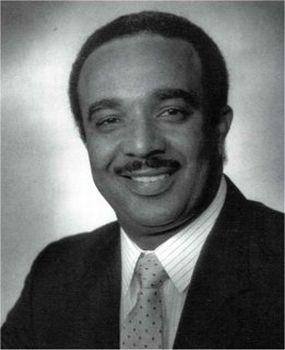
Remembering Mahlon Martin on what would have been his 73rd birthday

On July 19, 1945, future Little Rock City Manager Mahlon A. Martin was born in Little Rock.

After graduating in 1963 from Horace Mann High School, he attended Philander Smith College.  (He had received a baseball scholarship to Grambling, but chose to remain in Little Rock to be near his ailing grandmother.)  Martin graduated from Philander Smith in 1967 with a degree in business administration.

After working in the private sector for two years, Martin was hired by City Manager Jack T. Meriwether to work for the City of Little Rock in 1969 after the City had received a Model Cities grant.  Martin started working with community organizations and then became promoted to the City’s recruiting officer.

In 1972, he was named to leadership posts at the four-county Central Arkansas Manpower Program.  Three years later, he returned to the City of Little Rock to work on the staff of City Manager Carleton McMullin.  In 1976, Martin was named Assistant City Manager for Little Rock.

Martin left City Hall in 1979 to become a top executive at Systematics, Inc.  However, his stint in the private sector was short-lived.  In 1980, the City Board of Directors asked him to come back and be Little Rock’s sixth City Manager.  At thirty-four, he was one of the youngest chief administrators of a major city in the country and the first African American City Manager for Little Rock.

In 1983, Governor Bill Clinton asked him to join the state of Arkansas as the Director of the Department of Finance and Administration.  He was the first African American to lead that or any major Arkansas state department.  Throughout his tenure with the State, he oversaw numerous initiatives to restore the state to sound financial footing.

Martin joined the Winthrop Rockefeller Foundation as president in 1989.  He held that position until his death in 1995.

The name Mahlon Martin lives on in a son and grandson named after him, in an apartment complex on south Main Street, in a street in Clinton Presidential Park, and in the City of Little Rock’s Employee of the Year award.  The latter was created by City Manager Bruce T. Moore in 2004.  At the time Moore noted that Martin had been so popular while City Manager, “It was said you could criticize the Razorbacks to a City of Little Rock employee, but you better not say anything bad about Mahlon Martin to them.”

In 2001, Mahlon Martin was posthumously inducted into the Arkansas Black Hall of Fame.  A decade later, the Butler Center for Arkansas Studies created a fellowship in his memory.  It supports research and programming in the field of public policy in Arkansas.  In 2015, he was included in the Arkansas Civil Rights Heritage Trail.

Little Rock Look Back: Plans Approved for new City Hall in 1906. But will it be built?

The 1906 plans for City Hall with the Municipal Auditorium on the left portion.

On July 9, 1906, the Little Rock City Council approved Resolution 281 and Ordinance 1,295. These actions approved the plans for a new City Hall complex to be constructed on land at the northwest corner of Markham and Broadway Streets.  A few days later, the contract was awarded for the construction of the new building.

Mayor Warren E. Lenon had first called for a new city hall complex in his annual address in April 1904. He repeated his request in April 1905.   The City Council took up Mayor Lenon’s quest for a new city hall in December of 1905.  The Council appropriated money for the purchase of land for a city hall, jail and auditorium.

In response to this, the Arkansas Gazette daily newspaper ran a story featuring the viewpoints of a few civic leaders weighing in on the need for a new city hall complex which would also include a new jail and a city auditorium.  Two of the respondents, L. B. Leigh and P. Raleigh, stressed the need for paved streets and better sewers instead of a new city hall and auditorium.

The other three businessmen interviewed were more favorable to Mayor Lenon’s proposal.  Morris M. Cohn, a former Little Rock City Attorney, stated “I do not think we can make a better investment than in a fine city hall and auditorium.”  (Mr. Cohn, though an M. M. Cohn, was not related the M. M. Cohn who was the namesake for the longtime Little Rock department store.) County Judge William Marmaduke Kavanaugh offered his satisfaction with the action of the City Council on that matter.  R. E. Walt, a banker, opined that he thought $150,000 was not enough; he suggested $200,000 should be spent.

Later that month the Gazette reported that a site had been selected for the city hall and auditorium complex.  The proposed location was most of a city block located at the corner of Markham and Broadway Streets.  Mayor Lenon was vague as to the details of the deal because negotiations were still underway with the property owners

As 1906 dawned, Mayor Lenon and other city leaders continued to take steps to build the new city hall and auditorium.  They invited three local architects to make presentations for the chance to design the new complex.  The three were Charles L. Thompson, Frank W. Gibb and George R. Mann.  Mr. Thompson was chosen to receive the assignment.

On February 5, 1906, Mayor Lenon announced the creation of a special committee to work on the planning for a future city hall complex.  This committee consisted of Aldermen Louis Walther, A. B. Poe, L. N. Whitcomb, Christopher Ledwidge, and John A. Adams.

Mayor Lenon further stated that the new city hall complex and several private developments would “put us in that march of progress with which nothing can prevent us from having a 100,000 population in a few years.”

The saga to get the building built was just starting.

Little Rock Look Back: LR City Council authorizes expansion of Museum of Fine Arts

Twenty-two years after authorizing the creation of the Museum of Fine Arts in City Park, the Little Rock City Council was asked to consider expanding the facility.
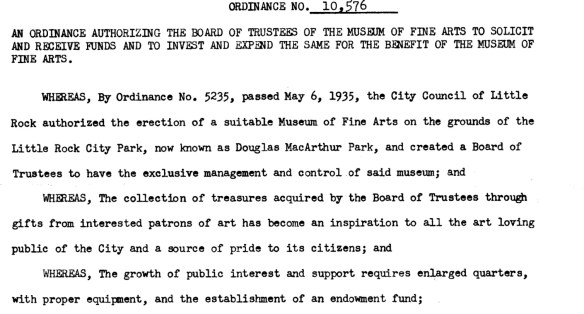
By 1957, the existing structure was felt to be inadequate.   There was a desire for more gallery space as well as for more space for educational programming.

On July 8, 1957, the Little Rock City Council passed an ordinance authorizing the Board of the Museum of Fine Arts to be able to raise the funds for an expansion.  This was merely the start of the process which would eventually lead to the creation of the Arkansas Arts Center.

The ordinance allowed for the expansion or extension of the building. It also authorized the museum’s board to accept gifts for the project and to invest those gifts for the purpose of the museum.  Since the museum only received City funds for maintenance and salary, the ability to raise funds for the expansion was key to the future of the institution.

Lastly, the ordinance gave the museum’s board the ability to increase its membership by up to six positions without having to get additional approval by the City Council.  With a fundraising drive underway and a larger facility planned, these additional board members could certainly prove to be key.

The ordinance passed with nine Ayes, zero Noes, and one absent.

125 years of MacArthur Park

On July 4, 1893, Arsenal Park opened in Little Rock.  This was the City’s first municipal public park.  Though it predated the establishment of a formal Parks and Recreation Department by several decades, it is the oldest part of that department.

The land now known as MacArthur Park had originally served as a horse racetrack in the early days of Little Rock.  By 1836, the federal government purchased the land for construction of a military arsenal.  The flagship building, the Arsenal Tower building, is the only remaining structure from that time period.

The land served as a military outpost until 1892.  On April 23, 1892, a land swap took place where in the City of Little Rock was given the property with the stipulation that it would be “forever exclusively devoted to the uses and purposes of a public park.” (Never mind that the federal government took part of the land back for the construction of the Wilbur Mills Freeway.)  Congressman William L. Terry was active in negotiating the land swap.

In return for giving the City this land, the federal government took possession of land on the north side of the Arkansas River (then part of Little Rock) – that 1,000 acres became Fort Logan H. Roots.

The park officially opened on July 4, 1893, with the name Arsenal Park. Since it was the City’s first and only park at the time, residents started referring to it as City Park. In time, the designation Arsenal Park fell from use.  In fact, it is referred to as City Park exclusively and officially in City documents throughout the first 42 years of the 20th Century.

On March 9, 1942, Little Rock’s first public park was renamed by the Little Rock City Council.  By a vote of fourteen ayes, zero nays and four absent, the alderman approved Ordinance 6,388 which renamed the park in honor of General Douglas MacArthur.

In 1952, General MacArthur (contemplating a run for the GOP nomination for President) visited Little Rock in March.  Later that year, the eventual GOP nominee (and 34th US President) General Dwight Eisenhower visited the park.

Today, MacArthur Park is the anchor of the burgeoning MacPark district as well as the MacArthur Park Historic Distric.