
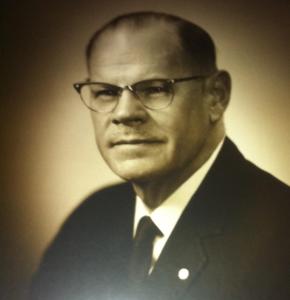
Little Rock Look Back: Werner C. Knoop

To Little Rock citizens under a certain age, the name Knoop means Knoop Park — a picturesque park tucked away in a pocket of Hillcrest.  There are, however, still many who remember Werner C. Knoop as a business and political leader who helped shape Little Rock as a modern city.

Knoop was born on March 30, 1902.

In 1946, Knoop joined with Olen A. Cates and P. W. Baldwin to form Baldwin Construction Company in Little Rock.  Knoop had previously founded Capital Steel Company and established his business reputation there.  From 1945 through 1951, he served on the Little Rock School Board.

Following a series of political scandals, efforts were undertaken for Little Rock to shift from Mayor-Council to City Manager form of government.  Even before the desegregation of Little Rock Central put the city in the eyes of the world, an election for new leaders had been set for November 1957.  Knoop was on a “Good Government” slate and was one of the members elected.

At the first meeting of the new City Board, Werner C. Knoop was chosen by his fellow directors to serve as Little Rock Mayor.  Knoop served as Mayor until December 1962.  For the first several months in office, Little Rock had no City Manager so Knoop oversaw the transition of City staff as the forms of government changed.

Though City Hall generally stayed out of school district matters, that did not mean that the public viewed the two entities separately.  In September 1959, the Baldwin Construction offices were bombed as part of a series of terrorist activities protesting the desegregated reopening of all Little Rock high schools.

Downtown LR as viewed from Knoop Park

Downtown LR as viewed from Knoop Park

After two terms on the City Board, Knoop decided against seeking a third term.  He concluded his elected public service on December 31, 1962.  Following his time on the City Board, Knoop did not retire from Civic Affairs.  In 1970, he served as Chairman of the Little Rock Chamber of Commerce.   The previous year he served as President of the Arkansas Chapter of Associated General Contractors.

Mayor Knoop died in July 1983.  He is buried at Roselawn Memorial Park next to his wife Faith Yingling Knoop, a renowned author.

In the 1930s, Knoop moved into an Art Moderne house on Ozark Point in Hillcrest.  It was adjacent to Little Rock Waterworks property which was developed around the same time.  Eventually much of the land was deeded to the City for creation of a park.  In 1989, it was named in tribute to long-time neighbor Knoop in honor of his lifetime of service to Little Rock.

Little Rock Look Back: Final City Council meeting in 1868 City Hall

On March 30, 1908, the Little Rock City Hall held its final meeting in the 1868 City Hall.  The new city hall, located at Markham and Broadway streets, was nearing completion.  The meeting was presided over by Mayor W. E. Lenon.

The aldermen present were: John A. Adams, John Brod, A. B. Hightower, W. H. Jarrett, Christopher Ledwidge, Louie Miller, Jonathan S. Odom, R. C. Powers, A. L. Smith, George Stratman, Jonathan H. Tuohey, Louis Volmer, and L. N. Whitcomb.  Three aldermen missed the meeting: John Herndon Hollis, A. B. Poe and Benjamin S. Thalheimer.

The meeting was filled with typical requests for zoning and street improvements.  There was actually nothing out of the ordinary about the meeting.  If there was mention that it would be the final meeting, it did not make it into the minutes.

There was a request by the Arkansas Association of Pharmacists to have a meeting at the new building on May 12, 13 and 14.  It was referred to the City Hall Committee.  At prior meetings, there had also been requests by other groups to hold conferences at the new edifice.

At the conclusion of the meeting, it was noted that former City Clerk Clay Jones had died. A resolution memorializing him was proposed to be presented and adopted at the next meeting.

And with that, the meeting ended.  Forty years of City Council meetings at 120 to 122 West Markham came to a close.

LR Women Making History – Kathy Webb

While Kathy Webb has had many titles over her career in public service, Advocate for Others probably encompasses all of them.

One of the most important committees at the Arkansas General Assembly is the Joint Budget Committee.  It is chaired by a senator and a representative.  In 2011 and 2012, as a state representative, Kathy Webb became the first woman to chair the committee.  

Considering that the first woman to be sworn in to the Arkansas General Assembly (Erle Chambers) was from Little Rock, and the first woman to chair a standing committee of the General Assembly (Myra Jones) was from Little Rock, it is fitting that the first woman to chair Joint Budget was also from Little Rock.

While women had been chairing committees for two decades, no female had ever led this committee.  During her tenure, Rep. Webb received praise from people in both houses and both parties for her leadership.  She served in the Arkansas General Assembly from 2007 until 2012.  During that time, she was also named the most effective legislator by Talk Business

Now, she is Vice Mayor of Little Rock.  Vice Mayor Webb is in her first term representing Ward 3 of Little Rock.  She will be vice mayor until December 2018.  Vice-Mayor Webb grew up in Arkansas and graduated from Little Rock Hall High. She earned a degree from Randolph-Macon Woman’s College and attended graduate school at the University of Central Arkansas. She has also participated in the Senior Executives in State and Local Government program at the John F. Kennedy School of Government at Harvard University.

After working in political advocacy in Washington D.C. and throughout the U.S. for several years, she spent over 20 years in the restaurant industry in Illinois, Tennessee, and Arkansas.

Her community involvement includes service on the UAMS College of Medicine Board of Visitors, Arkansas Hospice, and First United Methodist Church of Little Rock. She was the founding president of the Chicago-area affiliate of Susan G. Komen for the Cure.

Vice Mayor Webb has been honored by the Arkansas Kids Count Coalition, Just Communities of Arkansas, Arkansas Judicial Council, National Association of Women Business Owners, Sierra Club, Arkansas AIDS Foundation, Arkansas Chapter of the National Association of Social Workers, Pulaski County CASA, Interfaith Alliance for Worker Justice, Arkansas AARP, Arkansas Hospitality Association, Arkansas Municipal League, Hendrix College and Black Methodists for Social Renewal.

She is the Executive Director of the Arkansas Hunger Relief Alliance. The Alliance is the statewide umbrella organization for Feeding America food banks, food pantries and agencies and hunger activists and the education and advocacy clearinghouse on hunger issues in Arkansas

LR Women Making History – Lucy D. Dixon

Photo courtesy Little Rock School District

Lucy Dixon was elected to the initial Little Rock Board of Directors in November 1957.  She previously had served for six years on the Little Rock School Board.

Mrs. Dixon is the only woman to have served on both the governing boards of the City and the school district.  Mrs. Dixon chose not to seek a second term and left the City Board on December 31, 1960.

With her election in 1957, Mrs. Dixon became the first woman to be elected to a City position without her husband having previously held that position.

Her father had a lumber business, in which she worked off and on throughout her lifetime. She served not only as an officer of the business, but had a desk at the office and participated in the daily business.  She was also very active in Methodist Woman functions in Little Rock and Arkansas.

LR Women Making History – Josephine Pankey

josephinepankeyJosephine Pankey was a real estate developer at a time that few women or few African American men were engaged in that profession. The fact that she was an African American woman who was developing real estate made her efforts even more remarkable.
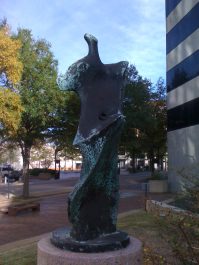
Born in Cleveland OH in 1869, she was educated at Oberlin College.  She moved to Arkansas to serve as a teacher for the African Methodist Episcopal church, first in DeValls Bluff and later in Pine Bluff.  While in the former, she married Eugene Harris.  After three years, the couple divorced.

In Pine Bluff, she met Samuel Pankey, a widowed postal worker with seven children. They married in 1904 and moved to Little Rock soon after because they felt it offered opportunities for their interest in real estate development.

Because of Little Rock’s restrictive Jim Crow era covenants which limited where African Americans could live or own property, Josephine Pankey decided to buy and develop land outside of the city limits.  In 1907, she purchased 80 acres approximately 13 miles west of Little Rock for $400.  Over the next several years, she purchased several more parcels of land which she platted and developed.  Working with Worthen Bank, she started arranging loans for her buyers.

In addition, she established schools and libraries for African Americans in Little Rock.    She was also active in the USO and YWCA.  In the 1950s, the Pulaski County Special School District built a school on land she donated in the community which bore her name.

Though her husband died in 1937, Josephine Pankey continued her real estate development until 1947, when she officially retired.   She died in 1954 and is buried at Oakland-Fraternal Historic Cemetery.

The community which bears her name still exists, though now it is within the Little Rock city limits.  A police substation and community center bears her name.  In 2017, she was honored with inclusion in the UA Little Rock Anderson Institute on Race & Ethnicity’s Civil Rights Heritage Trail.

Breakfast with Henry Moore

HenryMooreThe John Hughes classic The Breakfast Club takes place on March 24, 1984, a Saturday.  Inside the library of the fictional school is a replica of Henry Moore’s Large Standing Figure: Knife Edge.
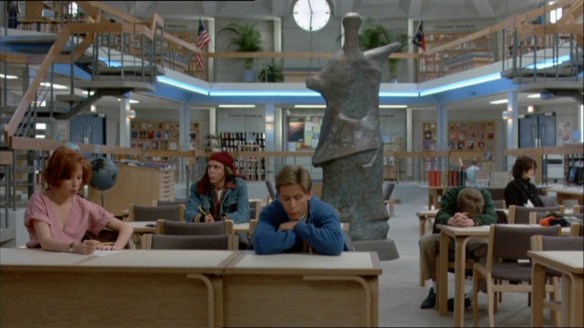
Earlier this week, the Little Rock City Board of Directors voted to accept the sculpture from the Metrocentre Improvement District in exchange for land.  The sculpture (which arrived in Little Rock in 1978) will be moved eventually to MacArthur Park to be placed at the entrance of the Arkansas Arts Center once renovations are complete in 2022.

MacArthur Park will mark the third location for the sculpture in Little Rock.  From 1978 to 1999, it stood at the intersection of Main and Capitol Streets as part of the Metrocentre Mall, a pedestrian development.  In anticipation of the last remaining portions of that project were reopened to vehicular traffic, it was moved to Capitol and Louisiana.

The_Breakfast_Club_229

It was not, contrary to what some on the internet may claim, loaned out for the filming of the movie.  The one in The Breakfast Club is either another striking of the sculpture or, more likely, a Papiermâché (or some other material) reproduction.

MacArthur Returns to Little Rock

MacArthur and Mayor Remmel

General MacArthur and Mayor Remmel

On Sunday, March 23, 1952, General Douglas MacArthur made his only post-infancy visit to Little Rock. He had previously been scheduled to visit Mississippi, and Little Rock Mayor Pratt Remmel had persuaded him to add a visit to Little Rock to the agenda. The fact that Little Rock now had a Republican mayor had apparently piqued the General’s interest.

General MacArthur, accompanied by his wife and son as well as several journalists and members of his military retinue, arrived at Little Rock Airport at 10:40 am. He was met by a delegation of civic leaders including Mayor Remmel. Alderman James Griffey made welcoming remarks on behalf of the city. Then the General and Mayor boarded an open car and led a motorcade from the airport to downtown.

The motorcade’s destination was Christ Episcopal Church at Capitol and Scott streets. It was at this church that MacArthur had been baptized as an infant. The delegation was greeted by the Episcopal Bishop R. Bland Mitchell, Rector J. Hodge Alves, and Rector Emeritus W. P. Witsell. (While he had been Rector, Dr. Witsell had garnered national attention by issuing an Easter blessing to Gen. MacArthur as he had been evacuating the Philippines at the height of World War II.) In order to gain admittance to the church that morning, church members and guests had to have tickets.

Following the worship service, the General and his party went to three events in the park named in his honor. The first was a tour of the Museum of Natural History (now the Museum of Discovery and located in the River Market; the current tenant of the building is the MacArthur Museum of Arkansas Military History), which was located in the building in which the General had been born. After the tour, he spoke at a dedication of a small rose garden adjacent to the museum. It was sponsored by the Little Rock City Beautiful Commission and the Garden Clubs of Greater Little Rock.

Though every stop of the General’s visit had featured crowds, the largest was at the third location in MacArthur Park. A crowd of several thousand greeted the General as he spoke from the Foster Bandshell in the park’s southwest corner. Chamber of Commerce president Richard C. Butler (brother-in-law of Mayor Remmel) was the master of ceremonies. Following an invocation by Methodist Bishop Paul Martin, the only other speaker was the General. In his remarks he spoke of his Southern heritage and of his appreciation for the support of the citizens of Little Rock over the years.

Several gifts were bestowed upon the MacArthurs at the ceremony. The City of Little Rock presented Mrs. MacArthur with an engraved silver serving tray.

Following the events in MacArthur Park, the family retired for a brief respite to the Hotel Marion. They then attended a luncheon buffet in their honor at the home of Howard and Elsie Stebbins on Edgehill Road. The General and Mrs. MacArthur circulated through the house greeting guests and then eschewed a special table in favor of balancing their plates on their laps and sitting in wingback chairs. Meanwhile Arthur MacArthur stayed upstairs and discussed stamp collecting and other hobbies with the Stebbins’ two teenage sons.

Following the luncheon, the MacArthur party went back to the airport and by 4:00pm, the plane was in the air.

Though this visit was coming at the end of a whirlwind of activities, by all accounts, the General and Mrs. MacArthur were very gracious and accommodating. The General was being mentioned as a potential GOP candidate for President, but purposefully steered clear of any political comments in his remarks. He and Mrs. MacArthur dutifully posed for photos not only for the media but also for amateur photographers. At lunch, the General even asked a Gazette photographer to take a photo of him with his Little Rock Police motorcycle escorts so that they could have a souvenir of the visit.