Little Rock Look Back: HST in LR

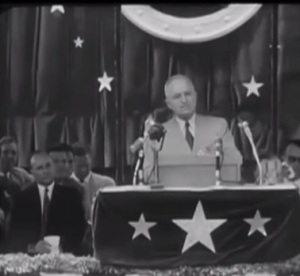
HST in LR2On June 10 and 11, 1949, President Harry S. Truman visited Little Rock.  He was here to participate in activities connected to the reunion of the 35th Division Association.  He had served in that division during World War I.

While he was in Little Rock, President Truman spoke several times.  He generally was accompanied by Governor Sid McMath and Mayor Sam Wassell.

On June 10, he spoke at Robinson Auditorium as part of a welcome ceremony, at a reception at the Hotel Marion and at a ball held at Robinson Auditorium.  His first address was at 3:48 pm and his final one was at 10:15 pm.  The next day he spoke at a breakfast and at a luncheon at the Hotel Marion.  He took pains at these times to stress he was here as a member of the 35th Division.  He also participated in a parade.

In his Presidential role, he spoke at the dedication of War Memorial Park on June 11.  His address took place inside War Memorial Stadium, which had been opened a few months earlier.  It was not a brief dedicatory speech, but instead was a lengthy treatise on foreign affairs.  The address was carried on nationwide radio.  The text of his address can be found here.

President Truman would return to Little Rock in July 1952.  He was in the state to speak at the dedication of Bull Shoals Dam. He did not make any formal remarks in Little Rock while in the city for that visit.

Little Rock Look Back: MacArthur Returns

General MacArthur and Mayor Remmel

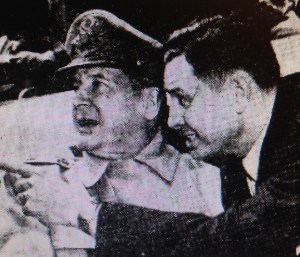
On Sunday, March 23, 1952, General Douglas MacArthur made his only post-infancy visit to Little Rock. He had previously been scheduled to visit Mississippi, and Little Rock Mayor Pratt Remmel had persuaded him to add a visit to Little Rock to the agenda. The fact that Little Rock now had a Republican mayor had apparently piqued the General’s interest.

General MacArthur, accompanied by his wife and son as well as several journalists and members of his military retinue, arrived at Little Rock Airport at 10:40 am. He was met by a delegation of civic leaders including Mayor Remmel. Alderman James Griffey made welcoming remarks on behalf of the city. Then the General and Mayor boarded an open car and led a motorcade from the airport to downtown.

The motorcade’s destination was Christ Episcopal Church at Capitol and Scott streets. It was at this church that MacArthur had been baptized as an infant. The delegation was greeted by the Episcopal Bishop R. Bland Mitchell, Rector J. Hodge Alves, and Rector Emeritus W. P. Witsell. (While he had been Rector, Dr. Witsell had garnered national attention by issuing an Easter blessing to Gen. MacArthur as he had been evacuating the Philippines at the height of World War II.) In order to gain admittance to the church that morning, church members and guests had to have tickets.

Following the worship service, the General and his party went to three events in the park named in his honor. The first was a tour of the Museum of Natural History (now the Museum of Discovery and located in the River Market; the current tenant of the building is the MacArthur Museum of Arkansas Military History), which was located in the building in which the General had been born. After the tour, he spoke at a dedication of a small rose garden adjacent to the museum. It was sponsored by the Little Rock City Beautiful Commission and the Garden Clubs of Greater Little Rock.

Though every stop of the General’s visit had featured crowds, the largest was at the third location in MacArthur Park. A crowd of several thousand greeted the General as he spoke from the Foster Bandshell in the park’s southwest corner. Chamber of Commerce president Richard C. Butler (brother-in-law of Mayor Remmel) was the master of ceremonies. Following an invocation by Methodist Bishop Paul Martin, the only other speaker was the General. In his remarks he spoke of his Southern heritage and of his appreciation for the support of the citizens of Little Rock over the years.

Several gifts were bestowed upon the MacArthurs at the ceremony. The City of Little Rock presented Mrs. MacArthur with an engraved silver serving tray.

Following the events in MacArthur Park, the family retired for a brief respite to the Hotel Marion. They then attended a luncheon buffet in their honor at the home of Howard and Elsie Stebbins on Edgehill Road. The General and Mrs. MacArthur circulated through the house greeting guests and then eschewed a special table in favor of balancing their plates on their laps and sitting in wingback chairs. Meanwhile Arthur MacArthur stayed upstairs and discussed stamp collecting and other hobbies with the Stebbins’ two teenage sons.

Following the luncheon, the MacArthur party went back to the airport and by 4:00pm, the plane was in the air.

Though this visit was coming at the end of a whirlwind of activities, by all accounts, the General and Mrs. MacArthur were very gracious and accommodating. The General was being mentioned as a potential GOP candidate for President, but purposefully steered clear of any political comments in his remarks. He and Mrs. MacArthur dutifully posed for photos not only for the media but also for amateur photographers. At lunch, the General even asked a Gazettephotographer to take a photo of him with his Little Rock Police motorcycle escorts so that they could have a souvenir of the visit.

RobinsoNovember: President Harry S. Truman

HST in LR2

President Truman in War Memorial Park. A photo of him at Robinson does not seem to exist.

Today is Veterans’ Day, a chance to pause and remember those — both living and deceased — who have served in the Armed Forces of the US.  November 11 was chosen since it was on November 11 in 1918, at 11:11 (Paris time), the Armistice was signed to end the Great War, as World War I was then known.  In 1954, the holiday was renamed Veterans Day since the US had been in two military conflicts since the Great War.

A World War I infantry reunion brought President Harry S. Truman to Little Rock in June 1949, a few months after he won his own term in the Presidency. During his time here, he spoke twice at Robinson Auditorium.

Upon arriving, he made some informal remarks:

I am most happy to be here. I am only here in my capacity as a member of the 35th Division. Tomorrow I will address you as President of the United States, and I am afraid you will have to listen, whether you like it or not.

I hope to have a pleasant time in Little Rock, as I always have when I come here. I have been here a dozen times–one of the most hospitable cities in the United States. They know how to treat you, they know how to make you like it, and want you to come back.

I will see more of you later on in the day.

I appreciate the welcome that everybody has given us here this afternoon.

Thank you very much.


Later that night, he spoke at a Ball at Robinson.  It followed a banquet that had taken place at the Hotel Marion.

Governor McMath, the Mayor of Little Rock, and distinguished guests:

I can’t tell you how very much I appreciate the cordial reception which I have received in Little Rock. It has been like coming back home to come down here. It’s a habit of mine and has been for 25 years. I have been here in town many a time, and attracted no attention at all. But my friends were just as cordial to me then as they are now.

And I want to thank Eberts Post No. r for its cooperation with the 35th Division in putting on this ball and entertainment.

My education, so far as taking part on the floor is concerned, was sadly neglected as I grew up. I am a Baptist–not a light-foot one–so I didn’t learn how to dance. But I did learn a lot of other things in life, maybe, that I shouldn’t have learned.

I hope that the 35th Reunion this year will be the usual success that 35th Reunions are. I have missed only one, I think, in 25 years or more. I didn’t want to miss this one. The fact that you had it on a weekend gave me and the congressional delegation of the great State of Arkansas an opportunity to be present and attend the meeting. Otherwise, we would have had to stay in Washington and work.

It doesn’t make any difference, though, where the President goes, his work follows him up. I told the congregation this afternoon–you see, I am talking as a Baptist talks–that it didn’t make any difference where I went, I have to sign my name some 600 times a day to keep the country running. And it has, up to date, and I think it will continue, at least for 3 1/2 years more.

I am looking forward to a most pleasant time. I am talking to you now as a member of the 35th Division only, but if you want to hear the President of the United States you had better come out to the stadium tomorrow, and I will tell you something that will be good for your souls.

Thank you very much.

The following day he gave a national address on foreign affairs at the dedication of War Memorial Park.  It was carried on coast-to-coast radio.  There was no radio coverage of his remarks at Robinson, but a large press corps of national correspondents captured his words.

The Little Rock Mayor to whom he referred was Sam Wassell.  Mayor Wassell’s wife had christened the USS Little Rock during World War II.  A first cousin, Dr. Corydon Wassell, was a war hero who had been played by Gary Cooper in a movie.

RobinsoNovember: Grady Manning

h-grady-manningIn 1938, the first Auditorium Commission was appointed to oversee the administration of Robinson Auditorium.  At the time, it was anticipated that the auditorium would be ready to open by no later than September 1939.  (Actually, the building was originally supposed to have been opened by June 1938 in order to fulfill a funding request.)

The first chairman of the Auditorium Commission was H. Grady Manning.  He was founder and president of Southwest Hotels, which included the Hotel Marion, Ben McGehee, Albert Pike, and Lafayette Hotels in Little Rock as well as the Arlington and Majestic Hotels in Hot Springs.

Manning was a native of Scott County. He moved to Fort Smith to attend a business college. To help defray expenses, he started working at the hotel in which he was staying. Enjoying this, he decided to make hotels his career.  Manning then moved to Hot Springs and worked at the Eastman Hotel before moving to Niagara Falls to work at the Queen Royal Hotel.  He returned to Arkansas in 1917 and became the assistant manager at the Hotel Marion.  In 1919, he became the manager of the Basin Park Hotel in Eureka Springs before moving to Fort Smith and managing the Goldman Hotel.

In the 1920s, he founded Southwest Hotels, Inc. which then started building and acquiring existing properties.  He and his wife, Ruth, resided in the Hotel Marion.  His daughter, Joy, grew up at the hotel.  With the proximity of his hotels to the forthcoming auditorium and his understanding of the convention business, Manning was a natural fit to lead the new auditorium commission.  As construction woes delayed the opening of the building, Manning struggled to keep the commission together.  The commission, by state statute, was not charged to oversee a construction project, but instead to administer a functioning building.

On Labor Day, 1939, Manning and his wife were enjoying the day at Lake Hamilton with some friends.  The boat they were in capsized, and Manning drowned at the age of 47.  The City was in mourning.  A City Council resolution was passed to memorialize his contributions.  In addition to being signed by Mayor J. V. Satterfield, it was signed by three members of the City Council–Aldermen E. W. Gibb, S. Major Dent, and Charles Davis.

Later in September, the remaining four members of the Auditorium Commission resigned. Since they had no building to manage and no leader, they decided it was best to disband.  Mayor Satterfield declined to name their replacements until the building got closer to opening.

A few years after his death, the Ben McGehee was renamed the Grady Manning Hotel.  That hotel, and the Hotel Marion were imploded in February 1980 to make way for the Statehouse Convention Center and the Excelsior Hotel.

Arkansas Heritage Month – LR Mayor Pat L. Robinson and a municipal auditorium

PLR AuditIn April 1929, at the age of 29, Pat L. Robinson (no relation to Senator Joe T. Robinson) was inaugurated as Little Rock’s mayor.  Shortly after he took office, a variety of City Council committees and city interest groups started making proposals for projects to be funded by City bonds.  The decision was made to put a municipal bond issue before voters in August 1929.

The Young Business Men’s Association proposed a municipal auditorium be included.  In his 1929 inaugural address, Mayor Robinson had commented that an auditorium would be a worthwhile project for the city, should funding be available.  Another proposal, which seemed to have mayoral support, was the Civic Center plan (including land for an auditorium) which J. N. Heiskell had started shopping in the waning days of the Moyer administration.

The City Council approved the calling of the election and the submission of eleven different items.  Mayor Robinson then invoked the ire of the aldermen by noting he would only support four of the eleven proposals. Over the ensuing weeks, he and the aldermen traded charges and parliamentary ploys.  In July, the Council voted to cancel the election, which the mayor vetoed.  Though the Council had the votes to override the veto (and therefore not have the election), they let the veto stand.  The election proceeded as planned in August.

Hobbled by a lack of a cohesive campaign to begin with which was exacerbated by the City Hall infighting, it was probably no surprise that the few of the election proposals were approved by voters.  The marvel is probably that any were actually approved.  This appears to have been the first municipal bond election put forth after the 1926 approval of the new amendment to the Arkansas constitution.

Neither the Auditorium nor the Civic Center proposals were approved.  Throughout his term, the Hotel Marion continued to be the main site in Little Rock for conventions, while Little Rock High School’s auditorium was the showcase for performances.

No further proposals for an auditorium were put forth during the remainder of the Pat L. Robinson administration.  After continuing to alienate the Democratic power structure, he was challenged in the November 1930 primary, and failed to receive the nomination to be the Democratic nominee for mayor in 1931.

Arkansas Heritage Month – LR Mayor Moyer and a Municipal Auditorium

Moyer AuditIn anticipation of the November 2016 reopening of Robinson Center Music Hall, this week’s Arkansas Heritage Month entries look at seven Little Rock Mayors who worked on proposals for a municipal auditorium between 1904 and 1940.

After having served as Pulaski County Judge, Charles Moyer was elected Little Rock Mayor in April 1925.  He concluded his inaugural address later that month with a request that all Little Rock voters should support the auditorium district proposal in the May 1925 special election.  Voters approved the auditorium, but the concept of an auditorium district was thrown out by the Arkansas Supreme Court after a legal challenge.

Mayor Moyer then led a statewide effort to get a Constitutional amendment approved to allow for public bonds to be used on auditoriums and a host of other structures, as long as voters approved the issuance of bonds.  This was approved by voters in October 1926.  Though Mayor Moyer publicly advocated for an auditorium after that election, he did not lead a subsequent effort to create one.  During his tenure, conventions were largely centered around the Hotel Marion.  A new Little Rock High School was built (now Little Rock Central High) with that auditorium supplanting its predecessor as the location of choice for large-scale performances.

He left office in April 1929.  In the final weeks of Mayor Moyer’s second term, Planning Commission Chair J. N. Heiskell (editor of the Arkansas Gazette) started discussing the need for a civic center for Little Rock which would include space for a municipal auditorium.

Charles Moyer returned to the office of mayor for an additional two terms in the 1940s. By that time Robinson Auditorium had been opened.

Arkansas Heritage Month – LR Mayor Taylor and a Municipal Auditorium

Taylor AuditIn anticipation of the November 2016 reopening of Robinson Center Music Hall, this week’s Arkansas Heritage Month entries look at seven Little Rock Mayors who worked on proposals for a municipal auditorium between 1904 and 1940.

Charles Taylor became Little Rock’s mayor in April 1911.  He inherited the temporary auditorium that was already showing signs of wear and tear after four years.  Throughout the eight years he was in office, he and the City Council wrestled with the question of what to do about the auditorium.

Time and time again, there would be calls to tear the building down. Its proximity to the 1913 fire station was causing the insurance rates on that building to be increased. It was viewed as structurally unsound and had outlived its useful life.  However, without that building, there would be no public space for conventions and community meetings.  While the Hotel Marion offered convention facilities in its ballroom, it did not necessarily lend itself to trade shows. In addition, as a private entity, it was able to set its own rules without necessary regard to the general public.

A 1913 proposal by planner John Nolen had called for an auditorium to be built on a new plaza area near City Hall.  Due to funding issues, that plan never gained traction, despite repeated attempts by its backers to push for it.

At the time he left office in April 1919, Mayor Taylor had still not been able to solve the problem of a municipal auditorium.