Little Rock Look Back: J. N. Heiskell

At the age of 87, J. N. Heiskell in 1960.

At the age of 87, J. N. Heiskell in 1960.

John Netherland (J. N.) Heiskell served as editor of the Arkansas Gazette for more than seventy years.

He was born on November 2, 1872, in Rogersville, Tennessee, to Carrick White Heiskell and Eliza Ayre Netherland Heiskell. He entered the University of Tennessee at Knoxville before his eighteenth birthday and graduated in three years at the head of his class on June 7, 1893.

His early journalism career included jobs with newspapers in Knoxville and Memphis and with the Associated Press in Chicago and Louisville. On June 17, 1902, Heiskell’s family bought controlling interest in the Arkansas Gazette. Heiskell became the editor, and his brother, Fred, became managing editor.

Governor George Donaghey appointed Heiskell to succeed Jeff Davis in the United States Senate after Davis’s death in office. Heiskell served from January 6, 1913, until January 29, 1913, when a successor was elected.

On June 28, 1910, Heiskell married Wilhelmina Mann, daughter of the nationally prominent architect, George R. Mann. The couple had four children: Elizabeth, Louise, John N. Jr., and Carrick.

In 1907, he joined a successful effort to build the city’s first public library. He served on the library board from that year until his death and was issued the first library card.  He also served on the City’s Planning Commission for decades.

In 1912, he was instrumental in bringing John Nolen to Little Rock to devise a park plan. Heiskell was also largely responsible for the location of Robinson Auditorium. When City Council members had competing locations, he advocated for the corner of Markham and Broadway. And kept at it until the site was selected.

In the paper and in his own personal opinions, he crusaded on a variety of progressive causes.  Perhaps the most famous was the Gazette’s stance in the 1957 Central High desegregation crisis.  It was for this effort that the paper received two Pulitzer Prizes.

Although Heiskell stopped going to the office at age ninety-nine, he continued to take an active interest in the newspaper. He began by having a copy of the newspaper delivered to his home by messenger as soon as it came off the press each night. Eventually, he switched to having his secretary call him daily at his home and read the entire newspaper to him. He operated on the premise that “anyone who runs a newspaper needs to know what’s in it, even to the classified ads.”

A few weeks after turning 100, Heiskell died of congestive heart failure brought on by arteriosclerosis on December 28, 1972. He is buried in Little Rock’s Mount Holly Cemetery.  Interestingly, he is buried in the same cemetery as two of his most notable adversaries: Governor Jeff Davis, and segregationist Congressman Dale Alford.

Little Rock Look Back: Site selected for Robinson Auditorium

Potential rendering of new auditorium which appeared in October 30, 1937 ARKANSAS GAZETTE

Potential rendering of new auditorium which appeared in October 30, 1937 ARKANSAS GAZETTE

On October 29, 1937, the Little Rock City Council finally selected the site for the Municipal Auditorium.  It had been approved by voters in January of that year, but no site had been identified during the campaign.

During the early autumn, the City had engaged a consultant to evaluate several downtown locations as potential sites for the municipal auditorium.  One stipulation was that it had to be an entire city block.

The six sites were:

Broadway, Markham, Spring and Garland Streets; Center, Markham, Spring and Second Streets; Center, Eighth, Louisiana and Ninth Streets; Scott, Fourth, Cumberland and Capitol Streets; Scott, Tenth, Cumberland and Ninth Streets; and Third, State, Second and Gaines Streets


The top choice was the site bounded by Center, Markham, Spring and Second Streets.  It was felt that location’s proximity to public buildings made it ideal for a civic auditorium.  It was across the street from the former state capitol (then known as the Arkansas War Memorial) which was, at the time, housing state and federal offices.  The site was also adjacent to the county courthouse structures.

Half of the desired property was owned by the federal government.  Because it was being used for federal offices, it was uncertain as to the site’s availability.  Therefore a city committee recommended the site bounded by Center, Eighth, Louisiana and Ninth Streets be utilized as the auditorium location.

The City Council met on October 20 to make a decision. But were at a stalemate. They met again a few days later with still no resolution.

At an October 25 City Council meeting, Arkansas Gazette publisher (and chairman of the Planning Commission) J. N. Heiskell, advocated the site on Markham and Broadway Streets. The Council convened on October 29 to meet again.  The clock was ticking, a site had to be selected because ground had to be broken prior to January 1, 1938.


At the October 29th meeting, the discussion from previous meetings among the aldermen picked up where it had left off.  Again J. N. Heiskell spoke about the importance of employing city planning concepts in selecting the site.

“In the past, selection of a site for a public building has been merely a matter of who could sell the city some property.  I had hoped we were starting a new effort in starting selection of an auditorium site with the advice of Mr. Bartholomew.  Starting with the auditorium, we should be guided by competent advice and locate future buildings following a city plan.  Your vote today will determine the future of Little Rock so far as city building goes.”

After having engaged in discussions with various federal government agencies, Mayor Overman reported that the city could not obtain the recommended site.  It would not be possible for the federal government to relocate those agencies currently occupying half of that block within the time allowed.  The mayor also stated that he had been warned that if construction did not start by January 1, 1938, (which was just a few weeks away) then the money could be taken back and allocated to other projects.

Ultimately the City Council voted 16 to 1 with 1 absent to locate it at the corner of Markham and Broadway.  At last, Little Rock had a location for the new municipal auditorium!

Though it had not been anyone’s first choice (except Mr. Heiskell, who did not have a vote), in retrospect, the auditorium site finally chosen offered many advantages which were not identified during the marathon selection discussions.  The grade of the land sloped toward the Arkansas River from Markham Street down to Garland Street which allowed for a street level entrance to both the planned exhibition hall on a lower level and the music hall on an upper level.  Given the topography of the other sites under consideration, this was only possible at the chosen location.  By stacking the two major components the project did not take up an entire block, which had been the forecasted footprint.  Not using the entire block allowed for subsequent expansion of the complex’s footprint in the coming decades.  This would not have been possible at any of the other sites under consideration if the original structure had taken up the entire block.  In addition, both Markham and Broadway Streets are wider than normal city streets which allowed for better traffic flow and for easier access to a loading dock.

Interestingly, the Convention & Visitors Bureau, which oversees Robinson Center Music Hall, now has offices in the Cromwell Building. This building is located on the site which had been the first choice for the auditorium in 1937.


CALS announces cancellation of tonight’s Heiskell Lecture with Jonathan Karl

Due to recent developments regarding the election of a new Speaker of the House, ABC News requires Jonathan Karl, ABC News’ chief White House correspondent,to be in Washington, D.C., and he is unable to present the Central Arkansas Library System’s (CALS)J.N. Heiskell Distinguished Lecture today.
In an email, Karl said, “The breaking news on the Capitol has forced me to be in Washington — I tried hard to avoid that but I was given no choice. In such a major breaking story, ABC News felt I must be there to report for World News Tonight and our other platforms.
“We are hopeful that we will be able to reschedule Mr. Karl’s presentation,” said CALS director Bobby Roberts. “We are very disappointed the lecture will not happen tonight. Journalists’ jobs are to cover current events, and important things are happening now in Washington, D.C.”

CANCELLED – Jonathan Karl will present the CALS J.N. Heiskell Distinguished Lecture

jonathankarlJonathan Karl, ABC News’ chief White House correspondent, will present the Central Arkansas Library System’s (CALS) J.N. Heiskell Distinguished Lecture on Friday, October 9, at 6:30 p.m. in the Ron Robinson Theater, 100 River Market Ave.
 The event is free and open to the public. A reception will follow the program. Seating is general admission. Reservations are appreciated, but not required. RSVP at lellis@cals.org, or 918-3024.
Jonathan Karl, ABC News’ chief White House correspondent, covers the White House forWorld News Tonight, Nightline, and Good Morning America. Karl joined ABC News in January, 2004, and has also served as the network’s Senior Congressional Correspondent, Senior Foreign Affairs Correspondent, Senior National Security Correspondent, and Senior Political Correspondent.
Karl has covered political campaigns in virtually every state and has reported from more than 30 countries, including Iraq, Afghanistan, China, Pakistan, and Sudan. He traveled internationally with the President, Vice President, Secretary of State, and Secretary of Defense to cover topics such as three presidential elections, the wars in Iraq and Afghanistan, the intelligence community, and Congressional reaction to the September 11 terrorist attacks.
Jonathan Karl’s extensive experience and political knowledge allow him to discuss foreign affairs, America’s role in the post-September 11 world, national politics, and current events with insight and expertise. Karl also elaborates on what he has learned as moderator and organizer of Sustaining Democracy, a series of panel discussions on America’s changing political landscape. In 2001, Karl won the National Press Foundation’s Everett McKinley Dirksen Award, the highest honor for Congressional reporting and in 2013 was awarded with a Walter Cronkite Excellence in Journalism award.
The Heiskell Distinguished Lecture is named for J.N. Heiskell, the longest-serving member of the Library’s Board of Trustees and editor of the Arkansas Gazette for more than seventy years. J.N. Heiskell was the longest-serving member of the Library’s Board of Trustees, serving from 1910-1972, and he served as President from 1950 until his death in 1972. Speakers and programs honor Heiskell’s commitment to excellence in journalism as well as his support of the library. Past speakers include Helen Thomas, Ernest Dumas, Walter Mears, David Pryor, Dexter Filkins, and John O’Hara.

Learn about Little Rock’s earliest auditorium (which also was a roller rink AND rifle range) today at noon at Old State House Museum Brown Bag Lecture

11805726_10154024863604908_1192217255_nToday at noon, the Old State House Museum will have another Brown Bag Lecture.  This one focuses on three decades of unsuccessful efforts to build a municipal auditorium in Little Rock.  That time period was filled with big dreams, lawsuits, personality clashes, disappointments, and a Roller Rink that was also a Rifle Range.

In April 1904, Little Rock Mayor W. E. Lenon spoke of the need for a municipal auditorium in Little Rock. It would take thirty-six years for that dream to be realized. Along the way there were numerous twists, turns, detours and disappointments as the saga was played out in the newspapers, courtrooms, and offices of every major Little Rock architect at the time.

Until a permanent auditorium could be found, the City made do with vaudeville houses, high schools, and even a roller skating rink which doubled as a rifle range. Over the three decades of planning for an auditorium, some names came and went, others such as Mayor Lenon, architect Charles L. Thompson and Arkansas Gazette publisher J. N. Heiskell appeared time and time again. This Brown Bag Lunch Lecture explores the time period from 1904 to 1934 as it looks at the numerous unsuccessful attempts to construct a municipal auditorium in Little Rock.

In 2016, there will be a Brown Bag Lecture to look at construction and opening of Robinson Center Music Hall.

Scott Whiteley Carter is Special Projects Administrator for the City of Little Rock. As the unofficial historian of Little Rock City Hall, he can often be found leafing through sheaves of papers in the City Clerk’s vault or furiously scribbling notes in Little Rock research libraries. He is also the author of the LRCultureVulture.comblog. A native of Little Rock, he is a graduate of Missouri State University.

On Memorial Day pay tribute to Veterans who paid the ultimate price at Mount Holly or other cemeteries

MountHolly Memorial DayToday is Memorial Day – a time to pay tribute to the men and women in uniform who died in service to their country.

As a way to give this recognition, today would be a good day to visit a cemetery. One of Little Rock’s most storied cemeteries is Mount Holly Cemetery. There are veterans from all wars: Revolutionary, War of 1812, Mexican, Civil War, Spanish-American, World War I and II, Korean, Vietnam and Desert Storm.

Founded in 1843, Mount Holly has been called “The Westminster Abbey of Arkansas.” Thousands of visitors come each year. Those interested in history come to see the resting places of the territorial citizens of the state, including governors, senators, generals, black artisans, and even a Cherokee princess. For others the cemetery is an open air museum of artistic eras: Classical, Victorian, Art Deco, Modern––expressed in gravestone styles from simple to elaborate. Some come to read the epitaphs that range from heartbreaking to humorous to mysterious.

Though a City of Little Rock facility, the cemetery is maintained by the Mount Holly Cemetery Association, a non-profit organization with a volunteer Board of Directors. The cemetery is located at 1200 South Broadway in Little Rock. Gates are open from 8 a.m. until 5 p.m. in the summer and from 8 a.m. until 4 p.m. in the winter.

Interred within the rock walls of Mount Holly are 11 state governors, 15 state Supreme Court justices, four Confederate generals, seven United States senators and 22 Little Rock mayors, two Pulitzer Prize recipients, as well as doctors, attorneys, prominent families and military heroes.  Proving that death is the great equalizer (and the J. N. Heiskell lived a very long time) longtime Gazette owner and publisher J. N. Heiskell is buried near two different nemeses: Senator, Governor and demagogue Jeff Davis; and segregationist Congressman Dr. Dale Alford.

On Pulitzer Day – Prizing Mount Holly

The Pulitzer Prizes are to be announced today.  Mount Holly Cemetery not only touts that it is the site of a whole host of elected officials, it is also the only place in Arkansas where two Pulitzer Prize recipients are buried. The cemetery is open every day, but a special visit to these two prize winner gravesites can be made next Sunday during the Mount Holly Cemetery Association’s annual “Rest in Perpetuity” fundraiser picnic.

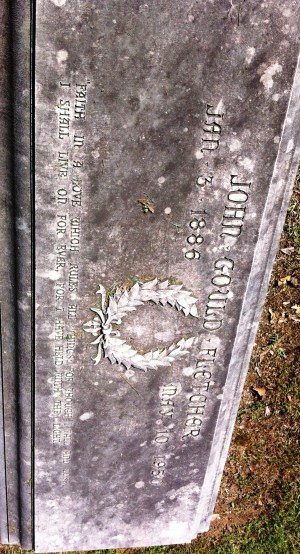
In 1939, John Gould Fletcher became the first Southern poet to win the Pulitzer Prize for Poetry.  He was born into a prominent Little Rock family in 1886.  Fletcher was awarded the prize for his collection Selected Poems which was published by Farrar in 1938.  Two years earlier, he had been commissioned by the Arkansas Gazette to compose an epic poem about the history of Arkansas in conjunction with the state’s centennial.

Fletcher is buried next to his wife, author Charlie May Simon and his parents (his father was former Little Rock Mayor John Gould Fletcher).  Other relatives are buried nearby in the cemetery.

The other Pulitzer Prize winner buried in Mount Holly is J. N. Heiskell, the longtime editor of the Arkansas Gazette.  It was Heiskell, in fact, who asked Fletcher to compose the poem about Arkansas.  Heiskell served as editor of the Gazette from 1902 through 1972.  He died at the age of 100 in 1972.

Under his leadership, the Gazette earned two Pulitzer Prizes for its coverage of the 1957 desegregation of Little Rock Central High.  One was for Harry Ashmore’s editorial writing and the other was for Public Service.

Heiskell remained in charge of the Gazette until his death in 1972.  He is buried alongside his wife with other relatives nearby.  Also not too far from Mr. Heiskell are two of his nemeses, proving that death and cemeteries can be the great equalizer. In the early days of his Gazette stewardship, he often locked horns with Senator (and former Governor) Jeff Davis. Later in Mr. Heiskell’s career, he vehemently disagreed with Dr. Dale Alford, who had been elected to Congress on a segregationist platform.