Arkansas Heritage Month – “Little Rock” Songs

Monroe RussellThe Capital City has popped up in a variety of songs in different genres over the years.  Today we look at five notable instances.

Collin Raye’s 1994 song “Little Rock” peaked at Number 2 on the Billboard Country charts and was Number 14 for the entire year.  Found on Raye’s album Extremes, it was written by Tom Douglas.  The song centers on a man who is trying to rebuild his life after battles with alcohol have affected his marriage.

Notable lyric: “I think I’m on a roll here in Little Rock.”


Hayes Carll’s take on Arkansas’ capital is also known as “Little Rock.” It was his title track from the 2005 album.  It tells the tale of a man who has traveled all over the US and is excited to make it back to Little Rock. With a driving country-rock beat, it typifies Carll’s style of music which has one foot squarely in both camps as a singer-songwriter.

Notable lyric: “All of my life I’ve tried to find/ “a piece of this earth for my peace of mind.”


Leo Robin and Jule Styne wrote the 1949 song “Little Girl from Little Rock” for their Broadway musical Gentlemen Prefer Blondes.  Introduced by Carol Channing, it told of quintessential 1920s vamp Lorelei Lee’s rise from “the wrong side of the tracks” to Manhattan’s elite neighborhoods.  It has remained part of Channing’s repertoire in nightclubs and concerts.  In 1953, it was retooled with sanitized lyrics and made into a duet for Marilyn Monroe and Jane Russell in the film version of the musical.

Notable lyric: “Then someone broke my heart in Little Rock/and I up and left old Arkansas.”


Little Rock has also appeared in several “List songs” including “I’ve Been Everywhere.” Originally written with Australian place names in 1959, it was adapted to North American places in 1962 by Hank Snow. Arkansan Johnny Cash recorded it in 1996.

Little Rock appears in the second verse: “Glen Rock, Black Rock, Little Rock, Oskaloosa,”


Billy Joel’s 1989 “We Didn’t Start the Fire” contains three references to Little Rock. In the first section’s look at 1949, the Rodgers and Hammerstein musical South Pacific is mentioned.  With a heroine from Little Rock, this musical was the most popular show on Broadway during the 1948-1949 and 1949-1950 Broadway seasons.  The second comes in the 1953 portion with “Rockefeller” which referenced playboy Winthrop Rockefeller’s abandonment of New York City for Arkansas. He had residences in both Little Rock and on Petit Jean Mountain. The final entry came in 1957, when Joel references the Central High integration crisis with the lyric “Little Rock, Pasternak, Mickey Mantle, Kerouac, Sputnik, Chou En-Lai, Bridge on the River Kwai.”


Little Rock Look Back: Longtime CALS trustee Rabbi Ira Sanders

SandersIraE_fOn May 6, 1894, Ira Eugene Sanders was born in Missouri.  After receiving an undergraduate degree and rabbinate degree in Cincinnati, he was ordained a rabbi in 1919.  He served congregations in Pennyslvania and New York before coming to Little Rock in September 1926.

Shortly after arriving to lead the B’nai Israel congregation, Rabbi Sanders became active in the Little Rock community.  Among his projects were the Little Rock Community Fund, Little Rock School of Social Work (which he founded), Central Council of Social Agencies, and University of Arkansas Extension Department. During the Great Depression, he helped organize the Pulaski County Public Welfare Commission.  Other areas of involvement over his career included the Arkansas Human Betterment League, Urban League of Greater Little Rock and Arkansas Lighthouse for the Blind.  On November 3, 1930, Rabbi Sanders debated Clarence Darrow about the existence of God in front of a packed house at Little Rock High School.

For his many involvements, he received an honorary Doctor of Humanities degree in 1951 from the University of Arkansas.  Three years later he received an honorary Doctor of Divinity degree from Hebrew Union College’s Jewish Institute of Religion.

A lifelong supporter of a Jewish state, he participated in nineteen bond drives for the state of Israel.  In August 1963, he retired as the leader of B’nai Israel after over 35 years. He would remain as Rabbi Emeritus until his deal in 1985.

In January 1978, Rabbi Sanders tendered his resignation from the Central Arkansas Library board of directors.  The City Board of Directors passed resolution 5873 which noted that he had served for 51 years on the Library Board. He was first appointed in 1926.  He served during 19 different Mayoral administrations from Charles Moyer’s first term through Donald Mehlburger’s.

On April 8, 1985, Rabbi Ira Eugene Sanders died of natural causes.  He is buried in the City’s Oakland Jewish Cemetery.  The Central Arkansas Library System honors his memory with an annual distinguished lecture series.

Arkansas Heritage Month – SOUTH PACIFIC wins the Pulitzer Prize

SoPa Pul GazOn May 6, 1950, the Associated Press ran a story which would later be carried in the Arkansas Gazette about the Rodgers and Hammerstein musical South Pacific capturing the Pulitzer Prize in Drama.  The reason this carried such weight in Arkansas was that the musical had a connection to Little Rock.

The 1950 Pulitzer for Drama went to a musical, for only the second time in the history of the awards.  The recipient was South Pacific by Richard Rodgers, Oscar Hammerstein II and Joshua Logan.  The character was the leading lady of Nellie Forbush. She was an Navy ensign and a nurse stationed on an exotic island during World War II.  The musical was based on a Pulitzer Prize winning novel, James Michener’s Tales of the South Pacific.

In the Michener novel, Miss Forbush is not from Little Rock.  She is actually from a small town in Alabama.  The part was written for Mary Martin from Weatherford, Texas.  Rodgers, Hammerstein & Logan did not discuss why they relocated Nellie’s birthplace.

Originally the musical contained a song entitled “My Girl Back Home” in which Nellie sang of being from “Little Rock, A-R-K” while another character sang of being from “Philadelphia, P-A” and “Princeton, N-J.”  It is possible the change to Little Rock was made because it offered more lyrical possibilities, but that is only a supposition on the part of the Culture Vulture. That song did appear in the movie version in which Mitzi Gaynor played Nellie Forbush.  It was also featured in the 2008 Broadway revival, this time with Kelli O’Hara playing Nellie.

In the musical, Nellie struggles with her own prejudices. This issue of prejudice became an instance of fact meeting fiction. In 1957, a few weeks after Eisenhower sent troops into Little Rock to ensure that Central High would be desegregated, a production of South Pacific on Long Island was temporarily halted when the audience booed and yelled after Nellie mentioned she was from Little Rock.  Interestingly, the movie was released in 1958, but retained references to Little Rock. That was either a testament to the expense of re-editing it, or the fact that audience reaction had lessened.

Sculpture at the River Market Show and Sale this weekend

Wayne Salge Photo: Mel Shockner Benito & Amelia 35x16x16” Bronze

Wayne Salge
Photo: Mel Shockner
Benito & Amelia
35x16x16” Bronze

Little Rock residents and visitors alike will have the opportunity to see and purchase works by leading sculptors when the ninth Sculpture at the River Market Invitational Show and Sale takes place from April 22 to 24.

Over 800 sculptures will be on display in the River Market pavilions and in the adjacent area of Riverfront Park on those three days in April. The works featured will include all types of media, style, subject matter, and size.

Sculpture at the River Market will feature the works of over 50 sculptors.

The 2016 sculptors include: Lorri Acott, Lori Arnold, Terry & Maritza Bean, Hunter Brown, Craig Campbell, Kathleen Caricof, Tim Cherry, Leslie Daly, Darrell Davis, Jane DeDecker, John Deering, Clay Enoch, Kimber Fiebiger, Peter Grimord, Guilloume, Denny Haskew, Bob Heintzelman, Mark Hyde, Greg Johnson, James Keller, Kevin Kresse, Mark Leichliter, Harold Linke, Allison Luedtke, and Bryan Winfred Massey, Sr.

Tod Switch Language is Key 24"H x 46"W x 24"D Powder Coated Steel

Tod Switch
Language is Key
24″H x 46″W x 24″D
Powder Coated Steel

Other participating sculptors are: James G. Moore, Nnamdi Okonkwo, Steven Olszewski, Richard Pankratz, Nathan Pierce, Merle Randolph, Dale Roark, Kevin Robb, Timothy Roundy, Emelene Russell, Wayne Salge, Valerie Jean Schafer, Adam Schultz, Stephen Shachtman, Kim Shaklee, Stephanie & Scott Shangraw, Gene Sparling, Lawrence Starck, Charles Strain, Tod Switch, Michael Warrick, C.T. Whitehouse, Longhua XU, and Michelle Zorich & Katherine Martin.

Sculpture at the River Market will be open in the River Market pavilions from 9 a.m. until 5 p.m. Saturday, April 23, and from 10 a.m. until 4 p.m. Sunday, April 24.  In addition to the opportunity to view the sculptures and meet with the sculptors, there are a variety of activities planned throughout the two days.

Stephen Shachtman Helix 20x18x3” Glass/Steel

Stephen Shachtman
Helix
20x18x3” Glass/Steel

Docent led tours of the Vogel Schwartz Sculpture Garden will be available at 2 p.m. Saturday, April 23 and Sunday, April 24.  Andina’s Café & Coffee Roastery will be set up at the sculpture show on Sunday beginning at 9:30 a.m.  From 11 a.m. until 2 p.m. Sunday, Southern Salt and Southern Gourmasian food trucks will be set up at the River Market.

On Friday, April 22, at 6:30 p.m., a Preview Party will kick off the weekend.  With food provided by Copper Grill, beverages provided by Glazer’s and Stella Artois, frozen treats by Le Pops, and live jazz music, it will be a festive atmosphere offering guests the first chance to purchase sculptures as well as visit with the sculptors.  Also that night, guests to the Preview Party will be able to vote for their favorite sculpture in the 2016 Public Monument Competition.

Prizing Mount Holly Cemetery on Pulitzer Day

The Pulitzer Prizes are to be announced today.  This year marks the 100th announcement of the prizes, though not all of the current categories have been around since 1917.

Mount Holly Cemetery not only touts that it is the site of a whole host of elected officials, it is also the only place in Arkansas where two Pulitzer Prize recipients are buried. The cemetery is open every day, but a special visit to these two prize winner gravesites can be made next Sunday during the Mount Holly Cemetery Association’s annual “Rest in Perpetuity” fundraiser picnic.

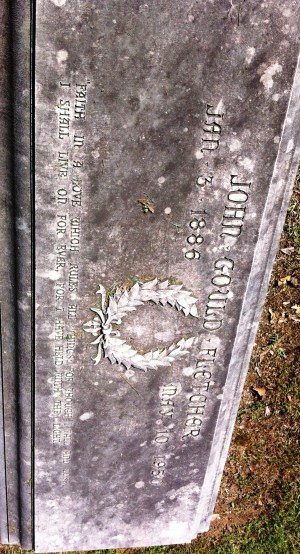
In 1939, John Gould Fletcher became the first Southern poet to win the Pulitzer Prize for Poetry.  He was born into a prominent Little Rock family in 1886.  Fletcher was awarded the prize for his collection Selected Poems which was published by Farrar in 1938.  Two years earlier, he had been commissioned by the Arkansas Gazette to compose an epic poem about the history of Arkansas in conjunction with the state’s centennial.

Fletcher is buried next to his wife, author Charlie May Simon and his parents (his father was former Little Rock Mayor John Gould Fletcher).  Other relatives are buried nearby in the cemetery.

The other Pulitzer Prize winner buried in Mount Holly is J. N. Heiskell, the longtime editor of the Arkansas Gazette.  It was Heiskell, in fact, who asked Fletcher to compose the poem about Arkansas.  Heiskell served as editor of the Gazette from 1902 through 1972.  He died at the age of 100 in 1972.
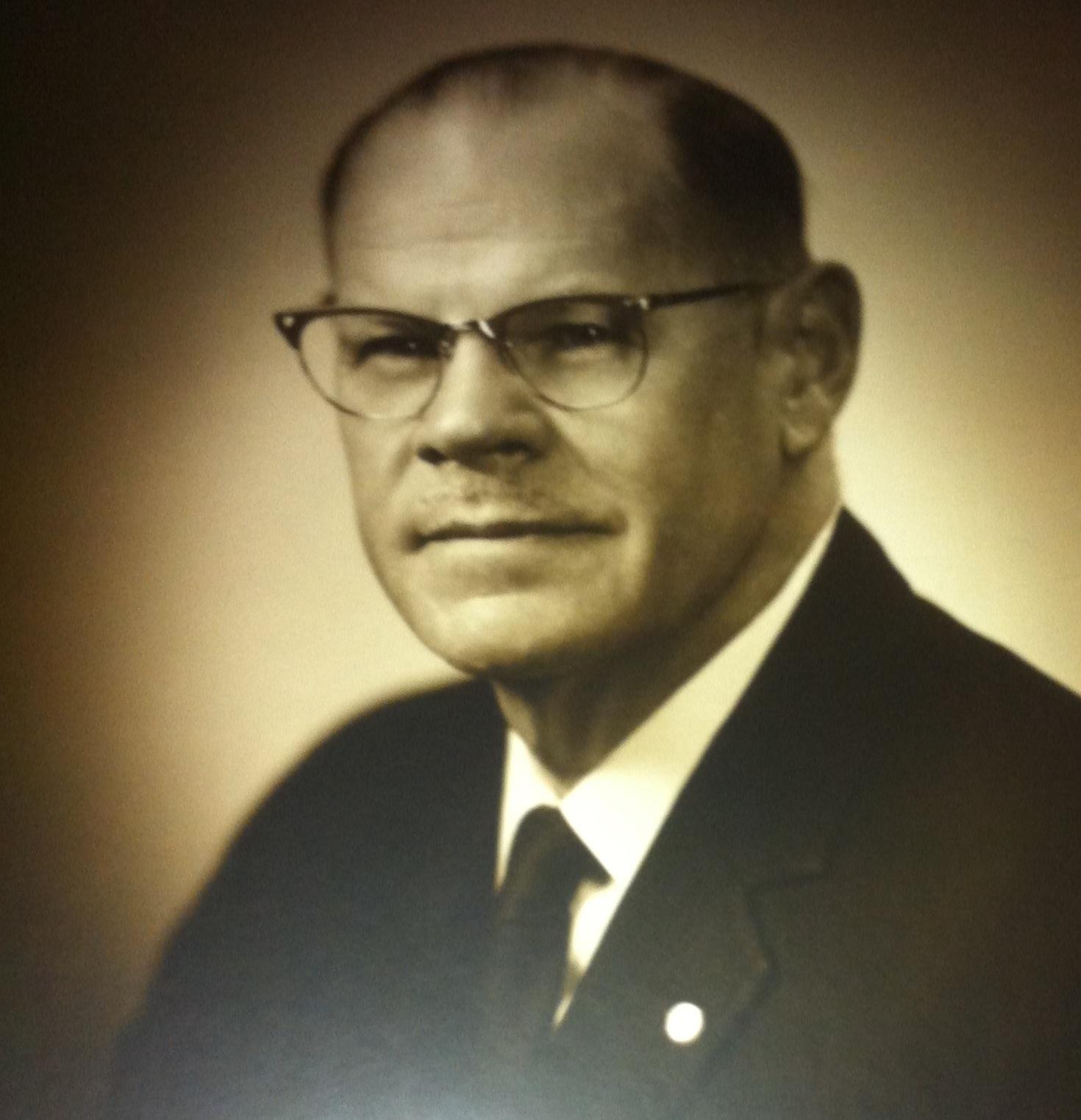
Under his leadership, the Gazette earned two Pulitzer Prizes for its coverage of the 1957 desegregation of Little Rock Central High.  One was for Harry Ashmore’s editorial writing and the other was for Public Service.

Heiskell remained in charge of the Gazette until his death in 1972.  He is buried alongside his wife with other relatives nearby.  Also not too far from Mr. Heiskell are two of his nemeses, proving that death and cemeteries can be the great equalizer. In the early days of his Gazette stewardship, he often locked horns with Senator (and former Governor) Jeff Davis. Later in Mr. Heiskell’s career, he vehemently disagreed with Dr. Dale Alford, who had been elected to Congress on a segregationist platform.

Little Rock Look Back: Werner Knoop

Mayor KnoopTo Little Rock citizens under a certain age, the name Knoop means Knoop Park — a picturesque park tucked away in a pocket of Hillcrest.  There are, however, still many who remember Werner C. Knoop as a business and political leader who helped shape Little Rock as a modern city.

Knoop was born on March 30, 1902.

In 1946, Knoop joined with Olen A. Cates and P. W. Baldwin to form Baldwin Construction Company in Little Rock.  Knoop had previously founded Capital Steel Company and established his business reputation there.  From 1945 through 1951, he served on the Little Rock School Board.

Following a series of political scandals, efforts were undertaken for Little Rock to shift from Mayor-Council to City Manager form of government.  Even before the desegregation of Little Rock Central put the city in the eyes of the world, an election for new leaders had been set for November 1957.  Knoop was on a “Good Government” slate and was one of the members elected.

At the first meeting of the new City Board, Werner C. Knoop was chosen by his fellow directors to serve as Little Rock Mayor.  Knoop served as Mayor until December 1962.  For the first several months in office, Little Rock had no City Manager so Knoop oversaw the transition of City staff as the forms of government changed.

Though City Hall generally stayed out of school district matters, that did not mean that the public viewed the two entities separately.  In September 1959, the Baldwin Construction offices were bombed as part of a series of terrorist activities protesting the desegregated reopening of all Little Rock high schools.

Downtown LR as viewed from Knoop Park

Downtown LR as viewed from Knoop Park

After two terms on the City Board, Knoop decided against seeking a third term.  He concluded his elected public service on December 31, 1962.  Following his time on the City Board, Knoop did not retire from Civic Affairs.  In 1970, he served as Chairman of the Little Rock Chamber of Commerce.   The previous year he served as President of the Arkansas Chapter of Associated General Contractors.

Mayor Knoop died in July 1983.  He is buried at Roselawn Memorial Park next to his wife Faith Yingling Knoop, a renowned author.

In the 1930s, Knoop moved into an Art Moderne house on Ozark Point in Hillcrest.  It was adjacent to Little Rock Waterworks property which was developed around the same time.  Eventually much of the land was deeded to the City for creation of a park.  In 1989, it was named in tribute to long-time neighbor Knoop in honor of his lifetime of service to Little Rock.

Little Rock Women’s History Month – Lucy D. Dixon

Lucy DixonKnown professionally as Mrs. Edgar F. Dixon (in an era when married women were listed publicly by their husband’s names), Lucy D. Dixon was elected to the Little Rock City Board of Directors in November 1957.  Though not noted at the time, her election was historic.  She was the first woman elected to a municipal office in Little Rock who had not first succeeded her husband.  Prior to her service on the City Board, Mrs. Dixon had served on the Little Rock School Board.  She was secretary of that body during the 1957 desegregation crisis.

Lucy Ann Dulin was born in Hensley in 1904.  She moved to Little Rock and graduated from Little Rock High School (then located on Scott Street) and attended the University of Arkansas.  From 1927 until 1935, she worked for her family’s business – Dulin Bauxite Company.  She returned to the company in 1941 and worked there until 1950.  She later served on the company’s board of directors.

Beginning in 1935, she became involved with the PTA and rose to the position of National Secretary in 1949, serving for three years in that position. As a PTA officer, she visited thirty-six of the then forty-eight states.

Among her other leadership positions were executive vice chair of the Governor’s Advisory Committee on Education, trustee of Little Rock Junior College (now UALR), delegate to the White House Conference on Children and Youth, delegate to White House Conference on Education, Pulaski County Welfare Board, and Little Rock Planning Commission.  She was also active in many Methodist organizations.  In 1953, she was the Arkansas Democrat Woman of the Year.

Married to Edgar F. Dixon, she had three children: Philip Edgar, Barbara and Mimi.  She died in January 1996 at age of 91.