Pulitzer Day – a good time to “Prize” Mount Holly Cemetery

The Pulitzer Prizes are to be announced today.  This year marks the 100th anniversary of the prizes, though not all of the current categories have been around since 1917.

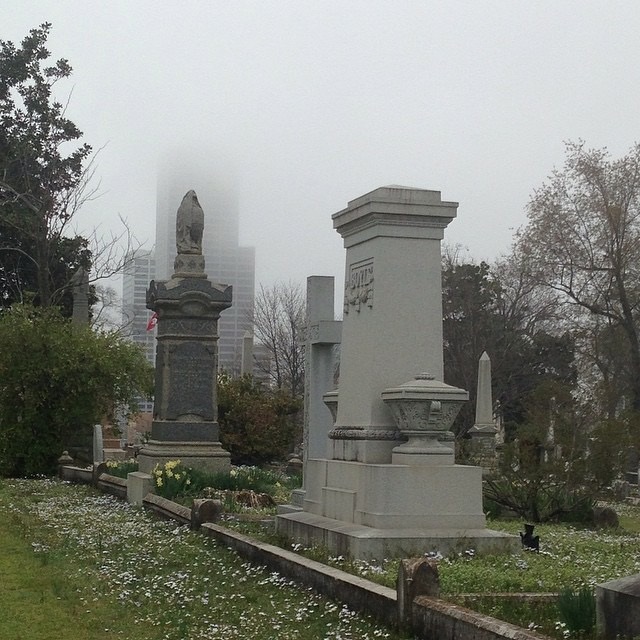
Mount Holly Cemetery not only touts that it is the site of a whole host of elected officials, it is also the only place in Arkansas where two Pulitzer Prize recipients are buried. The cemetery is open every day, but a special visit to these two prize winner gravesites can be made on Sunday, April 30, during the Mount Holly Cemetery Association’s annual “Rest in Perpetuity” fundraiser picnic.

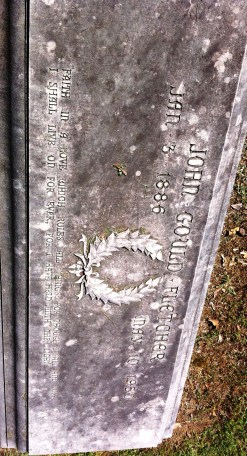
In 1939, John Gould Fletcher became the first Southern poet to win the Pulitzer Prize for Poetry.  He was born into a prominent Little Rock family in 1886.  Fletcher was awarded the prize for his collection Selected Poems which was published by Farrar in 1938.  Two years earlier, he had been commissioned by the Arkansas Gazette to compose an epic poem about the history of Arkansas in conjunction with the state’s centennial.

Fletcher is buried next to his wife, author Charlie May Simon and his parents (his father was former Little Rock Mayor John Gould Fletcher).  Other relatives are buried nearby in the cemetery.

The other Pulitzer Prize winner buried in Mount Holly is J. N. Heiskell, the longtime editor of the Arkansas Gazette.  It was Heiskell, in fact, who asked Fletcher to compose the poem about Arkansas.  Heiskell served as editor of the Gazette from 1902 through 1972.  He died at the age of 100 in 1972.

Under his leadership, the Gazette earned two Pulitzer Prizes for its coverage of the 1957 desegregation of Little Rock Central High.  One was for Harry Ashmore’s editorial writing and the other was for Public Service.

Heiskell remained in charge of the Gazette until his death in 1972.  He is buried alongside his wife with other relatives nearby.  Also not too far from Mr. Heiskell are two of his nemeses, proving that death and cemeteries can be the great equalizer. In the early days of his Gazette stewardship, he often locked horns with Senator (and former Governor) Jeff Davis. Later in Mr. Heiskell’s career, he vehemently disagreed with Dr. Dale Alford, who had been elected to Congress on a segregationist platform.

Remembering the Fallen on Memorial Day at Mount Holly Cemetery

MountHolly Memorial DayToday is Memorial Day – a time to pay tribute to the men and women in uniform who died in service to their country.

As a way to give this recognition, today would be a good day to visit a cemetery. One of Little Rock’s most storied cemeteries is Mount Holly Cemetery. There are numerous persons buried there who died while in service to their country.

One of them is 2Lt Carrick W. Heiskell, son of Arkansas Gazette editor J. N. Heiskell.  2Lt Heiskell died while flying for the Air Transport Command in the Himalayas during World War II.  He was posthumously the recipient of the Distinguished Unit Emblem, Purple Heart, and the Air Medal.

Founded in 1843, Mount Holly has been called “The Westminster Abbey of Arkansas.” Thousands of visitors come each year. Those interested in history come to see the resting places of the territorial citizens of the state, including governors, senators, generals, black artisans, and even a Cherokee princess. For others the cemetery is an open air museum of artistic eras: Classical, Victorian, Art Deco, Modern––expressed in gravestone styles from simple to elaborate. Some come to read the epitaphs that range from heartbreaking to humorous to mysterious.

Though a City of Little Rock facility, the cemetery is maintained by the Mount Holly Cemetery Association, a non-profit organization with a volunteer Board of Directors. The cemetery is located at 1200 South Broadway in Little Rock. Gates are open from 8 a.m. until 5 p.m. in the summer and from 8 a.m. until 4 p.m. in the winter.

Interred within the rock walls of Mount Holly are 11 state governors, 15 state Supreme Court justices, four Confederate generals, seven United States senators and 22 Little Rock mayors, two Pulitzer Prize recipients, as well as doctors, attorneys, prominent families and military heroes.

Prizing Mount Holly Cemetery on Pulitzer Day

The Pulitzer Prizes are to be announced today.  This year marks the 100th announcement of the prizes, though not all of the current categories have been around since 1917.

Mount Holly Cemetery not only touts that it is the site of a whole host of elected officials, it is also the only place in Arkansas where two Pulitzer Prize recipients are buried. The cemetery is open every day, but a special visit to these two prize winner gravesites can be made next Sunday during the Mount Holly Cemetery Association’s annual “Rest in Perpetuity” fundraiser picnic.

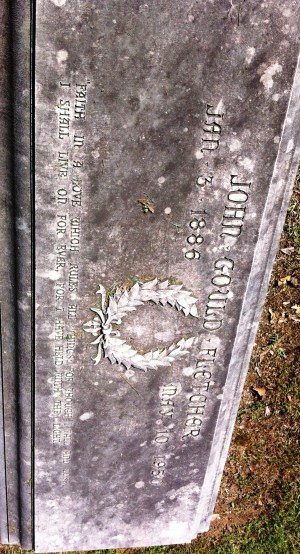
In 1939, John Gould Fletcher became the first Southern poet to win the Pulitzer Prize for Poetry.  He was born into a prominent Little Rock family in 1886.  Fletcher was awarded the prize for his collection Selected Poems which was published by Farrar in 1938.  Two years earlier, he had been commissioned by the Arkansas Gazette to compose an epic poem about the history of Arkansas in conjunction with the state’s centennial.

Fletcher is buried next to his wife, author Charlie May Simon and his parents (his father was former Little Rock Mayor John Gould Fletcher).  Other relatives are buried nearby in the cemetery.

The other Pulitzer Prize winner buried in Mount Holly is J. N. Heiskell, the longtime editor of the Arkansas Gazette.  It was Heiskell, in fact, who asked Fletcher to compose the poem about Arkansas.  Heiskell served as editor of the Gazette from 1902 through 1972.  He died at the age of 100 in 1972.

Under his leadership, the Gazette earned two Pulitzer Prizes for its coverage of the 1957 desegregation of Little Rock Central High.  One was for Harry Ashmore’s editorial writing and the other was for Public Service.

Heiskell remained in charge of the Gazette until his death in 1972.  He is buried alongside his wife with other relatives nearby.  Also not too far from Mr. Heiskell are two of his nemeses, proving that death and cemeteries can be the great equalizer. In the early days of his Gazette stewardship, he often locked horns with Senator (and former Governor) Jeff Davis. Later in Mr. Heiskell’s career, he vehemently disagreed with Dr. Dale Alford, who had been elected to Congress on a segregationist platform.

Little Rock Look Back: Leap Day City Council meetings

CLR Leap Day 1932February 29 may come around only once every four years, but it is even rarer for the City of Little Rock to have City Council or City Board meetings on that date.

The most recent official meeting on a Leap Day was on February 29, 1932.  Mayor Horace A. Knowlton presided with all sixteen Aldermen present.  Among the items discussed were regulating of junk dealers, taxes on slot machines, a building condemnation, and setting a license fee for bowling alleys.

There were several issues related to cemeteries discussed throughout the evening.  One forbade any new burials in a section of Oakland Cemetery while another sought to prohibit the creation of any new cemeteries within the City limits.  The Council also passed a motion instructing the Mayor to notify the State Board of Health that the City was “seriously objecting and would strenuously oppose the establishment of a [new] Cemetery within the present boundaries of the City of Little Rock.”  The final cemetery issue was the acceptance of the annual report of the Mount Holly Cemetery Association.

That night the Council also passed a resolution to name the city government hospital as “Little Rock City Hospital.” The purpose of the name was to “clearly designate said hospital to the citizens of Little Rock as the hospital owned and operated by the City of Little Rock.”

The issue which seems to have taken up most of the time was overriding a Mayoral veto of a resolution opposing the firing of a firefighter.  The motion to sustain the veto ended in a tie. After the Mayor promised to rehire the firefighter as soon as a vacancy occurred, on alderman changed his vote and the veto was sustained.

The only other City Council meeting on a February 29 was in 1892.  Mayor H. L. Fletcher presided over the meeting.  The main focuses of that meeting were to discuss boundaries of various sewer districts, pay the monthly bills, approve the relocation of a house from 9th Street to the corner of 12th Street and Commerce Street and to bring certain City criminal penalties in line with a new state law.

2015 In Memoriam – Mary Fletcher Worthen

In these final days of 2015, we pause to look back at 15 who influenced Little Rock’s cultural scene who left us in 2015.

1515 WorthenMary Fletcher Worthen cultivated history and music with the same grace and skill as she cultivated gardens.

Born outside of Scott, she attended Vassar and Little Rock Junior College. After marrying banker Booker Worthen, she devoted her life to improving Little Rock. Together with Stella Boyle and George Smith, she and Booker helped found the precursor to the Arkansas Symphony Orchestra.  Through its many iterations, she was a steadfast supporter and later was named a life member of the ASO Board.  She was also a supporter of many other music organizations in Little Rock including the Chamber Music Society of Little Rock, of which she was a founder.

Another hallmark of her involvement was Mount Holly Cemetery Association.  For over 50 years she served on the board of this body.  Without notes, she could recite the history of practically every resident buried there.  The tours she led with the late Peg Newton Smith were hot commodities when auctioned at fundraisers.  These two loving and lifelong friends would sometimes remember things differently. They playfully prodded and needled each other as they wended and winded their way through the headstones and history regaling rapt audiences with yarns of yore, quips and quotes, plus an anecdote or two.

She also served on the Old State House Museum Board and the Pulaski County Historical Society Board.  As a historian, she literally wrote the book on Trinity Episcopal Cathedral.  She combined her interest in herb gardening and history with the creation of the Medicinal Garden at Historic Arkansas Museum, which is now named in her honor.

Born in 1917, up until her final days Mary Worthen continued to learn new facts, share her love of history and music, and work to cultivate the next generations of cultural enthusiasts.

Tales of the Crypt tonight at Mount Holly Cemetery

talescryptThe ghosts of Little Rock past will arise tonight at Mt. Holly Cemetery for the 21st Annual Tales of the Crypt.

Held the second Tuesday of October, Tales of the Crypt is an annual Mount Holly event.  Founded by Fred Boosey and Judy Goss, it is now under the direction of Tamara Zinck.  Drama students from Parkview Arts & Science Magnet High School are each given a person buried in the cemetery to research. They then prepare short monologues or dialogues, complete with period costumes, to be performed in front of the researched person’s grave.

Award-winning local costumer Debi Manire will once again provide the wonderful historical characters’ costumes.  Audiences are led through the cemetery from grave to grave by guides with candles. Although it takes place around the same time as the American holiday Halloween, the event is meant to be historic rather than spooky.  Many local teachers award extra credit to students who attend.

Student tour guides will escort groups of approximately 15 from grave site to grave site to learn more about those who shaped central Arkansas in to what it is today.

The Mount Holly residents will greet you are:

  • Dr. Isaac Folsom (Peyton Hooks)
  • Mrs. Sallie Folsom (Rahlea Zinck)
  • David O. Dodd (Cameron Minor)
  • Mary Dodge (Delaney Robertson)
  • Dovenia (Dovie) Kirby (Emily Gardner)
  • Samuel B. Kirby (Brock Tittle)
  • Captain Benjamin Shattuck (Micah Patterson)
  • Anne Warren (Isha Horton)
  • Quatie Ross (Michelle Mora Dominguez)
  • Katherine Eller Henderson (Mikala Hicks)
  • Juliet Neill Peay  (Emorie Mansur)
  • Mary E. Gaines Belding (Abigail Mansur)
  • Albert Stocking (Tre’Vaughn Whitley)
  • Mollie Stocking (Taylar Hasberry)
  • George Borland (Harrison Wyrick)
  • Eleanor Counts (Stephanie Schoonmaker)
  • Edward Payson Washburn (Will Frueauff)
  • Lillian Scott (Sidney Kelly)
  • James Robbins (George Patterson)
  • Maria Rebecca Craigen (Angelique Camper)

(The names of the Parkview students portraying the residents are in parentheses.)

The Twenty-first Annual “Tales of the Crypt” is sponsored by Mount Holly Cemetery Association and Parkview Arts-Science Magnet High School.

The event will be held  at Mount Holly Cemetery, 1200 South Broadway, Little Rock, from 5:30 pm until 8:30 pm.  Admission is free to the public, however donations to Mount Holly Cemetery are appreciated and aid in the maintenance of the cemetery.

Heritage Month – Mount Holly Cemetery

Mount Holly greyMount Holly Cemetery is an area equal to four city blocks of the City of Little Rock.  The main entrance on Broadway is marked by an imposing structure of stone and iron, and the four block square area is enclosed in a stone and iron fence which dates from 1881.

The cemetery has a park-like appearance, generously shaded with tall and stately trees. Many of these trees are so old as to have trunk diameters in excess of 33 inches.  Mount Holly is quaint, imposing, and inspiring. It provides examples of over 170 years of funerary sculptures which range from the simple, traditional, chiseled stones of the middle 19th century to the ornate and grandiose monuments of the 1880-1890 period.  While Mount Holly may be notable for the many dignitaries who reside there, over the years persons of all economic backgrounds and races have been buried there.

After planning for a larger cemetery started in 1839, the first burial took place in 1843.  The land for the cemetery was donated by Chester Ashley and Roswell Beebe, both of whom are buried there.  Veterans of all U.S. wars dating from the War of 1812 are buried in Mount Holly Cemetery.

While today there are no more plots available for burial, there are spots available in the columbarium. A City cemetery, it has been governed by the Mount Holly Cemetery Association since 1915. Later this summer, that organization will celebrate its 100th birthday.

On March 5, 1970, Mount Holly Cemetery was added to the National Register of Historic Places.