
1897 UFO Sightings in Arkansas topic of Old State House Brown Bag Lecture today at noon

On Thursday, October 15, at noon, at the Old State House Museum, Brian Irby of the Arkansas History Commission will tell the story of one of the first waves of UFO hysteria that swept through the nation for a Brown Bag Lunch Lecture.

Between 1896 and 1897, the country was in the grips of what was one of the first major panics created by sightings of strange objects in the sky. Less than a decade before the Wright Brothers would fly the first powered flight, newspapers around the country began reporting on sightings of an airship, spotted in the wild.

In April of that year, the unidentified flying object stories came to Arkansas. In April, railroad conductor Jim Hooton told the Arkansas Gazette that he had seen the airship while hunting and provided a sketch to the paper. Just a few weeks later, mounted deputies near Hot Springs said they “noticed a brilliant light high in the heavens,” and drew their Winchesters on a man they said was traveling in an airship.

Brian Irby has a BA and MA from the University of Central Arkansas. He has been on staff at the Arkansas History Commission since 2008 as an archival assistant where he works on educational programs.

Admission is free, and attendees are welcome to bring a sack lunch. Soft drinks and water are provided.

The Old State House Museum is an agency of the Department of Arkansas Heritage.
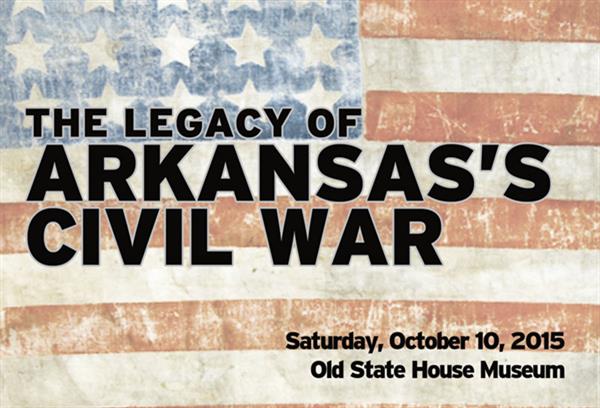
Legacy of Civil War topic of seminar at Old State House today

cw-seminarThe Arkansas Civil War Sesquicentennial Commission and the Old State House Museum are sponsoring a seminar on the legacy of the Civil War on Saturday, October 10.

ACWSC Chairman Tom Dupree described it thus: “As we near the end of the commemoration of the 150th anniversary of the Civil War, we wanted to address the lingering influences of the war,” Dupree said. “Each of our speakers will look at different aspects of the war and how they continue to affect us today.”

Speakers at the “Legacy of Arkansas’s Civil War” will be:

•Dr. Elliott West – University of Arkansas at Fayetteville on “Arkansas: Where One War’s Edge Was Another War’s Center”

•Dr. Carl Moneyhon – University of Arkansas at Little Rock on “Conflicting Civil War Memories and Cultural Divides in Arkansas”

•Dr. Jeannie Whayne – University of Arkansas at Fayetteville on “The Civil War and the Burden of Arkansas History”

•Dr. Cherisse Jones-Branch – Arkansas State University on “’How Free is Free?’: African Americans in Post-Civil War Arkansas”

•Dr. Kelly Houston Jones – Austin Peay University on “Women After the War: Profiles of Change and Continuity”

•Dr. Tom DeBlack – Arkansas Tech University on “’What Is to Become of Us?’: The Postwar Lives of Major Figures in Civil War Arkansas”

For more information on this and other sesquicentennial events, visit http://www.arkansascivilwar150.com/events/.

Sandwich in History today at the White-Baucum House

ahpp White-Baucum HouseThe monthly architectural history program “Sandwiching in History” visits the White-Baucum House, located at 201 South Izard Street. The program begins at noon today.  A historian with the Arkansas Historic Preservation Program delivers a brief lecture about the church before leading guests on a tour.

This Italianate-style house was built in 1869-1870 for Robert J. T. White, then-Arkansas secretary of state, and was enlarged in the mid-1870s by its second owner, businessman George F. Baucum. The White-Baucum House was recently rehabilitated using federal and state tax incentives to serve as office space.

Sandwiching in History is a program of the Arkansas Historic Preservation Program, an agency of the Department of Arkansas Heritage.  The AHPP is responsible for identifying, evaluating, registering and preserving the state’s cultural resources. Other DAH agencies are the Arkansas Arts Council, the Delta Cultural Center in Helena, the Old State House Museum, the Mosaic Templars Cultural Center, the Arkansas Natural Heritage Commission and the Historic Arkansas Museum.

Little Rock Look Back: Roswell Beebe receives Little Rock land title

Map showing boundaries of original City of Little Rock

Map showing boundaries of original City of Little Rock

On September 25, 1839, businessman Roswell Beebe received title to all of the land in Little Rock.

Starting in the 1810s, there had been much dissension as to who had title to land in what would become Little Rock.  As the settlement developed into a town and city, these disagreements became greater. Often land speculators would sell land to settlers without having the right to do so.

Coming to Little Rock in 1835, Beebe was a witness to the continued uncertainty over land ownership.  In early 1839, he acquired 240 acres which had the only incontestable title in town. This acreage comprised most of Little Rock. He went to Washington DC in 1839 and, on September 25, received the original patent for the town of Little Rock, signed by President Martin Van Buren. It is recorded in the Pulaski county recorder’s office Book L, page 312.

Upon his return, Beebe gave all the people who had bought lots from a certain real estate developer, whom he considered to be fair and honest, title to their land for a dollar. In December 1839, he drew up a plan for Little Rock, laying off blocks and streets. He deeded the streets and alleys to the city for a dollar. He gave the state the title for the land on Markham Street, where the new capitol building (now the Old State House Museum) was located.  He also donated part of the land for Mount Holly Cemetery, the other portion came from his brother-in-law Chester Ashley.

Little Rock Look Back: H. L. Fletcher, 35th Mayor of Little Rock

Mayor H L Fletcher

On September 15, 1833, future Little Rock Mayor Henry Lewis Fletcher was born in Saline County.  His parents were Henry Lewis and Mary Lindsey Fletcher.  One of his siblings was future Little Rock Mayor John Gould Fletcher.  The Fletcher brothers are the only set of siblings to serve as Mayors of Little Rock.

Though the life of John Gould Fletcher is fairly well documented, not much information is available on his brother Henry Lewis (and some of what is out there is incorrect).  He married Susan Bricelin August 30, 1855, in Pulaski County.  During the Civil War, he served as a sergeant in the cavalry for the Confederate Army in Captain Ed Nowland’s Company.

As a civic leader, Fletcher oversaw Arkansas’ contribution to the Philadelphia Centennial Exposition in 1876. The building received as a prize a cast-iron fountain. A replica of that stands in front of the Old State House Museum.

Fletcher served as Mayor of Little Rock from 1891 to 1893.  When Fletcher became Mayor he appointed a new Police Chief (as most Mayors did) and the entire police force was dismissed.  A new police force was hired by E. H. Sanders, who served as chief for 18 months.  Upon his resignation, Frank MacMahon (who had been dismissed from the force when Fletcher came to office), was appointed Chief by Mayor Fletcher.  He would serve from 1892 until 1905.

Mayor Fletcher died on June 30, 1896 and is buried at Oakland Cemetery next to his wife (who died in 1911).

Today is last day to purchase tickets for First Ladies event at Old State House

Help save the dresses by participating in the Luncheon on Tuesday, October 6!

The First Ladies’ Gowns exhibit at the Old State House Museum is the largest exhibit of its kind outside the Smithsonian and by far the most popular at the museum. The exhibit features gowns worn by the first ladies alongside items of everyday life in Arkansas from the 1840s to the present.

While the gowns have always been preserved according to the highest professional standards, some deterioration with age is inevitable. The current version of the First Ladies’ Gowns exhibit is housed on the second floor of the museum, in the west wing, in cases specially designed to minimize the deterioration caused by light, dust and humidity.

During a routine survey of artifacts in 2014, the museum’s curator noticed signs of stress on certain gowns. Upon closer inspection it was decided that a textile conservator should evaluate the collection. The museum staff worked closely with conservator Harold Mailand to create a prioritized list of conservation needs for gowns in the exhibit.

“One challenge is to secure funding both to conserve the gowns and to update the exhibit area so that a substantial part of the collection can be kept on view while preserving the gowns for generations of future Arkansans,” said Bill Gatewood, director of the Old State House Museum, a museum of the Department of Arkansas Heritage.

First lady Susan Hutchinson, along with the Old State House Museum Associates board of directors, a nonprofit group established to support the Museum, will host a lunch on the grounds of the Governor’s Mansion on Tuesday, October 6, to raise funds to preserve the gowns.

A seated lunch on the lawn will be followed by a special presentation in the Great Hall. Five of Arkansas’s former first ladies (Ginger Beebe, Janet Huckabee, Betty Tucker, Gay White and Barbara Pryor) have committed to be present for the event and will attend a special reception for table sponsors before the luncheon.


New Deputy Director for Arkansas Heritage announced

DAH Dep DirStacy Hurst, director of the Department of Arkansas Heritage (DAH), announced today that she has named Rebecca Burkes as the new deputy director for DAH. Burkes holds an M.S. in operations management from the University of Arkansas, Fayetteville, and a Juris Doctorate from the Baylor University School of Law.

“I am very happy to bring Rebecca on board to help lead and manage DAH,” said Hurst. “Her skills in managing organizations and people will be a tremendous asset to us. Our seven separate agencies, operating under the larger umbrella of Heritage, will benefit greatly from her skills.”

Burkes most recently was an assistant professor at the University of Wisconsin Law School, Madison. Previous to that, she lived in Northwest Arkansas, where she practiced law in Fayetteville (1993-95), was corporate counsel at Wal-Mart Stores, Inc., in Bentonville (1995-98) and was vice president and chief counsel for the Burkes Company, a diversified real estate development, construction and brokerage company (1998-2011).

The Department of Arkansas Heritage, through its seven agencies, seeks to recognize the state’s heritage and to enhance Arkansas’s quality of life through the discovery, preservation and presentation of the state’s cultural, natural and historic resources. The agencies are Arkansas Arts Council, Arkansas Historic Preservation Program, Arkansas Natural Heritage Commission, Delta Cultural Center, Historic Arkansas Museum, Mosaic Templars Cultural Center and Old State House Museum.