Big Boo!-seum Bash Tonight

BooseumLogo_EventIt’s the 19th Annual Big Boo!-seum Bash, where kids can enjoy a safe and fun Halloween Thursday, Oct. 30 from 6 – 8:30 p.m.  Come out and trick-or-treat, play games and have fun at participating area museums!

There will be free candy and Halloween activities for all ages. Visit every participating location to enter in the drawing for a flat-screen TV or a $100 gift card!

Locations:
* Arkansas Arts Center – 501 East 9th Street

* Historic Arkansas Museum – 200 East 3rd Street

* Little Rock Visitor Center at Curran Hall – 615 East Capitol Avenue
— Arkansas State Capitol will participate on site

* MacArthur Museum of Arkansas Military History – 503 East 9th Street
— Arkansas National Guard Museum will participate on-site

* Mosaic Templars Cultural Center – 9th Street and Broadway
— Little Rock Central High School National Historic Site will participate on-site

* Museum of Discovery – 500 President Clinton Avenue

* Old State House Museum – 300 West Markham Street

* CALS Ron Robinson Theater – 100 River Market Avenue

* Witt Stephens Jr. Central Arkansas Nature Center – 602 President Clinton Avenue
— Arkansas Inland Maritime Museum will participate on-site

LR Cultural Touchstone: Peg Newton Smith

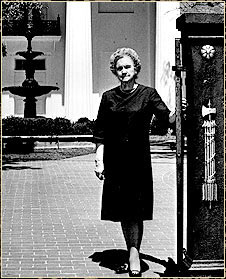
peg_3While the Culture Vulture remains a huge fan of Peg Newton Smith, it is better for this entry to be taken from a tribute written by her longtime friend Bill Worthen.

Peg Newton Smith was a pioneer in the field of history and historic preservation.  A founder of both the Arkansas Museums Association and the Quapaw Quarter Association, Little Rock’s historic preservation organization, she served as a significant resource for many local history researchers and historians.

Born February 10, 1915, Peg Smith came from a family deeply engaged in Arkansas history. Two Arkansas counties – Newton and Hempstead – are named after ancestors.  She married George Rose Smith, himself from a prominent Arkansas family, in 1938. Peg Smith became his most vigorous supporter as George Rose Smith was elected and  reelected to the State Supreme Court, ultimately offering 38 years of service as Associate Justice.

She  enjoyed a sixty-two year career as a volunteer at the Historic Arkansas Museum, where she served as Commission Chair from 1978 to 1983. On the museum’s first day, she was dressed in period garb as a volunteer.  She was named Chair Emerita of the Commission in 2002. Her commitment to history has also included decades of service on the Mount Holly Cemetery Association Board of Directors, where she was famous with Mary Worthen for tours of the cemetery, often hot items at charity auctions.

Because of her instrumental work for the Arkansas Museums Association and the Quapaw Quarter Association, both organizations named significant annual awards after her. She was appointed to the inaugural Review Committee of the State Historic Preservation Program and with architect Edwin Cromwell was the first Arkansan named to the Board of Advisors of the National Trust for Historic Preservation. She was appointed to the Arkansas Bicentennial Commission, was elected president of the Junior League of Little Rock, was a founding member of the Board of the Historic Preservation
Alliance of Arkansas, and was active in the Pulaski County Historical Society.  She also was an early supporter of the MacArthur Museum of Arkansas Military History.

She was honored by many groups, being named 1967 Greater Little Rock Woman of the Year by the Arkansas Democrat, Shield of the Trojan Award winner from the UALR Alumni Association in 1979, Fellow of the Museum of Science and History in 1981, and Candlelight Gala Honoree of the Historic Arkansas Museum in 1994. She became the first recipient of the Lifetime Achievement Award from the Arkansas Museums Association in 2003.

Peg Newton Smith died on July 20, 2003.

Because of her love of Arkansas history and Arkansas art, the Historic Arkansas Museum commissioned the pARTy for Peg sculpture which dances near the north entrance to the museum.  pARTy for Peg is not a portrait of our dear friend—it is a sculpture inspired by her spirit. It had been her brainchild for the museum to have a separate gallery devoted to contemporary Arkansas artists. She also founded the Museum Store, filled with Arkansas crafts.


LR Cultural Touchstone: Cheryl Griffith Nichols

C NicholsCheryl Griffith Nichols is a historian, with an emphasis on historical structures, who has lived and worked in Arkansas since 1978.

She was born and raised in Indiana and graduated from Hanover College in 1974. After working for three years as the executive director of the Bartholomew County Historical Society in Columbus, Indiana, she enrolled in George Washington University in Washington DC, majoring in American studies with a concentration in historic preservation. While living in Washington, she worked for the National Register of Historic Places.

She moved to Little Rock in 1978, where she married attorney Mark Nichols and completed her Masters degree by writing a thesis on the Pulaski Heights community; the thesis was accepted in 1981. Meanwhile, Nichols became acquainted with Charles Witsell (a prominent Little Rock architect and historic preservation advocate) while he was working with F. Hampton Roy (a Little Rock ophthalmologist, historic preservation advocate and Little Rock City Director) to write a book about the history of Little Rock. Nichols did extensive research for the book, which was published in 1984 by August House as How We Lived: Little Rock as an American City.

Nichols then became a free-lance researcher, operating a business in Little Rock which she called History, Inc. This business did research and documentation of historic structures in Arkansas, mostly but not entirely in Pulaski County. Nichols also worked for the Museum of Science and History (now the Museum of Discovery) in Little Rock, served as the Executive Director of the Quapaw Quarter Association from 1984 through 1987 and again from 1991 through 1997, and wrote several books for the Arkansas Historic Preservation Program (Little Rock: Driving Tour of Three Historic Neighborhoods, 1989; MacArthur Park Historic Tours, 1993, Governor’s Mansion Area, 1993; Historically Black Properties in Little Rock’s Dunbar School Neighborhood, 1999, The Arkansas Designs of E. Fay Jones, 1999, Hillcrest: The History and Architectural Heritage of Little Rock’s Streetcar Suburb, 1999, and Construction of the Military Road Between Little Rock, Arkansas, and Fort Gibson, Oklahoma, 2003.)

She has remained active in historic preservation efforts.  She has served on the board of the Historic Preservation Alliance of Arkansas and the National Trust for Historic Preservation.  She also served on a task force to determine the best use of Curran Hall.  Much of her research has been donated to the Arkansas Studies Institute.

LR Cultural Touchstone: Agnes Loewer

Photo from Arkansas History Commission

Photo from Arkansas History Commission

Agnes McDaniel Loewer was a driving force and the first curator of the Old State House Museum.

Born June 26, 1893, in Searcy, she moved to Little Rock with her family in 1900.  After turning 18, she began her business career working for the Underwood Typewriter Company, Mayor Charles Taylor, and the Little Rock YWCA.  In 1919, at age 26, she married Charles F.W. Loewer.

Throughout the years, Agnes McDaniel Loewer was active in numerous civic organizations, devoting her business and organizational skill to a great many causes. She served as secretary, treasurer, and president of various organizations, and filled leadership roles in accomplishing goals and missions. Loewer was a member of the Arkansas Federation of Women’s Clubs, the Business and Professional Women’s City Club, the Women’s Division of the State Fair, the Arkansas Conference of Welfare Legislation, the National Youth Association, the Canteen Corps of the American Red Cross, and the Arkansas Federation of Garden Clubs, among others.
Around 1939 Loewer and Louise Loughborough lobbied daily in the halls of the State Capitol for the preservation of the Old State House. Successful in this endeavor, Loewer was appointed a member of the Arkansas Commemorative Commission of 1947, which was formed that year to oversee the restoration of the Old State House and create a future museum of Arkansas history. She served as secretary to the commission, a position that later evolved into director.
When the restoration was completed, Loewer was hired as the first curator of the Old State House, beginning July 1951.  Utilizing a small paid staff and an army of well-instructed volunteers, she oversaw the museum.  Throughout her curatorship, she promoted the Old State House as a historic shrine and tourist attraction, and continued to battle threats to its preservation.

Her interest in history extended beyond the Old State House, she was a member of the Quapaw Quarter Association, Arkansas State Historical Society, Pulaski County Historical Society, and Arkansas Landmarks.

In March 1972, she retired at age 78, after 21 years as curator.  Among the honors she received were a commendation from the Arkansas Legislative Council in 1971 for her public service; a certificate of appreciation from the Arkansas Parks, Recreation and Travel Commission in 1974; and an award from the National Trust for Historic Preservation in 1974, presented by former first lady Lady Bird Johnson.
Loewer died on September 18, 1975 and is buried in Roselawn Memorial Park.

Mid-Century Modern architecture in Little Rock is on tour today

qqa mcmOn Sunday, October 12, the QQA will host the first-ever tour of mid-century modern architecture in Little Rock. The tour will begin at 1:00 p.m. at the Tower Building, 323 Center Street. Tickets are $15 for QQAmembers, $20 for nonmembers.

Guests will be viewing 10 prime examples of this often overlooked architectural style in the downtown area by trolley, with interior tours of 3 locations. .

Tickets may be purchased by calling (501)375-0076 or clicking here. Space is limited, reserve seats now.

The tour is sponsored by Delta Capital Partnership.

The Quapaw Quarter Association’s mission is to promote the preservation of Little Rock’s architectural heritage through advocacy, marketing and education.

Incorporated in 1968, the QQA grew out of an effort to identify and protect significant historic structures in Little Rock during the urban renewal projects of the early 1960s. Throughout its existence, the QQA has been a driving force behind historic preservation in Greater Little Rock.

Greater Little Rock Preservation Awards presented tonight at Quapaw Quarter annual meeting

QQAThe Quapaw Quarter Association will present the Greater Little Rock Preservation Awards at its 2014 Annual Membership Meeting on Tuesday, October 7 at the Ron Robinson Theater.  This year’s award recipients include the Argenta Branch of the William F. Laman Public Library System, Stone’s Throw Brewing Company, the Clinton Foundation, Donna Thomas and Wright Avenue Neighborhood Association, and J. Chandler and Co.  Rachelle Walsh will receive the Peg Smith Award to recognize her exemplary volunteer work. Carolyn Newbern will be presented with the Jimmy Strawn Award, the QQA’s most prestigious award, presented to someone whose efforts on behalf of the preservation of Greater Little Rock’s architectural heritage are an inspiration to the entire community.  Matt DeCample will serve as emcee of the awards ceremony.

The QQA is also kicking off efforts to raise awareness about mid-century modern architecture in Little Rock, beginning with a special lecture from Dr. Ethel Goodstein-Murphree of the Fay Jones School of Architecture.  Goodstein-Murphree’s lecture, “Rock ‘n’ Roll, Poodle Skirts, and a White I-Beam: The Preservationist’s Guide to Loving the 1950s and its Architecture” will be presented at the meeting.

The meeting will begin at 6:00 p.m. following a 5:30 reception at the Ron Robinson Theater at 100 River Market Avenue in Little Rock.  The QQA’s annual membership meeting is free and open to the public.  Nonmembers may join at the door.

Little Rock Look Back: City Councilman Angelo Marre

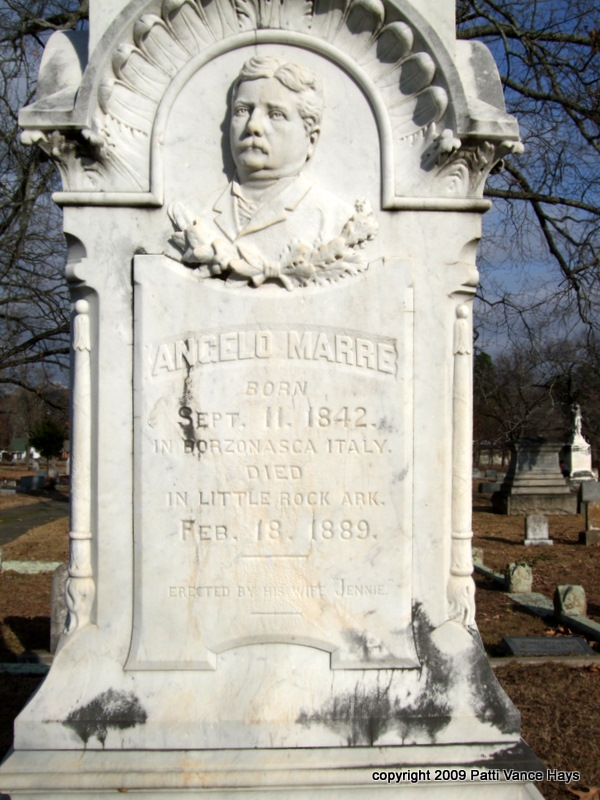
angelomarreOn September 11, 1842, future Little Rock Alderman Angelo Marre was born in Borzonaca, Italy.  He immigrated to Tennessee with his parents in 1854.

During the Civil War, he served in the Confederate Army. From 1865 to 1868, Angelo Marre worked for the Memphis Police Department but was forced to resign after he was accused of killing a man during an argument.  After his acquittal, he returned to the saloon business.  In 1872 Marre was convicted of stealing money and sentenced to three years in prison.

Tennessee Governor John Brown granted Marre a full pardon two years into his sentence, and he regained his citizenship in 1879.

After getting out of prison, he claimed an inheritance and joined his brothers in Little Rock.  He worked as a bartender at the Metropolitan Hotel.  He later opened a saloon and billiard parlor.

By the mid-1880s, Marre owned two saloons, a liquor import business, an office building in downtown LR, 3,000 sharesof stock in mining companies operating in Garland and Montgomery counties, and he was the first president of Edison Electric Company of LR.

In 1883, he was elected as an alderman on the Little Rock City Council.  He lost is bid for reelection in 1885. In 1888, he was an unsuccessful candidate for Pulaski County Sheriff.

villamarreAngelo Marre died February 18, 1889, as a result of his infection.  He is buried at Calvary Cemetery in LR. His custom designed, marble monument was ordered from Florence, Italy, and cost $5,000.

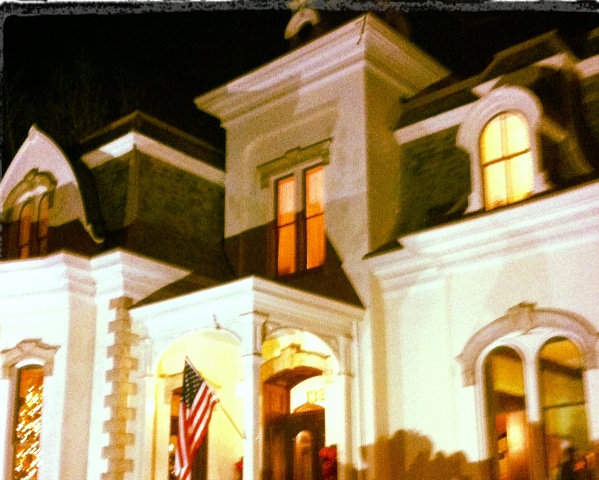
Marre is probably best known today as the builder of the structure now known as the Villa Marre.  Built in 1881, it is designed in the Italianate and Second Empire styles.  It was built in 1881 and 1882 on Block 21, Lots 5 & 6 of the Original City of Little Rock.  The cost was $5,000.

It was originally a red brick structure and has been modified and expanded several times as well as painted white.  It did not bear the name Villa Marre until the 1960s when historic preservation advocate Jimmy Strawn gave it that name.

After serving as the headquarters for the Quapaw Quarter Association for several years, it was returned to a private residence.  It is now available for special events and rentals.

The Villa Marre is probably best known locally and nationally for serving as the facade for the Sugarbaker design firm on the CBS sitcom “Designing Women.”  Though the interior of the house does not match the interior on TV, the building was featured in the opening credits as well as in exterior shots each week.