Little Rock Look Back: City Council approves 1935 auditorium plan

An August 25, 1935, rendering in the ARKANSAS GAZETTE of the proposed Little Rock auditorium at Capitol and Scott Streets.

An August 25, 1935, rendering in the ARKANSAS GAZETTE of the proposed Little Rock auditorium at Capitol and Scott Streets.

On August 26, 1935, the City of Little Rock took its first significant step in a decade for the creation of a City auditorium..  Under the leadership of Mayor R. E. Overman, the City Council approved authorization for the City to apply for $1,000,000 from the Federal Emergency Administration of Public Works (PWA) for the construction of an auditorium.  The PWA had issued a September 16, 1935, deadline for applications to be received as it sought to spend $4.8 billion in construction projects.

The auditorium plan was announced on Saturday, August 24, 1935.  Much preparation had already been undertaken before the project was publicly unveiled.  Private presentations hhad taken place, a team of architects had been chosen (Eugene Stern and the firm of Wittenberg & Delony), and a location had been selected.

The auditorium complex was slated for a block bounded by Capitol, Scott, Fourth and Cumberland Streets.  The Women’s City Club building on that block would remain with the new structure being built to wrap around two sides of the existing structure. The site was chosen because it was one block east of the Main Street business corridor and near existing meeting locations such as the Boys Club, Albert Pike Hotel, Albert Pike Masonic Lodge and several churches.

As planned by the architects, this structure’s front façade would have run the length of the Capitol Avenue side of the block.  The building was proposed to be constructed of concrete, stone and steel.  It would have a large hall with a proscenium stage and seating capacity of 4,000 with overflow of an additional 500.  The adjoining exhibition hall could seat 3,500 people.  The plan called for 150 cars to be parked in the building, and an additional 100 cars to be parked on a surface lot on the site.

Following an August 26 closed door meeting to discuss the project from which members of the public and press were excluded, in open session the City Council voted to pursue the funding for the million dollar auditorium.  If approved by the PWA, the funds would be provided in grants and loans, to be paid by over a 35 year period.

The auditorium proposal was filed with the PWA in Washington in September 1935.  Throughout the next several months, Mayor Overman and the city were engaged in a series of conversations and negotiations with the PWA for the expansion of both the water system and the sewer system. This diverted attention from pursuing the auditorium immediately.  This specific auditorium project stalled.  But because the plan had been filed by the September 16 deadline, it allowed the City to make use of PWA funds a few years later which would lead to the construction of Robinson Auditorium.
 

Happy Birthday Maureen O’Hara – In 1940 she set off a stampede of fans at Robinson Center

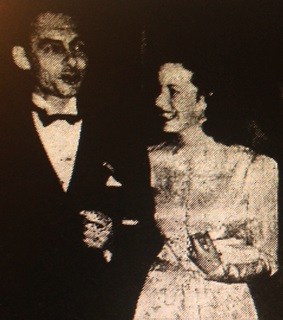
Mayor J V Satterfield escorting actress Maureen O'Hara at the Movie Ball (photo from Arkansas Democrat)

Mayor J V Satterfield escorting actress Maureen O’Hara at the Movie Ball (photo from Arkansas Democrat)

Oscar winner Maureen O’Hara turns 95 today.  With her elegance and beauty, she still turns heads. Seventy-five years ago, in February 1940, a nineteen year old Miss O’Hara turned many heads and set off a frenzy of autograph seekers when she came to Little Rock to attend a series of events.

In conjunction with a meeting of film executives and movie theatre owners sponsored by Robb and Rowley Theaters (which later became the United Artists theatre chain), several Hollywood actors were in Little Rock and headlined a Movie Ball. While in Little Rock, Maureen O’Hara, Phyllis Brooks, Arleen Whelan, Tim Holt and Gene Autry had also made a variety of public appearances.

On the evening of February 1, 1940, Robb and Rowley hosted the Movie Ball in the lower level of Robinson Auditorium. So many of the attendees crowded around for autographs that the evening’s grand march could not take place (a newspaper headline in the Democrat innocently used the word “orgy” to describe the crowd). After two attempts, Little Rock Mayor J. V. Satterfield (who was escorting Miss O’Hara) and the other members of the Little Rock host delegation led the Hollywood stars to their reserved table. For quite a while that evening, the table was besieged by autograph seekers.

Though it is unknown as to whether he sought an autograph, photos from the evening showed a very satisfied Mayor Satterfield with Miss O’Hara on his arm. Satterfield family lore joked that Mrs. Satterfield (who had stayed home that night to tend to a sick son) was not a fan of Miss O’Hara’s films after that evening.

The Movie Ball showed Little Rock citizens the value of Robinson Auditorium even before it had been officially dedicated. The film industry meetings had taken place at the Albert Pike Hotel which did not feature a ballroom large enough to host the ball. Without the auditorium’s availability for the gala, organizers might not have chosen Little Rock for the meeting.

Little Rock Look Back: Judge Eisele rules HAIR must flow at Robinson Auditorium

Ad for the original production of HAIR in Little Rock. Note the ticket prices. And that they could be purchased at Moses Music Shops.

Ad for the original production of HAIR in Little Rock. 

Forty-four years ago today, on August 11, 1971, Nixon appointee Federal Judge G. Thomas Eisele ruled that the musical Hair must be allowed to play in Little Rock in 1972 at Robinson Auditorium.

In February 1971, a young Little Rock attorney named Phil Kaplan petitioned the Little Rock Board of Censors to see if it would allow a production of Hair to play in the city. He was asking on behalf of a client who was interested in bringing a national tour to Arkansas’ capital city. The show, which had opened on Broadway to great acclaim in April 1968 after an Off Broadway run in 1967, was known for containing a nude scene as well for a script which was fairly liberally sprinkled with four-letter words. The Censors stated they could not offer an opinion without having seen a production.

By July 1971, Kaplan and his client (who by then had been identified as local promoter Jim Porter and his company Southwest Productions) were seeking permission for a January 1972 booking of Hair from the City’s Auditorium Commission which was charged with overseeing operations at Robinson Auditorium. At its July meeting, the Commissioners voted against allowing Hair because of its “brief nude scene” and “bawdy language.”

Kaplan decried the decision. He stated that the body couldn’t “sit in censorship of legitimate theatrical productions.” He noted courts had held that Hair could be produced and that the Auditorium Commission, as an agent for the State, “clearly can’t exercise prior censorship.” He proffered that if the production was obscene it would be a matter for law enforcement not the Auditorium Commission.

The Commission countered that they had an opinion from City Attorney Joseph Kemp stating they had the authority. One of the Commissioners, Mrs. Grady Miller (sister-in-law of the building’s eponym, the late Senator Robinson, she had served on the Commission since 1940), expressed her concern that allowing Hair would open the door to other productions such as Oh! Calcutta!

On July 26, 1971, Southwest Productions filed suit against the Auditorium Commission. Four days later there was a hearing before federal Judge G. Thomas Eisele. At that hearing, Auditorium Commission member Lee Rogers read aloud excerpts from the script he found objectionable. Under questioning from Kaplan, a recent touring production of Neil Simon’s Plaza Suite was discussed. That play has adultery as a central theme of one of its acts. Rogers admitted he found the play funny, and that since the adultery did not take place on stage, he did not object to it. Among those testifying in favor of it was Robert Reddington, who was director of performing arts at the Arkansas Arts Center.

Judge Eisele offered a ruling on August 11 which compelled the Auditorium Commission to allow Hair to be performed. Prior to the ruling, some of the Auditorium Commissioners had publicly stated that if they had to allow Hair, they would close it after the first performance on the grounds of obscenity. To combat this, Judge Eisele stated that the Commission had to allow Hair to perform the entire six day engagement it sought.

Upon hearing of the Judge’s ruling, Commissioner Miller offered a succinct, two word response. “Oh, Dear!”

On January 18, 1972, Hair played the first of its 8 performances over 6 days at Robinson Auditorium.  In his review the next day, the Arkansas Gazette’s Bill Lewis noted that Hair “threw out all it had to offer” and that Little Rock had survived.

Little Rock was by no means unique in trying to stop productions of Hair.  St. Louis, Birmingham, Los Angeles, Tallahassee, Boston, Atlanta, Charlotte NC, West Palm Beach, Oklahoma City, Mobile and Chattanooga all tried unsuccessfully to stop performances in their public auditoriums.  Despite Judge Eisele’s ruling against the City of Little Rock, members of the Fort Smith City Council also tried to stop a production later in 1972 in that city. This was despite warnings from City staff that there was not legal standing.

Little Rock Look Back: Louis Armstrong

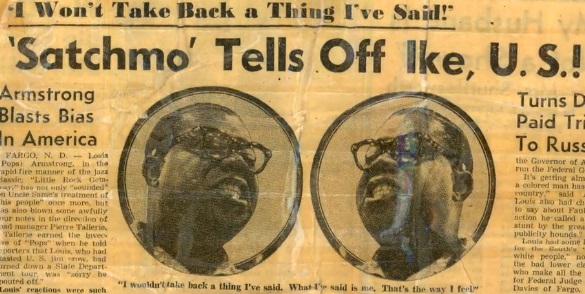
SatchmoLouis Armstrong was born on August 4, 1901 in New Orleans.  As he rose to fame, he would play Little Rock numerous times in a variety of venues.

As the Civil Rights movement started taking hold in the mid-1950s, many African American entertainers were vocal in their support.  Armstrong stayed silent.  Until, that is, September 17, 1957.  That night, in Grand Forks, North Dakota, he blasted President Dwight Eisenhower for his lack of action to make Governor Orval Faubus obey the law.  This was in an interview conducted by a 21 year old University of North Dakota journalism student named Larry Lubenow.

Journalist David Margolick wrote about the incident in The New York Times in September 2007 in conjunction with the 50th anniversary of the integration of Little Rock Central High School.  He recounted how the story, written for the Grand Forks Herald, was picked up all over the country.  The entire Margolick piece can be read here.  Margolick tells that when Armstrong was given the chance to back off the comments, he asserted that he meant all of it.

On September 24, 1957, the night that the 101st Airborne was being mobilized to come into Little Rock, Armstrong sent Eisenhower a telegram again criticizing him for lack of action.  He used colorful language which sarcastically spoofed the “Uncle Tom” moniker which some of his critics had bestowed when they felt he was not doing enough for Civil Rights.  The Eisenhower Presidential Library has a copy of that telegram.  The incident between Satchmo and Ike was the basis for two different plays: Terry Teachout’s Satchmo at the Waldorf and Ishmael Reed’s The C Above C Above High C.

Armstrong would again play a part in Little Rock’s Civil Rights history.  In September 1966, he played the first major concert in Robinson Auditorium that was before a fully integrated audience.  Since the early 1960s, there had been a few sporadic concerts which had been before integrated audiences. But the policy of the Auditorium Commission remained that the building was to be segregated.  Following the approval of the 1964 Civil Rights Act, public facilities had to be integrated. Louis Armstrong played before a full house at Robinson Auditorium that night.

Learn about Little Rock’s earliest auditorium (which also was a roller rink AND rifle range) today at noon at Old State House Museum Brown Bag Lecture

11805726_10154024863604908_1192217255_nToday at noon, the Old State House Museum will have another Brown Bag Lecture.  This one focuses on three decades of unsuccessful efforts to build a municipal auditorium in Little Rock.  That time period was filled with big dreams, lawsuits, personality clashes, disappointments, and a Roller Rink that was also a Rifle Range.

In April 1904, Little Rock Mayor W. E. Lenon spoke of the need for a municipal auditorium in Little Rock. It would take thirty-six years for that dream to be realized. Along the way there were numerous twists, turns, detours and disappointments as the saga was played out in the newspapers, courtrooms, and offices of every major Little Rock architect at the time.

Until a permanent auditorium could be found, the City made do with vaudeville houses, high schools, and even a roller skating rink which doubled as a rifle range. Over the three decades of planning for an auditorium, some names came and went, others such as Mayor Lenon, architect Charles L. Thompson and Arkansas Gazette publisher J. N. Heiskell appeared time and time again. This Brown Bag Lunch Lecture explores the time period from 1904 to 1934 as it looks at the numerous unsuccessful attempts to construct a municipal auditorium in Little Rock.

In 2016, there will be a Brown Bag Lecture to look at construction and opening of Robinson Center Music Hall.

Scott Whiteley Carter is Special Projects Administrator for the City of Little Rock. As the unofficial historian of Little Rock City Hall, he can often be found leafing through sheaves of papers in the City Clerk’s vault or furiously scribbling notes in Little Rock research libraries. He is also the author of the LRCultureVulture.comblog. A native of Little Rock, he is a graduate of Missouri State University.

Robinson Renovation Tops Out

LRCV 1The Little Rock Convention & Visitors Bureau (LRCVB), members of the Little Rock Advertising and Promotion Commission (LRA&P), local officials, and members of the design and construction teams hosted a topping out ceremony July 1, 2015 at 10:00 AM for the Robinson Center’s new conference facility, signifying a one–‐year milestone in the 28–‐month, $70 million renovation and expansion project.

Following a press conference and ceremonial beam signing held on the western side of the Robinson Center, local media and special guests were given tours of the magnificent ballroom platform and conference center located on Robinson’s north side. This new addition not only provides some of the most dramatic enhancements of the project, but will also provide groups with spectacular views of the Arkansas River and the city’s illuminated bridges.

Along with additional meeting and pre–‐function space situated above its ballroom, the new conference center will also provide a new connection to the DoubleTree Hotel, with an adjoining lobby and additional pre–‐function space.

LRCV 5For more information on the Robinson Center Second Act renovation and expansion project, visit http://www.RobinsonCenterSecondAct.com and follow us on https://www.facebook.com/pages/Robinson–‐ Center/276515585880 and https://twitter.com/RobinsonCenter .

Robinson Construction Facts to Date:

  • Nearly 10,000 tons of material have been recycled, representing 91% of the waste material diverted 1,216 tons of steel has been erected
  • 2,300 cubic yards of concrete has been placed
  • 470 individuals have gone through CDI/Hunt Safety Orientation
  • 73% of the project subcontractors are local
  • 130,000 man hours have been spent.

LRCV 6LRCV 4LRCV 7

Little Rock Look Back: Truman visits LR

HST in LR2On June 10 and 11, 1949, President Harry S. Truman visited Little Rock.  He was here to participate in activities connected to the reunion of the 35th Division Association.  He had served in that division during World War I.

While he was in Little Rock, President Truman spoke several times.  He generally was accompanied by Governor Sid McMath and Mayor Sam Wassell.

On June 10, he spoke at Robinson Auditorium as part of a welcome ceremony, at a reception at the Hotel Marion and at a ball held at Robinson Auditorium.  His first address was at 3:48 pm and his final one was at 10:15 pm.  The next day he spoke at a breakfast and at a luncheon at the Hotel Marion.  He took pains at these times to stress he was here as a member of the 35th Division.  He also participated in a parade.

In his Presidential role, he spoke at the dedication of War Memorial Park on June 11.  His address took place inside War Memorial Stadium, which had been opened a few months earlier.  It was not a brief dedicatory speech, but instead was a lengthy treatise on foreign affairs.  The address was carried on nationwide radio.  The text of his address can be found here.

President Truman would return to Little Rock in July 1952.  He was in the state to speak at the dedication of Bull Shoals Dam. He did not make any formal remarks in Little Rock while in the city for that visit.