
Black History Month Spotlight – Freedom Riders and Sit-In Demonstrators

UALR Trail Sit inThe new Arkansas Civil Rights History Audio Tour was launched in November 2015. Produced by the City of Little Rock and the University of Arkansas at Little Rock allows the many places and stories of the City’s Civil Rights history to come to life an interactive tour.  This month, during Black History Month, the Culture Vulture looks at some of the stops on this tour which focus on African American history.

The Arkansas Civil Rights Heritage Trail was launched in 2011 by the UALR’s Institute on Race and Ethnicity.  Each year, a theme is chosen to honor a particular group of people who were active in Arkansas’s civil rights movement.  Year by year, the trail grows.  The plan is that over time the trail will stretch from the current starting point at the Old State House, down West Markham Street and President Clinton Avenue to the Clinton Presidential Library and Museum, and then back up the other side of the street to opposite the Old State House.

Freedom Riders and Sit-In Demonstrators

In 1961, the Freedom Rides spread across the South to place pressure on local communities and the federal government to implement court-ordered desegregation of bus terminal facilities.  Little Rock’s first Freedom Riders, a contingent of five members of the St. Louis branch of the Congress of Racial Equality, arrived on the evening of July 10 at the Mid-West Trailways bus station at Markham and Louisiana.  A plaque there marks the site and tells the story of the Little Rock Freedom Rides.  The pressure exerted by the Freedom Rides, together with an Interstate Commerce Commission order to desegregate, led to the integration of all Little Rock’s bus terminals on November 1, 1961.  Five markers also commemorate Philander Smith College students involved in sit-in demonstrations between 1960 and 1962, as well as members of the Arkansas Student Non-violent Coordinating Committee.  SNCC was active in Arkansas from 1962 to 1967.

The app, funded by a generous grant from the Arkansas Humanities Council, was a collaboration among UALR’s Institute on Race and Ethnicity, the City of Little Rock, the Mayor’s Tourism Commission, and KUAR, UALR’s public radio station, with assistance from the Little Rock Convention and Visitors Bureau.

Black History Month Spotlight – Pike-Fletcher-Terry Mansion

IMG_5151The new Arkansas Civil Rights History Audio Tour was launched in November 2015. Produced by the City of Little Rock and the University of Arkansas at Little Rock allows the many places and stories of the City’s Civil Rights history to come to life an interactive tour.  This month, during Black History Month, the Culture Vulture looks at some of the stops on this tour which focus on African American history.

In 1958, in this stately antebellum home, seventy-six-year-old Adolphine Fletcher Terry helped to organize the Women’s Emergency Committee to Open Our Schools (WEC). Always involved in civic activities, she was dismayed that the four high schools in Little Rock remained closed rather than become integrated. Mrs. Terry told Arkansas Gazette editor Harry Ashmore that “It’s clear to me that the men are not going to take the lead in turning this thing around and so the women are going to have to.” She organized the Women’s Emergency Committee (WEC).

When segregationist school board members tried to fire forty-four teachers and administrators who supported integration in the public schools, the WEC worked with a group of businessmen who had organized a Stop This Outrageous Purge (STOP) campaign to elect new school board members who favored integration. High schools were reopened with token integration in August 1959. The WEC operated in secret because of concerns about harassment or worse. In 1998, on the fortieth anniversary of its founding, the names of WEC members were released for the first time. Those names are now etched in the window panes of the house.

Originally built in approximately 1840 by Albert Pike, it was purchased by Lou Krause from the Pike family in 1886. In 1889, she sold it to her brother-in-law, former Little Rock Mayor John Gould Fletcher. He was the father of Adolphine Fletcher Terry, who grew up in the house.  Since the 1970s, it has been property of the City of Little Rock for use by the Arkansas Arts Center.  This was stipulated in the wills of Mrs. Terry and her sister Mary Fletcher Drennan.

The app, funded by a generous grant from the Arkansas Humanities Council, was a collaboration among UALR’s Institute on Race and Ethnicity, the City of Little Rock, the Mayor’s Tourism Commission, and KUAR, UALR’s public radio station, with assistance from the Little Rock Convention and Visitors Bureau.
 

Black History Month Spotlight – TESTAMENT sculpture on State Capitol grounds

Testament 006The new Arkansas Civil Rights History Audio Tour was launched in November 2015. Produced by the City of Little Rock and the University of Arkansas at Little Rock allows the many places and stories of the City’s Civil Rights history to come to life an interactive tour.  This month, during Black History Month, the Culture Vulture looks at some of the stops on this tour which focus on African American history.

In 1957, nine African-American students enrolled at Little Rock’s Central High School, beginning the process of desegregating Little Rock’s public schools and marking a seminal event in America’s civil rights movement. This sculptural grouping was dedicated in August 2005 to honor the courage of those students, known collectively as the Little Rock Nine. Quotations from each of the Nine are featured around the bronze figures, which are the work of artists John and Cathy Deering.

The site for the statues was selected to face the end of the building which contains the Arkansas Governor’s Office.  It was from those windows that then-Governor Orval Faubus would have looked as he was making decisions to deny the Little Rock Nine entry into Little Rock Central. It is out those windows now that any governor since 2005 looks to see the statues.

The app, funded by a generous grant from the Arkansas Humanities Council, was a collaboration among UALR’s Institute on Race and Ethnicity, the City of Little Rock, the Mayor’s Tourism Commission, and KUAR, UALR’s public radio station, with assistance from the Little Rock Convention and Visitors Bureau.
Black History Month Spotlight – Arkansas State Capitol

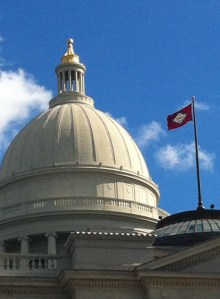
Arkansas birthdayThe new Arkansas Civil Rights History Audio Tour was launched in November 2015. Produced by the City of Little Rock and the University of Arkansas at Little Rock allows the many places and stories of the City’s Civil Rights history to come to life an interactive tour.  This month, during Black History Month, the Culture Vulture looks at some of the stops on this tour which focus on African American history.

The Arkansas state capitol has been the site of a number of civil rights events over the years. In 1964, Ozell Sutton, a local African American leader, was denied service at the capitol’s basement cafeteria because of his race. The cafeteria then reincorporated as a private members-only club to avoid integration. A number of conflicts occurred when local black students from Philander Smith College and an interracial group of Arkansas Student Nonviolent Coordinating Committee members tried, on several occasions, to desegregate the cafeteria. In 1965, the courts finally ordered the cafeteria to open its doors to blacks and whites on an equal basis.

In 1968, after the assassination of Martin Luther King, Jr., Arkansas governor Winthrop Rockefeller held a memorial service on the capitol steps for the slain civil rights leader—the only southern governor to make such a gesture of reconciliation. His actions are credited with limiting the impact of the violence that rocked other cities in the wake of the King assassination. In 2005, John and Cathy Deering’s “Testament” bronze sculpture of the Little Rock Nine was dedicated on the north side of the building. It was the first civil rights monument erected on the grounds of a southern state capitol.

The app, funded by a generous grant from the Arkansas Humanities Council, was a collaboration among UALR’s Institute on Race and Ethnicity, the City of Little Rock, the Mayor’s Tourism Commission, and KUAR, UALR’s public radio station, with assistance from the Little Rock Convention and Visitors Bureau.
Black History Month Spotlight – Arkansas Studies Institute

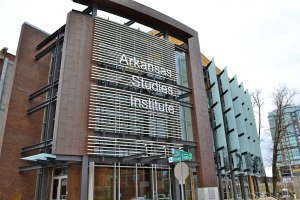
ASI CALS UALRThe new Arkansas Civil Rights History Audio Tour was launched in November 2015. Produced by the City of Little Rock and the University of Arkansas at Little Rock allows the many places and stories of the City’s Civil Rights history to come to life an interactive tour.  This month, during Black History Month, the Culture Vulture looks at some of the stops on this tour which focus on African American history.

The Arkansas Studies Institute building is a Central Arkansas Library System (CALS) facility. It houses both the Butler Center for Arkansas Studies (a CALS department) and the Center for Arkansas History and Culture, a department of the University of Arkansas at Little Rock (UALR).

Exterior and interior panels are featured showing Arkansas African American life through historic photographs. Both archives offer genealogy and photography collections, and visual, audio and reference materials relating to African American history and civil rights topics in Arkansas. The Encyclopedia of Arkansas History and Culture, a Butler Center project, has many entries on African American history.

The Arkansas Sounds music collection contains materials relating to black musicians William Grant Still, Florence Price, Louis Jordan, Sister Rosetta Tharpe, and Al Bell. The Butler Center’s galleries feature local art, jewelry and crafts, many by Arkansas black artists.

The UALR Center for Arkansas History and Culture contains extensive archives, including virtual exhibits relating to the Civil War, Gov. Winthrop Rockefeller, and the city of Little Rock. Adding another dimension to the struggle for civil rights are documents and art from the World War II Japanese American Relocation Camps at Rohwer and Jerome, Arkansas, and two large Jewish history collections.

The app, funded by a generous grant from the Arkansas Humanities Council, was a collaboration among UALR’s Institute on Race and Ethnicity, the City of Little Rock, the Mayor’s Tourism Commission, and KUAR, UALR’s public radio station, with assistance from the Little Rock Convention and Visitors Bureau.

Black History Month Spotlight – Old State House Museum

OSH logoThe new Arkansas Civil Rights History Audio Tour was launched in November 2015. Produced by the City of Little Rock and the University of Arkansas at Little Rock allows the many places and stories of the City’s Civil Rights history to come to life an interactive tour.  This month, during Black History Month, the Culture Vulture looks at some of the stops on this tour which focus on African American history.

The 1836 Old State House, the oldest standing state capitol building west of the Mississippi River, was a center of political activity for many years. During the Civil War, Union and Confederate forces alternately occupied it. During Reconstruction, with many black men registering to vote, eight African Americans were delegates to the 1868 Constitutional Convention, held in this building.

The new constitution recognized the equality of all persons before the law, provided suffrage for freedmen, and required a system of free public education for blacks and whites (in separate schools.) By 1874, twenty black men were serving in the Arkansas General Assembly. In 1891, African American Senator George W. Bell and Representative John Grey Lucas gave inspiring speeches against the Separate Coach Law.

Now a museum, the Old State House exhibits include ones relating to African American history. “On the Stump: Arkansas Political History“ explains civil rights issues from statehood (1836) into the twentieth century. Its collections, which are searchable on-line, include quilts by black Arkansans, photographs by African American photographer Geleve Grice, and music by Louis Jordan. Portions of the Arkansas Slave Narratives, collected by the Works Progress Administration in the 1940s, are available on the web-site.

The app, funded by a generous grant from the Arkansas Humanities Council, was a collaboration among UALR’s Institute on Race and Ethnicity, the City of Little Rock, the Mayor’s Tourism Commission, and KUAR, UALR’s public radio station, with assistance from the Little Rock Convention and Visitors Bureau.

Black History Month Spotlight – Historic Arkansas Museum

hamlogoThe new Arkansas Civil Rights History Audio Tour was launched in November 2015. Produced by the City of Little Rock and the University of Arkansas at Little Rock allows the many places and stories of the City’s Civil Rights history to come to life an interactive tour.  This month, during Black History Month, the Culture Vulture looks at some of the stops on this tour which focus on African American history.

The Historic Arkansas Museum interprets early Arkansas history through Little Rock’s oldest buildings, a medicinal herb garden, and modern exhibits. “Giving Voice” is a permanent memorial to the 138 men, women and children enslaved by Nineteenth Century landowners where the museum now stands. An African American character representing the mid-1800s is regularly included in the living history presentations.

Changing exhibits in the museum’s seven galleries often include ones related to African American history and local artists with African American heritage. On-line exhibits and educational materials relate to this history. “We Walk in Two Worlds,” a permanent exhibit, tells the story of the Caddo, Osage, and Quapaw tribes who first lived in Arkansas. The Native American voice shapes the exhibit, which includes pottery, clothing, and weapons.

The app, funded by a generous grant from the Arkansas Humanities Council, was a collaboration among UALR’s Institute on Race and Ethnicity, the City of Little Rock, the Mayor’s Tourism Commission, and KUAR, UALR’s public radio station, with assistance from the Little Rock Convention and Visitors Bureau.