April 15 Architeaser

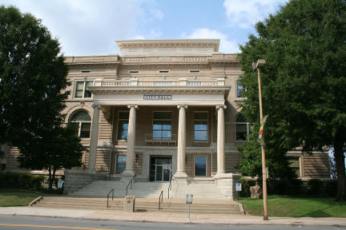
IMG_4853This week’s Architeasers will examine elements of Little Rock City Hall, which officially opened to the public on April 15, 1908.  Today’s features the front doors and wrought iron mini-balcony off the second floor.  These are covered by the portico which extends from the third floor facade.

It is doubtful the wrought iron balcony ever functioned as a place for people to stand. It is not a heavy structure and is secured very simply.  In addition, to reach it, one would have to climb over the 2nd story windows and crawl out onto it.  It appears to have always been for decorative purposes.

The glass doors are not original to City Hall.  They were installed as late as the 1980s renovation.  There also was once a porchlight which hung in the area.  The ceramic tile is original as is the masonry.

The architect for City Hall was Charles L. Thompson.  The building was championed by Mayor W. E. Lenon.  He served as Mayor from 1903 to 1908.  At the first meeting in the new building, he resigned because his work was needing his full attention.  At the time the position of Mayor was part-time.

Pulitzer Day at Mount Holly

The Pulitzer Prizes are to be announced today.  Though Mt. Holly Cemetery touts that it is the site of a whole host of elected officials, it is also the only place in Arkansas where two Pulitzer Prize recipients are buried.

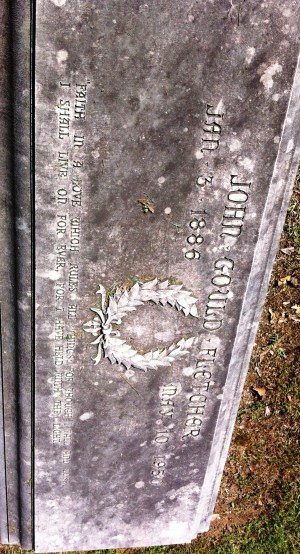
In 1939, John Gould Fletcher became the first Southern poet to win the Pulitzer Prize for Poetry.  He was born into a prominent Little Rock family in 1886.  Fletcher was awarded the prize for his collection Selected Poems which was published by Farrar in 1938.  Two years earlier, he had been commissioned by the Arkansas Gazette to compose an epic poem about the history of Arkansas in conjunction with the state’s centennial.

Fletcher is buried next to his wife, author Charlie May Simon and his parents.  Other relatives are buried nearby in the cemetery.

The other Pulitzer Prize winner buried in Mt. Holly is J. N. Heiskell, the longtime editor of theArkansas Gazette.  It was Heiskell, in fact, who asked Fletcher to compose the poem about Arkansas.  Heiskell served as editor of the Gazette from 1902 through 1972.  He died at the age of 100 in 1972.

Under his leadership, the Gazette earned two Pulitzer Prizes for its coverage of the 1957 desegregation of Little Rock Central High.  One was for Harry Ashmore’s editorial writing and the other was for Public Service.

Heiskell remained in charge of the Gazette until his death in 1972.  He is buried alongside his wife.


Little Rock Look Back: City Hall turns 105

CityHa78105 years ago today, Little Rock City Hall officially opened at the corner of Markham and Broadway.

On April 15, 1908, the Italian Renaissance Revival style building, which had been designed by local architect Charles Thompson, played host to an open house. Staff had started moving into the building in March of that year.   This was, as often is the case, behind schedule.  The date in the cornice toward the top of the building is 1907, but the building was not completed until 1908.

In 1903, W. E. Lenon became Mayor of Little Rock. Back then, the terms were two-year terms.  By the start of his second term in 1905, he realized that the City was outgrowing City Hall, which was, at the time, on the northeast corner of Markham and Louisiana – where part of the Statehouse Convention Center sits today.

In February 1906, Mayor Lenon appointed a committee of five aldermen to over see the planning for the building of a new City Hall. In July 1906, the City Council approved plans, which called for a City Hall with an municipal auditorium wing. There was some hue and cry about wasteful spending, so, in September 1906, those plans were scrapped and a simpler City Hall was approved for the cost of $175,000.

The last resolution in the old City Hall called for the banning of smoking in the new Council Chambers – while the Council was in session. This may well have been the first smoking ban in a public government building in the history of Arkansas.

When the building opened, the third floor was not finished out. The space was not needed. When the Museum of Natural History and Antiquities (now the Museum of Discovery) moved into City Hall in 1929, they had to finish out their space.

In 1913, the new Central Fire Station, designed in the Beaux Arts style, was constructed adjacent to City Hall. During the 1930s, as the City grew, more space was needed. A garage, designed in the “austere, utilitarian” style was built in 1936 and a City Jail Annex, built by the WPA in the modified Art Deco style was built in 1938.
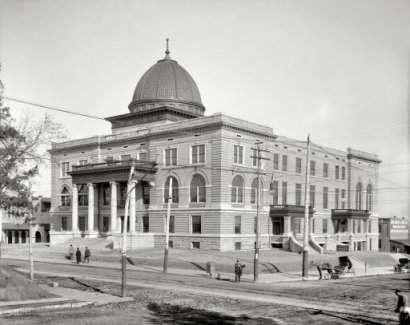
City Hall prior to 1912

City Hall prior to 1912

By 1955, the copper-clad dome which sat on top of City Hall needed severe repairs. The wooden supports and the copper cladding were both in dire shape. Mayor Pratt Remmel set aside money for the dome to be repaired. After defeating Remmel in his bid for a third term, Mayor Woodrow Mann scrapped plans for the repair and, indeed, scrapped the dome.

Following the lead of County Judge Arch Campbell who had removed the tower at the County Courthouse, Mann proposed removal of the dome. He had an informal survey which had three options: repair the dome, replace the dome with an aluminum one, or remove it. This was open to anyone to respond – voting eligibility or Little Rock residency did not matter. By a slim margin, remove the dome won – so the dome was removed.

In 1960, as air conditioning was installed, windows were bricked in to promote energy efficiency. At the time, the feeling was that a new City Hall would be constructed in the 1970s somewhere more central to the growing city. Relocation talk persisted throughout the 1970s and early 1980s. By that time, City Hall had been modified a great deal – with no thought about historic preservation. When the Police and Fire Department had moved out into their new facilities, their old spaces had become storage.

By 1984, the decision was made to stay at Markham and Broadway. An extensive renovation and restoration effort was undertaken. In 1988, the building reopened, and the interior had been restored to its 1908 appearance.

Artspree closes 2012-13 with Triple Play

tp-without tastyUALR’s Artspree series concludes the 2012-2013 season today with a performance at UALR at 3pm.

Triple Play is the name given to three outstanding and versatile musicians, Peter Madcat Ruth (on harmonica, guitar, jaw harp, percussion & vocals), Joel Brown, (folk and classical acoustic guitar and vocals) and Chris Brubeck (electric bass, bass trombone, piano & vocals).

Collectively they bring a rare level of joy, virtuosity, and American spirit to the folk, blues, jazz and classical music they perform. Triple Play’s musical roots go way back (nearly 40 years!) in each member’s history. Chris and Madcat have toured and recorded together in different settings since 1969, first as young rock musicians in the group “New Heavenly Blue” (with albums on RCA and Atlantic Records), “Sky King”(on Columbia), and then as jazz musicians touring the world with Dave Brubeck

With an ever-expanding repertoire, the Trio continues to play in concert halls, clubs and festivals all over the country, including performing many of Chris’ symphonic arrangements with orchestras across the U.S. Recently they played a set at the Monterey Jazz Festival and later that evening were featured in the premiere of Dave Brubeck’s Cannery Row Suite.

Paul deBarros, writer for the Seattle Times and Downbeat, commented: “Triple Play is what jazz always was and always should be about: good-time rhythm, unbridled joy and the sweet release but bittersweet aftertaste of the blues. If there’s a better old-time blues and jazz harmonica player out there than Madcat Ruth, I’d sure love to know where he lives.”

ASO features Midori, Tchaikovsky, Mozart and Brahms

midori_playingWorld famous violinist Midori joins forces with the Arkansas Symphony Orchestra (under the baton of music director Philip Mann) to close the ASO Masterworks season in unforgettable fashion.

Midori performs Tchaikovsky’s celebrated Violin Concerto in a pairing of two inimitable favorites which also connects with the season’s opener, in that it was inspired by Lalo’s Symphonie Espagnole. Adding to the festive feel of the program is Mozart’s frothy and iconic overture to the Marriage of Figaro, which defies any listener not to smile.

Closing the program is Brahms’s final and incredible 4th symphony– a work of stunning beauty and depth that grows out of the most simple of gestures, a falling then rising line. A sense of yearning and urgency underlie the work as counterpoint adds flavor and intensity to sublime lyricism. An almost overwhelming final movement harkens back to an earlier time in music in a masterstroke combination of the Baroque, Classical, and Romantic.

The opportunity to hear Tchaikovsky, Mozart and Brahms in one program is a special treat.  These three are certainly among the top favorite of classical composers for most listeners.  The concerts are tonight at 8pm and tomorrow at 3pm at Robinson Center Music Hall.

LR Film Fest Rooftop Screening of BLOODY MAMA

lrff_mp_hdr_logoThe Little Rock Film Festival is hosting its first ever Rooftop Screening featuring ‘Bloody Mama’- a classic gangster film featuring Robert De Niro and Robert Walden. It will be tonight at 7pm atop the River Market Tower.

What better way to spend an evening under the stars than watching a movie with a star in the audience? Actor Robert Walden will join the audience on the rooftop for this special screening and will discuss his role in the film.

The event is free, but purchase of an 2013 LRFF pass is required to attend this screening.

Directed by Roger Corman, Bloody Mama was filmed in the Ozark mountains of Arkansas and tells the story of  machine gun totin’ Ma Barker, who lead her family gang (her sons) on a crime spree in the Depression era.Robert Walden plays Fred Barker in the film, who has just been released from prison, and Robert De Niro plays Lloyd Barker, a spaced-out drug addict who sniffs glue if nothing better is around.

During his long an successful career as a Hollywood actor, three time Emmy nominated actor Robert Walden has acted alongside many of the Hollywood greats including George C. Scott, Anthony Hopkins and Dusti Hoffman and has worked with director such as Woody Allen,, Martin Scorcese and Alan Pakula.

Walden currently stars in the new TV land sitcom, Happily Divorcedwith Fran Drescher and Rita Moreno. He will also star in the Arkansas Repertory Theater’s version of Death of a Salesman as Willy Loman, running April 24th to May 12th www.therep.org


April 12 Architeaser

IMG_4796This brick work and star is found on the 1882 Porbeck and Bowman building.  Designed by Joseph Willis and built by Max Hilb and William Probst, the building was modified by architect Charles Thompson in 1909.  It was revamped by the firm of Polk Stanley Wilcox for the Central Arkansas Library System as part of the Arkansas Studies Institute project.  It now houses gallery space and meeting space for CALS and classrooms for the Clinton School of Public Service.

Tonight is 2nd Friday Art Night. Visitors to the space tonight can view art on display.